Project Name: Urban Regeneration of The Venegas Neighborhood
Student Name: John Limaylla
Awards: Summa Cum Laude recognition for the UPC Architecture Faculty | Nomination to Archiprix International for the World Best Graduation Projects Biennial
Excerpt:‘Urban Regeneration of The Venegas Neighborhood’ is an architecture thesis by John Limaylla from Facultad de Arquitectura, Universidad Peruana de Ciencias Aplicadas (UPC), that seeks to give a new urban identity for the future Lima city in a favourable site within a vital highway city project. This project seeks to provide a solution for the families who will be relocated as part of a housing development that can revitalise the neighbourhood and re-establish its connection to the city.
Introduction: Lima is a metropolis that is constantly developing. As a result of its expansion, it now has a great number of underprivileged neighbourhoods that are cut off from the rest of the city due to the construction of numerous high-density housing developments. One of them is the area around Venegas. It has informally taken up some of the space set aside for the extension of Paseo de la Republica, one of the city’s most important highways, as it is located between the district lines of two of the densest areas.
Due to the city’s current exponential growth, the stalled construction projects must be resumed, which will require the relocation of numerous families. This urban regeneration project seeks to provide a solution for the current families who will be relocated as part of a housing development that can revitalise the neighbourhood and re-establish its connection to the city. As a result, the locals will have the possibility of benefiting from the location’s prospects. In order to meet the challenges of coming up with a fresh urban expression for the small Lima city of the future, the proposal places a strong emphasis on architecture as a means for urban integration.
One of the city’s principal highways, the Paseo de la Republica, runs north-south across the city and connects the Pan-American Highway with the city’s historic centre. Unfortunately, the land for the final stretch of the highway was reserved in 1969 when the government decided to postpone completion indefinitely. Urbanisation around this location began to take shape in the following years. However, a portion of this territory was occupied by the low-density, humble neighbourhood of Venegas as a result of the city’s exponential growth.
Families must be moved and a neglected urban area must be consolidated since the highway construction must now be finished. In this situation, a housing project that can revitalise and integrate this neighbourhood with the city has a great potential to take advantage of the location.
The Venegas Neighbourhood
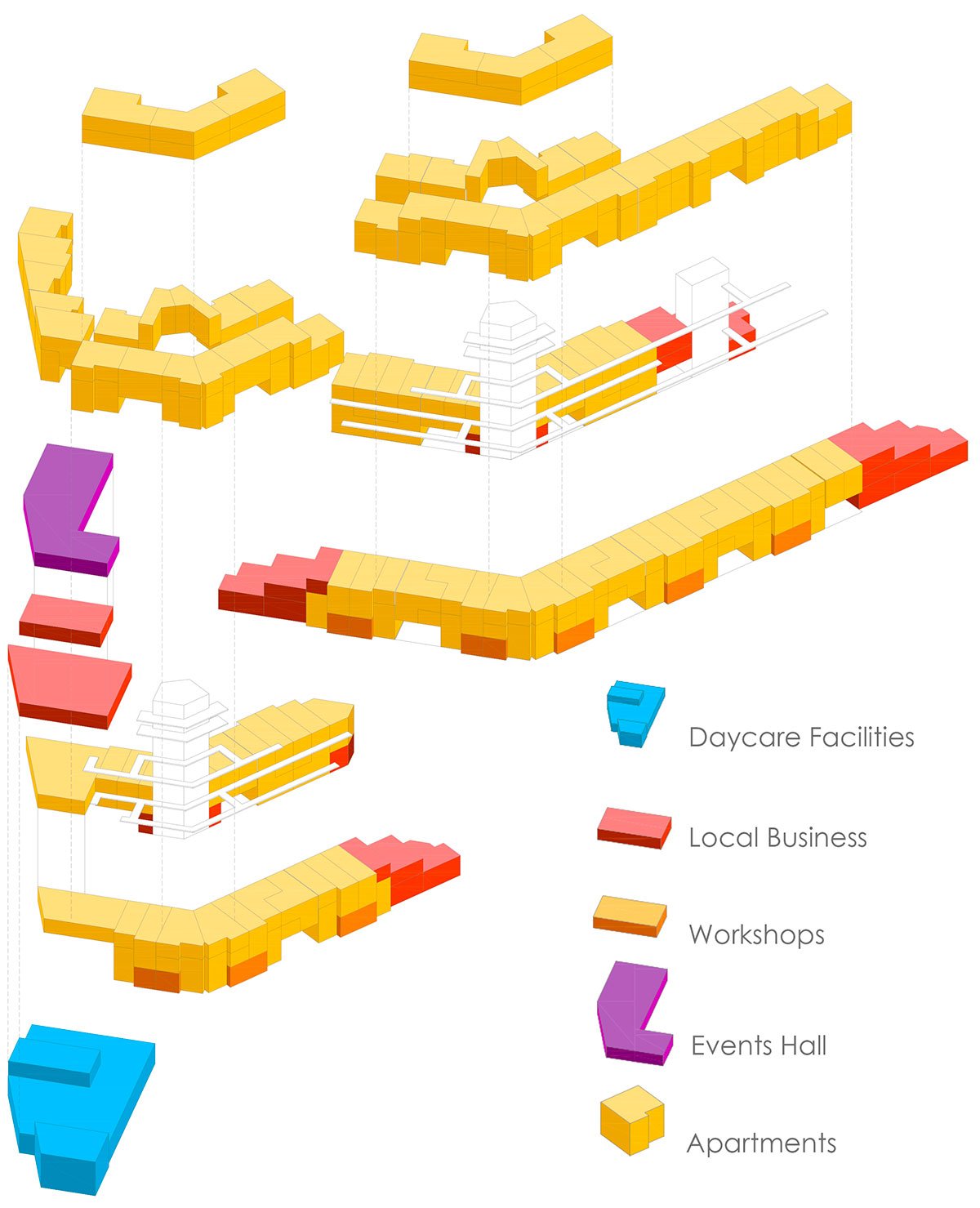
Starting with housing for the families that now reside there as well as for the new ones who will finish off the ideal density of this significant region, this urban regeneration project has a comprehensive programme. A local commercial programme, a programme for public services like healthcare and education, and a programme for public places like recreation are also intended to meet the needs of this new neighbourhood.
Design Process
Finding the best concepts and objectives for the project was the first step in the development of the architecture thesis. Urban regeneration case studies identical to this one from around the world were thoroughly examined in order to complete this theoretical work. Site mapping and neighbourhood analysis were also done, along with proper documentation, photos, and interviews with locals.
Every aspect of this project had to be considered as a means of urban integration from the outset. As a starting point, the already-existing urban paths were utilised to envision the buildings as an urban framework that contains various pedestrian trails all throughout the structures and links them to the city.
Public Spaces TransitionsUrban Image of Buildings
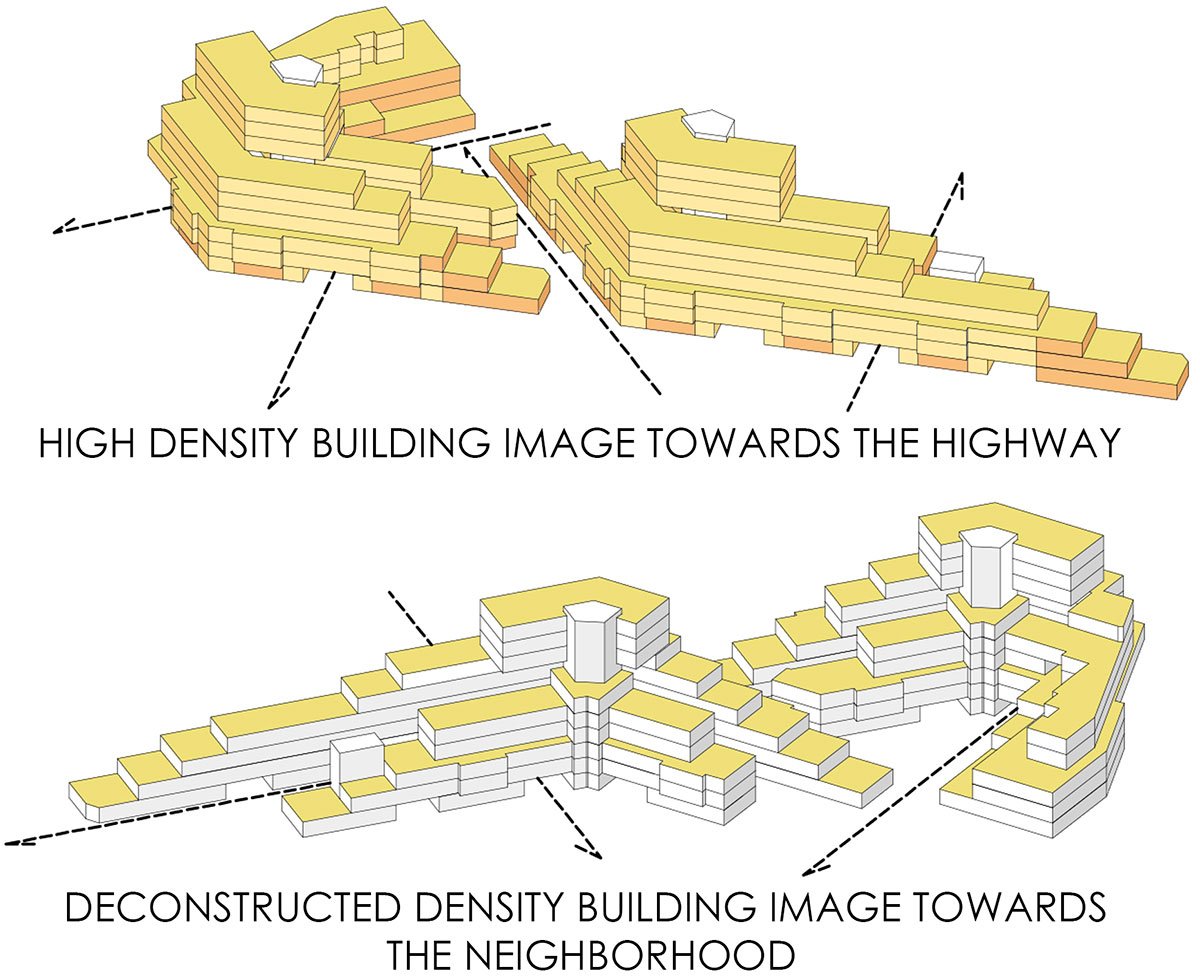
With its fluid and attractive spatial transitions from public to private, the architectural proposal extends urban interactions to various levels of the buildings, in order to establish an image of a progressive urbanisation that could be merged with the existing neighbourhood.
Final Outcome
MasterplanSite Section
The goal of the project is to densify the old neighbourhood in order to relocate the original family and give more people the chance to take advantage of its proximity to one of the city’s main public transit networks, the “Metropolitano.” By combining the demolished blocks into smaller sections, urban activities and pedestrian traffic are given priority, and vehicular transit is more effective.
Ground Floor PlanElevated Pedestrian Street Floor Plan
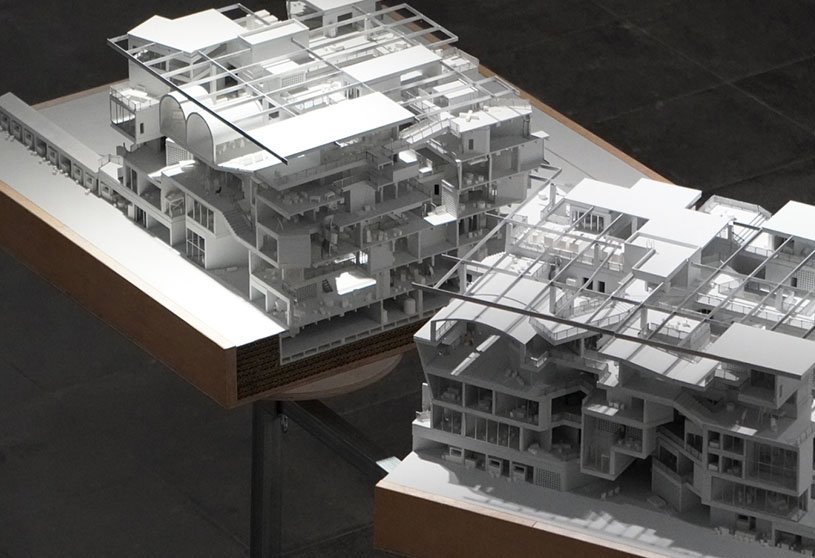
This resulted in the development of an urban circuit that takes users through a variety of urban settings, including squares, bridges, parks, and elevated pedestrian paths. These elements help tie the project together, linking the newly constructed buildings with the nearby public transportation hubs and the city’s existing built environment.
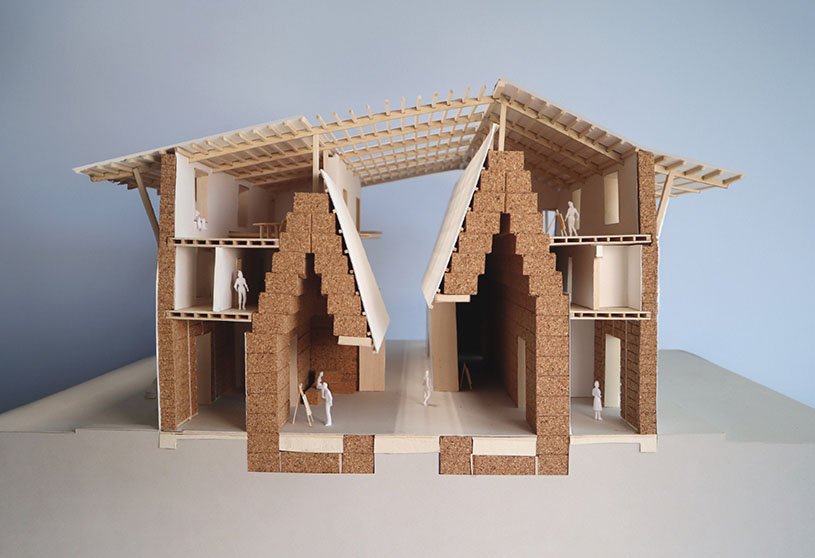
Main Building Section
The project must also contend with the challenge of reuniting the city in this neighbourhood for pedestrians. The proposal involves a park bridge that completes the urban integration of the neighbourhood after the highway that passes through the city separates the region into two.
Main Building Front ViewBuilding Interior Pedestrian Street Detail
In order to be integrated into urban activities, the buildings traverse along the existing pedestrian pathways. Further, bicycle lanes link “The Metropolitano” bus terminals with the Venegas and surrounding neighbourhoods.
Façade Composition DetailMain Building
Another objective of this proposal is to find an architectural expression that can unite the old community with the bustling new one. Therefore, it won’t turn into a physical obstruction that further isolates the neighbourhood. The architectural expression of the building serves as a means of blending with the city, with increased volumetry fusing the metropolis and brick facades that reflect the character of the surrounding neighbourhoods.
Main Building Aerial View
Conclusion: This architecture thesis achieved its goal of being an innovative urban regeneration strategy for Lima City that acknowledges the potential to take advantage of a small neighbourhood’s advantageous location within a major highway city project. With this, it also seeks a fresh urban expression for the future compact Lima metropolis.
[This Academic Project has been published with text submitted by the student]
Site Context
Design Process
Final Outcome
To submit your academic project for publication at ArchiDiaries, please visit the following link >> Submit
Get the best of ArchiDiaries, directly in your inbox.
We use cookies on our website to give you the most relevant experience by remembering your preferences and repeat visits. By clicking “Accept All”, you consent to the use of ALL the cookies. However, you may visit "Cookie Settings" to provide a controlled consent.
This website uses cookies to improve your experience while you navigate through the website. Out of these, the cookies that are categorized as necessary are stored on your browser as they are essential for the working of basic functionalities of the website. We also use third-party cookies that help us analyze and understand how you use this website. These cookies will be stored in your browser only with your consent. You also have the option to opt-out of these cookies. But opting out of some of these cookies may affect your browsing experience.
Necessary cookies are absolutely essential for the website to function properly. These cookies ensure basic functionalities and security features of the website, anonymously.
Cookie
Duration
Description
cookielawinfo-checkbox-analytics
11 months
This cookie is set by GDPR Cookie Consent plugin. The cookie is used to store the user consent for the cookies in the category "Analytics".
cookielawinfo-checkbox-functional
11 months
The cookie is set by GDPR cookie consent to record the user consent for the cookies in the category "Functional".
cookielawinfo-checkbox-necessary
11 months
This cookie is set by GDPR Cookie Consent plugin. The cookies is used to store the user consent for the cookies in the category "Necessary".
cookielawinfo-checkbox-others
11 months
This cookie is set by GDPR Cookie Consent plugin. The cookie is used to store the user consent for the cookies in the category "Other.
cookielawinfo-checkbox-performance
11 months
This cookie is set by GDPR Cookie Consent plugin. The cookie is used to store the user consent for the cookies in the category "Performance".
viewed_cookie_policy
11 months
The cookie is set by the GDPR Cookie Consent plugin and is used to store whether or not user has consented to the use of cookies. It does not store any personal data.
Functional cookies help to perform certain functionalities like sharing the content of the website on social media platforms, collect feedbacks, and other third-party features.
Performance cookies are used to understand and analyze the key performance indexes of the website which helps in delivering a better user experience for the visitors.
Analytical cookies are used to understand how visitors interact with the website. These cookies help provide information on metrics the number of visitors, bounce rate, traffic source, etc.
Advertisement cookies are used to provide visitors with relevant ads and marketing campaigns. These cookies track visitors across websites and collect information to provide customized ads.