Excerpt: ‘AGROHabitat’ is an architecture thesis by Abigail Iraheta Abarca from the ‘Facultad de Arquitectura y Diseño – Universidad de los Andes.’ The project aims to redefine Bogotá’s urban edge by integrating housing, agriculture, and infrastructure into a regenerative system. The project seeks to restore the relationship between dwelling and productive land, addressing food insecurity, loss of fertile soil, and fragmented urban growth by proposing housing as an active, ecological, and social agent that cultivates community, resilience, and local food production.
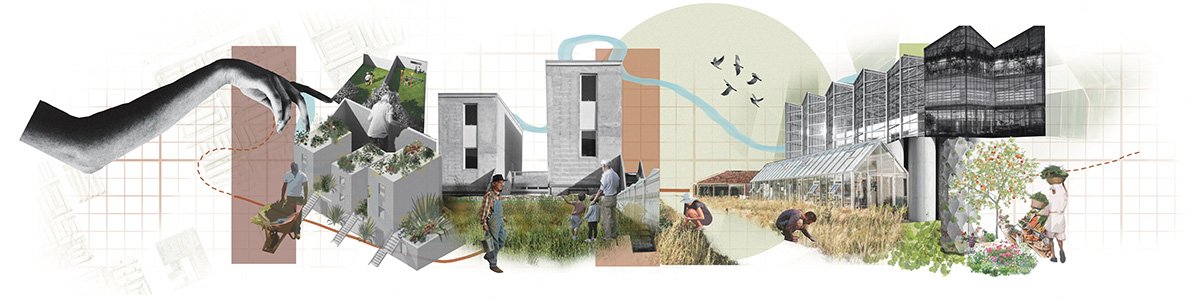
Introduction: AgroHábitat emerges from the urgent need to reconcile Bogotá with the land that sustains it. On the southern edge of the city—where the Avenida Longitudinal de Occidente abruptly ends and the landscape hangs between the urban and the rural—the project proposes to restore the relationship between dwelling and producing. Housing is reinterpreted as an artificial nature: a living organism that inhabits, cultivates, and regenerates itself. Through urban gardens, patios, and shared productive spaces, AgroHábitat seeks to transform a fragmented territory into a place of encounter, where the act of inhabiting returns life to the soil and nourishment to the community.
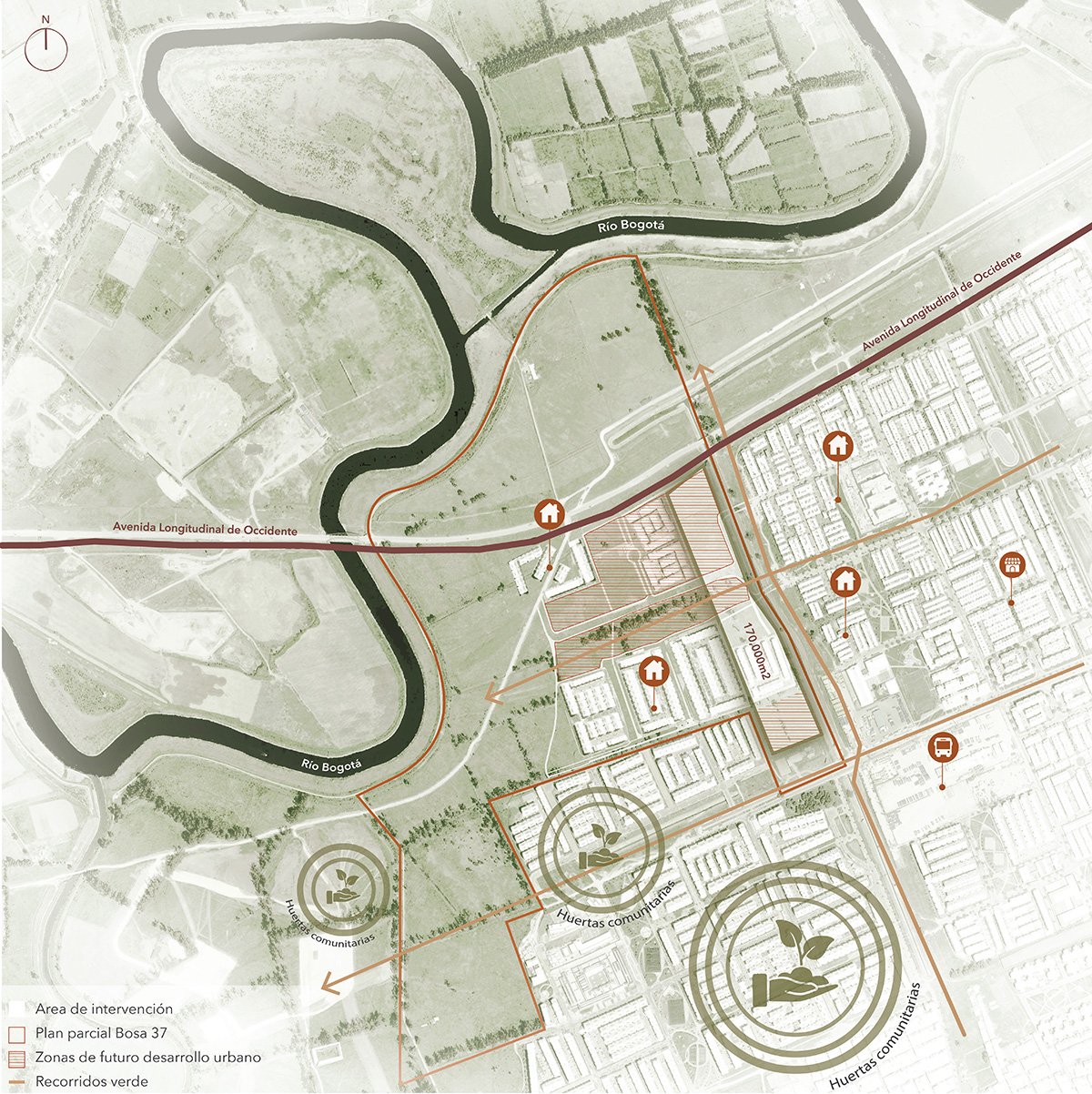
The project is situated in Bosa, on the southwestern edge of Bogotá, at the point where the unfinished Avenida Longitudinal de Occidente (ALO) intersects with consolidated social housing developments and remaining agricultural land. This area is characterized by high residential density, limited public space, food insecurity, and the gradual disappearance of productive soil within the Bogotá Savanna—one of the region’s most fertile ecological systems.
Site Analysis: Opportunities and Constraints
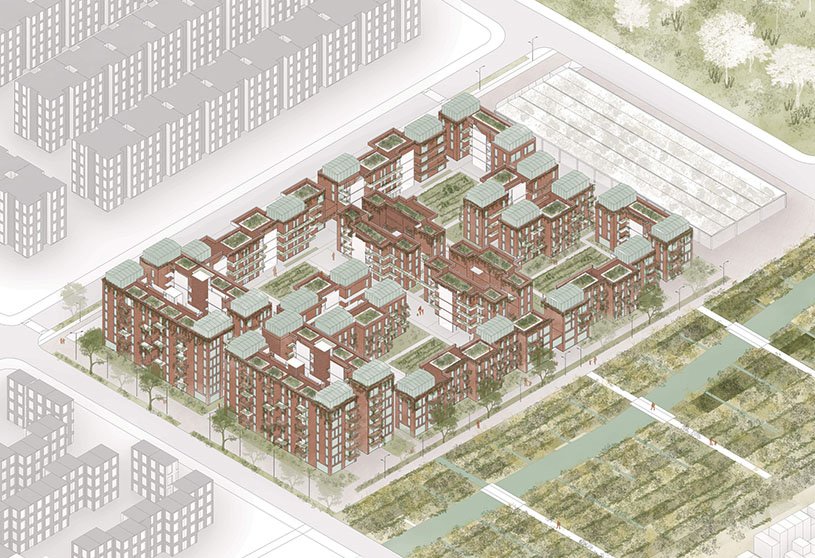
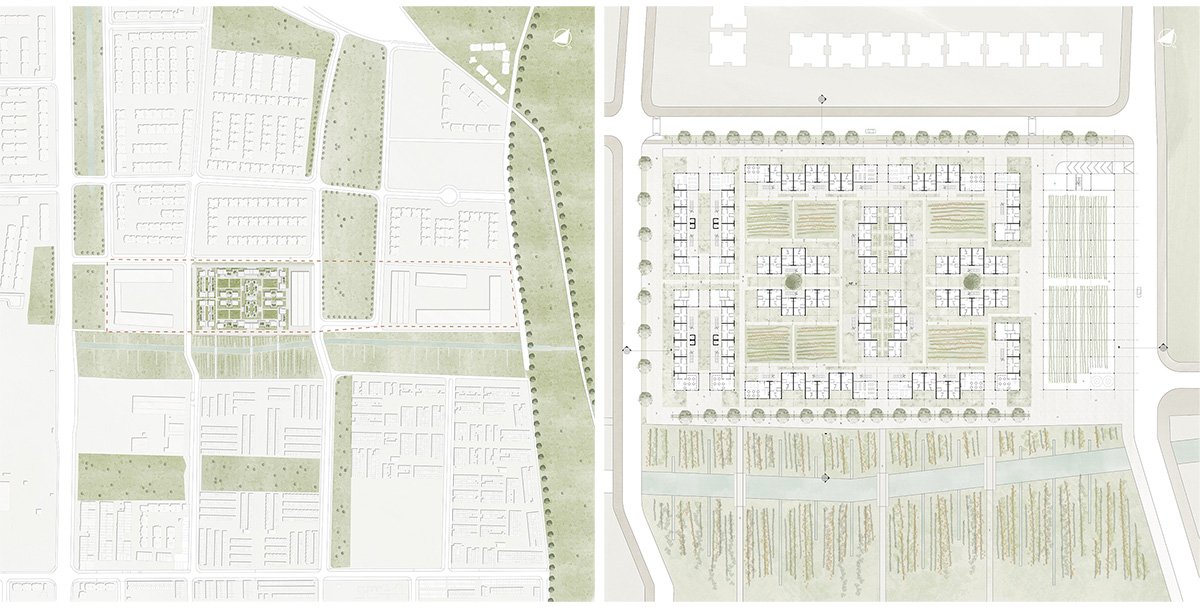
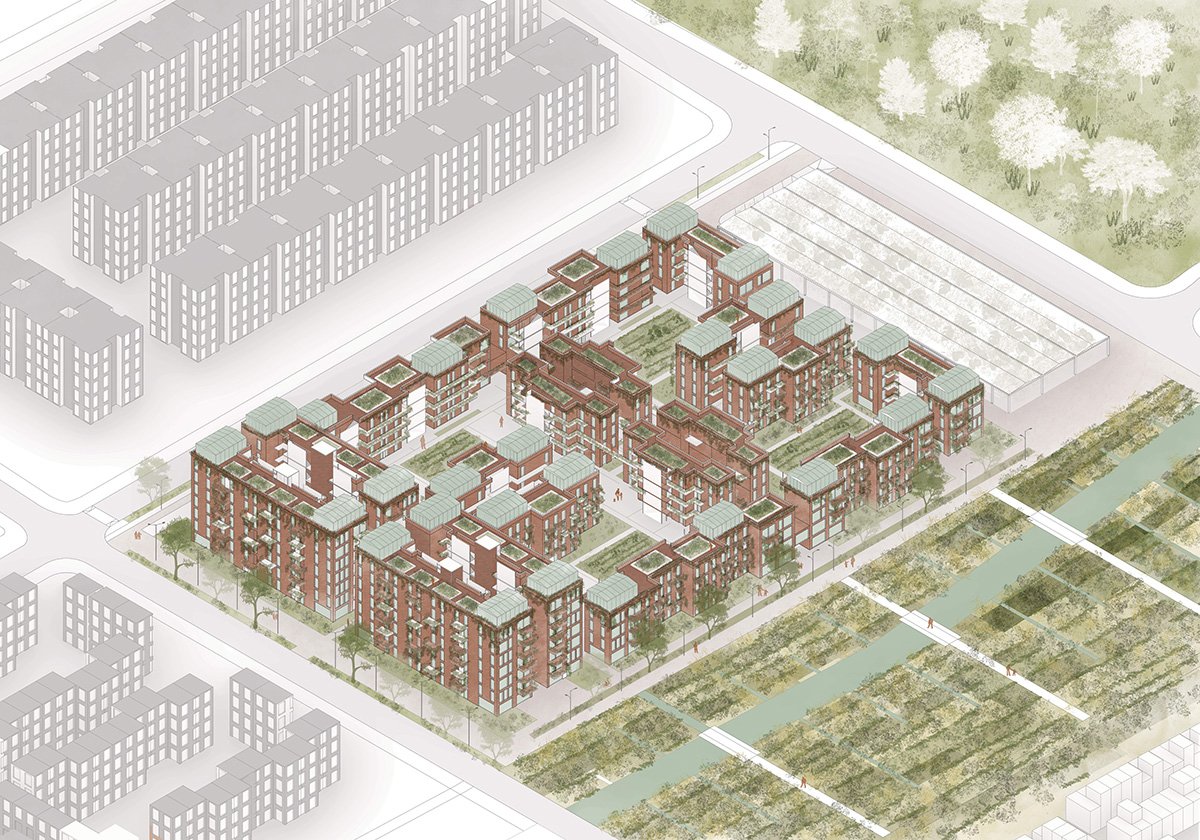
Rather than extending the logic of expansion, AgroHábitat intervenes within this fragmented edge condition. The program combines mid-density VIS/VIP housing (approximately 350–500 units per hectare) with productive landscapes, community gardens, and a research and cultivation center dedicated to urban agriculture. Circulation corridors, camellones, and public spaces organize the site as a continuous urban-productive system, linking local cultivation to neighborhood supply networks. The intervention operates at both architectural and territorial scales, proposing a new model of containment that integrates housing, infrastructure, and food production within the urban edge.
Design Process
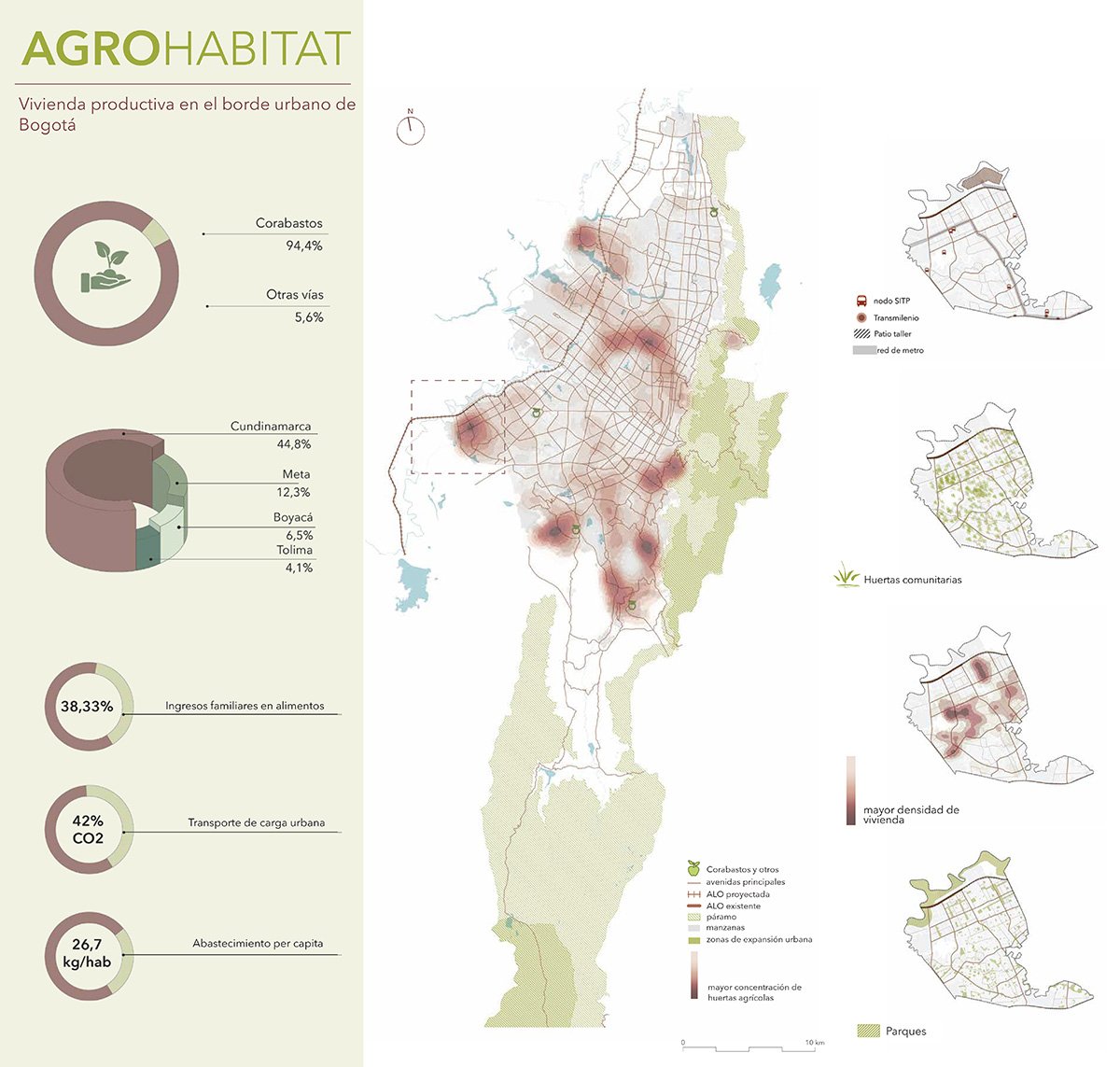
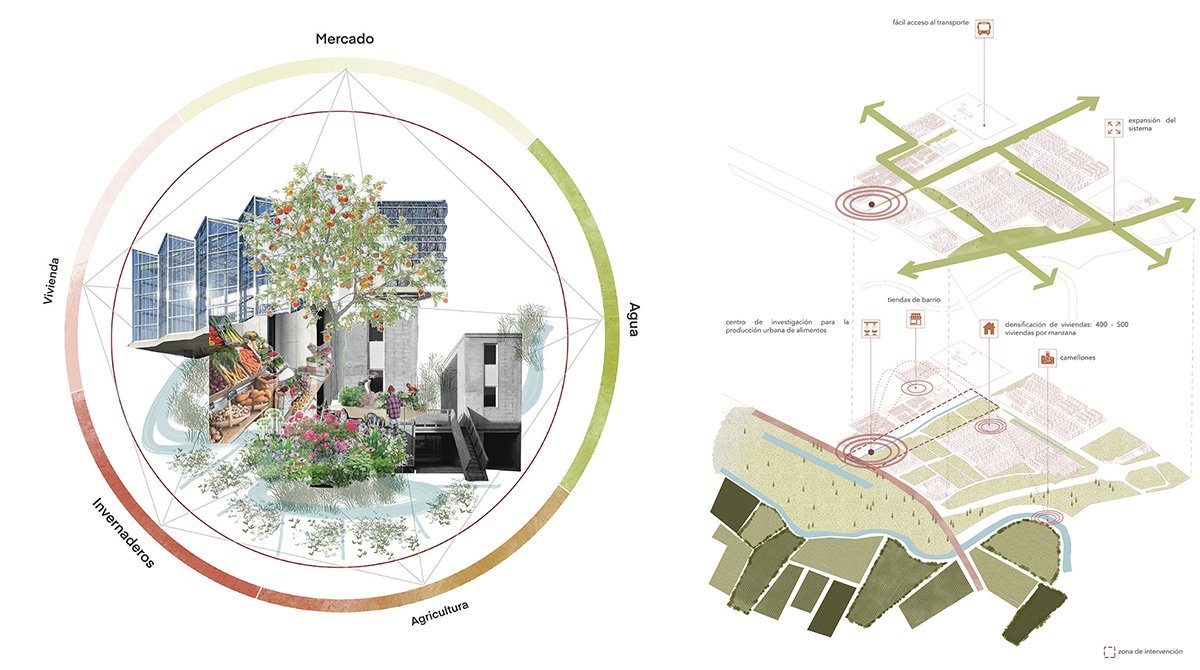
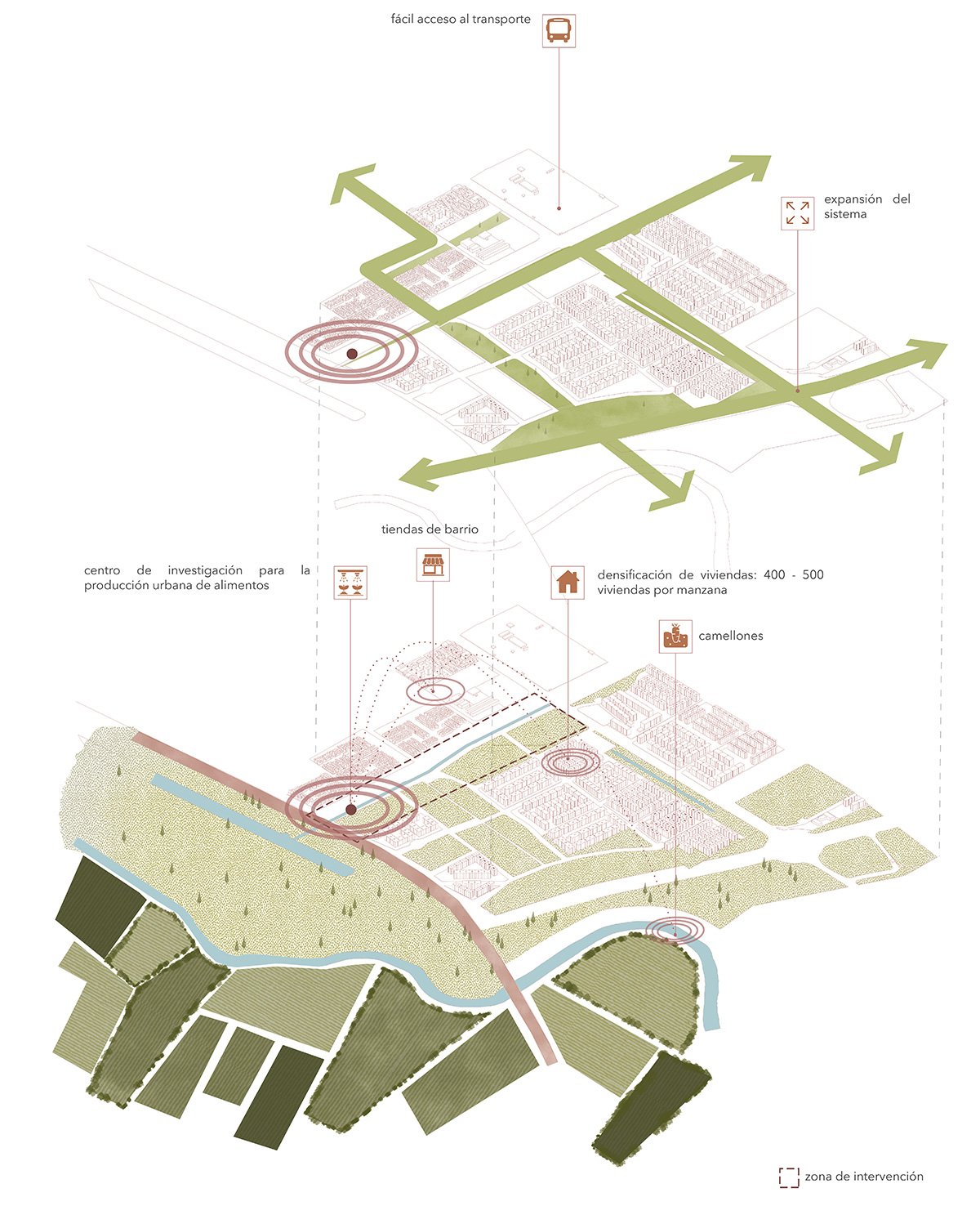
Territorial Systems Diagram
The design process began with a territorial analysis of Bogotá’s southwestern edge, focusing on the unfinished Avenida Longitudinal de Occidente (ALO) and its impact on the locality of Bosa. Mapping exercises identified key tensions: high housing density, deficit of public space, fragmented agricultural land, food insecurity, and flood-prone areas near the Bogotá River. These layers revealed the edge not as a limit but as a condition of conflict and opportunity.
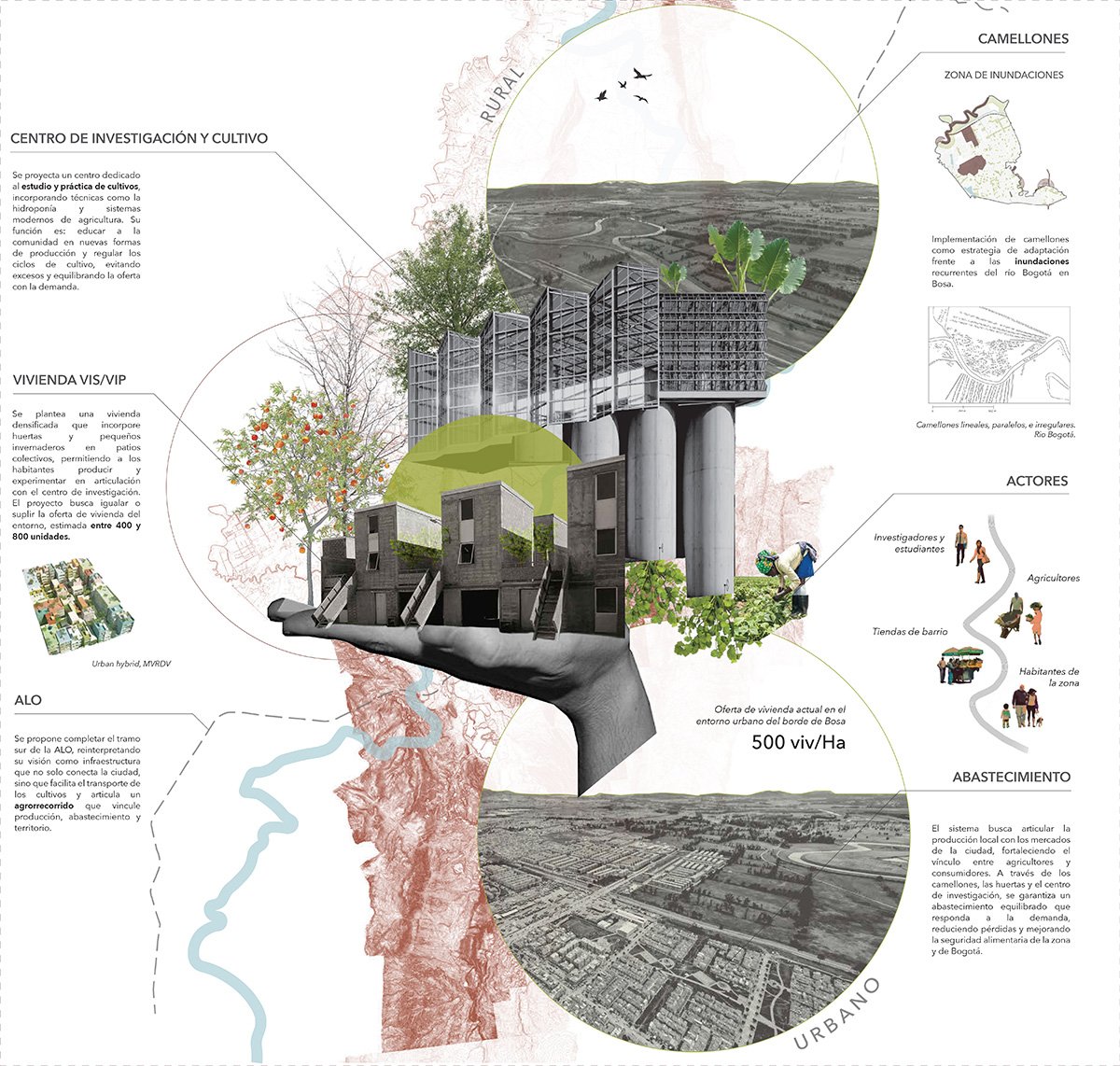
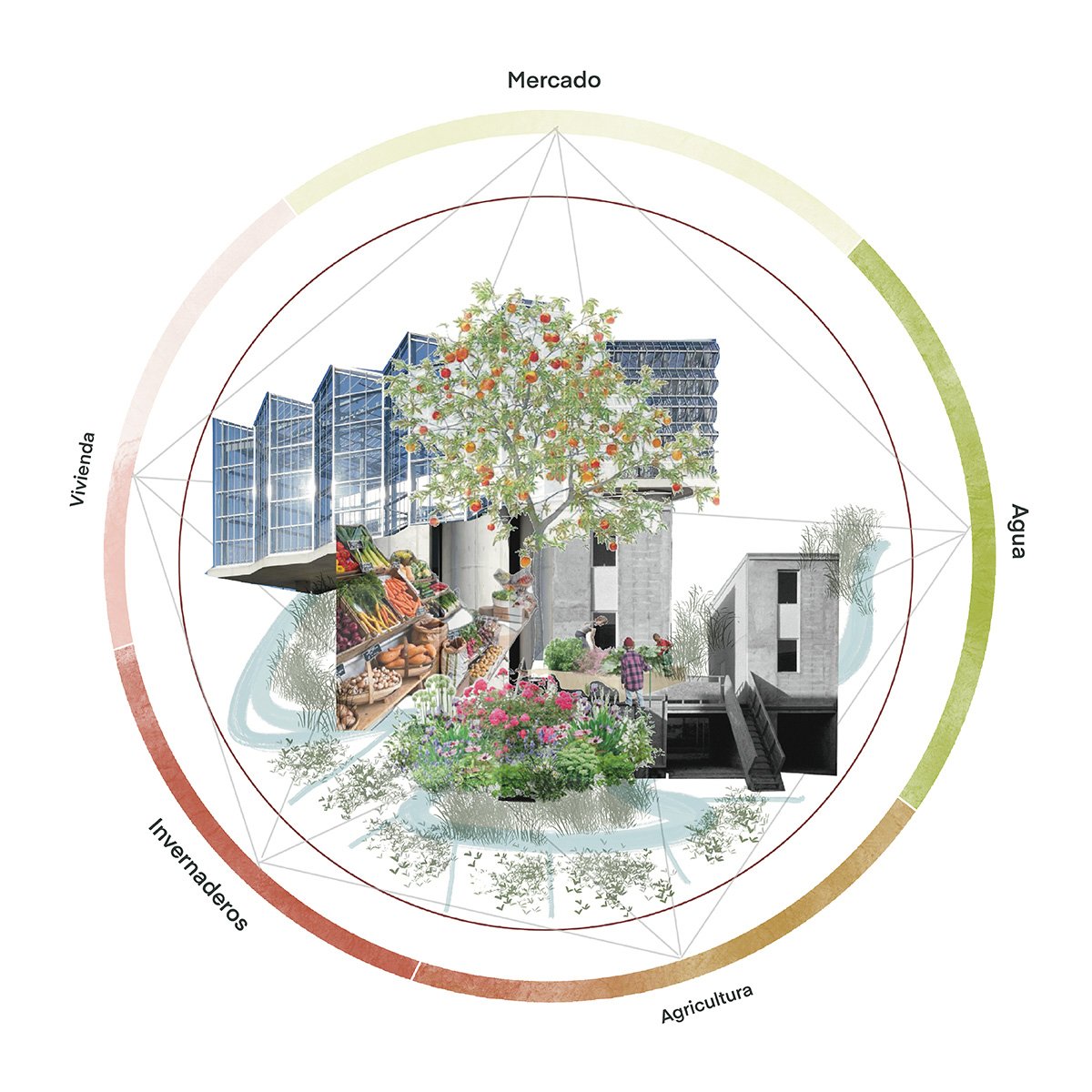
Techno-Nature & Urban Production Collage
The second phase involved theoretical and precedential research, examining concepts such as the urban edge as an active transition (Garden City), housing as “artificial nature,” and agriculture as urban infrastructure. Case studies, including Urban Hybrid (MVRDV) and Agrotopia, informed strategies of mixed typologies, productive integration, and vertical program stacking.
Concept Diagram | Strategic Axonometric Diagram
From this framework, spatial strategies were developed: reinterpreting the edge as a productive system, organizing the site through camellones and ecological corridors, and embedding agricultural spaces within housing typologies. Iterative massing studies and environmental analyses (sunlight, circulation, density) refined the proposal into a coherent urban-productive system integrating housing, research, and cultivation.
Final Outcome
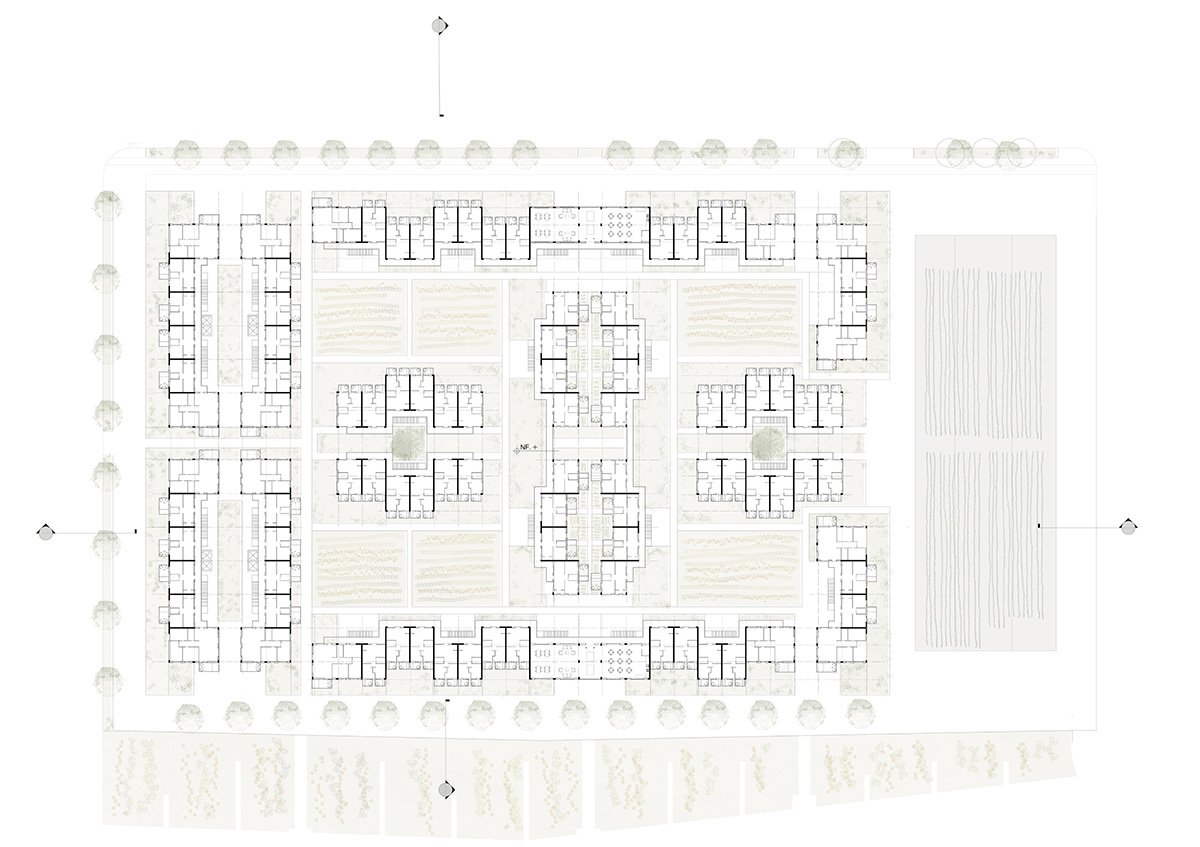
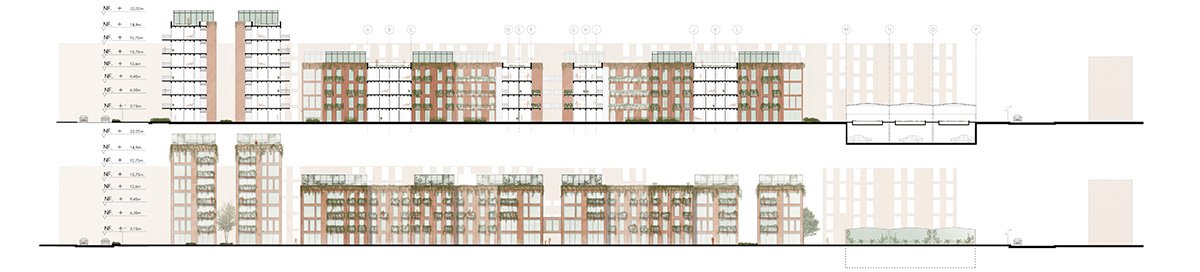
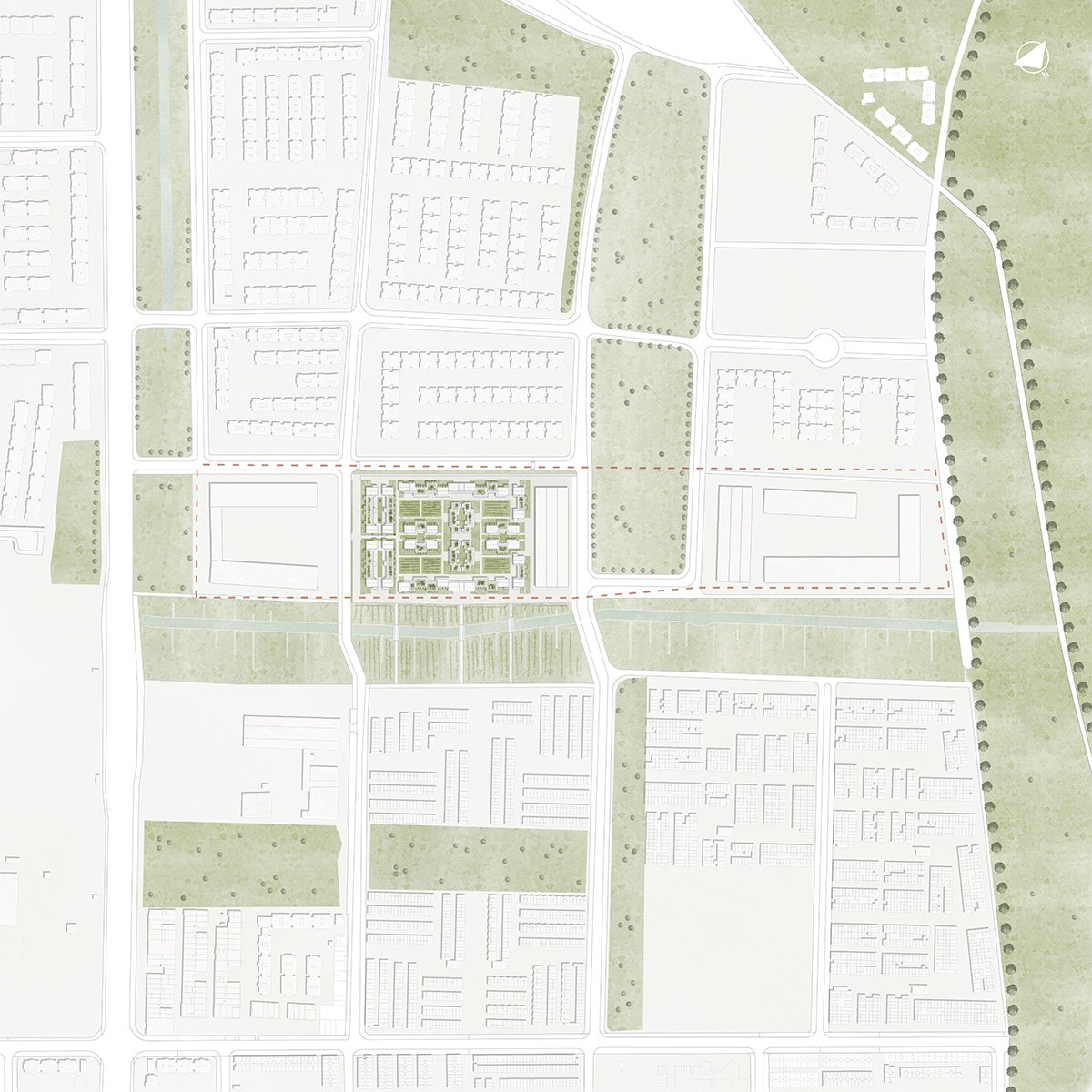
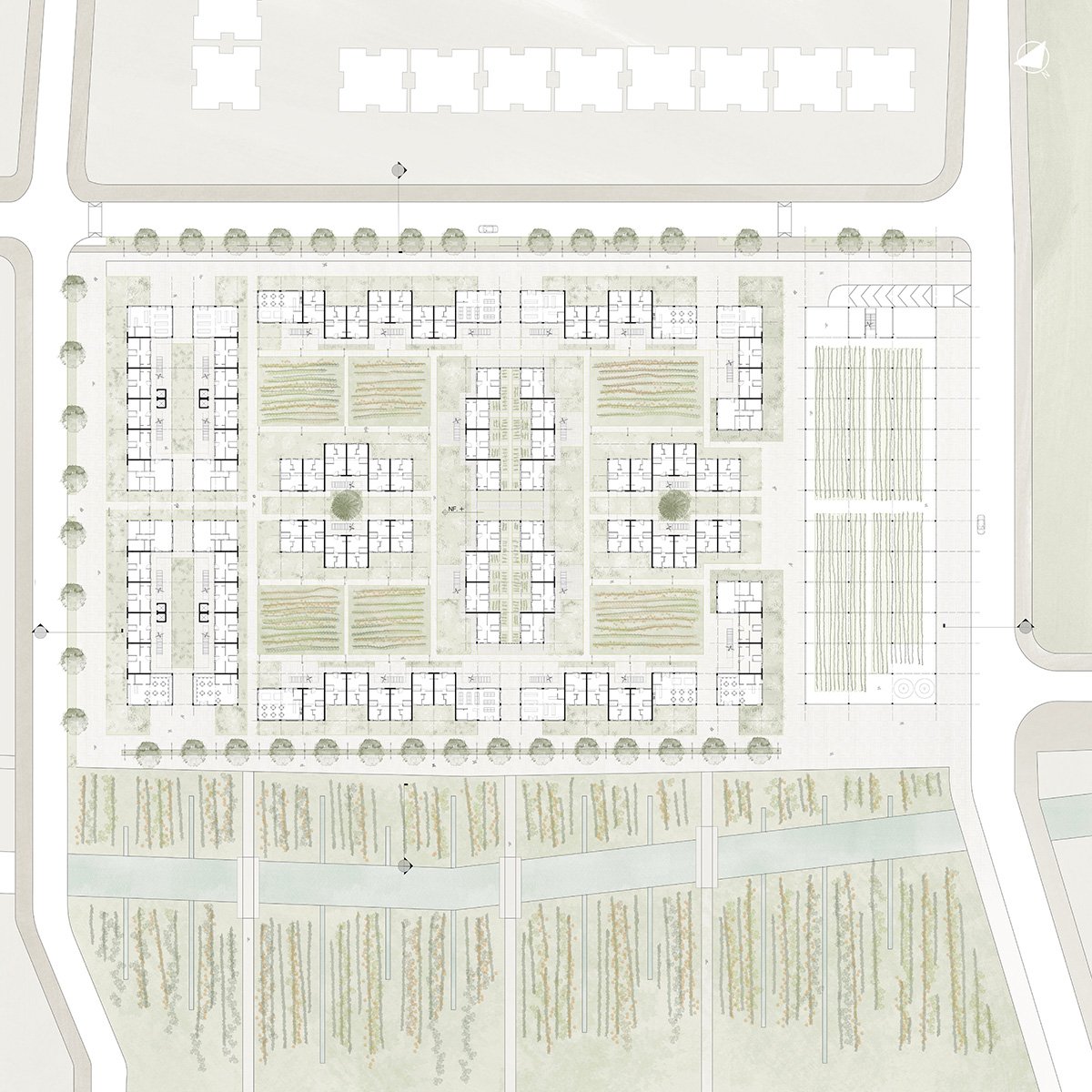
Site Master Plan | Ground Floor PlanTypical Floor PlanSection and East Elevation
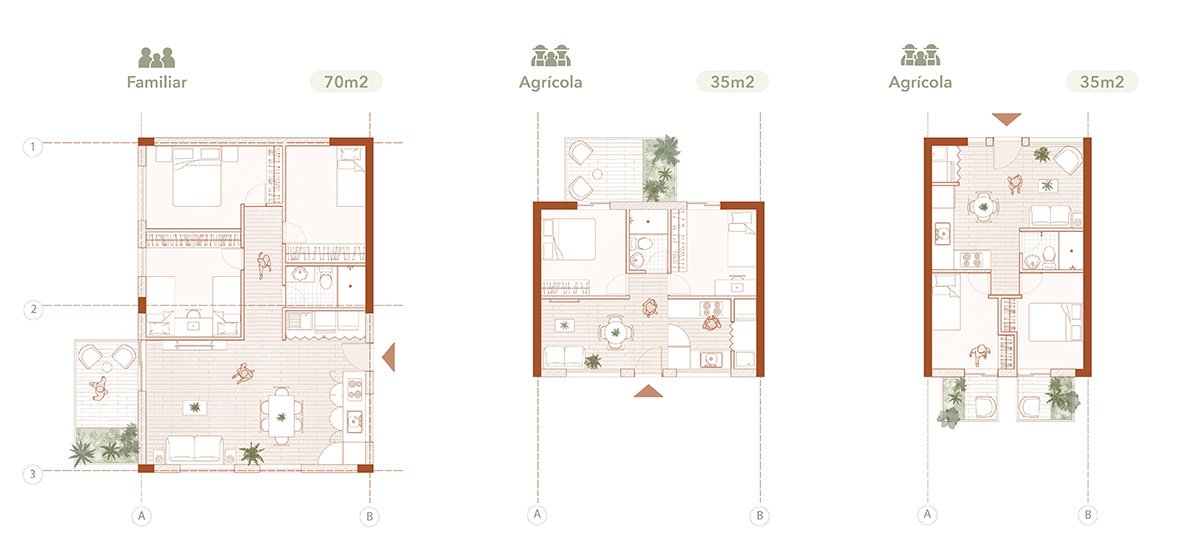
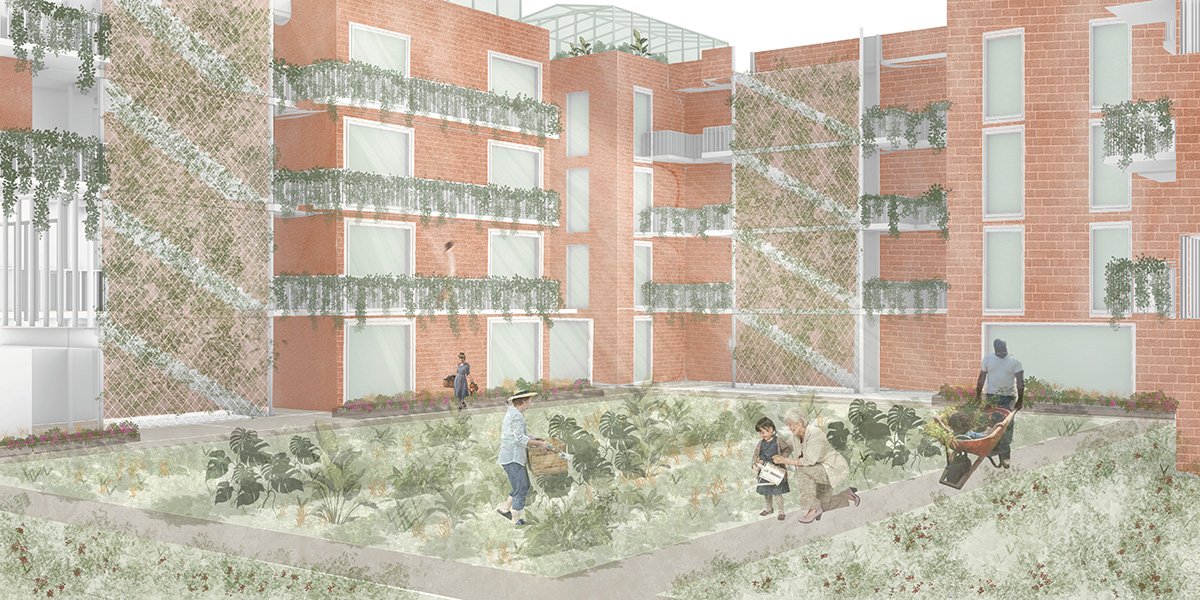
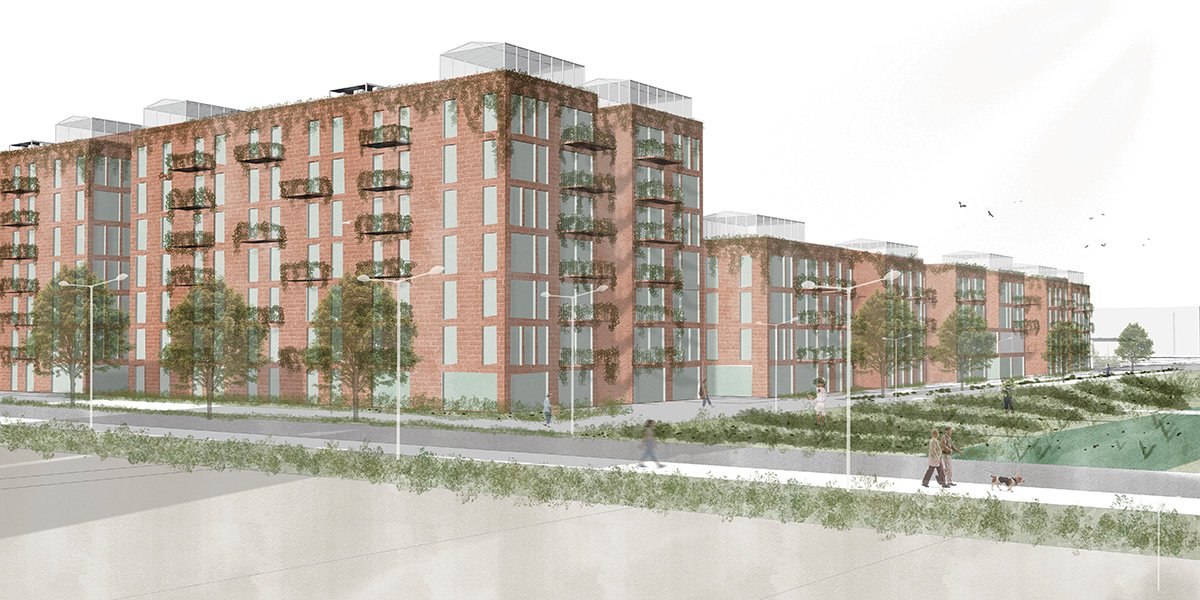
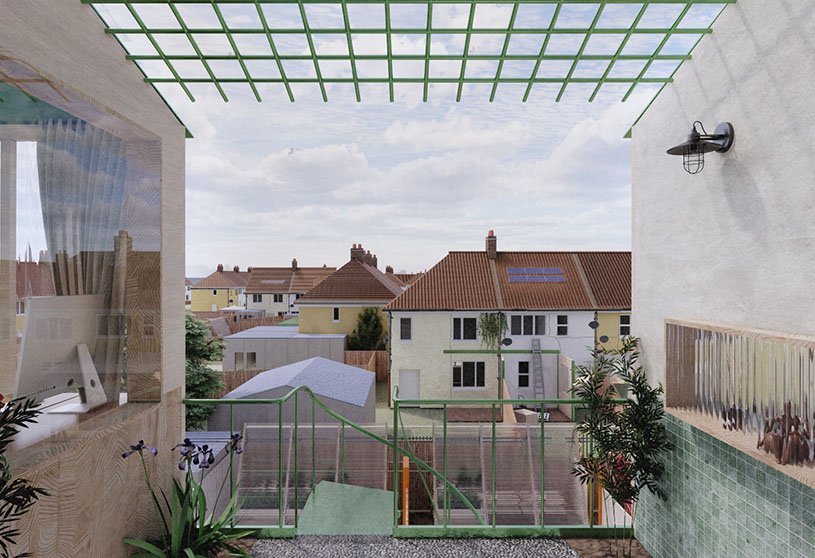
The final outcome of AgroHábitat is a mid-density urban-productive housing system that transforms Bogotá’s southwestern edge into a space of coexistence between dwelling and agriculture. The project consolidates approximately 350–500 housing units per hectare through flexible VIS/VIP typologies that integrate patios, terraces, and productive thresholds, allowing domestic life and food cultivation to occur simultaneously.
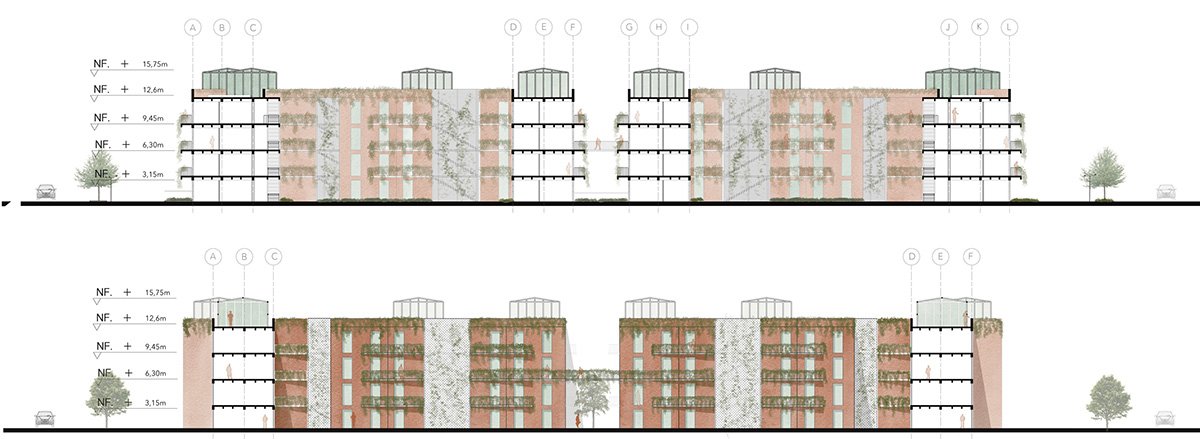
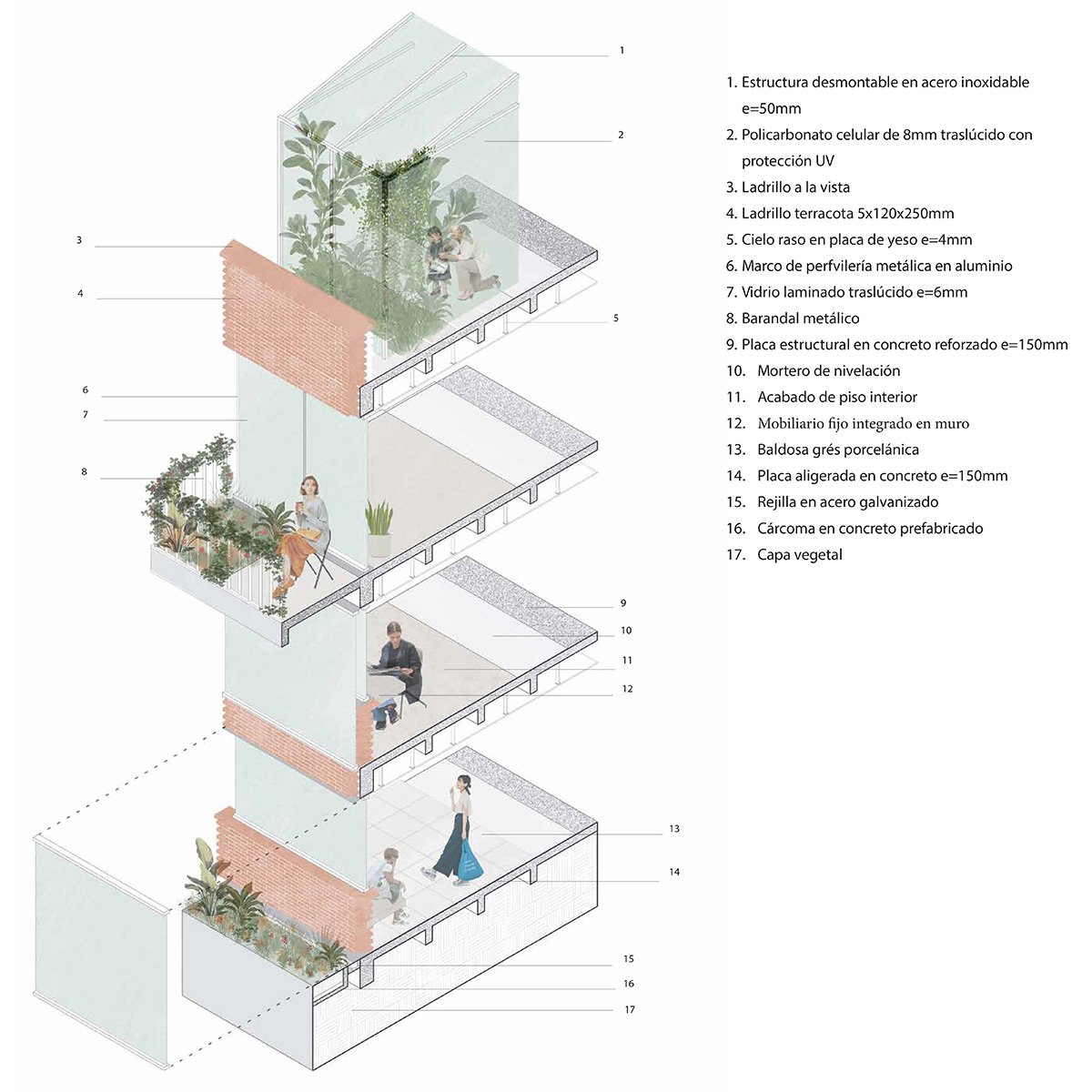
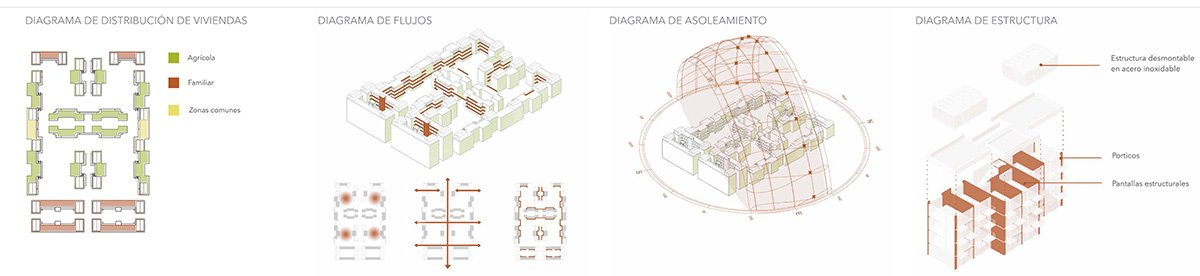
Housing Unit TypologiesSection and South ElevationConstruction DetailFunctional Diagrams
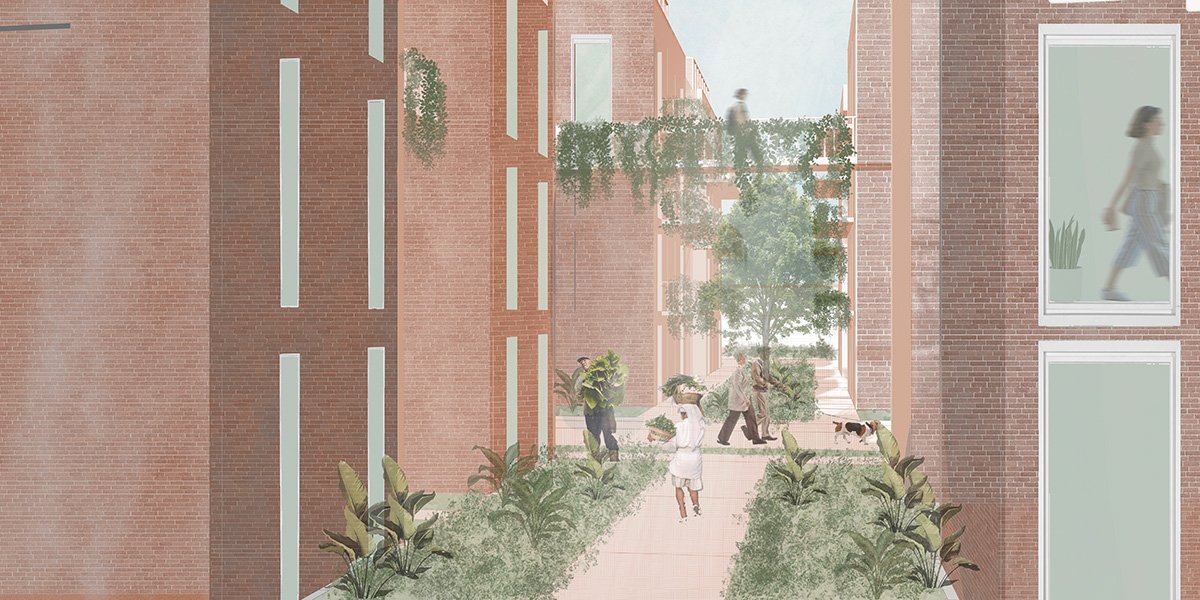
At the urban scale, the intervention restructures the fragmented territory through ecological corridors, camellones for water management, and public spaces that connect existing neighborhoods with new productive landscapes. A research and cultivation center anchors the system, linking local agricultural practices with education, innovation, and neighborhood supply networks.
Conclusion: Rather than proposing expansion over fertile land, AgroHábitat demonstrates a model of urban containment that integrates housing, infrastructure, and food production. The project ultimately redefines the urban edge as a regenerative system—one where architecture becomes an active participant in ecological cycles, social cohesion, and local food resilience.
[This Academic Project has been published with text and images submitted by the student]
Site Context
Design Process
Final Outcome
To submit your academic project for publication at ArchiDiaries, please visit the following link >> Submit
Get the best of ArchiDiaries, directly in your inbox.
We use cookies on our website to give you the most relevant experience by remembering your preferences and repeat visits. By clicking “Accept All”, you consent to the use of ALL the cookies. However, you may visit "Cookie Settings" to provide a controlled consent.
This website uses cookies to improve your experience while you navigate through the website. Out of these, the cookies that are categorized as necessary are stored on your browser as they are essential for the working of basic functionalities of the website. We also use third-party cookies that help us analyze and understand how you use this website. These cookies will be stored in your browser only with your consent. You also have the option to opt-out of these cookies. But opting out of some of these cookies may affect your browsing experience.
Necessary cookies are absolutely essential for the website to function properly. These cookies ensure basic functionalities and security features of the website, anonymously.
Cookie
Duration
Description
cookielawinfo-checkbox-analytics
11 months
This cookie is set by GDPR Cookie Consent plugin. The cookie is used to store the user consent for the cookies in the category "Analytics".
cookielawinfo-checkbox-functional
11 months
The cookie is set by GDPR cookie consent to record the user consent for the cookies in the category "Functional".
cookielawinfo-checkbox-necessary
11 months
This cookie is set by GDPR Cookie Consent plugin. The cookies is used to store the user consent for the cookies in the category "Necessary".
cookielawinfo-checkbox-others
11 months
This cookie is set by GDPR Cookie Consent plugin. The cookie is used to store the user consent for the cookies in the category "Other.
cookielawinfo-checkbox-performance
11 months
This cookie is set by GDPR Cookie Consent plugin. The cookie is used to store the user consent for the cookies in the category "Performance".
viewed_cookie_policy
11 months
The cookie is set by the GDPR Cookie Consent plugin and is used to store whether or not user has consented to the use of cookies. It does not store any personal data.
Functional cookies help to perform certain functionalities like sharing the content of the website on social media platforms, collect feedbacks, and other third-party features.
Performance cookies are used to understand and analyze the key performance indexes of the website which helps in delivering a better user experience for the visitors.
Analytical cookies are used to understand how visitors interact with the website. These cookies help provide information on metrics the number of visitors, bounce rate, traffic source, etc.
Advertisement cookies are used to provide visitors with relevant ads and marketing campaigns. These cookies track visitors across websites and collect information to provide customized ads.