Home » Academic projects » An Assembly of Livelihoods: Community-Based Housing for Climate Migrants in Bangladesh’s Rapidly Urbanising Cities | Masters Design Thesis
An Assembly of Livelihoods: Community-Based Housing for Climate Migrants in Bangladesh’s Rapidly Urbanising Cities | Masters Design Thesis
Excerpt: ‘An Assembly of Livelihoods’ is an architecture thesis by Robin Ringel from the ‘Faculty of Architecture and the Built Environment – TU Delft.’ The project proposes a dignified, affordable housing framework for climate-displaced migrants in Bangladesh, translating wetland community patterns into adaptable urban assemblies. The project seeks to secure livelihoods, social support, and belonging for newcomers to Dhaka and Sylhet, bridging necessity and dignity while transforming migration from a crisis response into a resilient, hopeful urban future.
Introduction: Bangladesh is a country of extremes — of beauty and resilience, but also of density and inequality. As the changing climate intensifies seasonal floods, livelihoods in the country’s wetland areas are eroding, forcing many rural migrants to leave their homes for cities like Dhaka or Sylhet. This creates cityscapes marked by stark contrasts between those who build and those who benefit. Many seek income and livelihood security but lack dignified, affordable housing, often ending up on the urban fringes where social support is scarce and benefits are fewer than in the ancestral lands they left behind. As migration accelerates, cities must rethink how to house displaced communities yet to come.
The proposed Assembly of Livelihoods draws on community-based dwelling patterns and the myriad reasons people migrate to cities. It represents an attempt to find common ground between displacement and rootedness, guilt and empowerment, and — at ‘the intersection of necessity and dignity’ — between crisis and hope.
The vacant land of the Hawker’s Market in its context; between the concrete halls of the current market, the Surma River and the DC’s Bungalow park. The site is secluded from busy traffic axes, making it feel like a calm discovery inside the city. Yet a connection to the river could be beneficial.The temporary market stalls on the vacant plot of the Hawker’s Market.
Located at the heart of Sylhet, near the Surma River and key commercial zones, the Hawkers’ Market site occupies roughly 2 hectares of publicly owned land. Once covered by narrow concrete market halls—demolished in 2017—the area has since transformed into a sprawling green field, gradually reclaimed by bamboo stalls and temporary structures. Today, it hosts a vibrant ecosystem of street vendors selling fish, vegetables, clothing, and household goods.
The temporary market stalls against the backdrop of the older concrete market structures.The ditches on site are heavily polluted by the market activities – one of the aims of the project is to revalue the water circulation towards the river.
The market shows how vendors actively appropriate public space, turning sidewalks and open plots into places for trade. These everyday acts of claiming space speak volumes about the aspirations of different socio-economic groups—those who cannot afford formal shops but still carve out a place in the city’s economy.
Vacant parts of the plot are neglected and heavily polluted. The site is separated from the lush gardens of the District Commissioner’s Bungalow by a ditch and a high wall.
Seen this way, the Hawkers’ Market becomes more than a marketplace: it reflects the many reasons people migrate to the city for—access to income, visibility, and the possibility of a better life. Its energy and informality became a key inspiration for the project’s vision of spatial justice and cohabitation. It became a lens through which to examine how cities are reshaped by migratory flows.
Design Process
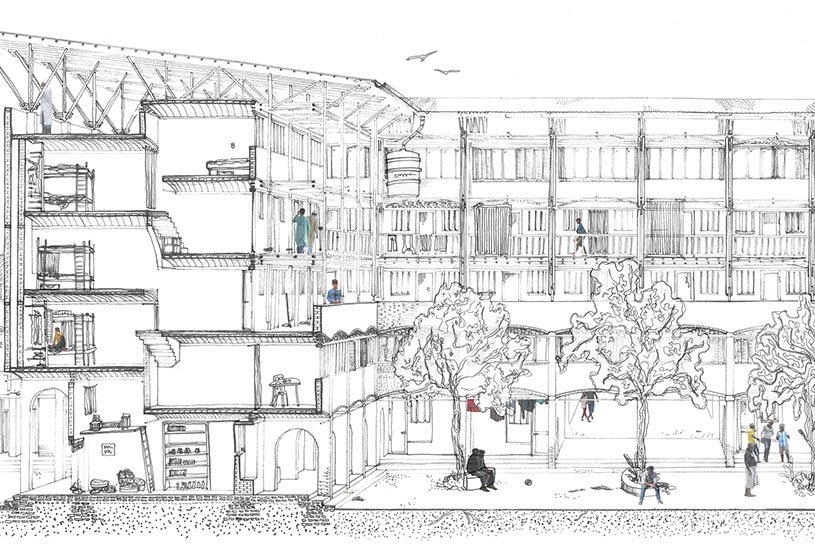
Scheme of the social ambition of the project to bridge the gap from migration towards integration into an urban community such as the Hawker’s Market.The design is based on an intricate network of inward-facing courtyards with outward-facing colonnades toward the market streets. This creates a gradient from private to public on the site.
The project began with the ambition to understand and respond to the shifting realities of internal migration. Following a visit to Sylhet and its surrounding regions, attention shifted from the study of construction workers and their living conditions to the overall lived realities of rural-to-urban migration and its profound societal impacts.
Research into the living conditions of construction workers – often living on site for several months, clustered together on the floor.
While in Bangladesh, the author began speaking with seasonal workers in both Sylhet and Dhaka who had left their home villages to seek employment in the cities. At the time, most connections were with construction workers living on-site for several months, who would return home to support their families during the monsoon seasons.
Research into the living conditions of construction workers – the poor living conditions found on site were a starting point in trying to design dignified housing for migrant workers.Research into the working conditions of construction workers.
It was only later, after seeing the diversity of the hawker’s market, that the design evolved to support a spectrum of lived experiences. Not only are those coming for seasonal work trying to combine the different temporalities of migration, but they are also weaving them into the already dense urban fabric of Sylhet. This meant including current market vendors, families fleeing their flooded farmlands, women leaving their communities, and individual workers supporting their families from afar. By incorporating these different stages, the design did become more complex, perhaps less clear, but only in this way could it reflect the uncertainty, transitions, and hopes of those who move in search of livelihood and security.
Final Outcome
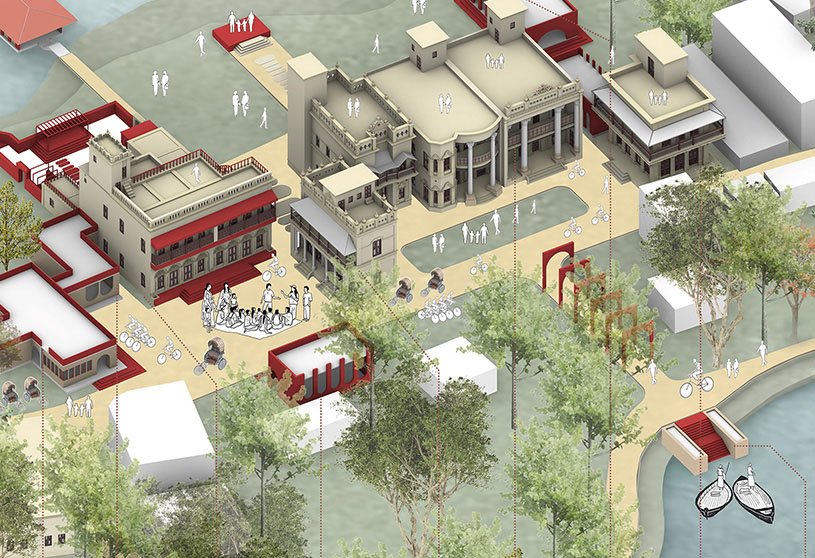
Overview showing the Assembly of Livelihoods with its central pond, its market axes and inner courtyards. | Proposed urban plan for the Assembly on the Hawker’s Market. When looking at the clusters, one can see the shifting relation between intimate inner courtyards and outward facing storefronts towards the busy market streets.Section across the site showing the different courtyard scales.
The current Hawker’s Market represents both the challenge and opportunity of how cities shape spaces for those who migrate in search of work and livelihood. Because of its strategic location but also its public ownership by the city, its future remains unclear.
Ground floor plan of the typical cluster, apartments for migrant families and store owners facing both the market streets and the inner courtyards. Each courtyard represents a different level of privacy | Second floor plan of the typical cluster, with apartments for seasonal workers located around shared galleries.Section across the site showing the different courtyard scales.Sketches showing possible infills the store houses could have. Mind the gradient in these plans, going from the public storefront towards the private backsides facing the courtyards.
The Assembly of Livelihoods envisions a mutual, supportive economy where informal storefronts can create stepping stones for more permanent jobs, and permanent facilities can host and sustain the rhythms of seasonal work. Rather than separation or competition, the proposal aims for interdependence: cohabitation that allows different livelihoods to complement and uplift one another.
Street profiles of the two main building blocks facing the public streets.The project is seen in its urban context – embedded between the Surma River, the Hawker’s Market and the District Commissioner’s bungalow park.
This mix is not just physical but also should have social and even emotional impact. It acknowledges the shared experience of displacement, often driven by climate pressures, and offers a setting where people can collectively rebuild their lives. Through shared spaces, skill exchange, and everyday proximity, internal migrants gain strength in connection rather than isolation on the fringes of the city.
Perspective view of the main market axis. The public colonnade forms a gradient between the street and the stores.Perspective view of an inner courtyard. A place for children to play and laundry to dry, away from the bustle of the streets.
Conclusion: Ultimately, by fostering a setting where diverse livelihoods intersect and evolve side by side, the project resists urban segregation and offers a counter-narrative: one of integration, codependency, and urban dignity—for everyone, regardless of when or why they arrived.
[This Academic Project has been published with text and images submitted by the student]
Site Context
Design Process
Final Outcome
To submit your academic project for publication at ArchiDiaries, please visit the following link >> Submit
Get the best of ArchiDiaries, directly in your inbox.
We use cookies on our website to give you the most relevant experience by remembering your preferences and repeat visits. By clicking “Accept All”, you consent to the use of ALL the cookies. However, you may visit "Cookie Settings" to provide a controlled consent.
This website uses cookies to improve your experience while you navigate through the website. Out of these, the cookies that are categorized as necessary are stored on your browser as they are essential for the working of basic functionalities of the website. We also use third-party cookies that help us analyze and understand how you use this website. These cookies will be stored in your browser only with your consent. You also have the option to opt-out of these cookies. But opting out of some of these cookies may affect your browsing experience.
Necessary cookies are absolutely essential for the website to function properly. These cookies ensure basic functionalities and security features of the website, anonymously.
Cookie
Duration
Description
cookielawinfo-checkbox-analytics
11 months
This cookie is set by GDPR Cookie Consent plugin. The cookie is used to store the user consent for the cookies in the category "Analytics".
cookielawinfo-checkbox-functional
11 months
The cookie is set by GDPR cookie consent to record the user consent for the cookies in the category "Functional".
cookielawinfo-checkbox-necessary
11 months
This cookie is set by GDPR Cookie Consent plugin. The cookies is used to store the user consent for the cookies in the category "Necessary".
cookielawinfo-checkbox-others
11 months
This cookie is set by GDPR Cookie Consent plugin. The cookie is used to store the user consent for the cookies in the category "Other.
cookielawinfo-checkbox-performance
11 months
This cookie is set by GDPR Cookie Consent plugin. The cookie is used to store the user consent for the cookies in the category "Performance".
viewed_cookie_policy
11 months
The cookie is set by the GDPR Cookie Consent plugin and is used to store whether or not user has consented to the use of cookies. It does not store any personal data.
Functional cookies help to perform certain functionalities like sharing the content of the website on social media platforms, collect feedbacks, and other third-party features.
Performance cookies are used to understand and analyze the key performance indexes of the website which helps in delivering a better user experience for the visitors.
Analytical cookies are used to understand how visitors interact with the website. These cookies help provide information on metrics the number of visitors, bounce rate, traffic source, etc.
Advertisement cookies are used to provide visitors with relevant ads and marketing campaigns. These cookies track visitors across websites and collect information to provide customized ads.