Home » Academic projects » Heritage at Risk: Community-Led Strategies for Continuity, Livelihood, and Everyday Life in Birulia, Bangladesh | Bachelors Design Thesis
Heritage at Risk: Community-Led Strategies for Continuity, Livelihood, and Everyday Life in Birulia, Bangladesh | Bachelors Design Thesis
Excerpt: ‘Heritage at Risk: Reviving the Soul Of Birulia’ is an architecture thesis by Md Shazzadul Islam from the ‘Department of Architecture – Rajshahi University of Engineering & Technology (RUET).’ The project aims to develop a sustainable conservation strategy that allows Birulia’s historic settlement to adapt to present-day needs while preserving its cultural identity. By integrating adaptive reuse, community participation, and economic activity, the project seeks to make heritage socially useful and ensure its long-term continuity.
Introduction: What if conservation is not about saving buildings, but about enabling life to continue around them?
This thesis begins with a refusal—a refusal to treat heritage as frozen nostalgia or isolated restoration detached from lived realities. It argues that preservation without everyday value is destined to fail. In Bangladesh, where thousands of heritage sites remain undocumented and vulnerable, conservation often remains symbolic rather than systemic.
This project repositions heritage as active urban infrastructure—socially useful, economically relevant, and publicly experienced. Instead of monumental restoration, it explores how small, community-based interventions can sustain both memory and livelihood. The central inquiry asks: How can a historic settlement retain authenticity while adapting to contemporary needs with limited resources?
Here, conservation is not an aesthetic exercise. It is a strategy for continuity. The past and present coexist; change occurs without erasure. Heritage becomes not a burden of history but the ground upon which the future is built.
Site location and SurroundingsSite location and SurroundingsSite location and Surroundings
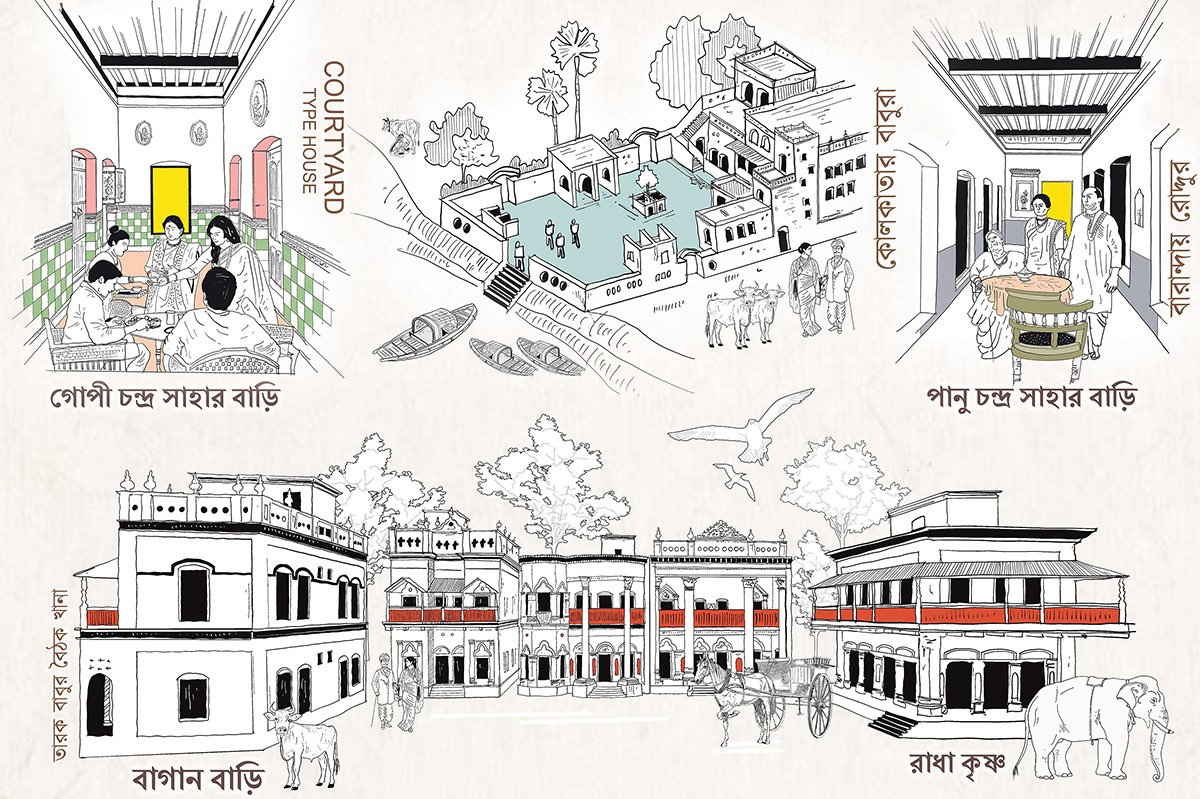
Located on the western bank of the Turag River near Dhaka, Birulia is a historic merchant settlement that flourished during British colonial rule following the Permanent Settlement Act of 1793. River-based trade supported influential families such as the Sahas under the Bhawal Zamindars, producing courtyard houses, temples, marketplaces, and a cohesive socio-religious landscape aligned along Tarok Babur Rasta.
Heritage Value Assessment – Homestead Layout and SectionAerial View and Elevation of HomesteadHeritage Value Assessment – The Merchant Houses at BiruliaHeritage Value Assessment – The Merchant Houses at Birulia
Political upheavals—Partition in 1947, communal riots in 1964, and the Liberation War of 1971—triggered displacement and abandonment. Of more than sixty colonial-era structures, only a fraction survives today. Yet Birulia continues to host Durga Puja, Pahela Baishakh, and Digambari Mela, where intangible heritage persists despite material decay.
Past Scenario of The Site (Year – 1920)Past Scenario of The Site (Year – 1920)
The program responds to this layered condition by addressing governance gaps, lack of economic incentives, and weak visitor infrastructure. Rather than treating Birulia as isolated monuments, the project approaches it as a living cultural landscape requiring adaptive, socially embedded conservation.
Design Process
Current Scenario of The Site (Year – 2024)Opinion by the people of Birulia
The design process began with a critical question: Can every part of Birulia be preserved in the same way? Field surveys, oral histories, stakeholder interviews, and architectural documentation revealed varied conditions — abandoned yet valuable buildings, socially active but fragile spaces, and areas under intense development pressure. A uniform conservation approach would freeze life instead of sustaining it.
Detecting IssuesDetecting IssuesDecisions
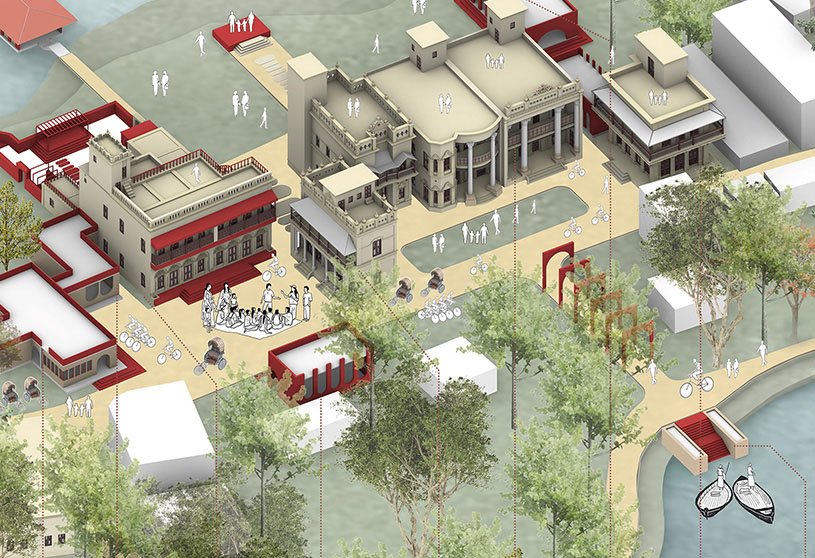
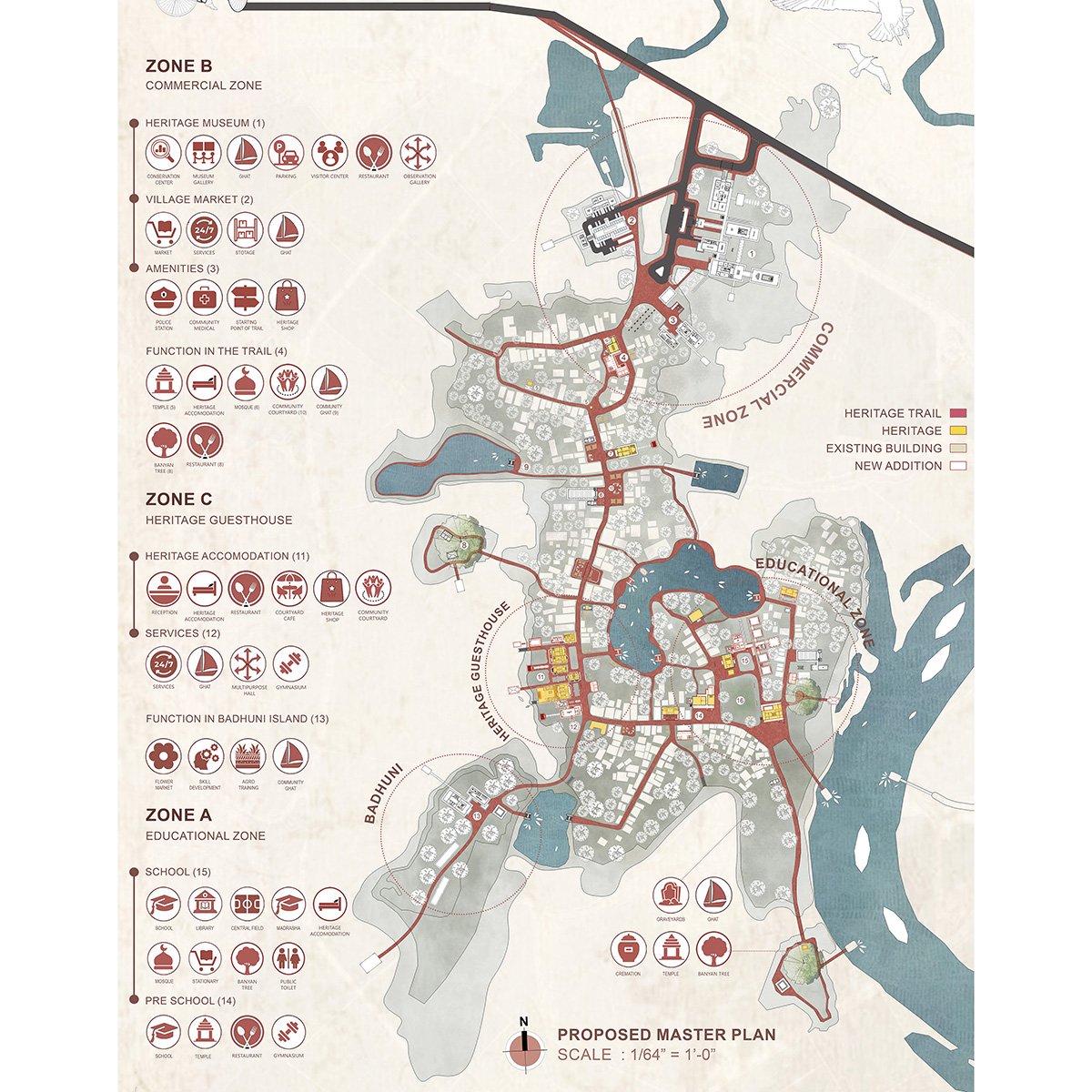
To negotiate between memory and change, the settlement is reorganized into three interdependent zones: Educational, Heritage, and Commercial. This zoning strategy allows differentiated intervention based on cultural value, physical condition, and community needs.
Future ProjectionFuture Projection
Implementation follows the “3D Rule”—Discuss, Detect, Decision—ensuring participatory evaluation before any intervention. Conservation becomes a collaborative process rather than a top-down imposition. The design prioritizes minimal intervention, adaptive reuse, livelihood integration, and infrastructural improvement, aligning preservation with everyday life.
Final Outcome
Masterplan with Serial VisionEducational ZoneEducational ZoneEducational Zone
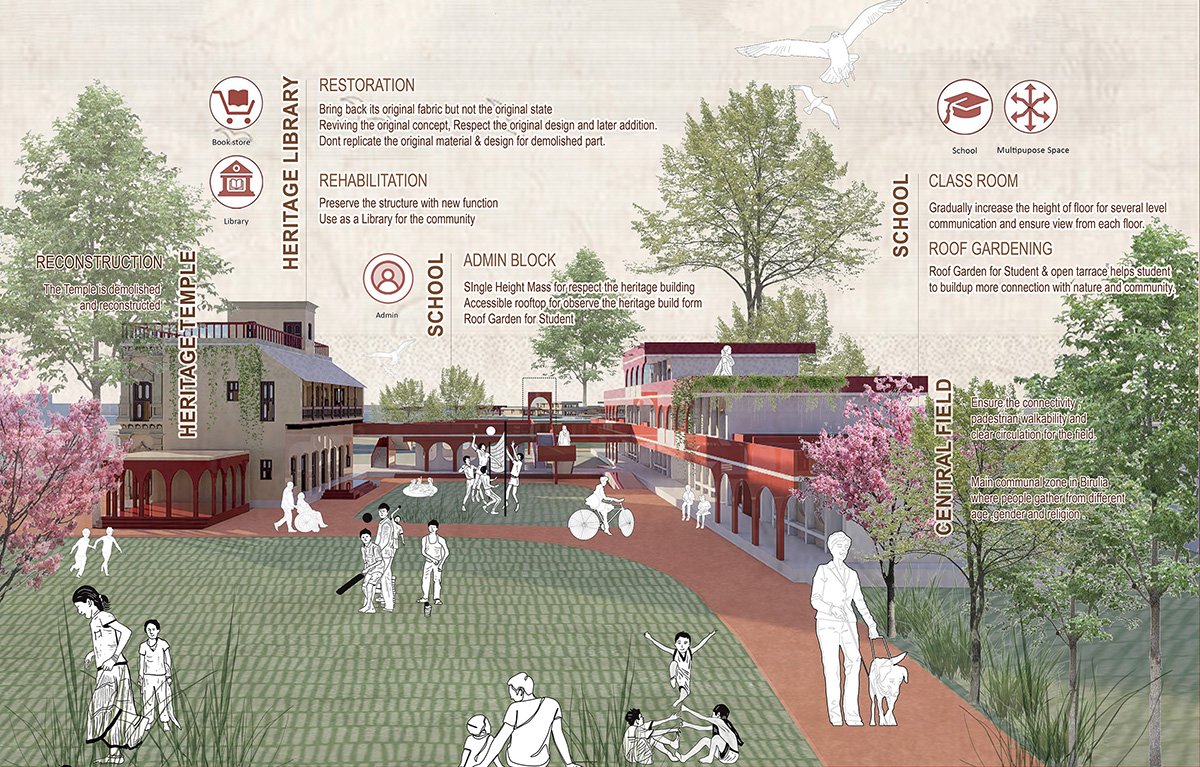
The final proposal transforms conservation into a self-sustaining system. In the Educational Zone, existing structures are adapted into a library and community club, while the central field becomes a shared platform for learning and cultural exchange.
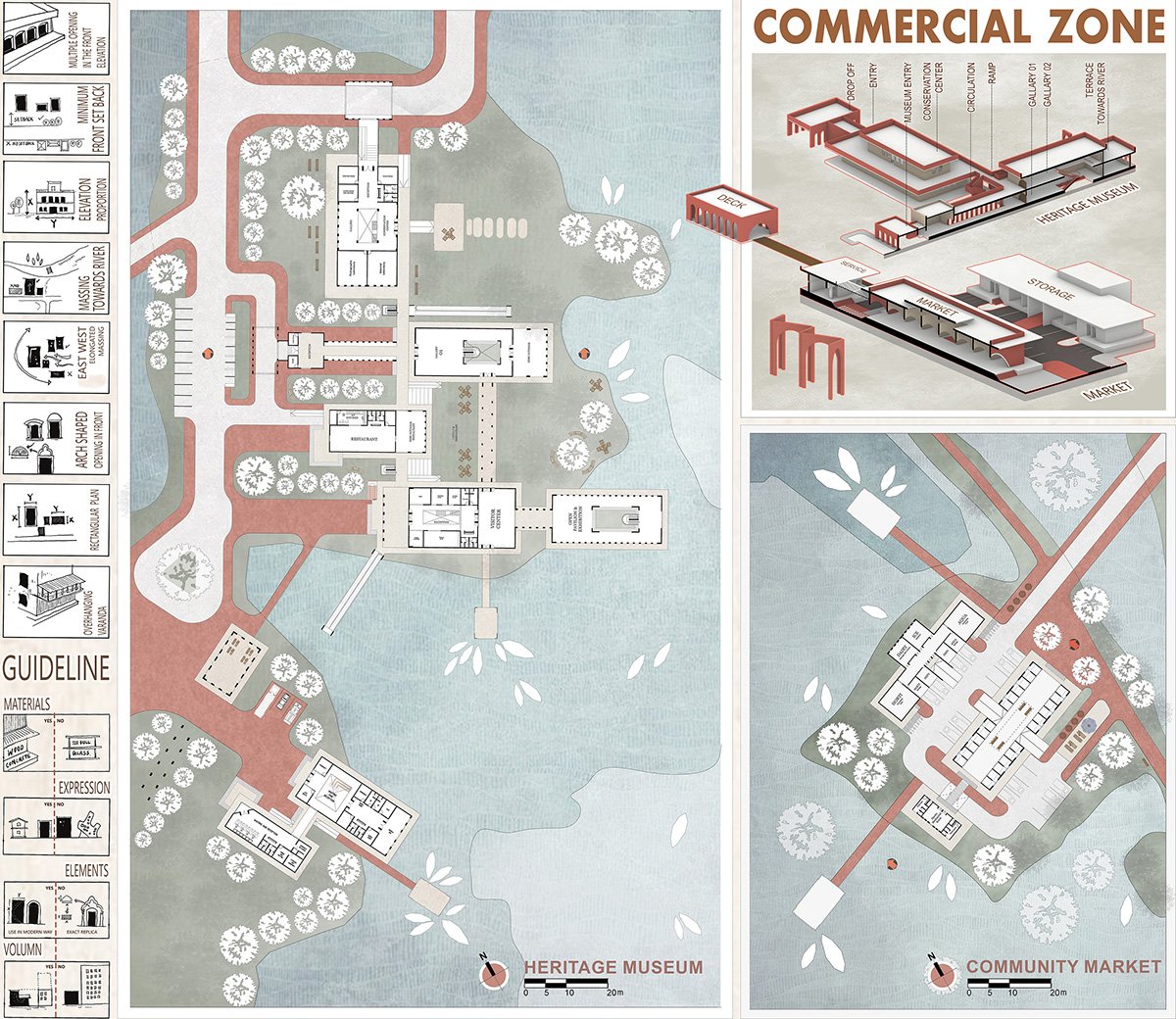
Commercial ZoneCommercial ZoneCommercial Zone
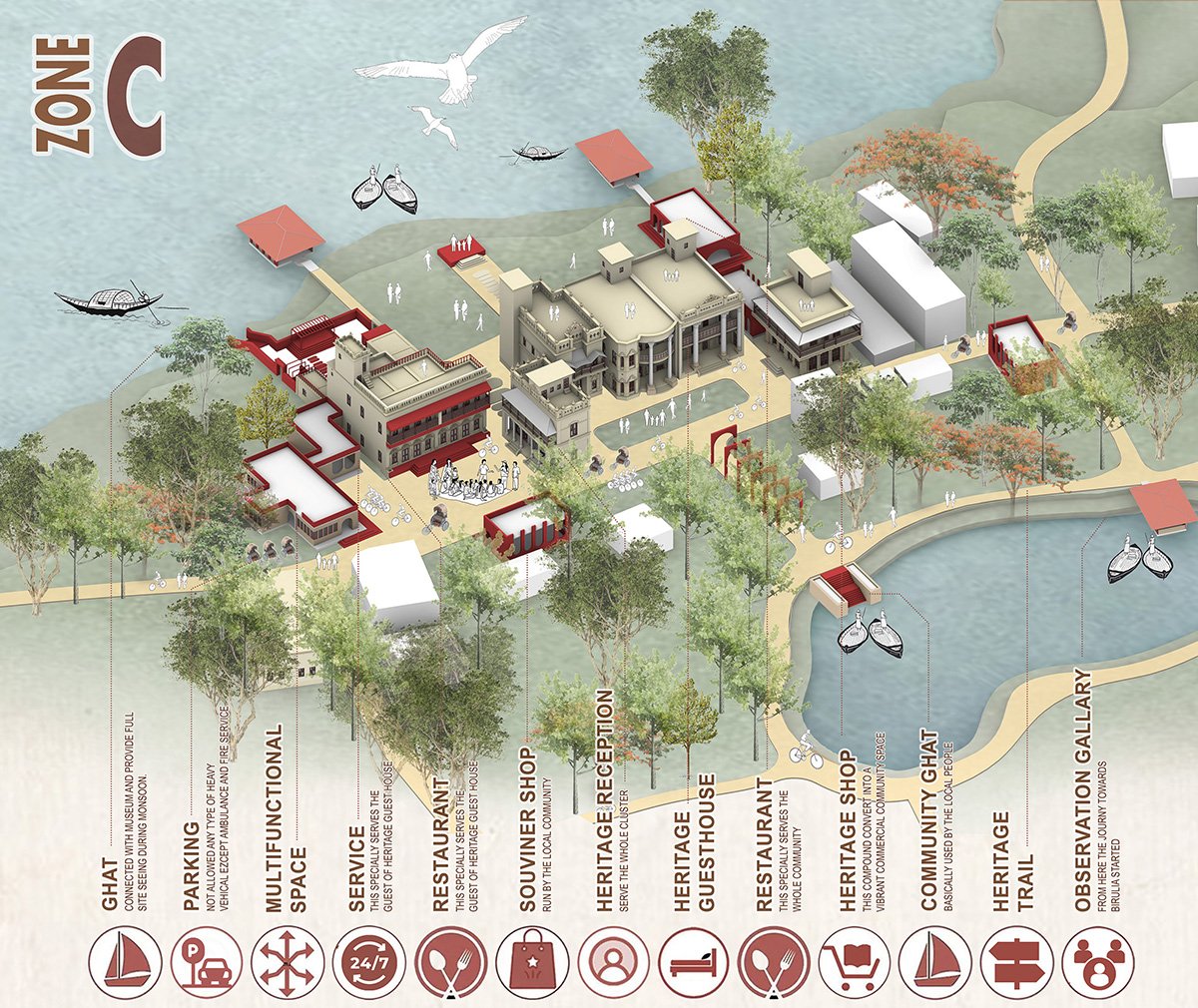
In the Heritage Zone, vacant historic houses are restored with minimal intervention and converted into a heritage guesthouse, generating income and reinforcing stewardship. In the Commercial Zone, a relocated substation enables the creation of a new gateway marked by a market, museum, and research facilities—establishing identity while supporting tourism and civic needs.
Heritage ZoneHeritage ZoneHeritage Zone
Conclusion: The outcome is not a preserved village frozen in time, but a living cultural landscape capable of renewal. This proposal does not simply conserve Birulia; it equips the village to sustain itself—transforming memory into use, and use into value.
[This Academic Project has been published with text and images submitted by the student]
Site Context
Design Process
Final Outcome
To submit your academic project for publication at ArchiDiaries, please visit the following link >> Submit
Get the best of ArchiDiaries, directly in your inbox.
We use cookies on our website to give you the most relevant experience by remembering your preferences and repeat visits. By clicking “Accept All”, you consent to the use of ALL the cookies. However, you may visit "Cookie Settings" to provide a controlled consent.
This website uses cookies to improve your experience while you navigate through the website. Out of these, the cookies that are categorized as necessary are stored on your browser as they are essential for the working of basic functionalities of the website. We also use third-party cookies that help us analyze and understand how you use this website. These cookies will be stored in your browser only with your consent. You also have the option to opt-out of these cookies. But opting out of some of these cookies may affect your browsing experience.
Necessary cookies are absolutely essential for the website to function properly. These cookies ensure basic functionalities and security features of the website, anonymously.
Cookie
Duration
Description
cookielawinfo-checkbox-analytics
11 months
This cookie is set by GDPR Cookie Consent plugin. The cookie is used to store the user consent for the cookies in the category "Analytics".
cookielawinfo-checkbox-functional
11 months
The cookie is set by GDPR cookie consent to record the user consent for the cookies in the category "Functional".
cookielawinfo-checkbox-necessary
11 months
This cookie is set by GDPR Cookie Consent plugin. The cookies is used to store the user consent for the cookies in the category "Necessary".
cookielawinfo-checkbox-others
11 months
This cookie is set by GDPR Cookie Consent plugin. The cookie is used to store the user consent for the cookies in the category "Other.
cookielawinfo-checkbox-performance
11 months
This cookie is set by GDPR Cookie Consent plugin. The cookie is used to store the user consent for the cookies in the category "Performance".
viewed_cookie_policy
11 months
The cookie is set by the GDPR Cookie Consent plugin and is used to store whether or not user has consented to the use of cookies. It does not store any personal data.
Functional cookies help to perform certain functionalities like sharing the content of the website on social media platforms, collect feedbacks, and other third-party features.
Performance cookies are used to understand and analyze the key performance indexes of the website which helps in delivering a better user experience for the visitors.
Analytical cookies are used to understand how visitors interact with the website. These cookies help provide information on metrics the number of visitors, bounce rate, traffic source, etc.
Advertisement cookies are used to provide visitors with relevant ads and marketing campaigns. These cookies track visitors across websites and collect information to provide customized ads.