Excerpt: ‘Mussel Built’ is a Masters Design Project by Shiqi Xu and Ruiqi Huang from the ‘Graduate School of Architecture, Planning and Preservation (GSAPP) – Columbia University.’ The project aims to challenge human-centered notions of architecture by redefining building as a long-term ecological process shaped by nonhuman agents and deep time. Focusing on the mussel as a resilient biological and material actor, the project explores how decay, growth, and environmental coupling can produce adaptive structures that persist beyond human systems.
Introduction: MUSSEL BUILT examines the Gowanus Canal as an industrial waterway shaped by dredging, disposal, and long-term material accumulation. The project focuses on the Atlantic ribbed mussel as an organism embedded in these altered conditions, using its growth and decay cycles to study resilience across extended temporal scales.
The project treats building as an ongoing process of material transformation. Decay is employed as an operational mechanism, informing how structures change through erosion, accretion, and decomposition rather than remaining fixed in form.
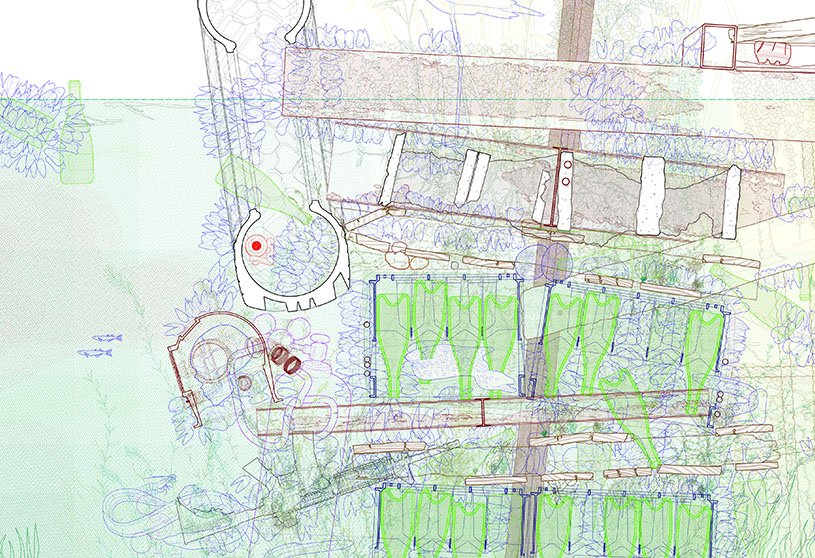
Mussels and allied actors are reorganized along the canal’s “murderer-dredger” edge, forming a floating Coupling Body, an evolving architecture that grows, erodes, and rebuilds itself within the canal’s long ecological timeline and continuous building process.
Humans are good at building. Our industry system is the best proof of this. Beyond the scope of everyday awareness, however, vast quantities of material are discarded by this system: surplus components rendered unnecessary, waste produced at the end of production lines, or goods deliberately destroyed as a result of overproduction.
Within this largely unseen realm, the built environment—though a human creation—can be understood as possessing a life of its own. It continues to generate, transform, and evolve independently, at times slipping beyond human control and producing outcomes that surprise or unsettle its creators.
Gowanus Canal – Old Wood Bulkhead
If we were forced to define our species, one answer might be: human and mussel. Yet the reality is more complicated.
Along the banks of the Gowanus Canal, hundreds of prisms have been installed to monitor subsidence. As early as 1853, the Brooklyn government officially initiated the Gowanus Canal project to support the borough’s growing port infrastructure. Over the past two centuries, the canal has received large volumes of tar, coal, chemical wastewater, combined sewer overflow, and landfill debris. These practices severely contaminated the soil and water, resulting in a five-meter-thick layer of toxic black sediment on the canal floor.
In last 15 years old wood bulkheads are replaced by the concrete and steelDredger on a Platform
In 2019, a collaboration between government agencies, the Superfund program, and conservancy groups produced a draft plan for the canal’s revival. The initial phase focused on dredging and removing the contaminated sediment. To prevent structural failure and the spread of organic pollutants, more than 80 percent of the original shoreline—once composed of wooden bulkheads and salt marshes—was replaced with engineered barriers such as steel and concrete walls.
Oil Processing IndustryOne Of The Landfills Near The Gowanus Canal
Ironically, these measures, intended to support ecological restoration, caused further harm to aquatic life already under stress, particularly mussels. Since the nineteenth century, human-made systems have expanded relentlessly, extending their reach like a vast, uncontrolled organism.
In 2020, one such extension—advancing forcefully—collided with ribbed mussels barely surviving in the Gowanus Canal. The mussels withdrew again and again, while the constructed infrastructure remained fixed and unyielding. This encounter drew little human attention; it was simply another unintended consequence of industrial intervention, noticed only in retrospect.
Water polluted by the emissions from factories near the canalCooperated with total station to monitor the change of ground
Countless similar incidents likely unfold daily in overlooked places. The mussel, without agency or awareness, can only endure these conditions in silence—much like many other species affected by human activity.
Design Process
Narratives_Three Stages SketchNarratives_Wooden PalletNarratives_Stack Unit
Through the study of mussels and the conditions that have nearly led to their disappearance, the project identifies an unexpected yet substantial capacity for resilience—one that becomes legible only across extended timescales. When provided with appropriate conditions, this potential can be realized. The project demonstrates these capabilities through a series of material-based thought experiments that foreground time as a critical variable, examining both the mussels themselves and the substrates essential to their survival.
This investigation reveals the mussels’ acute sensitivity to substrate conditions, as well as their remarkable capacity for rapid proliferation when those conditions are favorable. In such circumstances, mussels can function as a foundational framework, effectively forming a skeletal base for the development of a broader ecological system.
The study also highlights the significant role of mussels’ byssal threads—their strength and adaptability enabling survival while simultaneously acting as a biological anchoring mechanism for larger structures. By framing the built environment through this lens, the project expands conventional definitions of species by incorporating time as a determining factor, identifying agents that participate differently in processes of construction and transformation within the Gowanus Canal context.
Research_MusselsResearch_Total Station Scope 01Research_Total Station Scope 02
Ultimately, the project proposes a scenario in which the mussel becomes an active participant in building itself—enacting a slow, almost imperceptible form of resistance. In deep time, survival itself emerges as a quiet yet decisive victory.
The building process unfolds across three distinct stages.
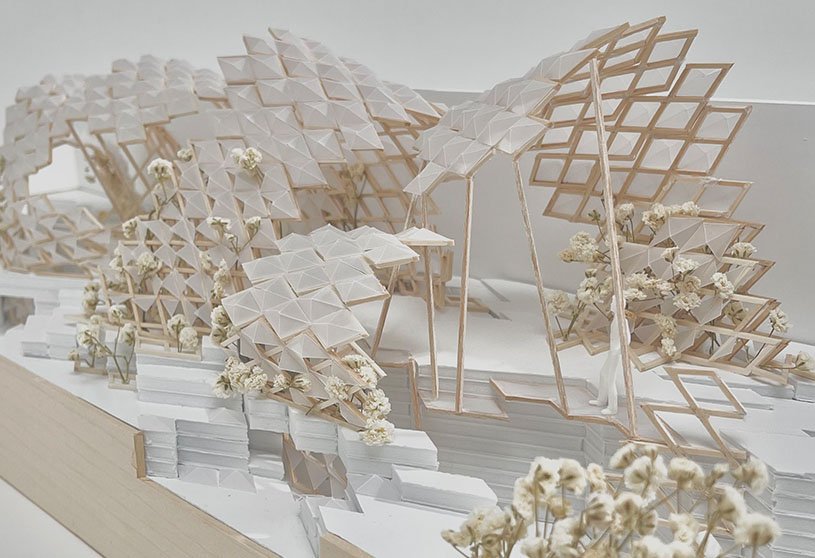
In the first stage, a barge is encircled by foundational structures. Over the final phase of the barge’s lifespan, plants and mussels gradually colonize its surface, binding together to form a stable floating system. By 2050, the barge itself is removed, leaving behind a newly formed platform that becomes available for other species, including humans.
Mussel Built_Plan & Section SequenceSection
The second stage occurs around 2100, when extreme climate conditions have drastically altered the global environment. The collapse of the industrial system forces human society into a pre-modern state. Floodwaters submerge much of Brooklyn, rendering arable land exceedingly scarce. The floating platform—constructed fifty years earlier—endures precisely because it functions as an eco-built system. Rising above the floodwaters, it becomes a rare and valuable terrain where people establish settlements, cultivate crops, and engage in fishing and hunting.
SectionSection
Throughout this period, mussels, aquatic grasses, root systems, and other aquatic organisms integrate with the platform’s fragmented structural components, collectively sustaining the buoyancy system that allows it to remain afloat.
Mussel Built_Rendering Series
Conclusion: Over the course of centuries, the platform undergoes a profound transformation, evolving into an ecological aggregate. Through ongoing biological and material processes, it continues to build itself, extending its existence far beyond its original architectural intent.
[This Academic Project has been published with text and images submitted by the student]
Site Context
Design Process
Final Outcome
To submit your academic project for publication at ArchiDiaries, please visit the following link >> Submit
Get the best of ArchiDiaries, directly in your inbox.
We use cookies on our website to give you the most relevant experience by remembering your preferences and repeat visits. By clicking “Accept All”, you consent to the use of ALL the cookies. However, you may visit "Cookie Settings" to provide a controlled consent.
This website uses cookies to improve your experience while you navigate through the website. Out of these, the cookies that are categorized as necessary are stored on your browser as they are essential for the working of basic functionalities of the website. We also use third-party cookies that help us analyze and understand how you use this website. These cookies will be stored in your browser only with your consent. You also have the option to opt-out of these cookies. But opting out of some of these cookies may affect your browsing experience.
Necessary cookies are absolutely essential for the website to function properly. These cookies ensure basic functionalities and security features of the website, anonymously.
Cookie
Duration
Description
cookielawinfo-checkbox-analytics
11 months
This cookie is set by GDPR Cookie Consent plugin. The cookie is used to store the user consent for the cookies in the category "Analytics".
cookielawinfo-checkbox-functional
11 months
The cookie is set by GDPR cookie consent to record the user consent for the cookies in the category "Functional".
cookielawinfo-checkbox-necessary
11 months
This cookie is set by GDPR Cookie Consent plugin. The cookies is used to store the user consent for the cookies in the category "Necessary".
cookielawinfo-checkbox-others
11 months
This cookie is set by GDPR Cookie Consent plugin. The cookie is used to store the user consent for the cookies in the category "Other.
cookielawinfo-checkbox-performance
11 months
This cookie is set by GDPR Cookie Consent plugin. The cookie is used to store the user consent for the cookies in the category "Performance".
viewed_cookie_policy
11 months
The cookie is set by the GDPR Cookie Consent plugin and is used to store whether or not user has consented to the use of cookies. It does not store any personal data.
Functional cookies help to perform certain functionalities like sharing the content of the website on social media platforms, collect feedbacks, and other third-party features.
Performance cookies are used to understand and analyze the key performance indexes of the website which helps in delivering a better user experience for the visitors.
Analytical cookies are used to understand how visitors interact with the website. These cookies help provide information on metrics the number of visitors, bounce rate, traffic source, etc.
Advertisement cookies are used to provide visitors with relevant ads and marketing campaigns. These cookies track visitors across websites and collect information to provide customized ads.