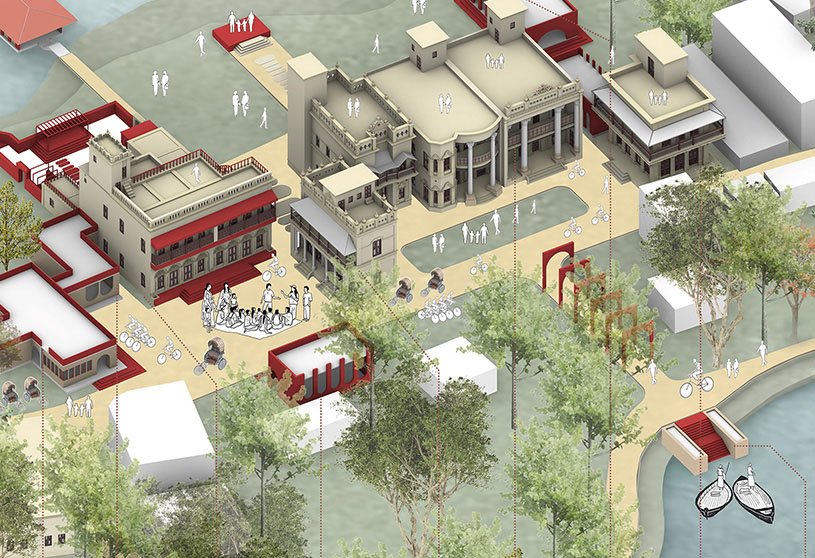
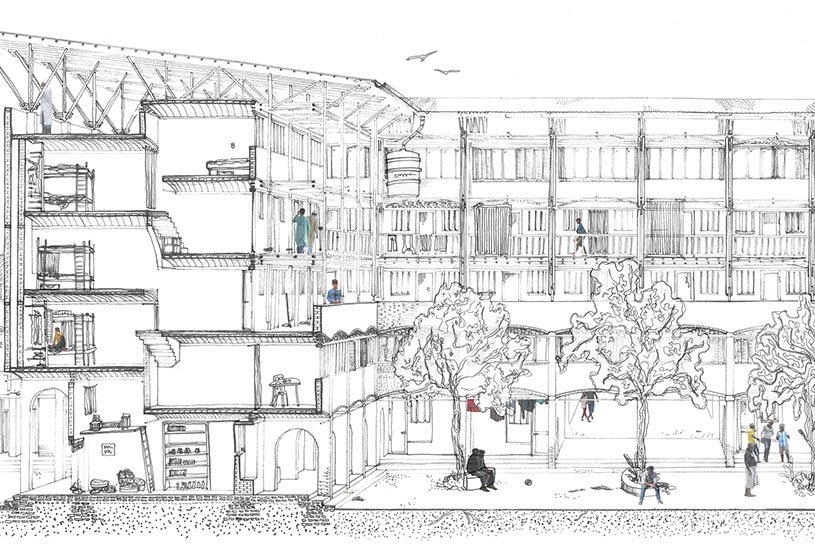
Excerpt: ‘Re-Framing the Hollow’ is an architecture thesis by Yana Shaban from the ‘Architectural Association School of Architecture (AA).’ The project addresses stone misappropriation in the West Bank by reclaiming abandoned quarries and fragments as essential resources. Through site-specific, sustainable techniques and traditional stone construction, it proposes a socially integrated architecture. Rooted in Palestinian cultural expressions, it envisions spaces of resilience, education, and community transformation.
Introduction: ‘Re-Framing the Hollow’ addresses the issue of stone misappropriation in the West Bank by drawing attention to the excessive mining of local stone for foreign markets. The project proposes employing site-specific and sustainable techniques to reintegrate building stone into the West Bank’s architectural typology. Through the identification of abandoned quarries and their stone fragments as essential resources, the project collaborates with RIWAQ to create architecture rooted in Palestinian social and cultural expressions.
The project explores the cultural relevance of quarries as a material and a form of resistance through investigative study and cartographic analysis. It addresses both contemporary issues with education and the historical processes of manufacturing power that have carved boundaries into the terrain.
Inspired by the Galilee Foundation’s youth centers, the building, which was first intended as a school for students affected by demolition orders, also transforms into a vibrant home for charities, non-governmental organizations, and the local community.
The project started with a detailed study of the landscape, focusing on the stone quarries in the West Bank, to investigate how power is created by a material with significant cultural influence. 85 quarries covering millions of square meters were found while exploring the West Bank’s geography; some are tucked away amongst olive terraces, some infiltrate settlements, and some are more subtly incorporated. Later, it was discovered that the current use of stone is the result of years of regulations. Although it is rarely used in the Palestinian landscape, about 75% of Palestinian stone is shipped to foreign markets. Schools in Zone C of the West Bank were a primary target for the stone face demolition that was used to build numerous urban cores. The majority of quarries in the same area are typically shut down either by having their permits revoked or having their equipment seized, leaving them abandoned.
QuarriesSite Location
The project addresses both current educational challenges and historical manufacturing power issues that shaped the terrain. Selecting a suitable location is crucial in rocky terrain. As a guideline, borders, spaces of incident, and quarries were mapped.
The project is sited in Zone B, on the eastern outskirts of Ramallah, where it will host a school. The site provides a secure buffer for social life and education given that it is situated between larger cities and areas that are being demolished. Teachers from central Ramallah can work locally according to the proposal, which also accommodates students from Zones A and C.
Design Process
Overlayed Circulation Diagram And Process Model
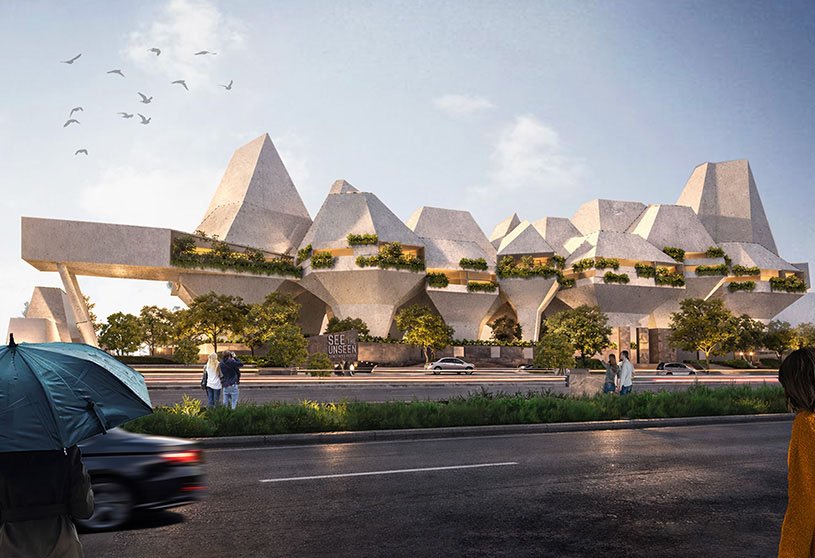
The form of the building was inspired by the cascading domes across the mountainous terrain of the West Bank. These structures reflect a vernacular tradition, binding the architecture to its landscape. This project aims to explore a balance between domes that emerge from and sink into the terrain, rethinking how architecture inhabits the landscape by drawing from the works of Michael Heizer.
Iterative Models
The design began with an iterative process, studying balance and testing the dialogue between domes and retaining walls. This ranged from domes fully enclosed by their perimeter walls to those shaping courtyards, framing entrances, and unfolding into quiet, walkable edges.
Final Outcome
Plan And RenderTop View
This project resides in a zone at the intersection of two powers, making it liminal both literally and symbolically. It exists at the intersection of necessary action and anticipatory vision. The structure transforms from a school into a vibrant hub for community life. A design strategy that proposes a new architecture by reclaiming discarded stone fragments is informed by the student’s research. The approach turns into a politically relevant, materially based, and socially integrated one.
ConstructionDetail
The construction process centers on reuse and low-tech approaches to formwork. Before the design phase, traditional stone construction was explored—particularly barrel vaults, cross vaults, and domes. Among these, cascading domes became the focus.
Interior VaultsAuditorium
Starting from the ground, the first layer is cast from the concrete ring beams to stones carefully placed on a sand bedding, allowing for an irregular, jagged surface. The walls form a system that compresses the dome in place, shifting in materiality from earth to stone and unfolding to expose the continuous ceiling the dome rests on.
The roofscapes invite movement and pause, shaping walkable, livable terrains for rest, gathering, and quiet moments of leisure—integrating the roof and sunken space into a unified landscape.
DiningVaults
Conclusion: Most notably, the project looks at the architect’s projective capacity, where it aims to balance a proposition based on research—grounded in existing conditions and their aftermath—but also based on resilience, where there is a paramount need to propose for now and for a transformative future.
[This Academic Project has been published with text and images submitted by the student]
Site Context
Design Process
Final Outcome
To submit your academic project for publication at ArchiDiaries, please visit the following link >> Submit
Get the best of ArchiDiaries, directly in your inbox.
We use cookies on our website to give you the most relevant experience by remembering your preferences and repeat visits. By clicking “Accept All”, you consent to the use of ALL the cookies. However, you may visit "Cookie Settings" to provide a controlled consent.
This website uses cookies to improve your experience while you navigate through the website. Out of these, the cookies that are categorized as necessary are stored on your browser as they are essential for the working of basic functionalities of the website. We also use third-party cookies that help us analyze and understand how you use this website. These cookies will be stored in your browser only with your consent. You also have the option to opt-out of these cookies. But opting out of some of these cookies may affect your browsing experience.
Necessary cookies are absolutely essential for the website to function properly. These cookies ensure basic functionalities and security features of the website, anonymously.
Cookie
Duration
Description
cookielawinfo-checkbox-analytics
11 months
This cookie is set by GDPR Cookie Consent plugin. The cookie is used to store the user consent for the cookies in the category "Analytics".
cookielawinfo-checkbox-functional
11 months
The cookie is set by GDPR cookie consent to record the user consent for the cookies in the category "Functional".
cookielawinfo-checkbox-necessary
11 months
This cookie is set by GDPR Cookie Consent plugin. The cookies is used to store the user consent for the cookies in the category "Necessary".
cookielawinfo-checkbox-others
11 months
This cookie is set by GDPR Cookie Consent plugin. The cookie is used to store the user consent for the cookies in the category "Other.
cookielawinfo-checkbox-performance
11 months
This cookie is set by GDPR Cookie Consent plugin. The cookie is used to store the user consent for the cookies in the category "Performance".
viewed_cookie_policy
11 months
The cookie is set by the GDPR Cookie Consent plugin and is used to store whether or not user has consented to the use of cookies. It does not store any personal data.
Functional cookies help to perform certain functionalities like sharing the content of the website on social media platforms, collect feedbacks, and other third-party features.
Performance cookies are used to understand and analyze the key performance indexes of the website which helps in delivering a better user experience for the visitors.
Analytical cookies are used to understand how visitors interact with the website. These cookies help provide information on metrics the number of visitors, bounce rate, traffic source, etc.
Advertisement cookies are used to provide visitors with relevant ads and marketing campaigns. These cookies track visitors across websites and collect information to provide customized ads.