Excerpt:‘Sediments: Performative Ecologies’ is an architecture thesis on regenerative architecture by Valentina Aguilar from the Facultad de Arquitectura y Diseño – Universidad de los Andes that offers an architectural solution to the fragmented landscapes in Honda, Colombia, which are shaped by sediments due to local ecologies and weather. The project proposes a Fishing Vertical Bio-Filter Tower, aiming to preserve regional knowledge and restore ecosystems by integrating ecology and history. The project evolves based on sediment movements, river flows, rainfall, and sun exposure.
Introduction: Sediment embodies accumulated tangible and intangible matter, carrying history within its journey. Along with fishermen, locals, and visitors, there are rocks, stones, gravel, sand, and woods, each carrying a story. Sediment represents a condensed temporality and carries with it the history of its journey. Fragile landscapes, like the abandoned railroad and river mouth to the Magdalena River in Honda, Colombia, have been shaped by architectural, vegetative, and anthropogenic sediments. Due to the local ecologies and weather, the water line is continuously drawn and undrawn. How to project in a place where change is permanent?
A Fishing vertical Bio-filter Tower, which unites ecology and history, appears as a response, serving as a centre for the preservation of regional knowledge and the restoration of ecosystems. With additional ecosystemic responsibilities, horizontal fishing dynamics condition new vertical dynamics that create a programmatic continuity for the Bio-filter Tower. The project will eventually take on the shape of landscape choreographies influenced by sediment movements, river flows, rainfall, and sun exposure.
Site Location: Honda, Tolima, Colombia | Aerial View of SiteEncounter Of Landscape LayersPermanent Change on Site
The site for the intervention is located in Honda, Colombia. The railway line, which was drawn by humans abruptly, now serves as an interface between history and place. A path that veers off course and leads to a fishing vertical bio-filter tower—a performative artefact that matches the landscape.
Site – The Atlas | Liquidscapes – UtopyThe Abandoned Railroad on Site
The former railway line, which was originally intended to connect regions for trade and territory exploitation, is currently being reimagined as a route that reconnects the geologic, cultural, and fluvial ecologies of the region, a system that restores an endangered ecosystem by accumulating biological, historical, and anthropogenic sediments.
Design Process
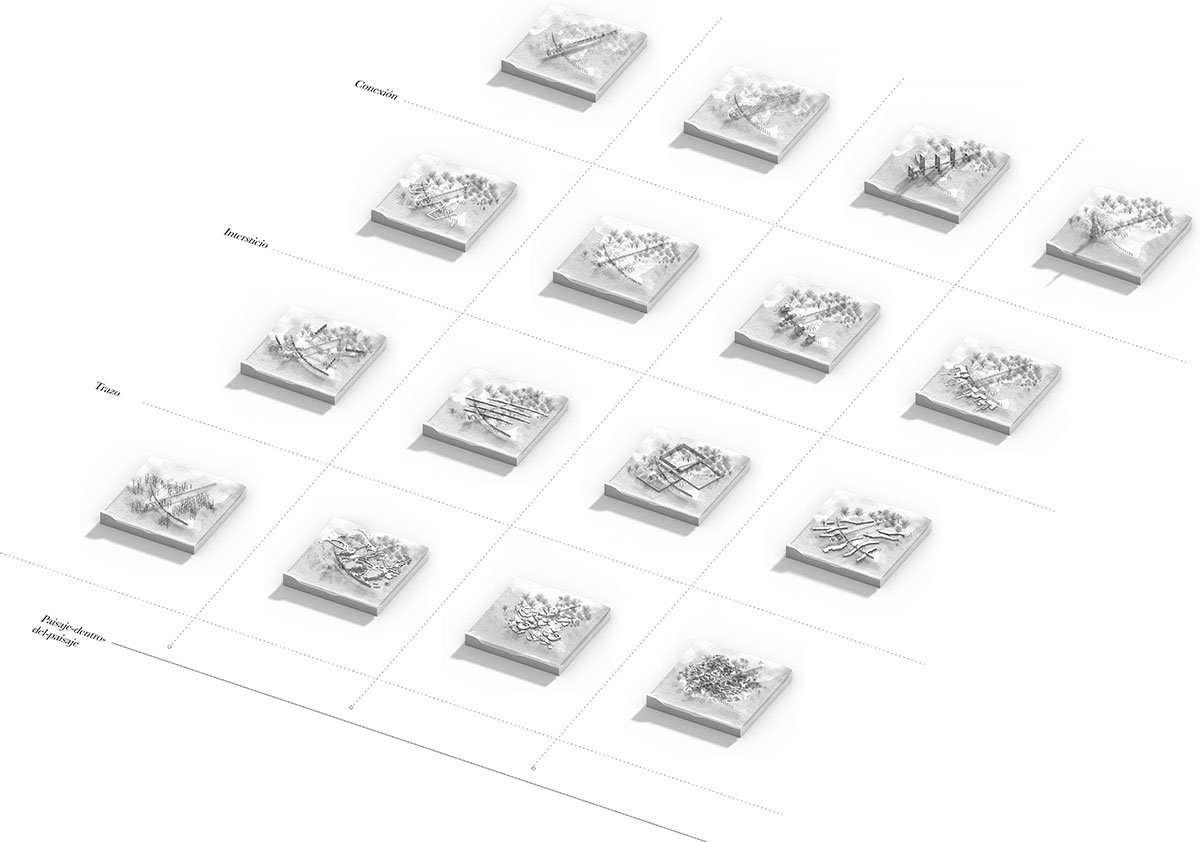
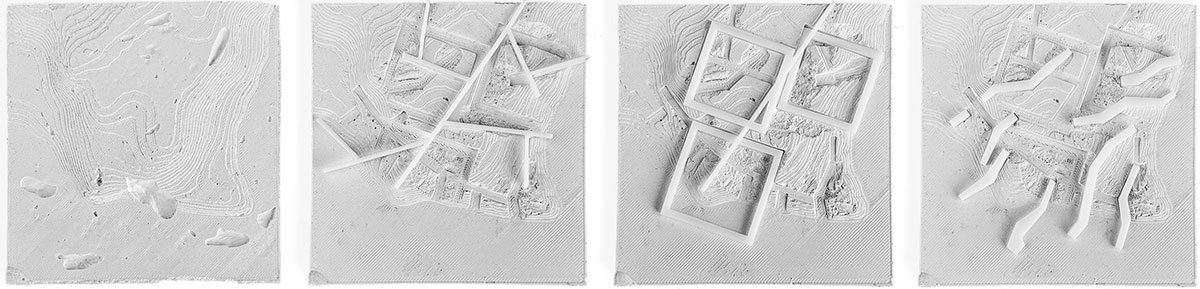
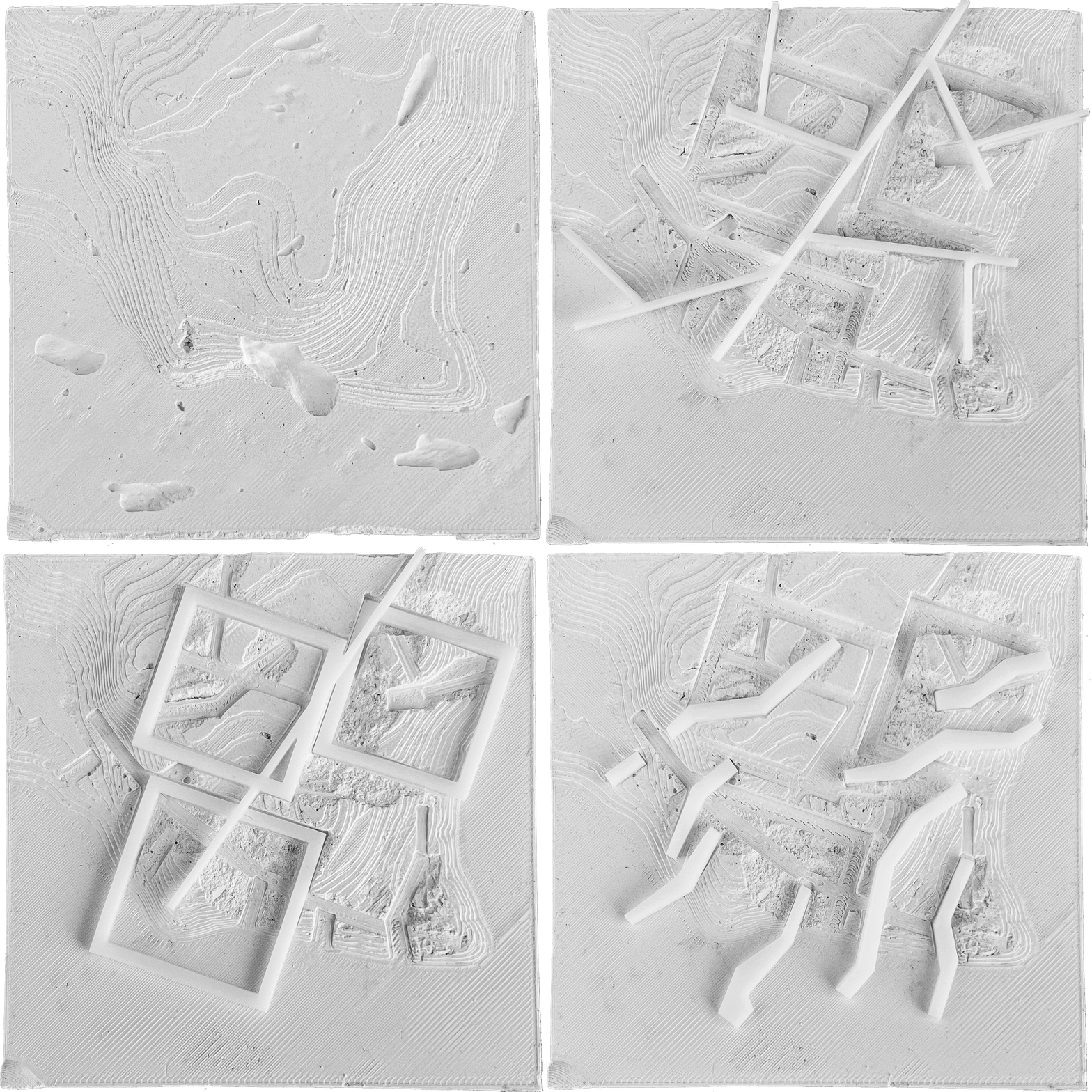
Synthesis Diagram: Landscape – A Performative ScenarioMulti-Iteration: Exploration Process
The question “How to respond to a place where the only constant is change?” is the starting point of the research process. The collected satellite images reveal the choreography of the landscape in a permanently changing river condition, at the mouth of the Guarinó River into the Magdalena River. The primary water system that ties together Colombia’s landmass is derived from both the movement of water and the people, stories, and sediments that navigate it.
Multi-Iteration: Hybridscapes
This abandoned piece, as the “violence,” was the starting point. A piece that has completely altered the location’s morphology while retaining its history and accumulated temporality. Instead, it aimed to become a “bio-lent” vestige that could connect biological processes and community to promote the recovery of the river ecosystem while also acknowledging the past.
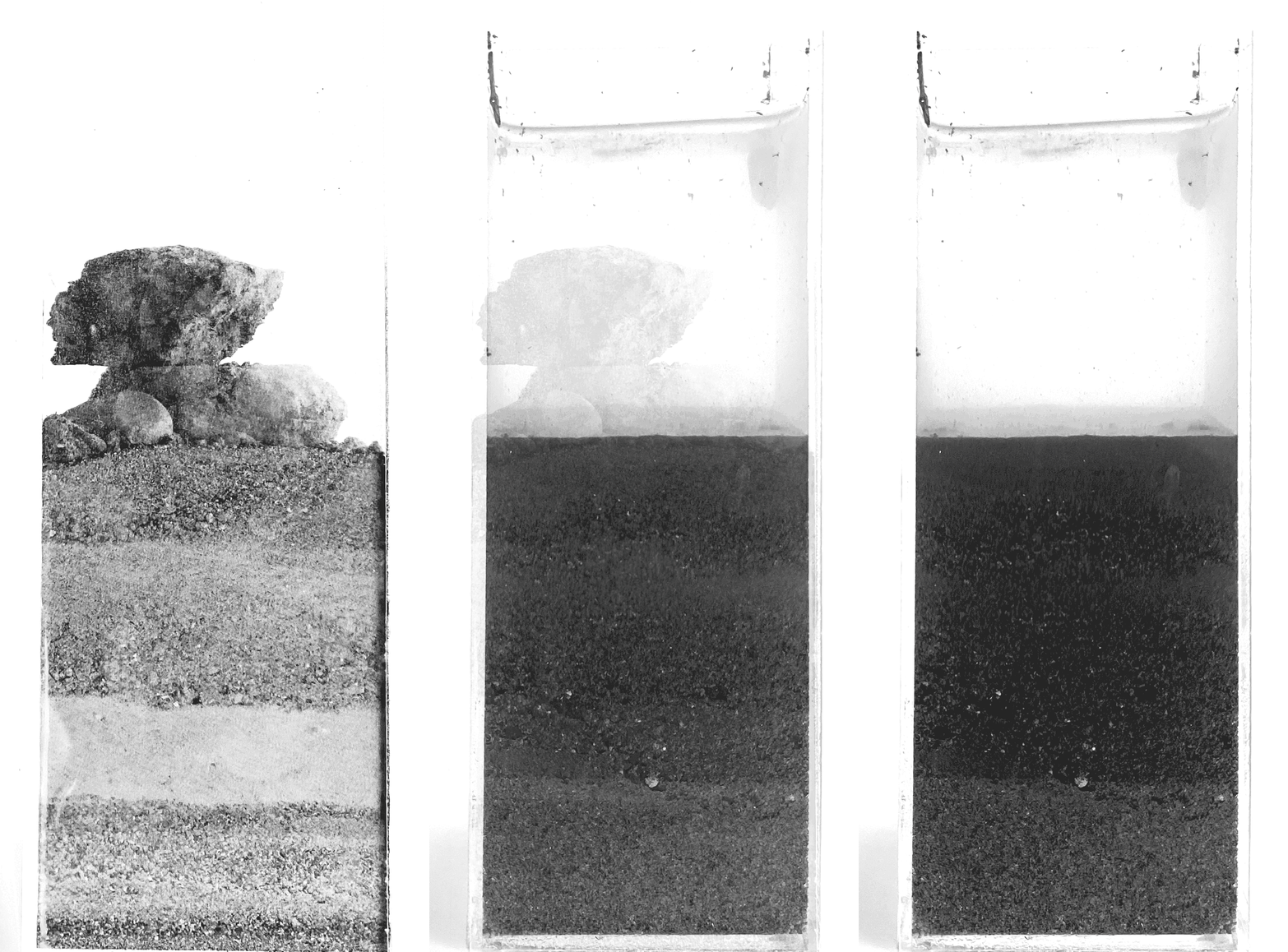
Sediments – Impermanent Matter
The project is heavily influenced by technology (drone photogrammetry, 3D printing, CNC fabrication, satellite imagery, and animation), which increases its specificity and, consequently, its relevance and capacities, particularly those that are developed over time. Besides, adopting a community-based program and ecosystemic responsibilities. This required a hybrid approach to the entire process in terms of research methodologies and digital and physical translations. A methodology that is as complex and unfinished as the landscape: a scenario that blends layers, states of time, and matter.
Final Outcome
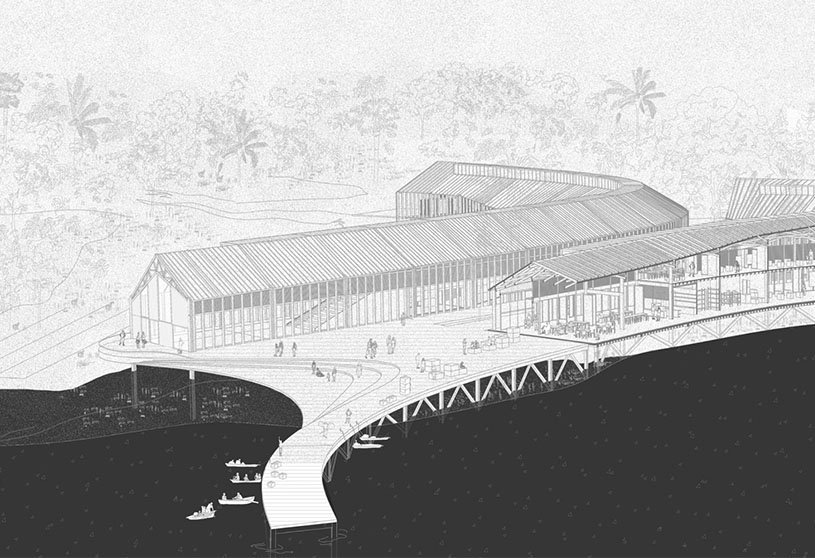
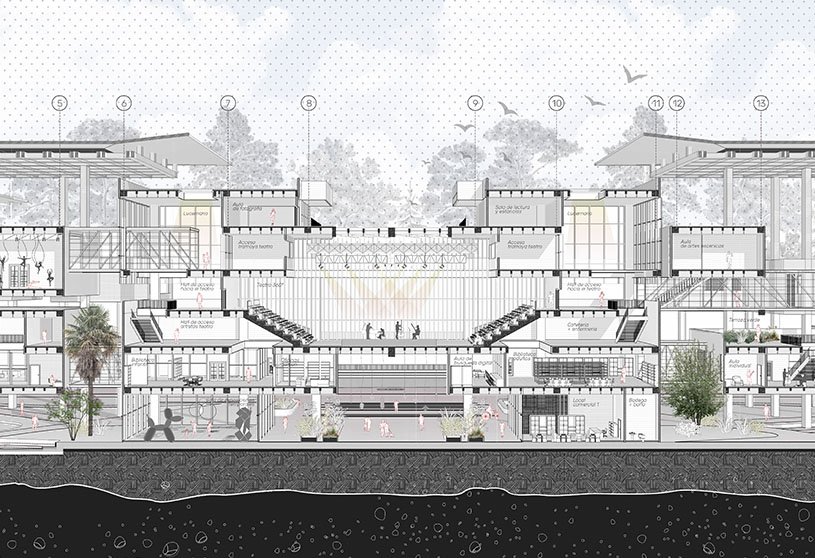
Bio-filter-tower-site – encounter of landscape layers: water and historic, biologic, anthropic sedimentAxonometry-vertical bio-filterPerformative-hybridscape: the tower becomes an artifact as performative as its landscape. A hybrid between its program, people, sediments and mixed representation technologiesSection-reconnected vestige: a vestige of an abandoned railroad trace that will now reconnect people with the river and the traditions travelling within it
The bio-filter tower functions as a verticalization of the horizontal dynamics of the river, from matter to its inhabitants. Fishing, being a transient activity, involves a variety of performative tasks, such as bringing in the catch by canoe, lifting it for storage, weaving fishing nets, drying it, and relocating it across the Magdalena River.
Bio-filter-chunk-section-detail: facade modules filter water, accumulate tangible sediment: rock, gravel, and sand but also intangible sediment: traditions and fishing knowledgeView-vertical-bio-filter: rainwater drips down the tower-bio-filter, cleaning water and slowly naturalizing the structure
The structure takes on ecosystemic responsibilities; its facades act as a living river museum, collecting sediment, cultivating vegetation, and bio-filtering rainwater. In biological succession, the vertical serves as a scaffold for successive stages. A pedestrian pathway is constructed over the pre-existing railroad, providing a link that will restore people’s connection to the river and its cultural practices.
Section: fisher’s workshops. The tower as the sediment (accumulation) of the river and its traditionsFacade temporality: the vertical acts as a scaffold for new stages of biological succession. People and traditions keep the project alive throughout timeExploded-landscape-axonometric: on the surface the weaved pieces act as scaffolding panels that filter water while accumulating sediment throughout the natural river flow
Static steel columns rise on concrete stilts amid a dynamic landscape, witnessing the constantly shifting vegetation and water levels. The project serves as a static observer of the landscape’s slow reclamation by nature. Its open design responds to river flows, wind, and rain better than other structures, and it makes it easier for fishermen to fish and for vegetation to grow.
Facade-modules: facade modules allow contemplation, work for bio-filtration and re-naturalization, and fish-dryingSurface detail: weaved steel panels filter and accumulate sediment flowing in the river, pieces that slowly build a natural vegetation barrier and then de-construct themselves through time
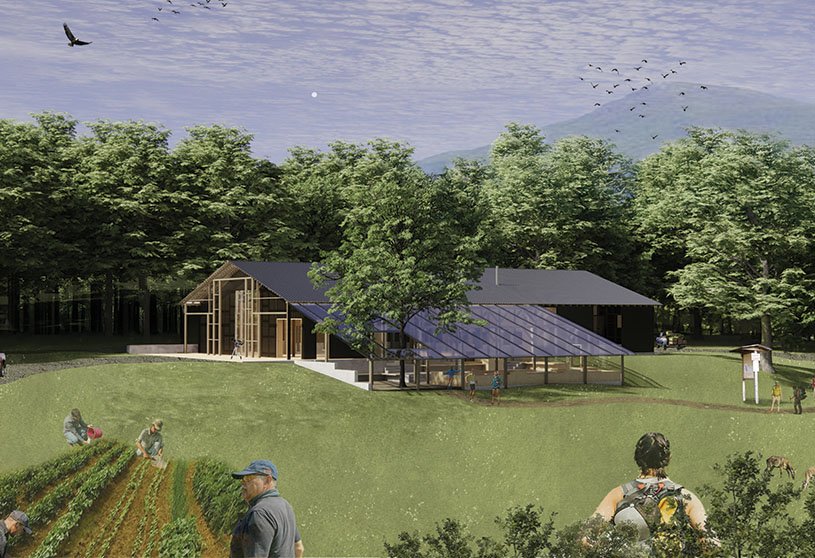
Vertically, it collects rainwater and vegetation; horizontally, it filters water and accumulates sediment. The abandoned vestige integrates human knowledge with landscape restoration by reestablishing a connection between people and the river and its traditions, which is crucial for the history of the site (Honda). A landscape that brings people together, where traces of the past can serve as a new way of bringing the community and ecosystem together.
Physical modelThe physical model is a translation of the project’s intentions informed digitally by real-time site information throughout its fabrication | Physical-model-performativity: the interior program performativity continuously interacts with the changing dynamics, and ecologies, of the surrouding riverside landscape
Conclusion: The project offers an architectural solution to the fragmented landscapes in Honda, Colombia, which are shaped by sediments due to local ecologies and weather. The Fishing Vertical Bio-Filter Tower preserves regional knowledge and restores ecosystems by integrating ecology and history. The project evolves based on sediment movements, river flows, rainfall, and sun exposure.
[This Academic Project has been published with text submitted by the student]
Site Context
Design Process
Final Outcome
To submit your academic project for publication at ArchiDiaries, please visit the following link >> Submit
Get the best of ArchiDiaries, directly in your inbox.
We use cookies on our website to give you the most relevant experience by remembering your preferences and repeat visits. By clicking “Accept All”, you consent to the use of ALL the cookies. However, you may visit "Cookie Settings" to provide a controlled consent.
This website uses cookies to improve your experience while you navigate through the website. Out of these, the cookies that are categorized as necessary are stored on your browser as they are essential for the working of basic functionalities of the website. We also use third-party cookies that help us analyze and understand how you use this website. These cookies will be stored in your browser only with your consent. You also have the option to opt-out of these cookies. But opting out of some of these cookies may affect your browsing experience.
Necessary cookies are absolutely essential for the website to function properly. These cookies ensure basic functionalities and security features of the website, anonymously.
Cookie
Duration
Description
cookielawinfo-checkbox-analytics
11 months
This cookie is set by GDPR Cookie Consent plugin. The cookie is used to store the user consent for the cookies in the category "Analytics".
cookielawinfo-checkbox-functional
11 months
The cookie is set by GDPR cookie consent to record the user consent for the cookies in the category "Functional".
cookielawinfo-checkbox-necessary
11 months
This cookie is set by GDPR Cookie Consent plugin. The cookies is used to store the user consent for the cookies in the category "Necessary".
cookielawinfo-checkbox-others
11 months
This cookie is set by GDPR Cookie Consent plugin. The cookie is used to store the user consent for the cookies in the category "Other.
cookielawinfo-checkbox-performance
11 months
This cookie is set by GDPR Cookie Consent plugin. The cookie is used to store the user consent for the cookies in the category "Performance".
viewed_cookie_policy
11 months
The cookie is set by the GDPR Cookie Consent plugin and is used to store whether or not user has consented to the use of cookies. It does not store any personal data.
Functional cookies help to perform certain functionalities like sharing the content of the website on social media platforms, collect feedbacks, and other third-party features.
Performance cookies are used to understand and analyze the key performance indexes of the website which helps in delivering a better user experience for the visitors.
Analytical cookies are used to understand how visitors interact with the website. These cookies help provide information on metrics the number of visitors, bounce rate, traffic source, etc.
Advertisement cookies are used to provide visitors with relevant ads and marketing campaigns. These cookies track visitors across websites and collect information to provide customized ads.