Home » Academic projects » See the Unseen, Museum of Synesthesia: An Architecture Exploring Multisensory Perception Beyond the Visual | Bachelors Design Thesis
See the Unseen, Museum of Synesthesia: An Architecture Exploring Multisensory Perception Beyond the Visual | Bachelors Design Thesis
Excerpt: ‘See the Unseen, Museum of Synesthesia’ is an architecture thesis by Elbert Hans from the ‘Department of Architecture – Tarumanagara University.’ The project aims to explore synesthesia through architecture by creating multisensory spatial experiences. Through the integration of light, form, material, and natural elements, the project encourages visitors to engage with and understand the interaction between human senses while raising awareness of synesthesia as a sensory potential rather than a disorder.
Introduction: See the Unseen is a museum that highlights the theme of synesthesia, a natural ability possessed by all humans, where the responses of all senses are interconnected and work together. Synesthesia plays an important role in helping us understand the essence of life. However, with the development of the modern era and a strong visual-oriented culture, people have become reliant solely on their sense of sight, losing sensitivity to other senses and, in turn, their synesthetic ability. Therefore, the museum serves as both an educational and recreational medium to cultivate synesthetic awareness across the senses.
The site is located in the PIK area, which offers diverse visual beauty ranging from international-style infrastructure, beaches, and sea to mangrove areas. This diversity stimulates various senses, making it an ideal location for the development of a museum.
Design Process
Program
The sensory researcher Richard E. Cytowic states that all humans are born with the potential for synesthesia. However, in the modern visual era, sight has become the dominant sense, gradually weakening the sensitivity of the other senses. Today, synesthesia is often regarded as a disorder, whereas Cytowic argues that it is a natural human ability that should be understood, studied, and developed through education.
Design Strategies
The program is organized into three zones. The first zone, Recognition, focuses on education and the stimulation of sensory awareness through interactive media. The second zone, Main Event, presents various forms of synesthesia by combining different sensory stimuli to create immersive experiences. The third zone, Synesthesia Hall, explores the meaning of synesthesia through the integration of augmented reality and artificial intelligence.
Design Scheme | Mass Development
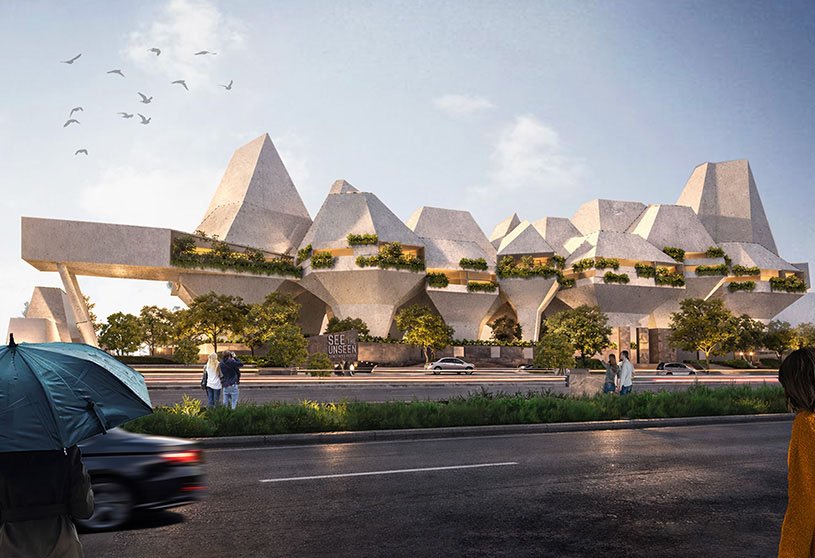
The Synesthesia Spatial Rooms are oriented along the north–south axis to optimize environmental conditions. In response to site challenges such as tidal flooding and land subsidence, the building mass is elevated above ground level. A conical form is adopted to allow sufficient sunlight penetration while also evoking a synesthetic spatial experience. The height of each space is adjusted according to the amount of sunlight required for its specific character. Based on site analysis, the spaces are slightly tilted to improve sunlight exposure and natural airflow while minimizing shadow formation. Connection pathways are also created to link the spaces with the surrounding environment.
Final Outcome
Site Plan | Second Story PlanSection AAEast Elevation
The first floor functions as a sensory stimulation space that incorporates natural elements such as gardens, ponds, and mangroves. This level offers a sensory experience that differs from the museum spaces above while also establishing a connection between the project, the surrounding mangrove area, and the sea on the northern side of the site.
The second floor is dedicated to the museum program and is divided into three zones: Recognition, Main Event, and Synesthesia Hall. The Main Event consists of ten museum rooms, each focusing on a different sense and offering distinct spatial interpretations of synesthesia.
Each museum room is designed with specific characteristics, including variations in floor elevation, angular spatial forms, controlled exposure to natural sunlight, and the incorporation of water and air elements. Different textures, scents, sounds, and other sensory components are also integrated to enhance the overall experience.
South ElevationWest ElevationDay Render
The elevation adopts a minimalist façade with variations in texture. Openings in the museum areas on the second and third floors are limited, including minimal use of skylights. The façade also incorporates greenery to reintroduce green spaces in the Pantai Indah Kapuk area, which is gradually losing its natural landscape character.
Evening RenderNight Render
Conclusion: Ultimately, this project explores synesthesia through multisensory spatial experiences, encouraging visitors to understand and appreciate the interaction between human senses.
[This Academic Project has been published with text and images submitted by the student]
Site Context
Design Process
Final Outcome
To submit your academic project for publication at ArchiDiaries, please visit the following link >> Submit
Get the best of ArchiDiaries, directly in your inbox.
We use cookies on our website to give you the most relevant experience by remembering your preferences and repeat visits. By clicking “Accept All”, you consent to the use of ALL the cookies. However, you may visit "Cookie Settings" to provide a controlled consent.
This website uses cookies to improve your experience while you navigate through the website. Out of these, the cookies that are categorized as necessary are stored on your browser as they are essential for the working of basic functionalities of the website. We also use third-party cookies that help us analyze and understand how you use this website. These cookies will be stored in your browser only with your consent. You also have the option to opt-out of these cookies. But opting out of some of these cookies may affect your browsing experience.
Necessary cookies are absolutely essential for the website to function properly. These cookies ensure basic functionalities and security features of the website, anonymously.
Cookie
Duration
Description
cookielawinfo-checkbox-analytics
11 months
This cookie is set by GDPR Cookie Consent plugin. The cookie is used to store the user consent for the cookies in the category "Analytics".
cookielawinfo-checkbox-functional
11 months
The cookie is set by GDPR cookie consent to record the user consent for the cookies in the category "Functional".
cookielawinfo-checkbox-necessary
11 months
This cookie is set by GDPR Cookie Consent plugin. The cookies is used to store the user consent for the cookies in the category "Necessary".
cookielawinfo-checkbox-others
11 months
This cookie is set by GDPR Cookie Consent plugin. The cookie is used to store the user consent for the cookies in the category "Other.
cookielawinfo-checkbox-performance
11 months
This cookie is set by GDPR Cookie Consent plugin. The cookie is used to store the user consent for the cookies in the category "Performance".
viewed_cookie_policy
11 months
The cookie is set by the GDPR Cookie Consent plugin and is used to store whether or not user has consented to the use of cookies. It does not store any personal data.
Functional cookies help to perform certain functionalities like sharing the content of the website on social media platforms, collect feedbacks, and other third-party features.
Performance cookies are used to understand and analyze the key performance indexes of the website which helps in delivering a better user experience for the visitors.
Analytical cookies are used to understand how visitors interact with the website. These cookies help provide information on metrics the number of visitors, bounce rate, traffic source, etc.
Advertisement cookies are used to provide visitors with relevant ads and marketing campaigns. These cookies track visitors across websites and collect information to provide customized ads.