Home » Academic projects » The Fragile Mountain: Regenerative Architecture Engaging Erosion and Material Flows in the Alpine Landscape | Master’s Design Thesis
The Fragile Mountain: Regenerative Architecture Engaging Erosion and Material Flows in the Alpine Landscape | Master’s Design Thesis
Excerpt: ‘The Fragile Mountain’ is an architecture thesis by Maximilian Loeschke from the ‘Faculty of Architecture and the Built Environment – TU Delft’. The project aims to rethink architecture in the Alpine landscape by engaging erosion as a generative force rather than a threat. It investigates how material flows caused by climate change, such as rock, driftwood, and sediment, can be intercepted, reused, and made visible through architectural systems that support flood mitigation, education, and public engagement.
Introduction: This project explores erosion as a driving force for architectural design in the Alpine landscape. In the Alps, climate change accelerates glacial retreat, permafrost thaw, and heavy rainfall, resulting in increasingly frequent rockfalls and flash floods. These processes expose the fragility of mountain environments and challenge conventional architectural approaches based on stability and control. Erosion is explored not only as a risk to be mitigated but also as a productive force for design. It investigates how architecture can engage with unstable, shifting material flows—such as driftwood and bedload rock—and translate them into spatial and structural systems.
Architecture is understood as sediment: a momentary gathering of material, shaped by gravity and environmental forces, where building becomes part of the mountain’s ongoing transformation.
Anthropogenic Sediments Found Along The Fieldtrip RouteTrajectory Of Eroded Material
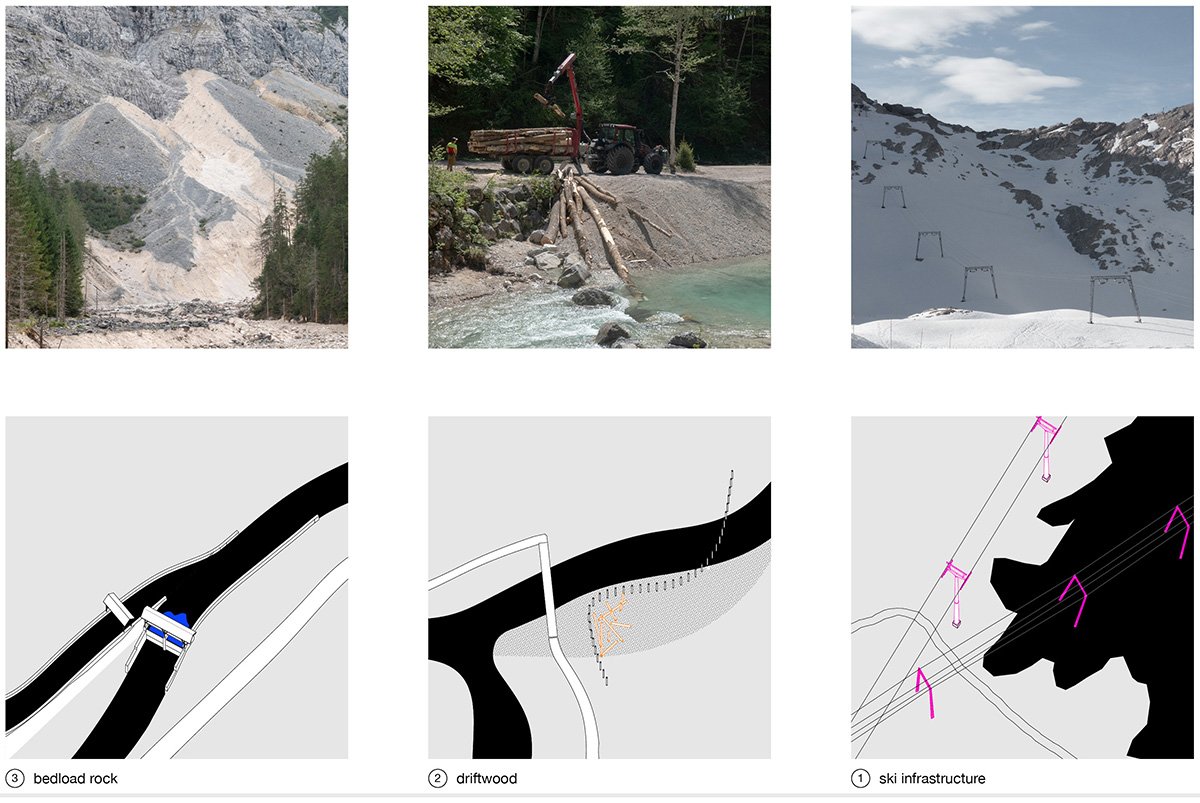
The project is situated at the Zugspitze, Germany’s highest and most visited mountain, where the Partnach river carries eroded material from a shrinking glacier down toward the town of Garmisch-Partenkirchen. Field research revealed that significant human effort is already invested in maintaining this landscape: ski-lifts are dismantled as glaciers move, driftwood is extracted to prevent gorge blockages, and bedload rock is regularly removed from a weir to mitigate build-up. These materials are currently treated as waste and discarded.
Accumulation Of Eroded Material
The project intervenes just upstream of Garmisch-Partenkirchen, a flood-prone town, proposing a material collection hub for these otherwise wasted materials. The program combines flood mitigation infrastructure with public and educational functions of a sculpting school with workshop spaces and a café. These functions allow the material flows of the mountain to be reused, displayed, and engaged with, turning maintenance processes into spatial, social, and cultural activators.
Design Process
Building Base As Initial InfrastructureTesting Landscape Transformation Through Flooding
The design process began with geological research into the formation of the Alps and the role of erosion over deep time. This was followed by extensive fieldwork, starting with a multiple day hike along the river’s course from glacier to valley, including mapping and material sampling. During this process, observations of infrastructure, material accumulation, and conversations with construction and maintenance workers revealed the scale and logic of existing extraction systems. These findings were translated into analytical drawings that traced material flows across different scales.
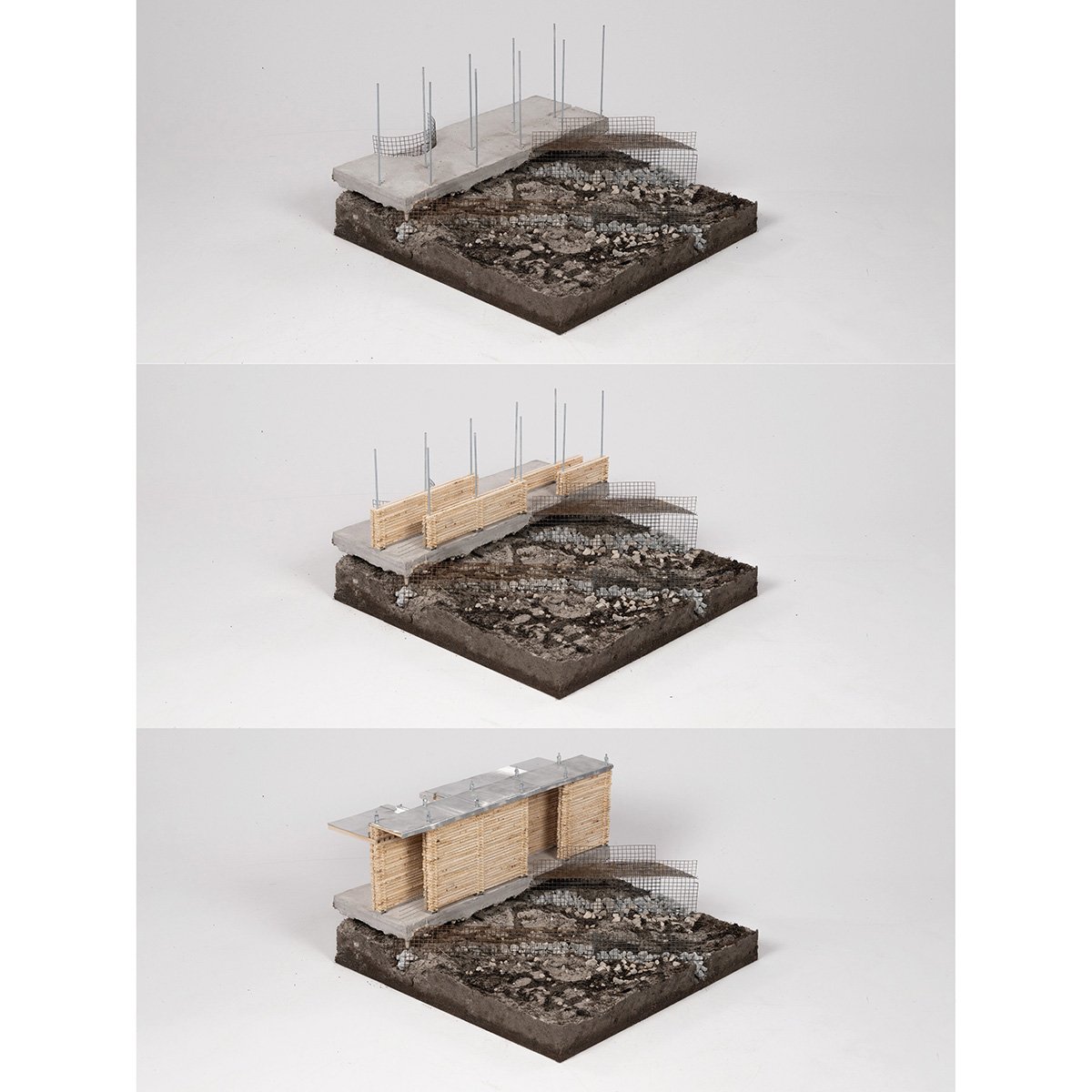
Architecture Evolving Through Phases Of Driftwood Accumulation
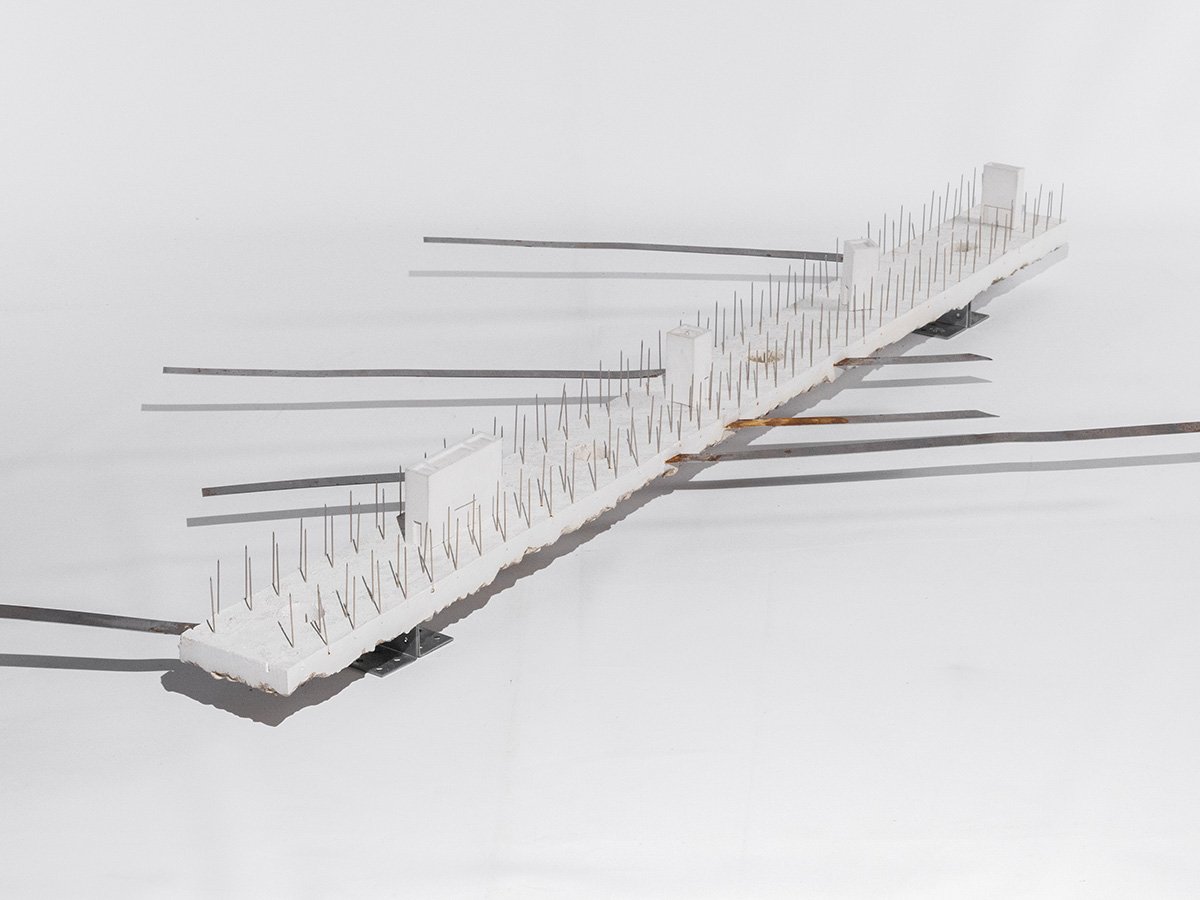
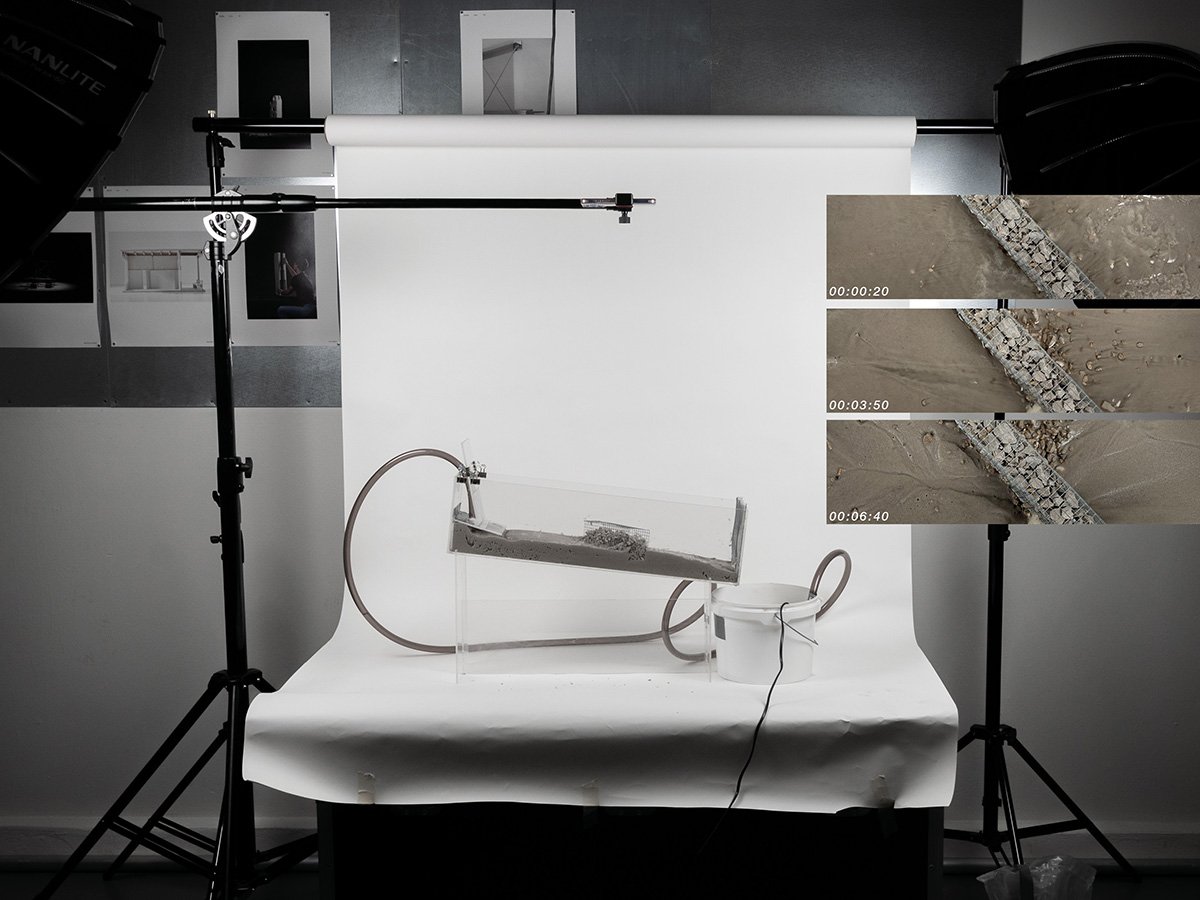
From these findings a design process started in which physical erosion models were developed to test how bedload rock behaves within gabion structures under varying water conditions, informing the design of flood-mitigating elements. Parallel to this, material experiments with driftwood explored stacking, drying, and deformation over time.
Rather than separating research and design, the two evolved simultaneously: mapping became a design tool, while models and prototypes functioned as research instruments. The process remained deliberately open-ended, allowing the project to grow out of observed landscape dynamics.
Final Outcome
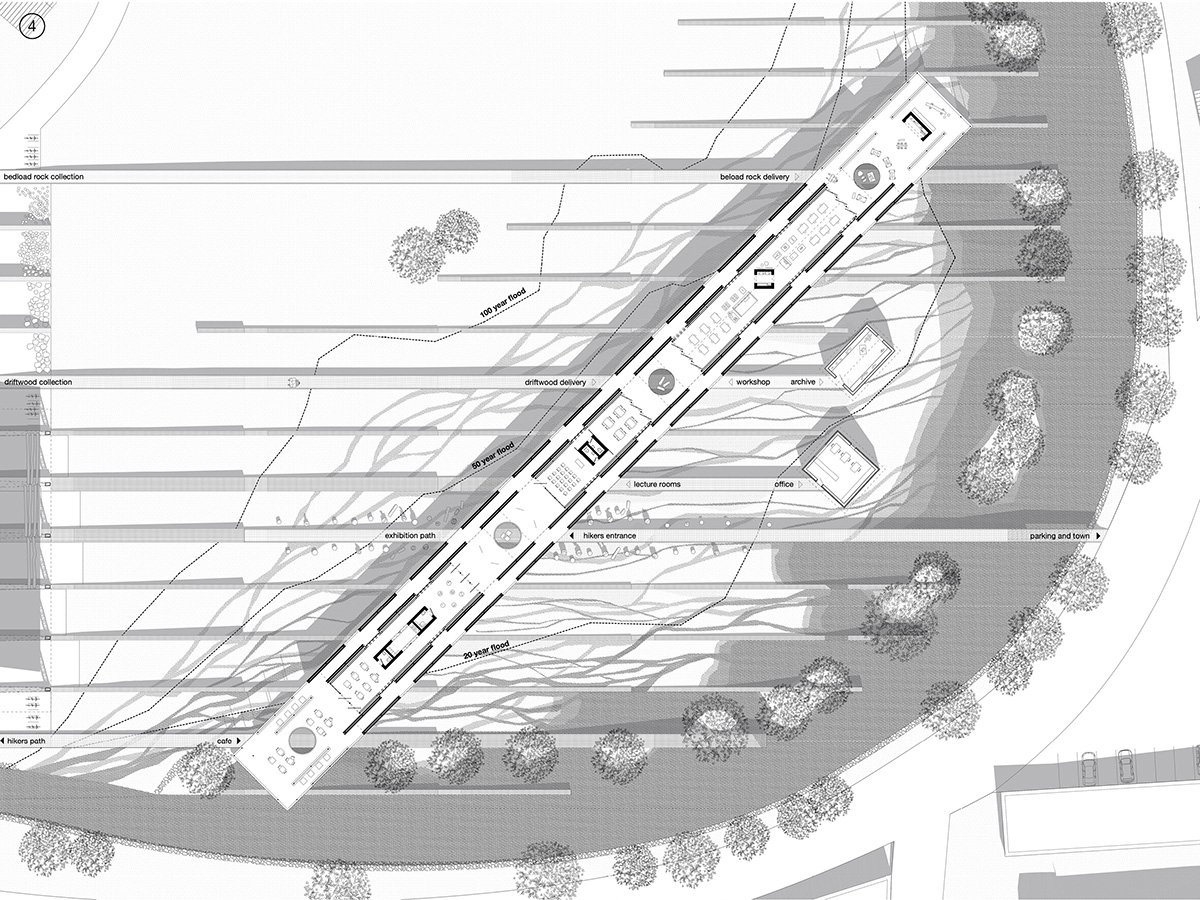
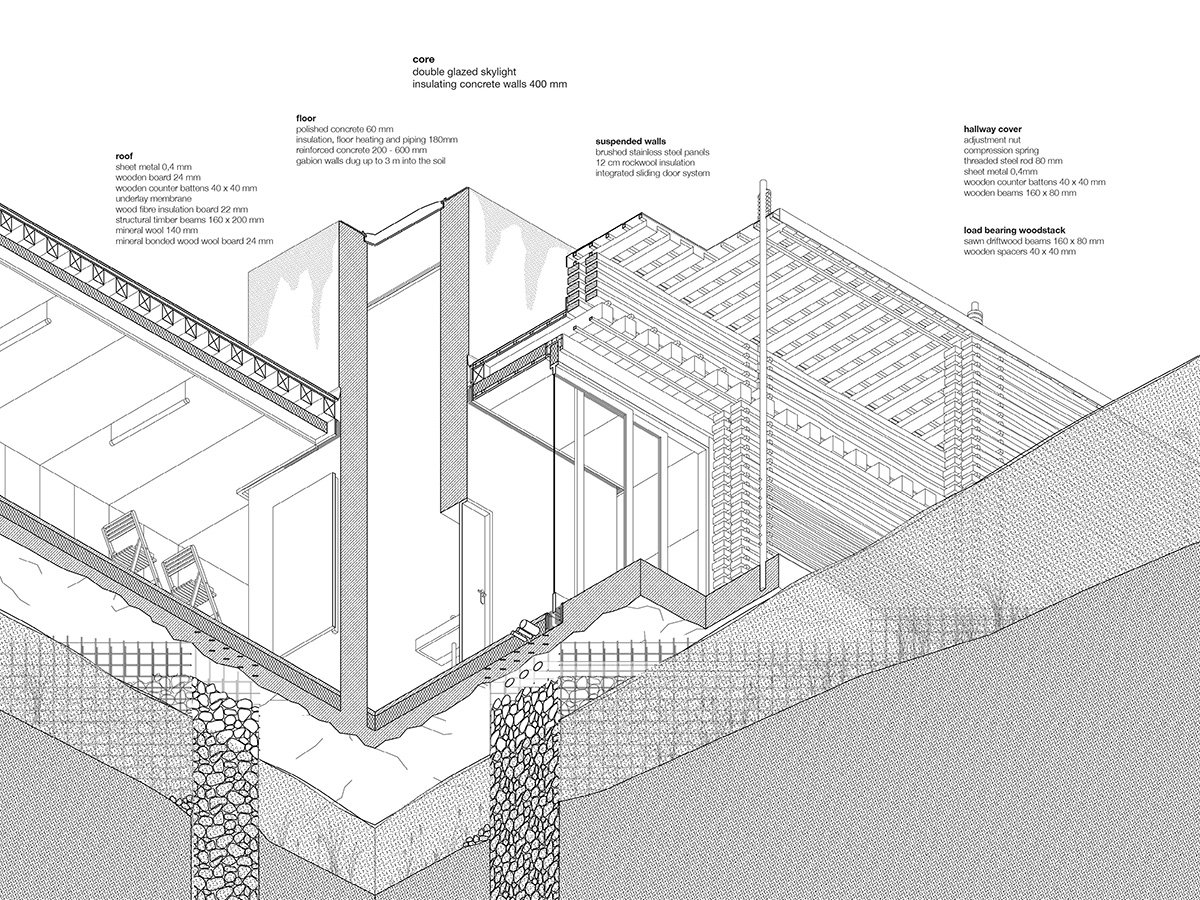
Floorplan With Flooding ZonesChoisy Perspective Detail Drawing
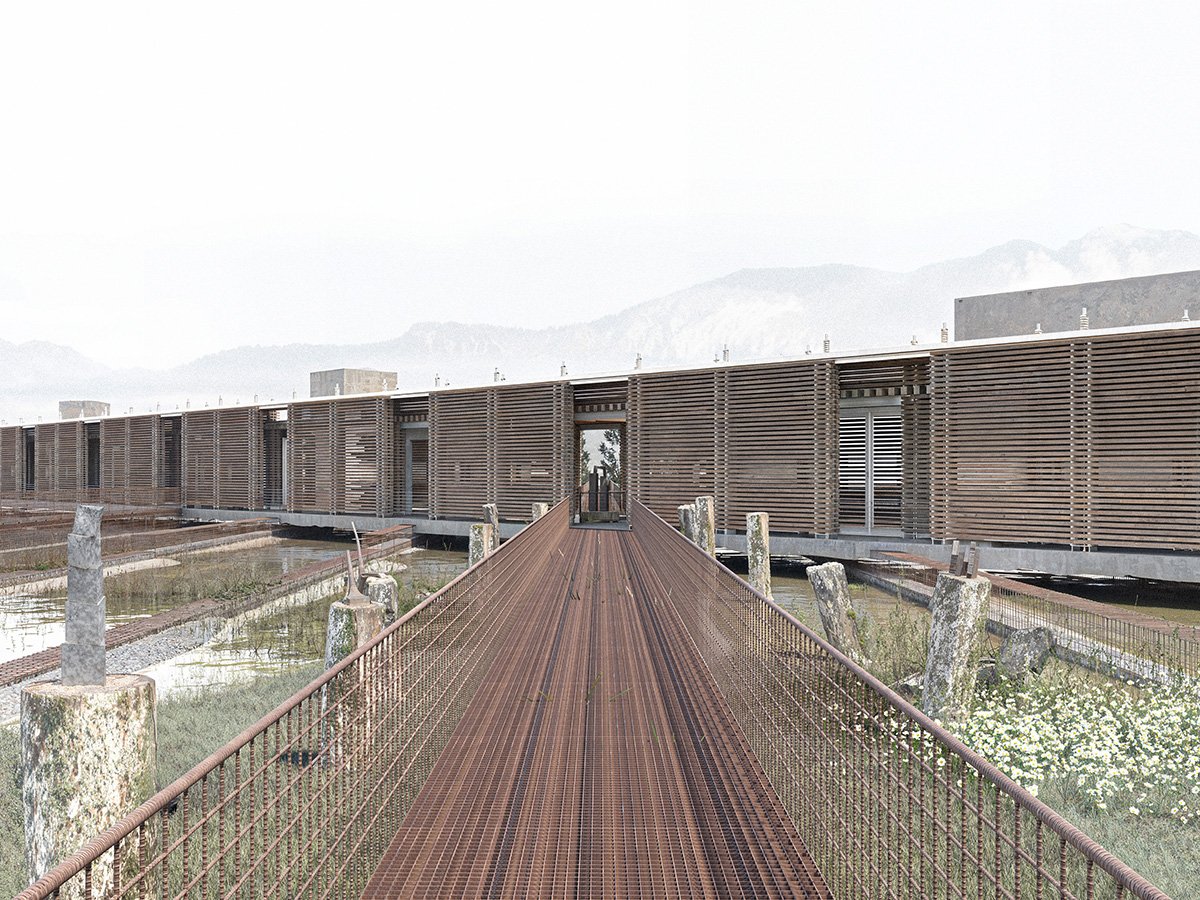
The final outcome is a network of small-scale architectural and landscape interventions that intercept and reuse eroded material flows. At its core is an infrastructural platform in the valley that gradually accumulates driftwood and rock. It is carried by strong gabion walls, which are filled with bedload rock to slow the river during floods while making erosion visible through changing delta-like formations.
View From The Gabion Wall Pathway | View Along The Wood Drying Corridor
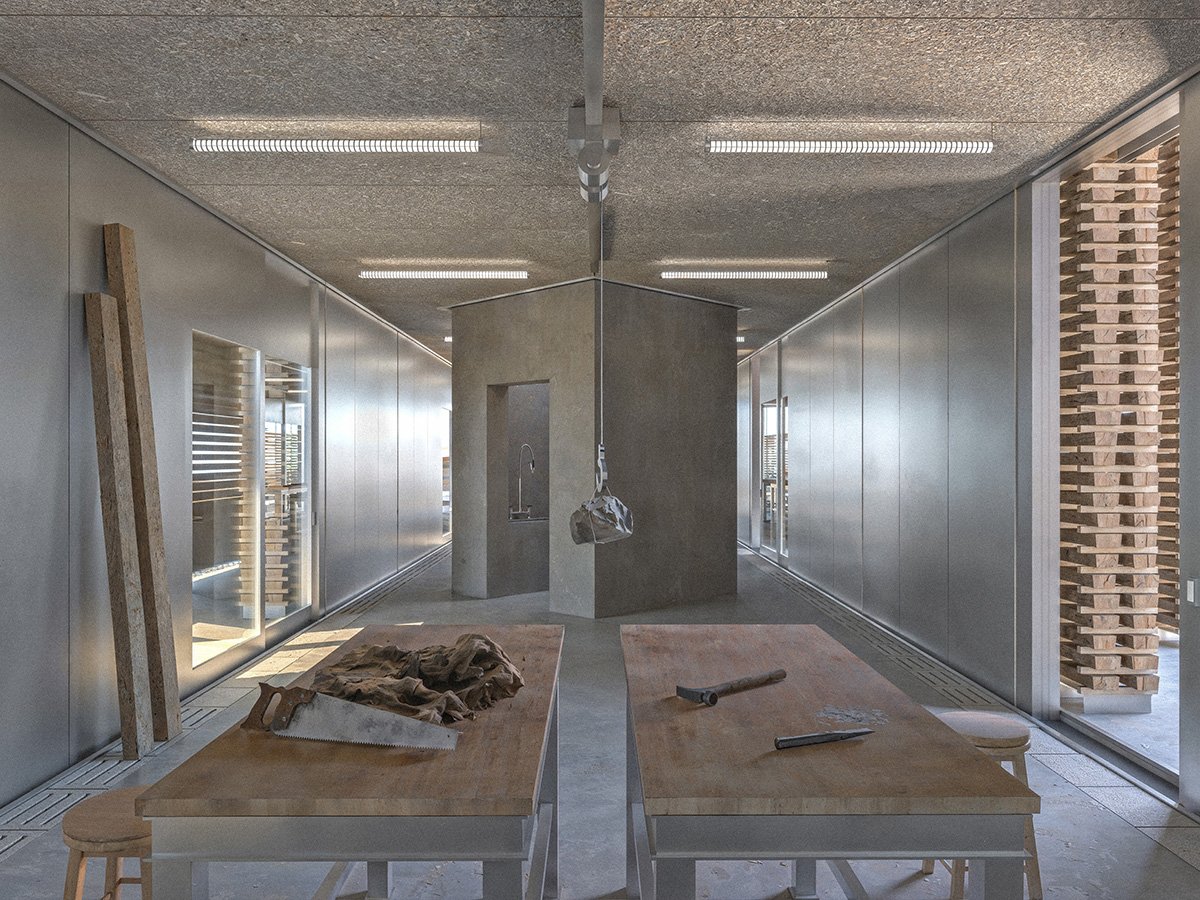
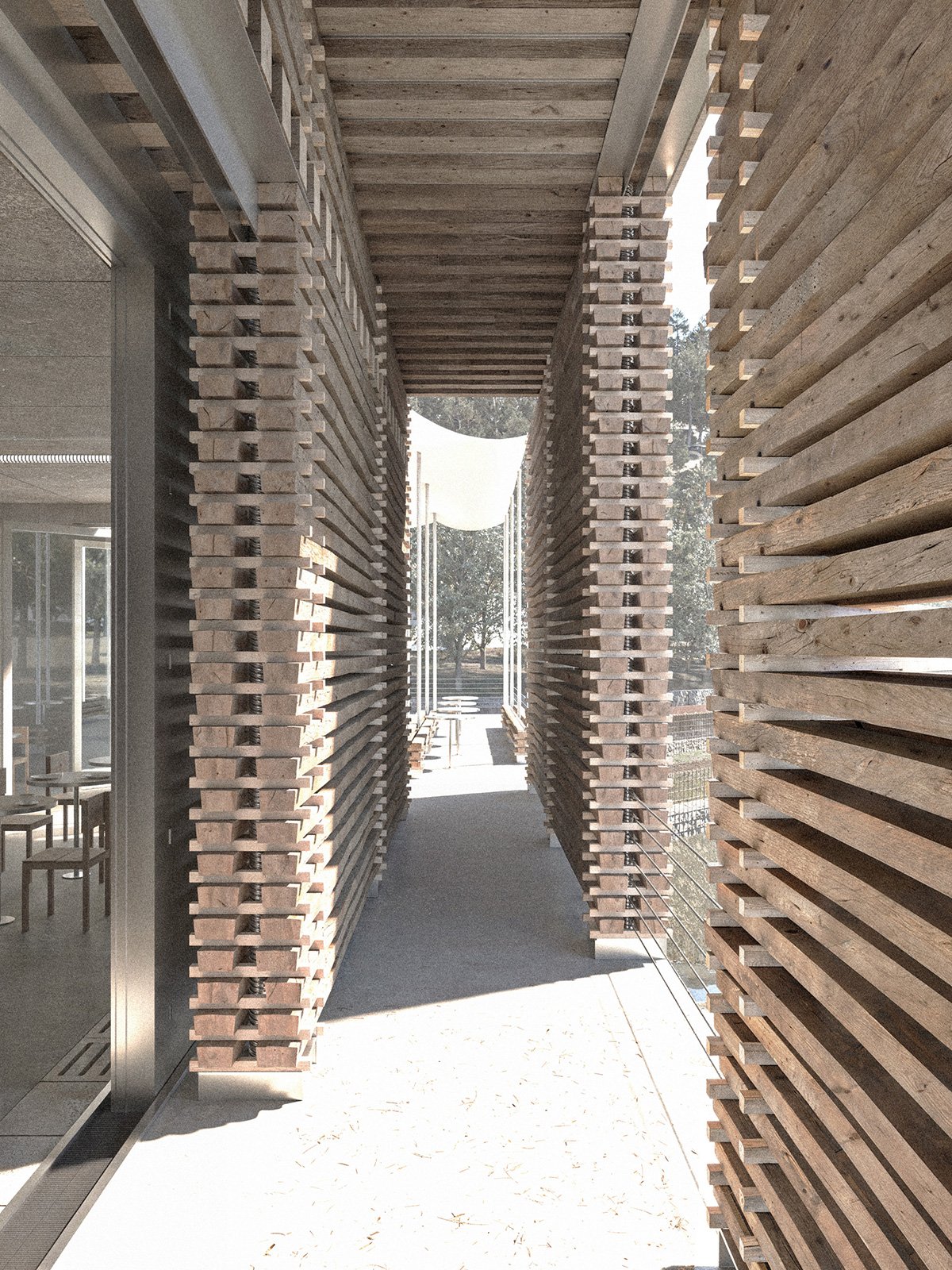
Driftwood is sawn into slabs and stacked to form the load-bearing structure of a sculpting school, whose walls and roof evolve as material availability changes. Sliding walls provide functional enclosure, while the wooden stacks remain exposed to environmental forces, allowing the building to settle, distort, and age. Dismantled ski lifts are reused as roof structures, extending their material life.
The project does not result in a fixed architectural object but in a system that grows, moves, and records the mountain’s ongoing transformation, inviting humans to participate in erosion rather than resist it.
View Inside The Wood And Stone Workshop
Conclusion: Ultimately, this project shows that architecture in fragile mountain environments can move beyond control and permanence by working with erosion and material flows, proposing an adaptive system where building, landscape, and maintenance merge to make environmental change tangible, social, and productive.
[This Academic Project has been published with text and images submitted by the student]
Site Context
Design Process
Final Outcome
To submit your academic project for publication at ArchiDiaries, please visit the following link >> Submit
Get the best of ArchiDiaries, directly in your inbox.
We use cookies on our website to give you the most relevant experience by remembering your preferences and repeat visits. By clicking “Accept All”, you consent to the use of ALL the cookies. However, you may visit "Cookie Settings" to provide a controlled consent.
This website uses cookies to improve your experience while you navigate through the website. Out of these, the cookies that are categorized as necessary are stored on your browser as they are essential for the working of basic functionalities of the website. We also use third-party cookies that help us analyze and understand how you use this website. These cookies will be stored in your browser only with your consent. You also have the option to opt-out of these cookies. But opting out of some of these cookies may affect your browsing experience.
Necessary cookies are absolutely essential for the website to function properly. These cookies ensure basic functionalities and security features of the website, anonymously.
Cookie
Duration
Description
cookielawinfo-checkbox-analytics
11 months
This cookie is set by GDPR Cookie Consent plugin. The cookie is used to store the user consent for the cookies in the category "Analytics".
cookielawinfo-checkbox-functional
11 months
The cookie is set by GDPR cookie consent to record the user consent for the cookies in the category "Functional".
cookielawinfo-checkbox-necessary
11 months
This cookie is set by GDPR Cookie Consent plugin. The cookies is used to store the user consent for the cookies in the category "Necessary".
cookielawinfo-checkbox-others
11 months
This cookie is set by GDPR Cookie Consent plugin. The cookie is used to store the user consent for the cookies in the category "Other.
cookielawinfo-checkbox-performance
11 months
This cookie is set by GDPR Cookie Consent plugin. The cookie is used to store the user consent for the cookies in the category "Performance".
viewed_cookie_policy
11 months
The cookie is set by the GDPR Cookie Consent plugin and is used to store whether or not user has consented to the use of cookies. It does not store any personal data.
Functional cookies help to perform certain functionalities like sharing the content of the website on social media platforms, collect feedbacks, and other third-party features.
Performance cookies are used to understand and analyze the key performance indexes of the website which helps in delivering a better user experience for the visitors.
Analytical cookies are used to understand how visitors interact with the website. These cookies help provide information on metrics the number of visitors, bounce rate, traffic source, etc.
Advertisement cookies are used to provide visitors with relevant ads and marketing campaigns. These cookies track visitors across websites and collect information to provide customized ads.