Excerpt: ‘The Great Clementi Tour’ is an architecture thesis by Goh Yi Fan from the Department of Architecture – National University of Singapore (NUS) that explores greenfield development and proposes a 6 km commercial spine in Singapore, creating activities and programs along the forest edges. The project rethinks urban planning to allow people to share and enjoy these spaces and conveniently access the programmes that support these homes without destroying or sacrificing additional forests.
Introduction: “The Great Clementi Tour” rethinks urban planning to prevent the destruction of further forests. Instead of taking a parcellated approach that could destroy 115 hectares of Singapore’s forests, the project proposes creating a 6 km long commercial spine that is packed with activities and programmes. It would meander along the edges of the forest, around extremely tall residential towers, and connect existing park connectors and transport nodes. Along with panoramic views of the new landscape and the preserved forests, residents and visitors can enjoy amenities in the kilometer-long spines right by their doorstep.
The site includes the Singaporean forests of Maju, Clementi, Greenleaf, and Old Holland Plain. Seemingly, more land is required to accommodate the growing population in spite of the rising demand for housing. Large hectares of forests are usually sacrificed by urban planners in response, where cities are planned in a parcellated manner, to make room for more land.
Typical response in planning to sacrifice forests (Drawing is projected from URA’s Masterplan 2019)Typical response in planning to sacrifice forests (Drawing is projected from URA’s Masterplan 2019)
This is also the case in Singapore; two recent examples are Tengah Forest and Dover Forest, which have both been cleared for public housing projects and have already been cleared once. In regard to this, the thesis proposes an alternative to the Urban Redevelopment Authority’s (URA) proposal to preserve Singapore’s forests. Without sacrificing forests, housing can be provided along with interesting programmes; these expansive green spaces are crucial for biodiversity and can be enjoyed right next to one’s block or flat.
Design Process
Design Strategies
According to the URA’s master plan, 115 hectares of forests would need to be cleared in order to make enough space for residential buildings. The estimated plot ratio of the land is derived from existing figures for nearby buildings.
Planning of residential towers using plot ratio to avoid congestion along perimeter
The new proposal aims to design residential towers without destroying forests or requiring sacrifices. Since forests are essential to our biodiversity, protecting them must come first in the overall planning, which determines which areas can and cannot be developed rather than focusing on plot ratio and height restrictions in individual parcels.
Final Outcome
Masterplan comprising private and public residential towers
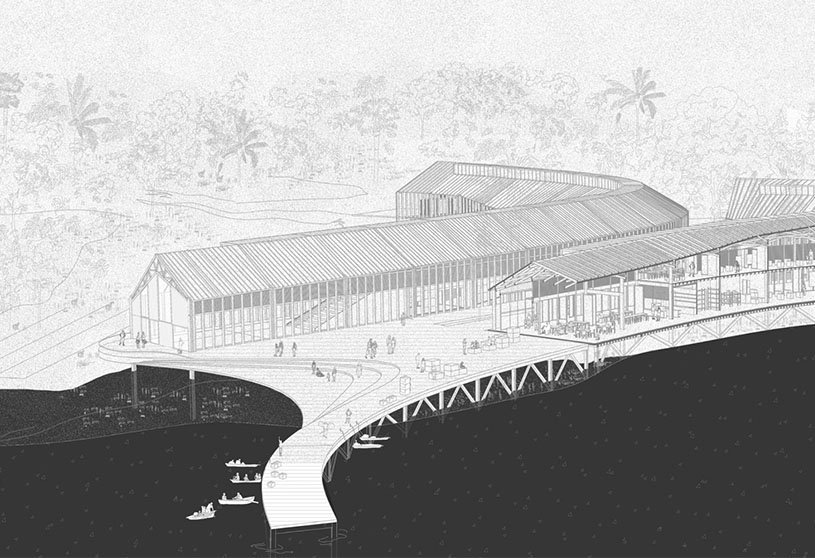
The master plan includes approximately 6 km of commercial spines that wind around the residential towers, connecting existing park connectors and important transportation nodes for convenience. This avoids the need for reliance on vehicles, allowing everyone to share and enjoy the entire landscape, including the forests. Externally, the existing engineering canal is naturalised into a waterway for recreational/competitive kayaking, flanked with fishing pavilions and a canal-side restaurant for visitors and residents there to enjoy.
Planning of towers and linking of spines considering important transport nodes and existing facilities surrounding siteThe final panel depicts narrative of injecting architecture with minimal interference with existing forests. An unfolded section (top) is used to visualise the experience through various spines with constant backdrop of retained greenery.
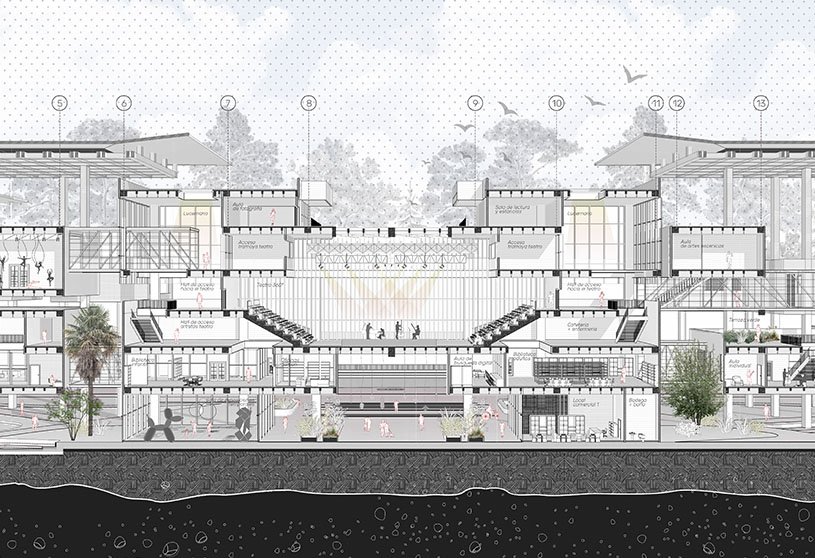
Except for interior shops, the spines are made to naturally ventilate and permit cross-ventilation. In response to the site, the spines have programmes that go beyond standard retail shops for daily use. These programmes include hosting international events, providing spacious communal spaces, and creating unique shops for those who enjoy outdoor activities and the outdoors and often use the nearby park connectors. As one enters the spine, they are surrounded by expansive views of the flower field, forest, and river. Part of the spine is covered by extended nature decks that allow nature lovers to venture deeper into the forest and have chance encounters with animals.
First third of the panel shows the overall masterplan addressing the problem of sacrificing forests to build more: spines connecting existing park connectors and important transport nodes weaving around super-tall residential towers
The towers and spines are made up of different structures; a short gateway connects each tower to the spine. This increases the flexibility of the construction sequence: residential towers can be built after spines to create foot traffic and connections between transportation nodes. For the residents to enjoy the views, it is imperative that the towers remain apart. Following the height control by URA would mean that a great wall around the forests would be formed, which is not ideal for visitors.
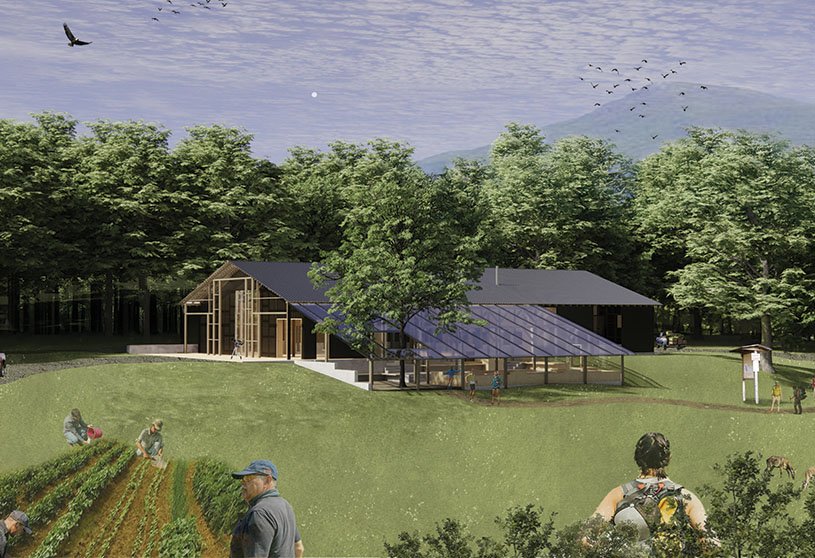
Middle portion of panel zooms into an area of the masterplan showing how internally spines can fit large programs while users within can interact with and immerse themselves in the surrounding landscapeLast panel depicts the importance of keeping the towers sufficiently far apart for residents & visitors to enjoy the surrounding landscape: the new flora field replacing the current plain field, and the new waterway replacing the current engineered canal
Although the proposal nearly doubles the gross floor area of the Marina Bay Financial Centre, the spine layout preserves green space full of living, working, and recreational activities while saving forests; the parcellated latter would require clearing and reclaiming green space. The proposal has more open green space per person than the WHO recommends, which is 9 square metres or 10.5 square metres per person, even with a high footfall.
Partial model showing the spine and its relationship with the surrounding landscape as part of proposed masterplan
Conclusion: The architecture thesis rethinks how we can design our cities so that people can share and enjoy these spaces and conveniently access the programmes that support these homes without destroying and sacrificing additional forests. This masterplan is intended to be beneficial to all individuals involved, including potential residents, designers, and nature enthusiasts.
[This Academic Project has been published with text submitted by the student]
Site Context
Design Process
Final Outcome
To submit your academic project for publication at ArchiDiaries, please visit the following link >> Submit
Get the best of ArchiDiaries, directly in your inbox.
We use cookies on our website to give you the most relevant experience by remembering your preferences and repeat visits. By clicking “Accept All”, you consent to the use of ALL the cookies. However, you may visit "Cookie Settings" to provide a controlled consent.
This website uses cookies to improve your experience while you navigate through the website. Out of these, the cookies that are categorized as necessary are stored on your browser as they are essential for the working of basic functionalities of the website. We also use third-party cookies that help us analyze and understand how you use this website. These cookies will be stored in your browser only with your consent. You also have the option to opt-out of these cookies. But opting out of some of these cookies may affect your browsing experience.
Necessary cookies are absolutely essential for the website to function properly. These cookies ensure basic functionalities and security features of the website, anonymously.
Cookie
Duration
Description
cookielawinfo-checkbox-analytics
11 months
This cookie is set by GDPR Cookie Consent plugin. The cookie is used to store the user consent for the cookies in the category "Analytics".
cookielawinfo-checkbox-functional
11 months
The cookie is set by GDPR cookie consent to record the user consent for the cookies in the category "Functional".
cookielawinfo-checkbox-necessary
11 months
This cookie is set by GDPR Cookie Consent plugin. The cookies is used to store the user consent for the cookies in the category "Necessary".
cookielawinfo-checkbox-others
11 months
This cookie is set by GDPR Cookie Consent plugin. The cookie is used to store the user consent for the cookies in the category "Other.
cookielawinfo-checkbox-performance
11 months
This cookie is set by GDPR Cookie Consent plugin. The cookie is used to store the user consent for the cookies in the category "Performance".
viewed_cookie_policy
11 months
The cookie is set by the GDPR Cookie Consent plugin and is used to store whether or not user has consented to the use of cookies. It does not store any personal data.
Functional cookies help to perform certain functionalities like sharing the content of the website on social media platforms, collect feedbacks, and other third-party features.
Performance cookies are used to understand and analyze the key performance indexes of the website which helps in delivering a better user experience for the visitors.
Analytical cookies are used to understand how visitors interact with the website. These cookies help provide information on metrics the number of visitors, bounce rate, traffic source, etc.
Advertisement cookies are used to provide visitors with relevant ads and marketing campaigns. These cookies track visitors across websites and collect information to provide customized ads.