Excerpt:‘The RIV’ is an architecture thesis by Omar Abunnaja and Jasbir Bhamra from the ‘Illinois School of Architecture (ISoA).’ The project proposes to develop a high-rise that serves as a vertical extension of Chicago’s Riverwalk, aiming to revitalize a quieter section of the riverfront. It will enhance connections between the city, river, and sky while offering diverse public, residential, and cultural spaces, thus balancing bold architectural identity with urban integration and community engagement.
Introduction: The RIV is a mixed-use high-rise project located in the heart of Chicago, fronting the city’s iconic Riverwalk. The exploration of this project focused on three major aspects: urban integration, architectural form, and public engagement. At its foundation, the RIV was conceived as an extension of the Riverwalk, reactivating a quieter stretch of the riverfront and creating seamless connections between the city, the river, and the sky. The tower’s chamfered geometry, inspired by the abstract patterns of the river and its bridges, became a key driver of both its aesthetics and structural performance. Another major focus was on creating dynamic public spaces, including a soaring 20-story atrium, stepped landscapes, and a crowning observatory that offers panoramic views of Chicago and Lake Michigan. Together, these elements established The RIV as more than a skyscraper—it is envisioned as a vibrant hub that merges community, architecture, and the urban fabric.
Site Location – Zoom inSite PlanE-W SectionPerspective Section
The RIV is located in Chicago’s Loop, directly fronting the iconic Riverwalk. The site occupies a strategic position along the Chicago River, an area rich in historical significance yet marked by uneven pedestrian activity. While portions of the Riverwalk are vibrant cultural and social hubs, the site remained underutilized. This condition provided both a challenge and an opportunity: to design a building that not only rises as a landmark in the skyline but also reactivates and enriches the ground-level public realm.
Site SurroundingsSite SurroundingsSite Surroundings
The program of The RIV was shaped to reflect the diverse character of the city while addressing contemporary urban needs. The tower is conceived as a mixed-use development that integrates multiple functions into one vertical community. It includes retail and commercial spaces at the podium level, a luxury hotel, high-end residential units, penthouses, and a grand ballroom for public and private events. At its peak, an observatory invites visitors to experience expansive views of Lake Michigan and Chicago’s skyline. Together, these elements establish The RIV as a hub of activity, blending living, leisure, and culture into the riverfront context.
Design Process
ConceptForm Development
The concept for The RIV was rooted in the site’s unique relationship with the Chicago River and its iconic Riverwalk. From the beginning, the goal was to design a tower that would not stand as a separate object but instead extend the Riverwalk vertically, reactivating a quieter portion of the riverfront and creating continuity between the river, the city, and the sky. The abstract geometry of the river and the bridges became the primary source of inspiration. We observed their angular forms, chamfers, and dynamic lines, translating these patterns into a bold architectural language.
Form development began with simple massing explorations that responded to the site’s orientation, surrounding skyline, and program distribution. These studies gradually evolved into a tower defined by sharp chamfered edges, a geometry that was both aesthetic and functional—helping to reduce wind loads in Chicago’s challenging climate. At the base, the form opens into a soaring public atrium that connects seamlessly with the Riverwalk and plaza level, while the top softens into a subtle curve, contrasting the bold chamfers and emphasizing their strength. Through this process, The RIV emerged as a vertical continuation of the Riverwalk, embodying the flow and vitality of the river in architectural form.
Final Outcome
Site PlanGround Floor PlanIsometric Section
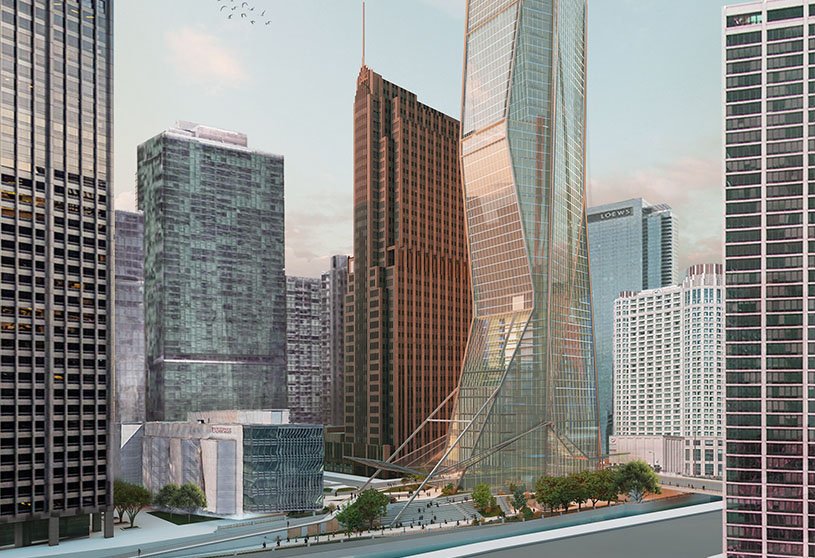
The final outcome of The RIV is a skyscraper that balances bold architectural expression with sensitivity to its urban context. The tower’s sharp chamfered geometry imparts a distinctive, aggressive presence, yet the careful selection of glass color and materiality ensures it blends harmoniously with Chicago’s elegant skyline. Its form stands out without clashing, complementing the city’s historic and modern architectural fabric.
Typical Floor PlanPerspective SectionRenderRender
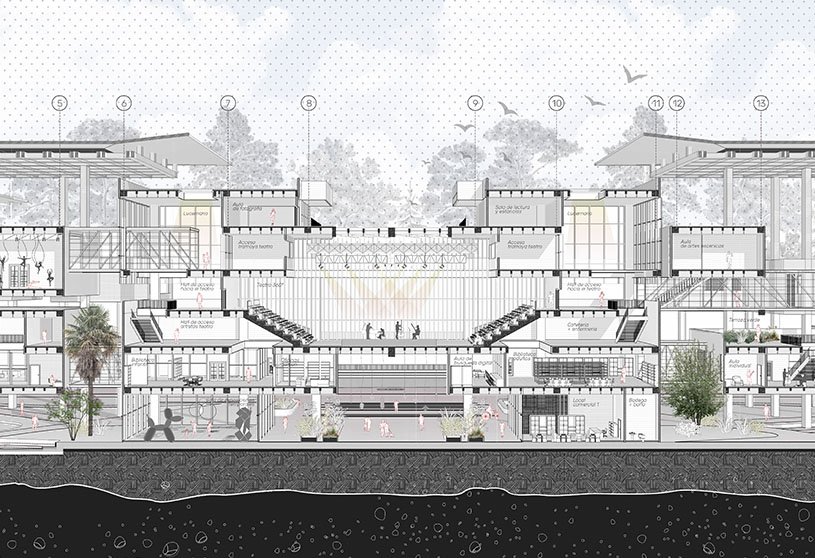
At the ground level, the tower opens into a public atrium and stepped landscape that merges seamlessly with the Riverwalk, transforming the site into an active civic space. The vertical gardens, bridges, and public plazas infuse energy into a previously quiet stretch of the riverfront, ensuring that the tower contributes to the life of the city both inside and out.
RenderRenderRender
Crowning the structure, the observatory offers panoramic views of Lake Michigan and Chicago, turning the very top of the building into a shared public experience.
RenderRenderPhysical Model
Conclusion: Ultimately, The RIV achieves a dual identity: as a striking landmark defined by bold geometry and as a welcoming extension of the Riverwalk, designed to connect people, place, and the dynamic spirit of Chicago.
[This Academic Project has been published with text and images submitted by the student]
Site Context
Design Process
Final Outcome
To submit your academic project for publication at ArchiDiaries, please visit the following link >> Submit
Get the best of ArchiDiaries, directly in your inbox.
We use cookies on our website to give you the most relevant experience by remembering your preferences and repeat visits. By clicking “Accept All”, you consent to the use of ALL the cookies. However, you may visit "Cookie Settings" to provide a controlled consent.
This website uses cookies to improve your experience while you navigate through the website. Out of these, the cookies that are categorized as necessary are stored on your browser as they are essential for the working of basic functionalities of the website. We also use third-party cookies that help us analyze and understand how you use this website. These cookies will be stored in your browser only with your consent. You also have the option to opt-out of these cookies. But opting out of some of these cookies may affect your browsing experience.
Necessary cookies are absolutely essential for the website to function properly. These cookies ensure basic functionalities and security features of the website, anonymously.
Cookie
Duration
Description
cookielawinfo-checkbox-analytics
11 months
This cookie is set by GDPR Cookie Consent plugin. The cookie is used to store the user consent for the cookies in the category "Analytics".
cookielawinfo-checkbox-functional
11 months
The cookie is set by GDPR cookie consent to record the user consent for the cookies in the category "Functional".
cookielawinfo-checkbox-necessary
11 months
This cookie is set by GDPR Cookie Consent plugin. The cookies is used to store the user consent for the cookies in the category "Necessary".
cookielawinfo-checkbox-others
11 months
This cookie is set by GDPR Cookie Consent plugin. The cookie is used to store the user consent for the cookies in the category "Other.
cookielawinfo-checkbox-performance
11 months
This cookie is set by GDPR Cookie Consent plugin. The cookie is used to store the user consent for the cookies in the category "Performance".
viewed_cookie_policy
11 months
The cookie is set by the GDPR Cookie Consent plugin and is used to store whether or not user has consented to the use of cookies. It does not store any personal data.
Functional cookies help to perform certain functionalities like sharing the content of the website on social media platforms, collect feedbacks, and other third-party features.
Performance cookies are used to understand and analyze the key performance indexes of the website which helps in delivering a better user experience for the visitors.
Analytical cookies are used to understand how visitors interact with the website. These cookies help provide information on metrics the number of visitors, bounce rate, traffic source, etc.
Advertisement cookies are used to provide visitors with relevant ads and marketing campaigns. These cookies track visitors across websites and collect information to provide customized ads.