Excerpt: ‘Yathartha – Cultural Appropriation In The Case of Retail Architecture’ is an architecture thesis by Karan Malkan from Rachana Sansad’s Academy of Architecture that seeks to discern the appropriateness of a built form based on its cultural landscape. By taking the BMC market, Borivali, as a model, the project explores the influence of cultural landscapes on diverse architectural typologies, resulting in an architectural solution.
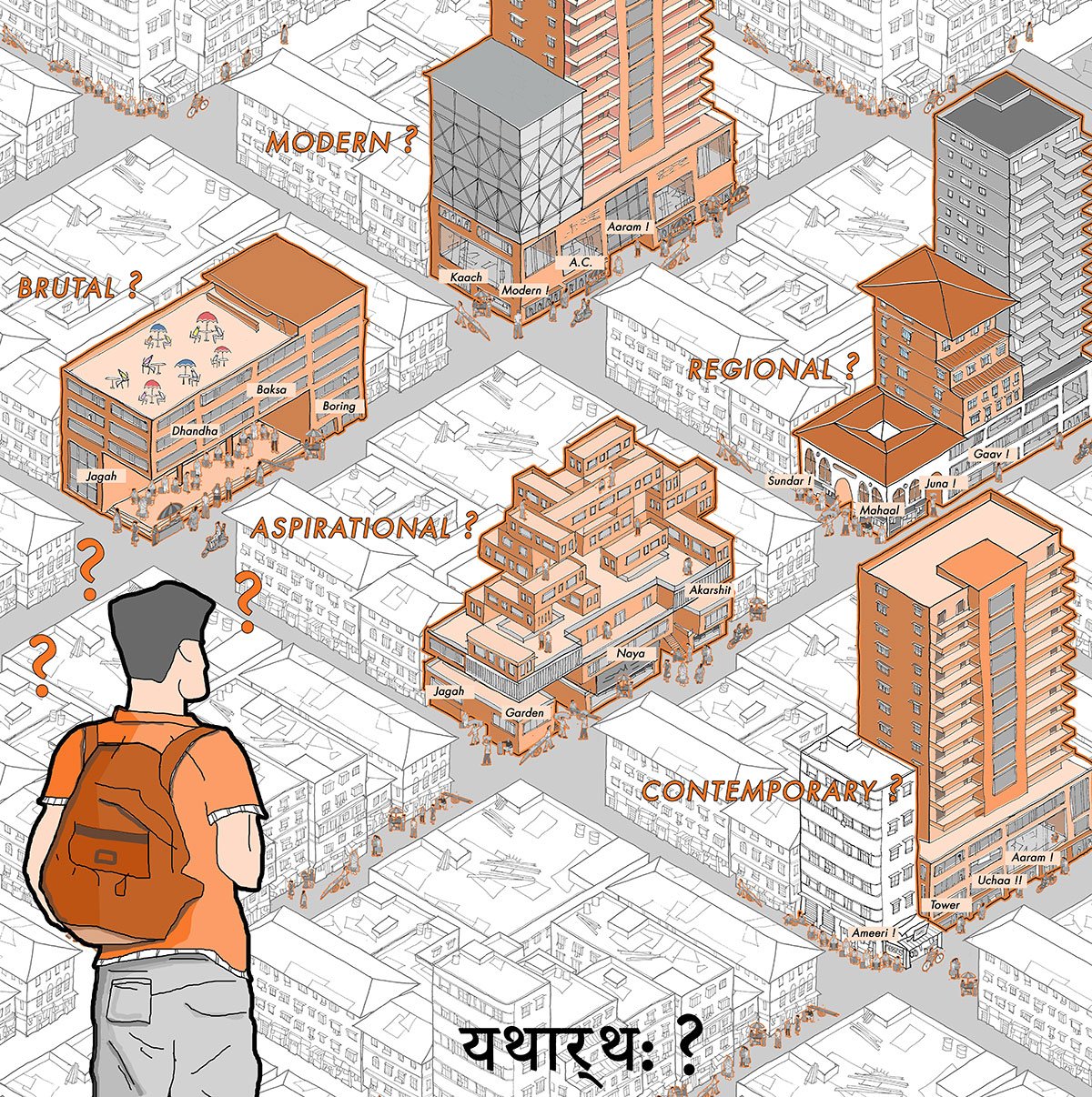
Introduction: The thesis seeks to discern the appropriateness of a built form based on its cultural landscape. It asserts that the identity of a built form expressed through architecture frequently diverges from the dominant identity of a region. As a result of globalisation, identities are no longer a static constant but rather the result of dynamic cultural phenomena.
There is a need to critically analyse the aspirations and traditions existing within a cultural landscape to form a deeper understanding of its prevailing architectural identity and appropriateness. Then, in a unique manner that avoids using any kind of generalisation, this needs to be integrated architecturally along with cultural enhancements.
The architecture thesis seeks to examine, evaluate, and discern the reading of cultural appropriations for retail architecture, which in turn leads to an architectural solution, resulting from a brief study of the influence of cultural landscapes on diverse architectural typologies.
Site Location (Source: Google Map) | Map Indicating the Commercial Zones (Source: Google Map)
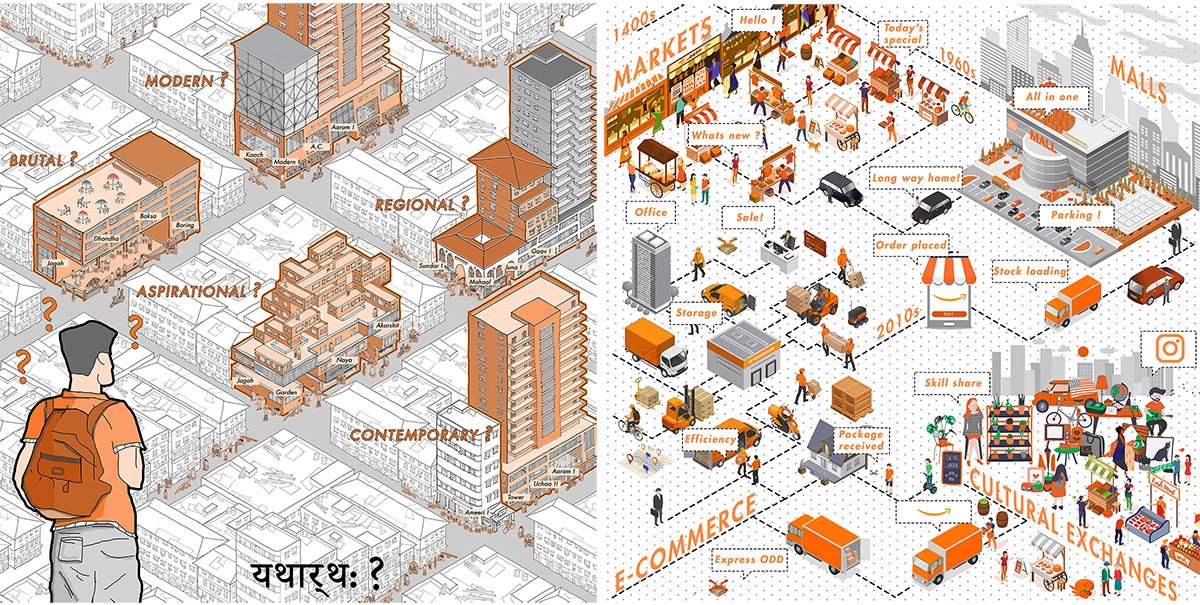
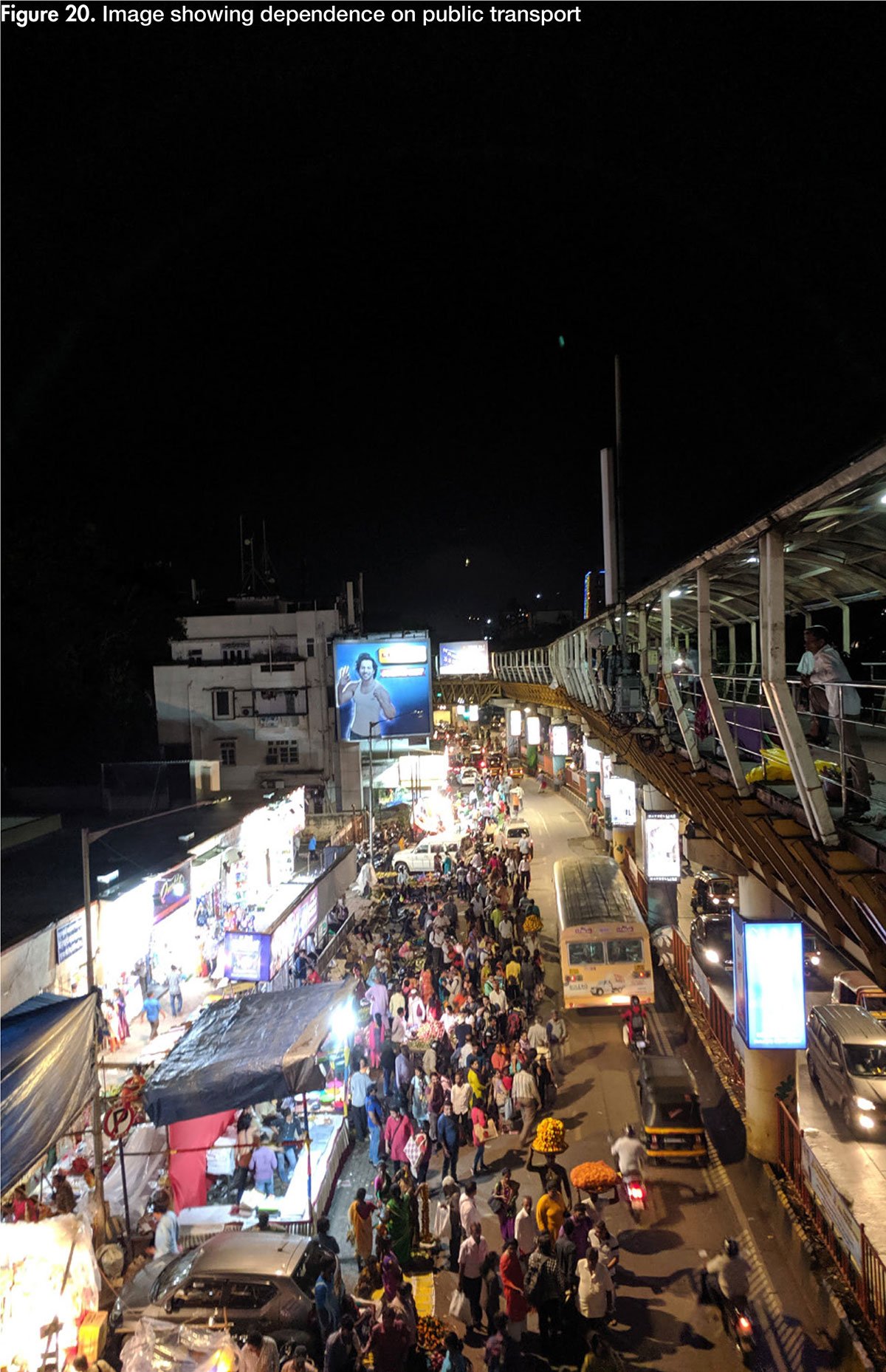
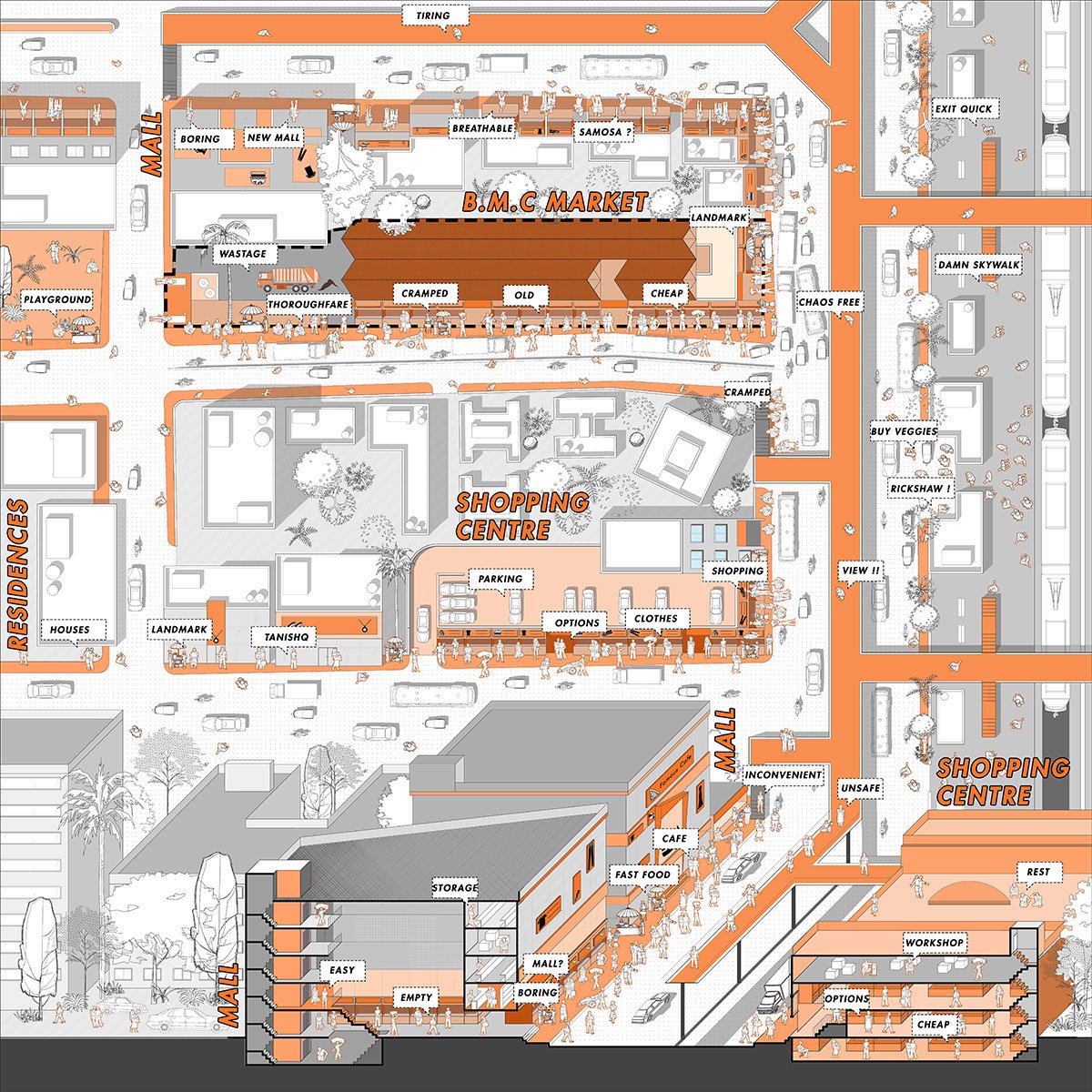
Due to its proximity to the train station, the site has always been dominated by its retail establishment. The site provides a wide range of products and services for production and consumption, from delicious street food to groceries, auto parts, apparel, stationery, and seasonal crafts. On S.V. Road in Borivali, there is room for every skill, thought, and craft. In the last fifty years, the location has seen a variety of retail-oriented developments, including markets, malls, shopping centres, and street vendors.
Urban Fabric Data and Analysis | Hawker ZonesUser Analysis and Behavioral Patterns
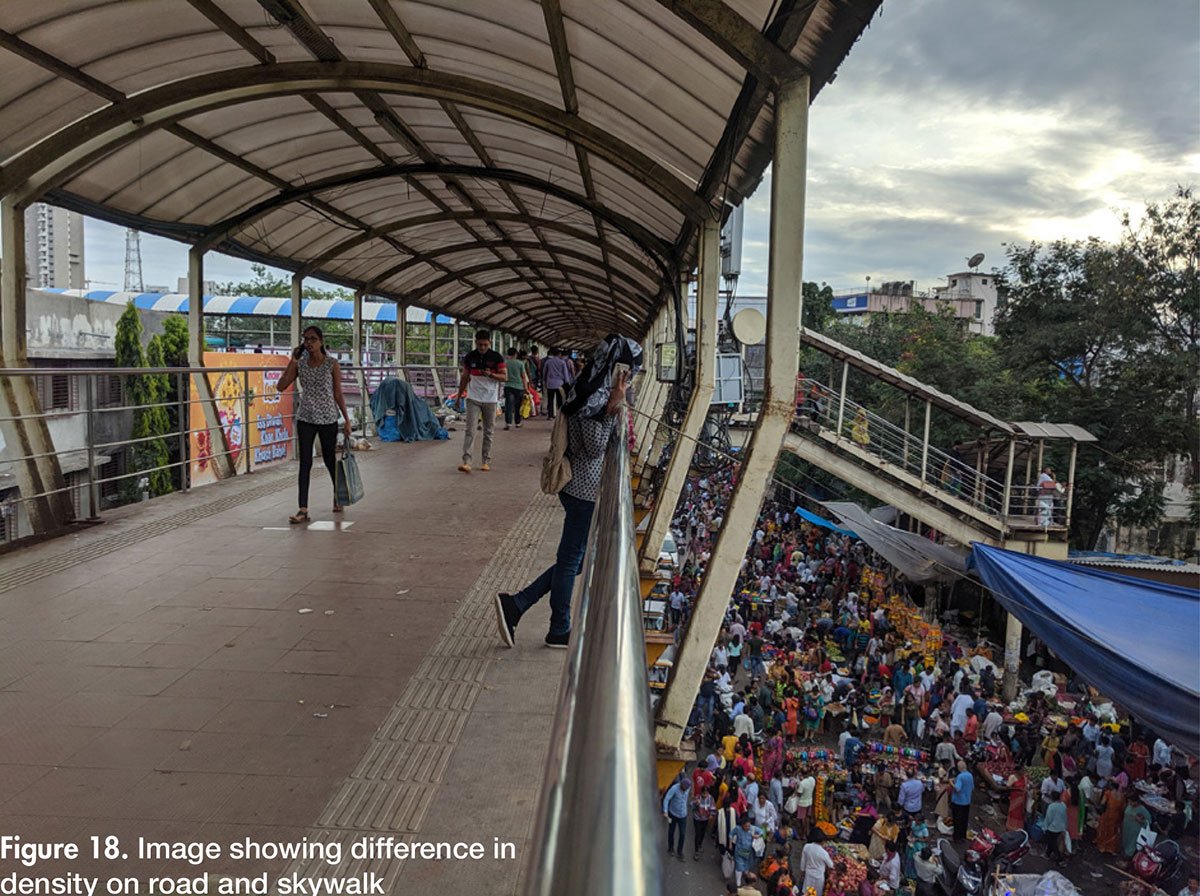
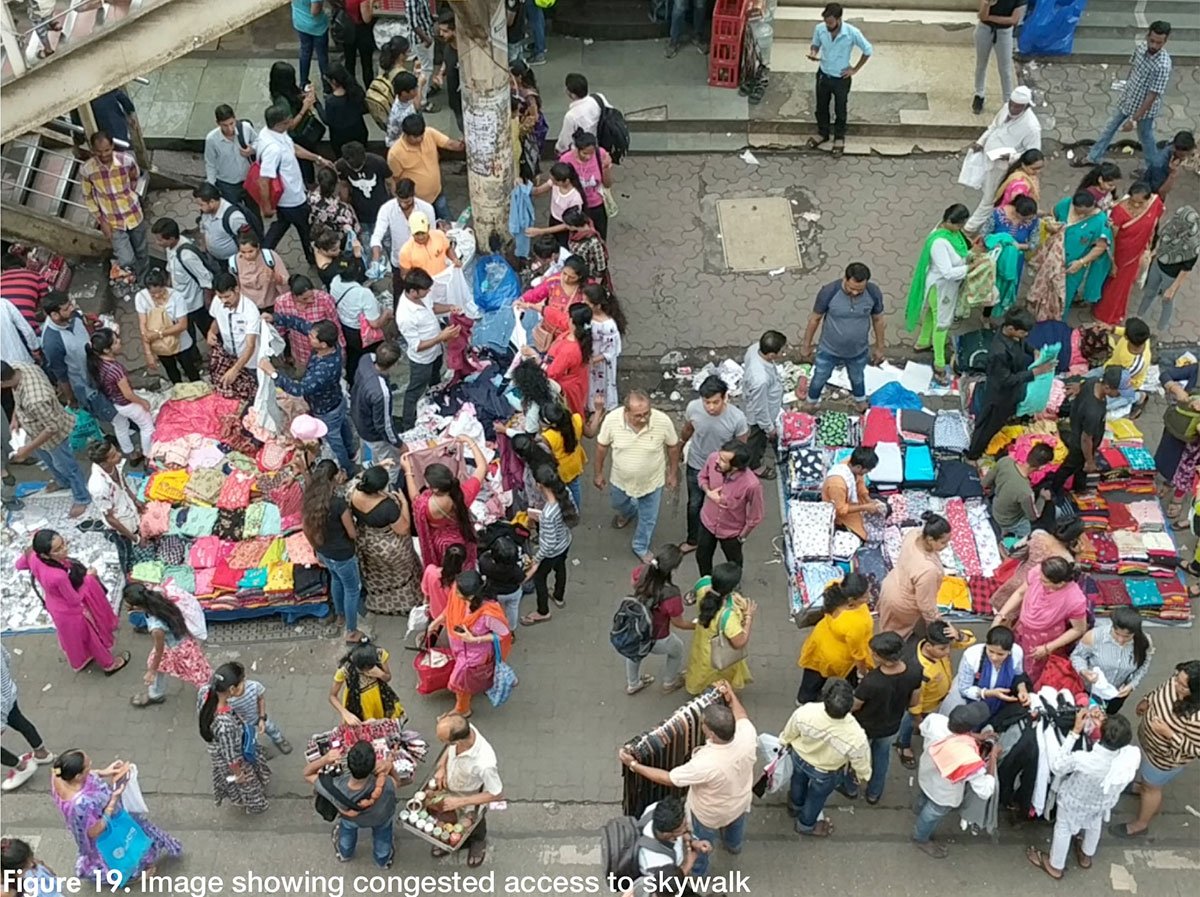
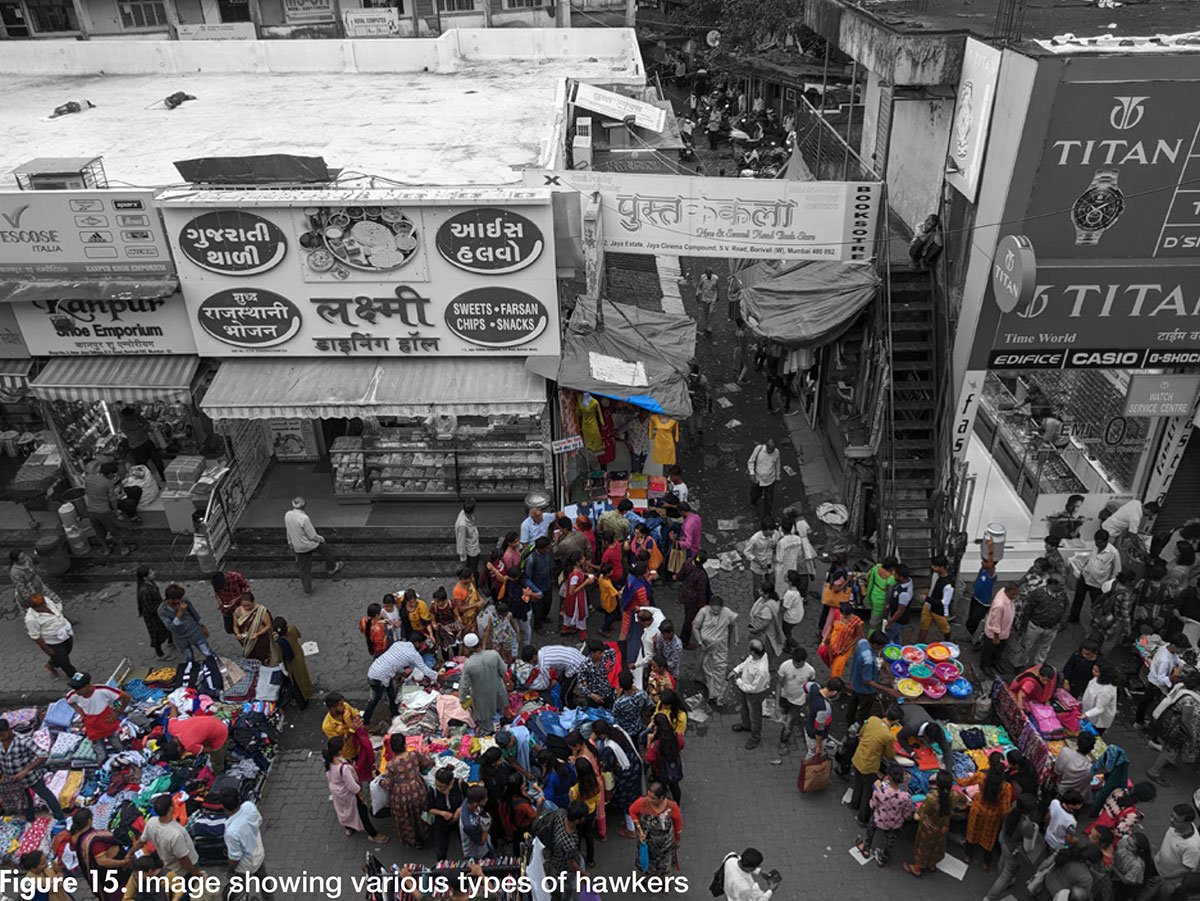
By analysing these developments in light of their unique cultural context, the thesis was able to identify the idea of cultural appropriation for this particular site. The streets and homogeneous shopping centres are thriving as usual, while the recent developments in the form of malls are now empty and being used as coaching classes and warehouses. For a site with such high mobility, homogeneity, equity, and freedom of movement are essential. A further rationale for why people still choose to use the congested streets over the redundant and merely inaccessible skywalks.
The project looks at the redevelopment of a BMC vegetable market as making it the next public forum, a breeding ground for exchanges. Exchange of art, culture, crafts, goods, food, and everything else that flows through the site. An extension of the streets, a free-flowing but routed entity.
Design Process
Yathartha Question | Case Of RetailMassing Diagram
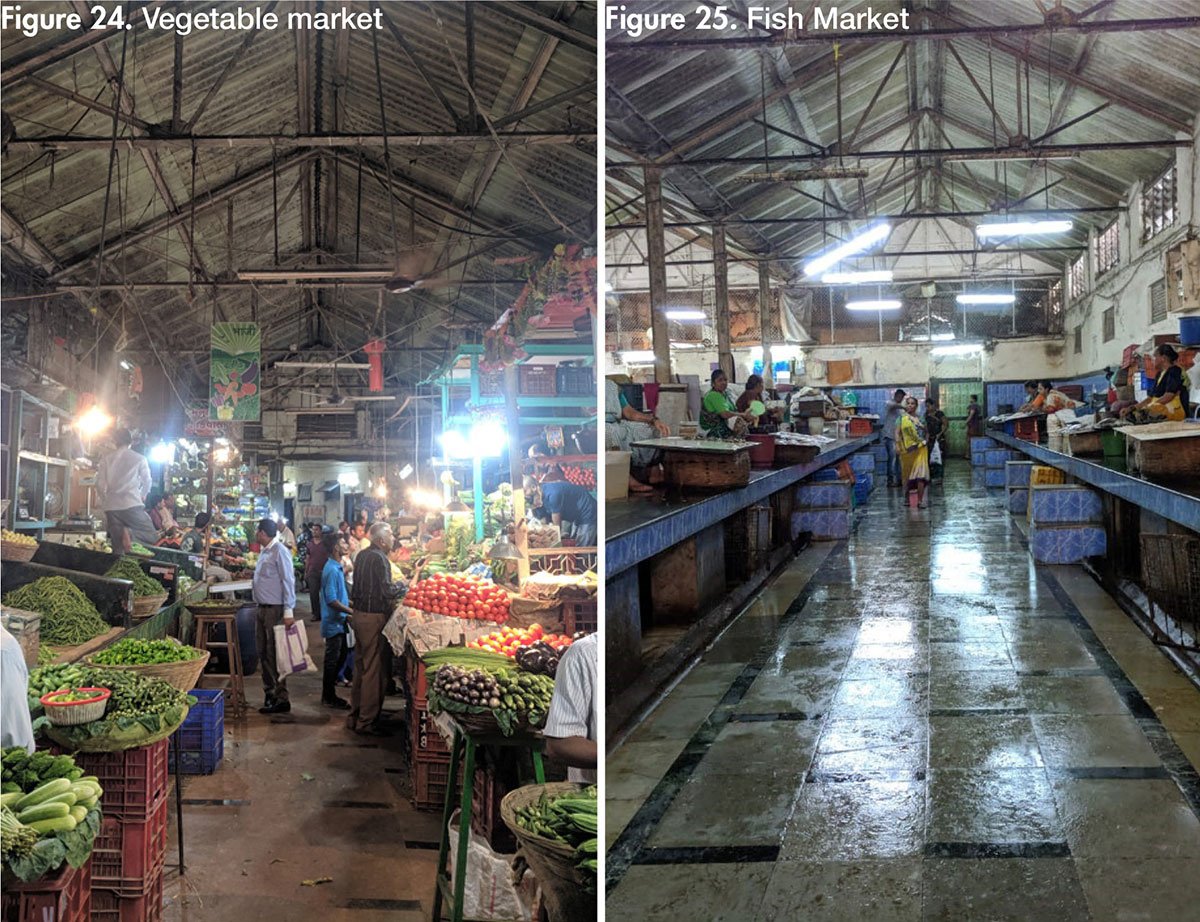
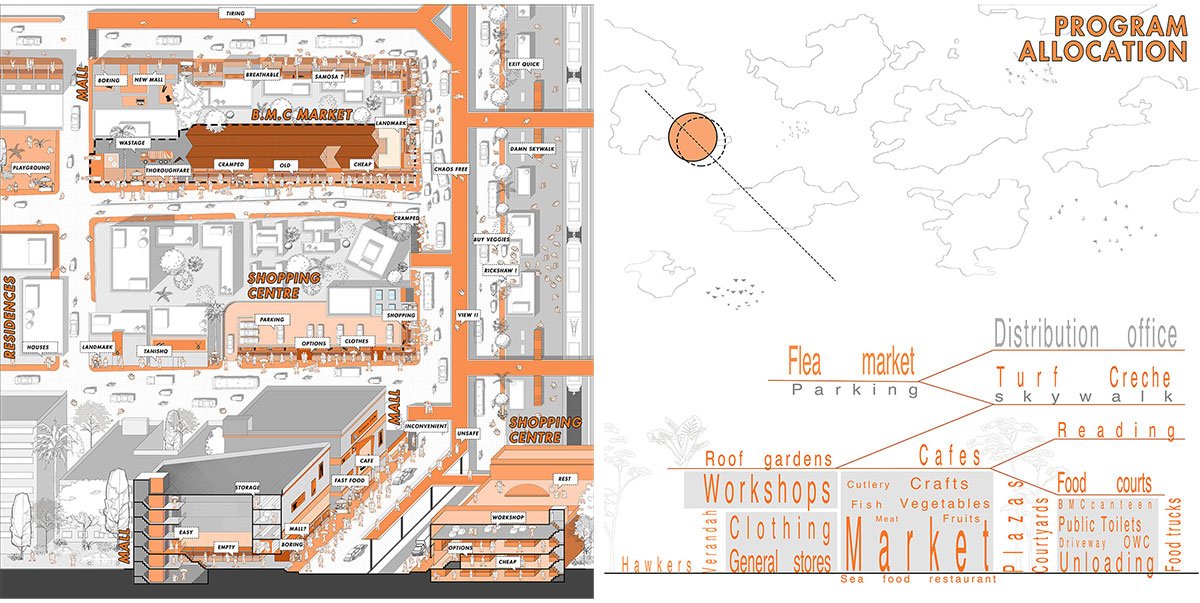
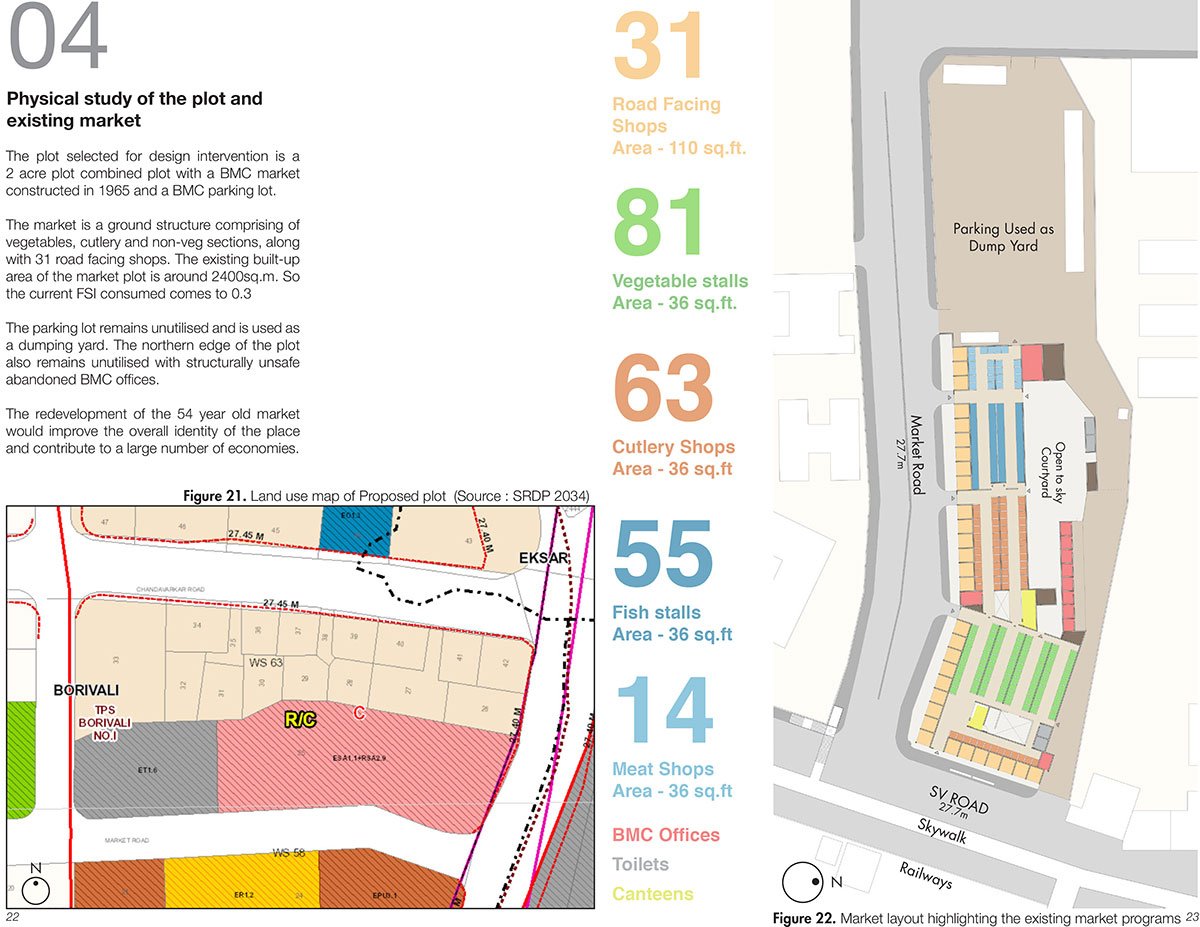
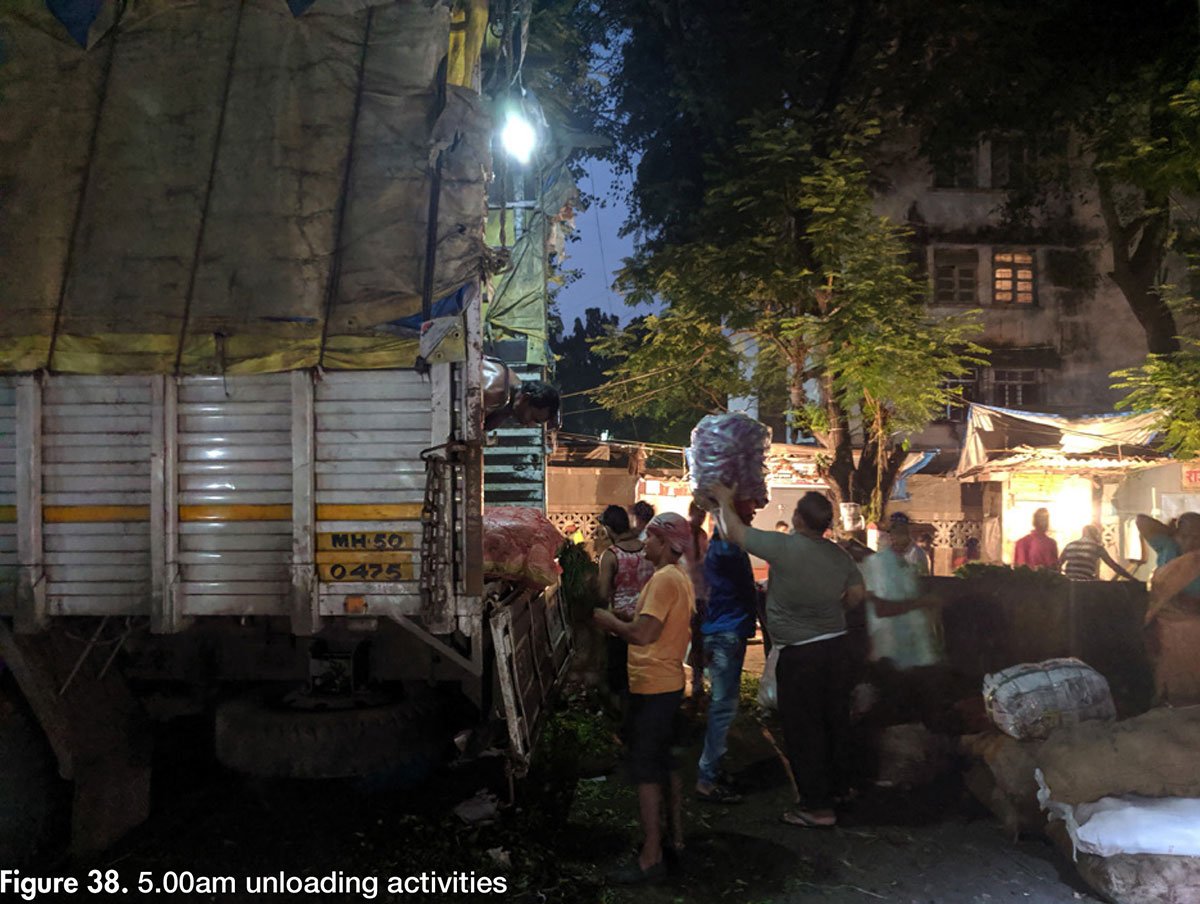
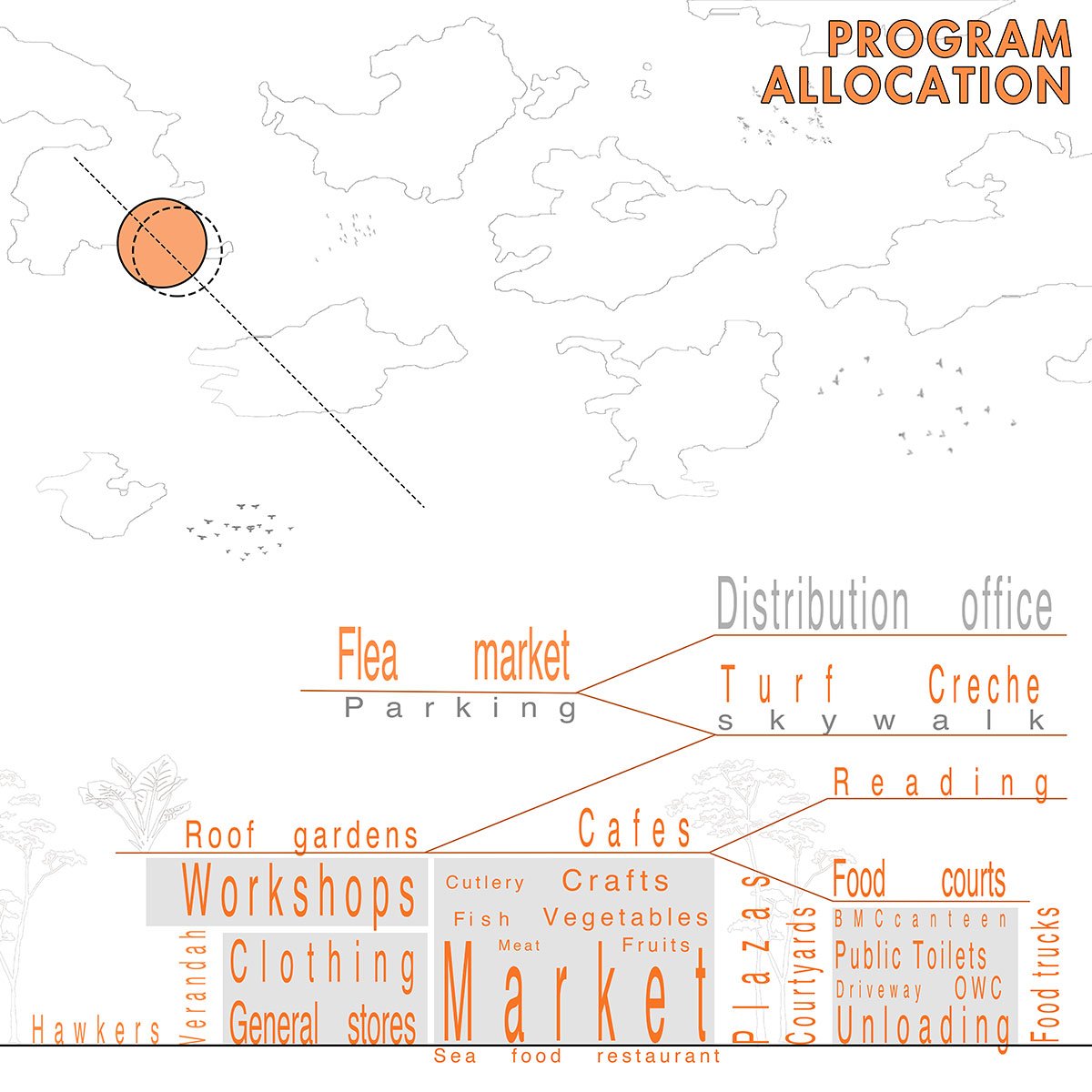
The first set of architectural programs include the existing market operations with its ancillary functions. The market has been functioning at overload capacities since its inception in 1964. It is only imperative to reorganise and modernise the same while retaining its original architectural fabric. Since the market building has resulted in an influx of illegal hawkers, the programme aims to integrate them instead of expelling them.
Appropriating Site Conditions | Program DiagramMassing DiagramMassing Diagram
As mentioned earlier the built form aims to be a public forum, where there will be a wide range of homogenous shops from food to clothing, something for everyone. The cutlery and crafts market now also invites all the skilled individuals to use this forum to sell their skills along with their goods by creating dedicated and accessible workshop areas. The workshop areas are further classified into two, the general workshop and tailoring workshop. As observed on site each clothing store is accompanied by a tailor accommodated in its false ceiling or at the back of the store. The design intends to highlight the skill of that tailor by giving dedicated workshop areas in affiliation with the shops.
Massing DiagramMassing Diagram
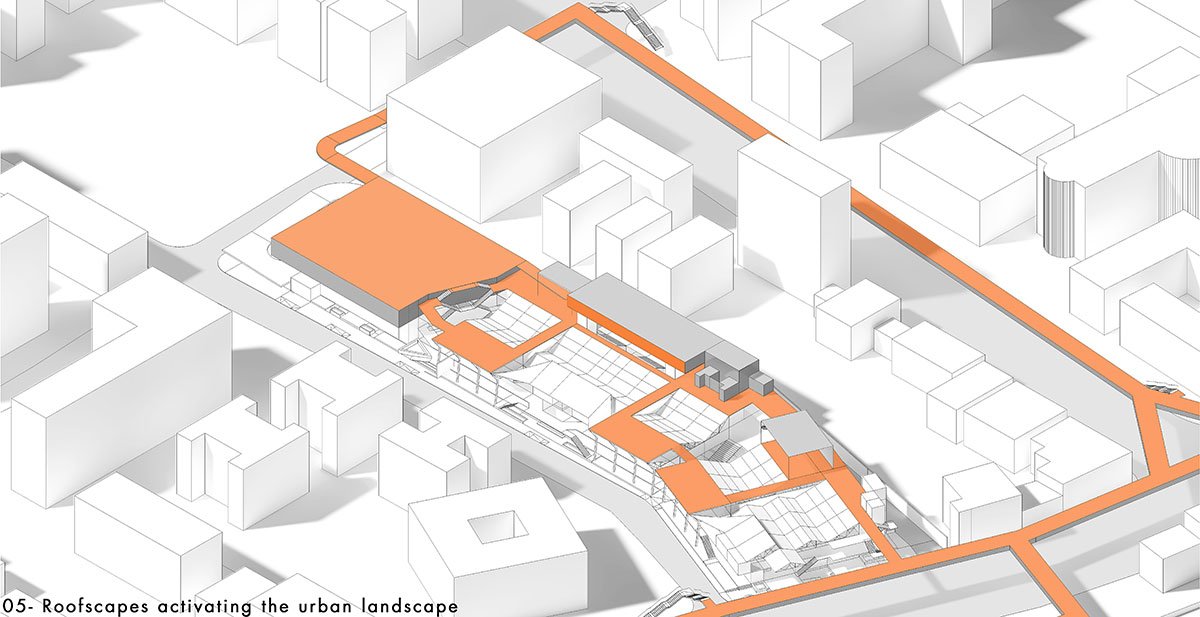
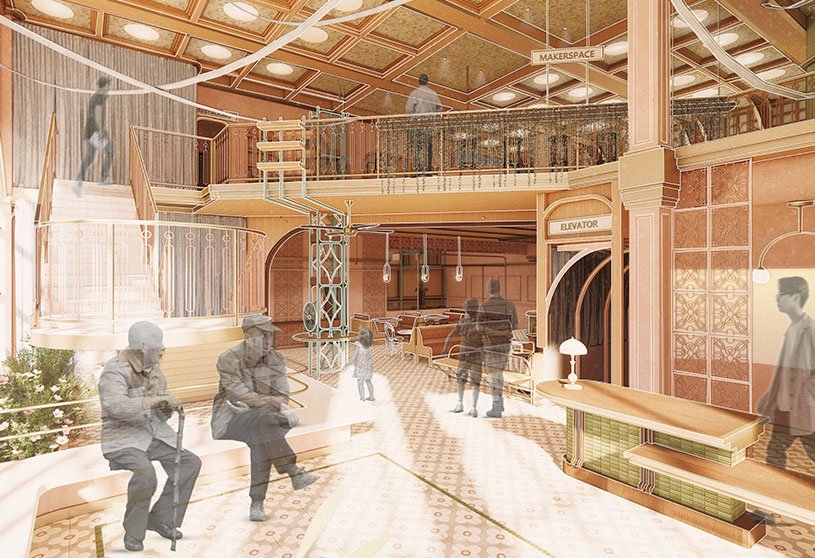
By allocating anchor cafes and other programmes for a specific audience, the design aims to revitalise the upper ground (skywalk) in a seamless manner. The design programmes are then connected to a number of other public initiatives, including roof gardens, flea markets, and public plazas. Lastly, the design includes space for a distribution office to complete the retail cycle, in order to expand the audience for the dialogue created on the site.
Final Outcome
Planometric Diagram | Market ViewIsometric – Before and After
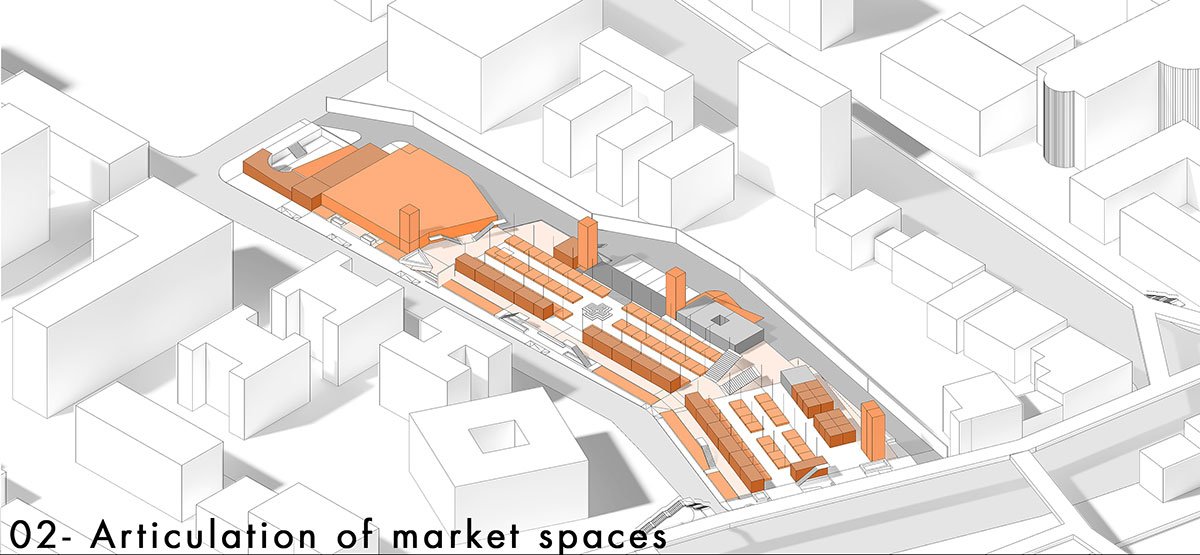
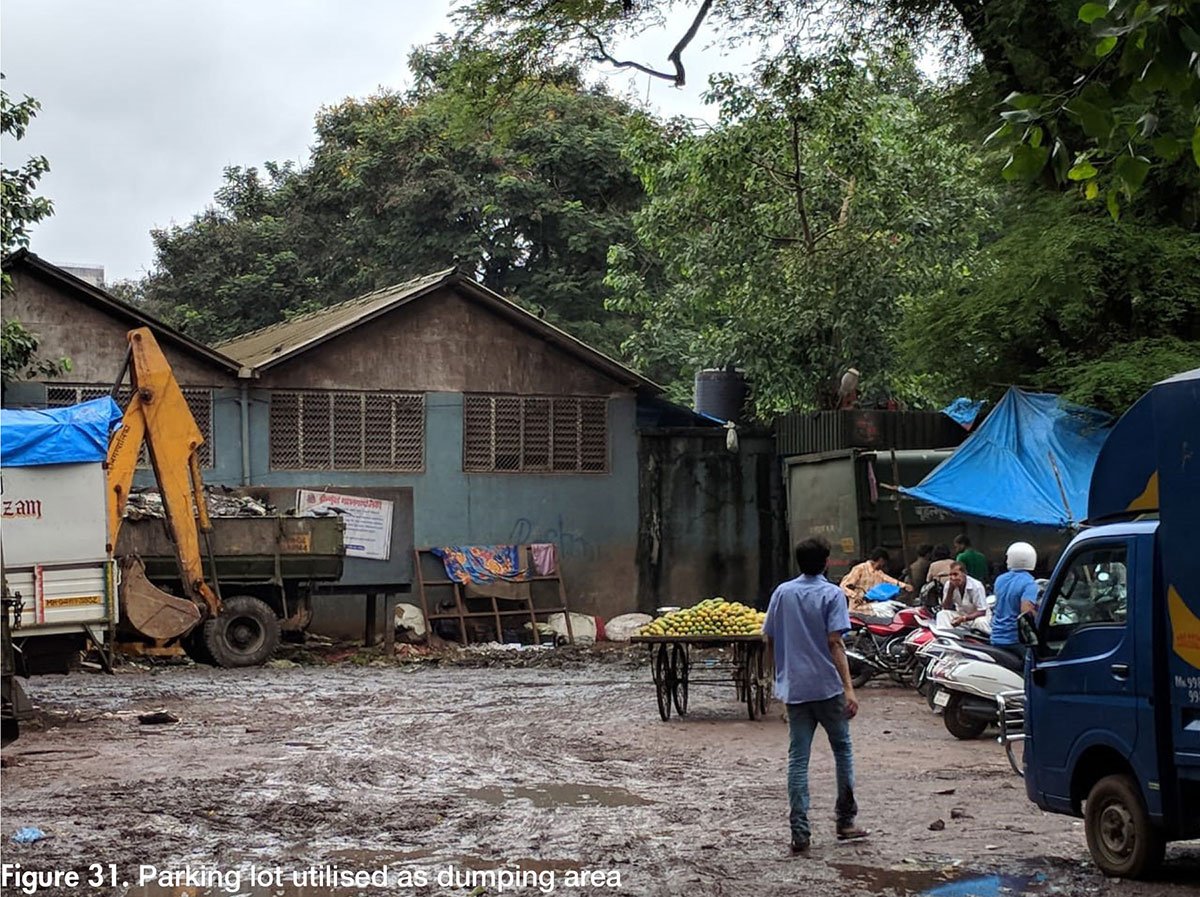
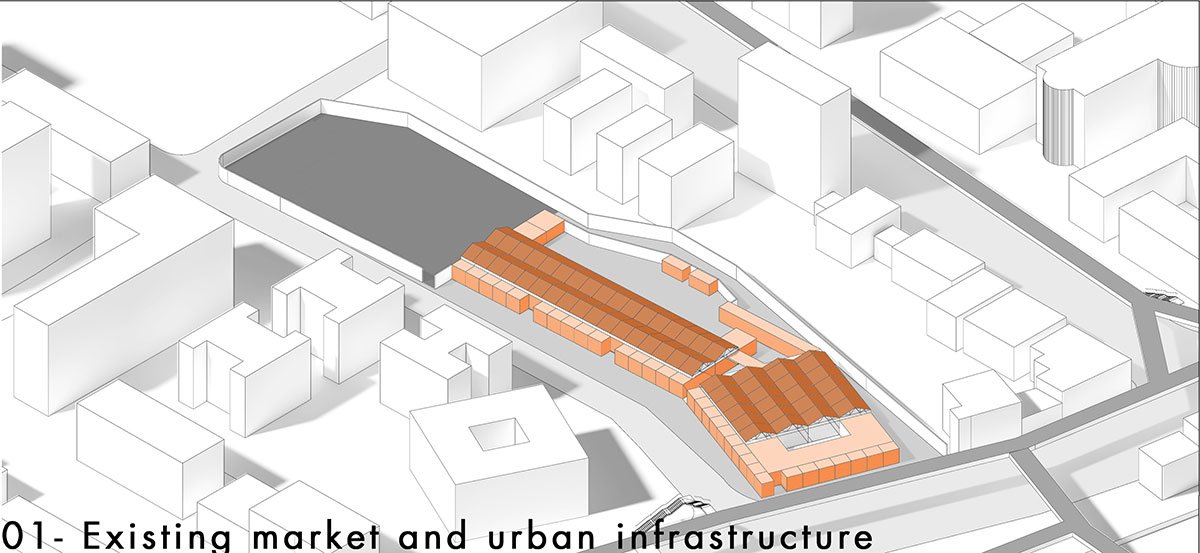
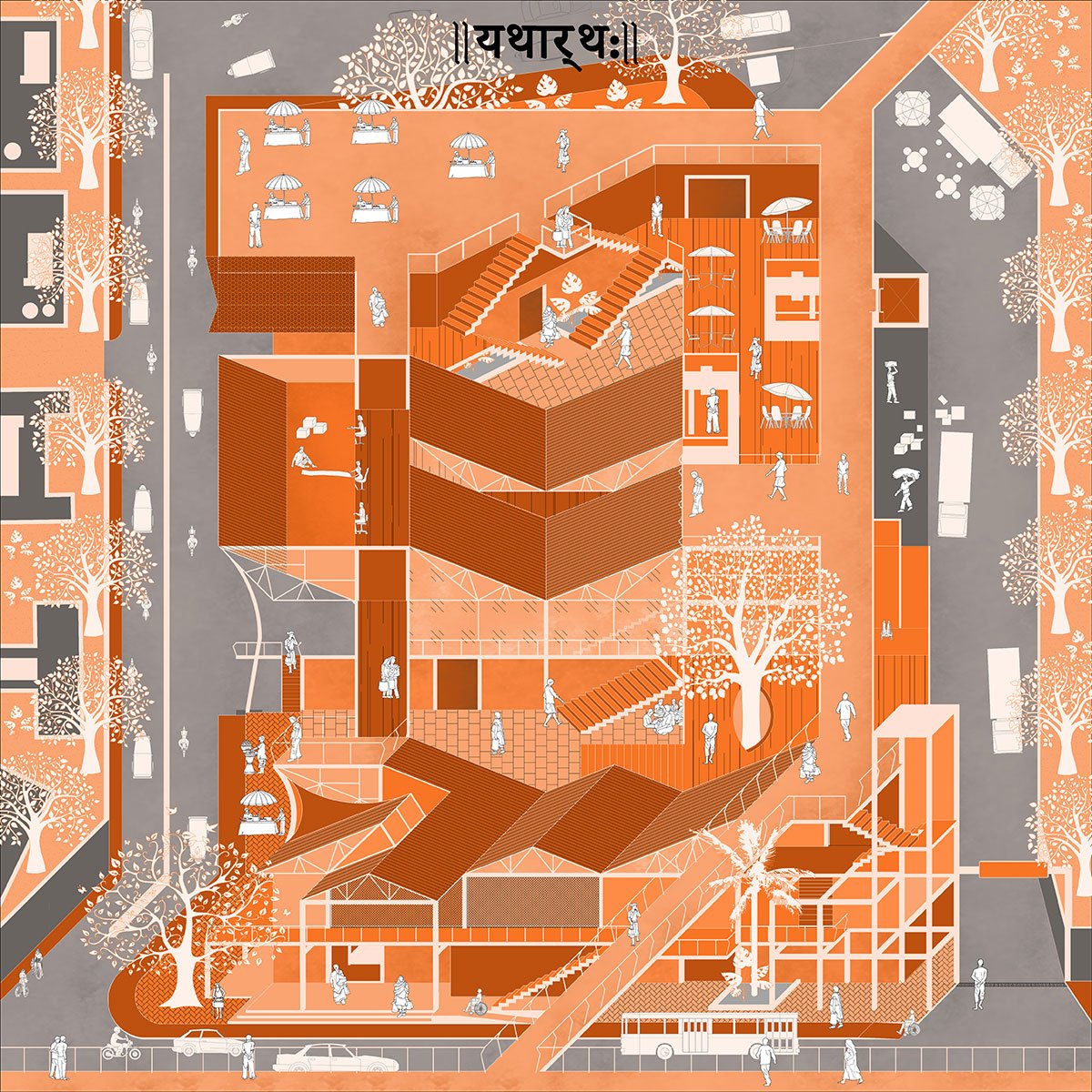
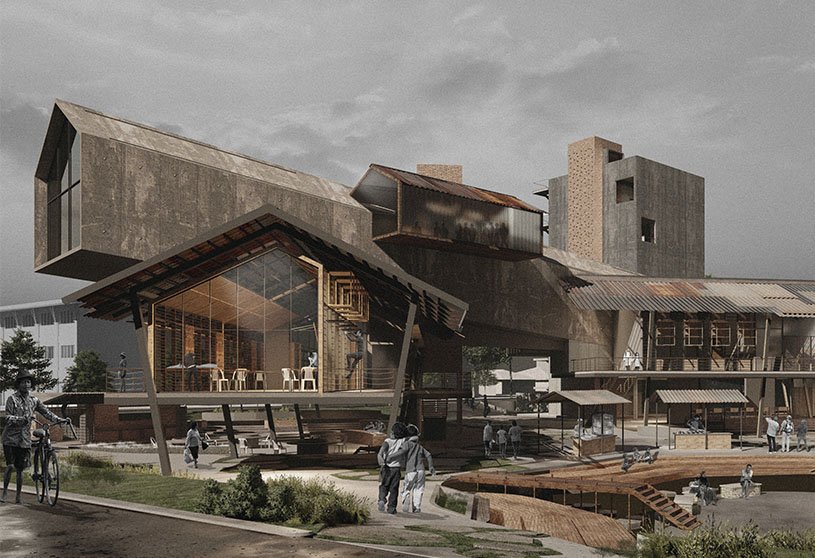
The existing market consists of linear shed spaces and a vacant plot utilised as a parking and dumping area. The redundant skywalk overlooks the market sheds but does not allow any form for seamless accessibility. The markets are organised such that there are intersecting plazas and courtyards. The ancillary functions are accommodated at the back end of the plot connected through the intersecting plazas.
ElevationTypology Diagram
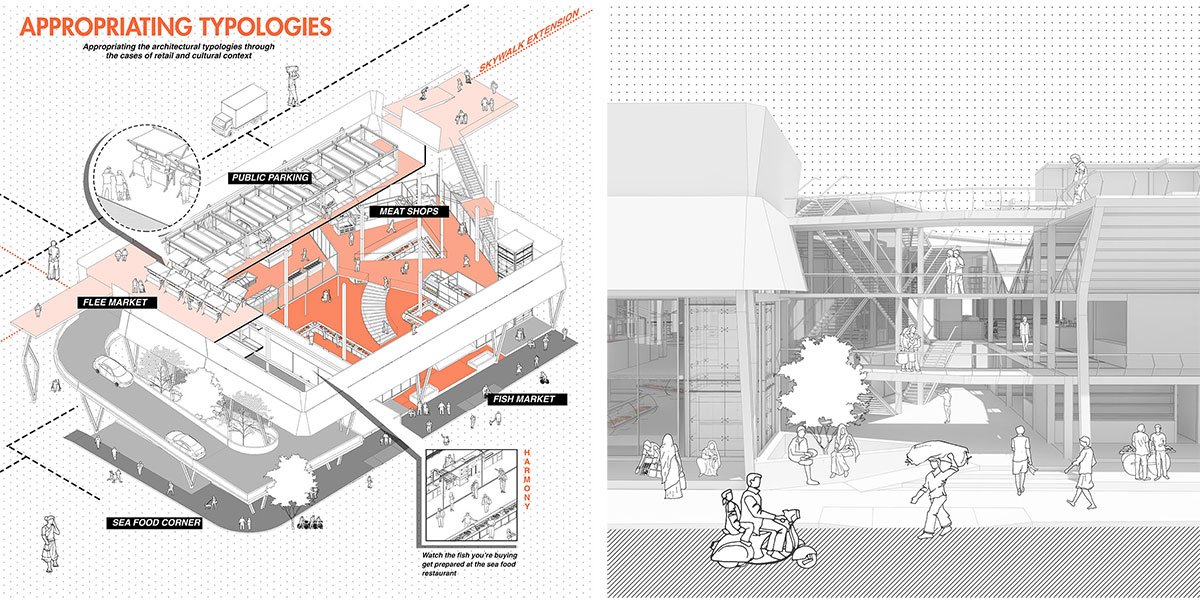
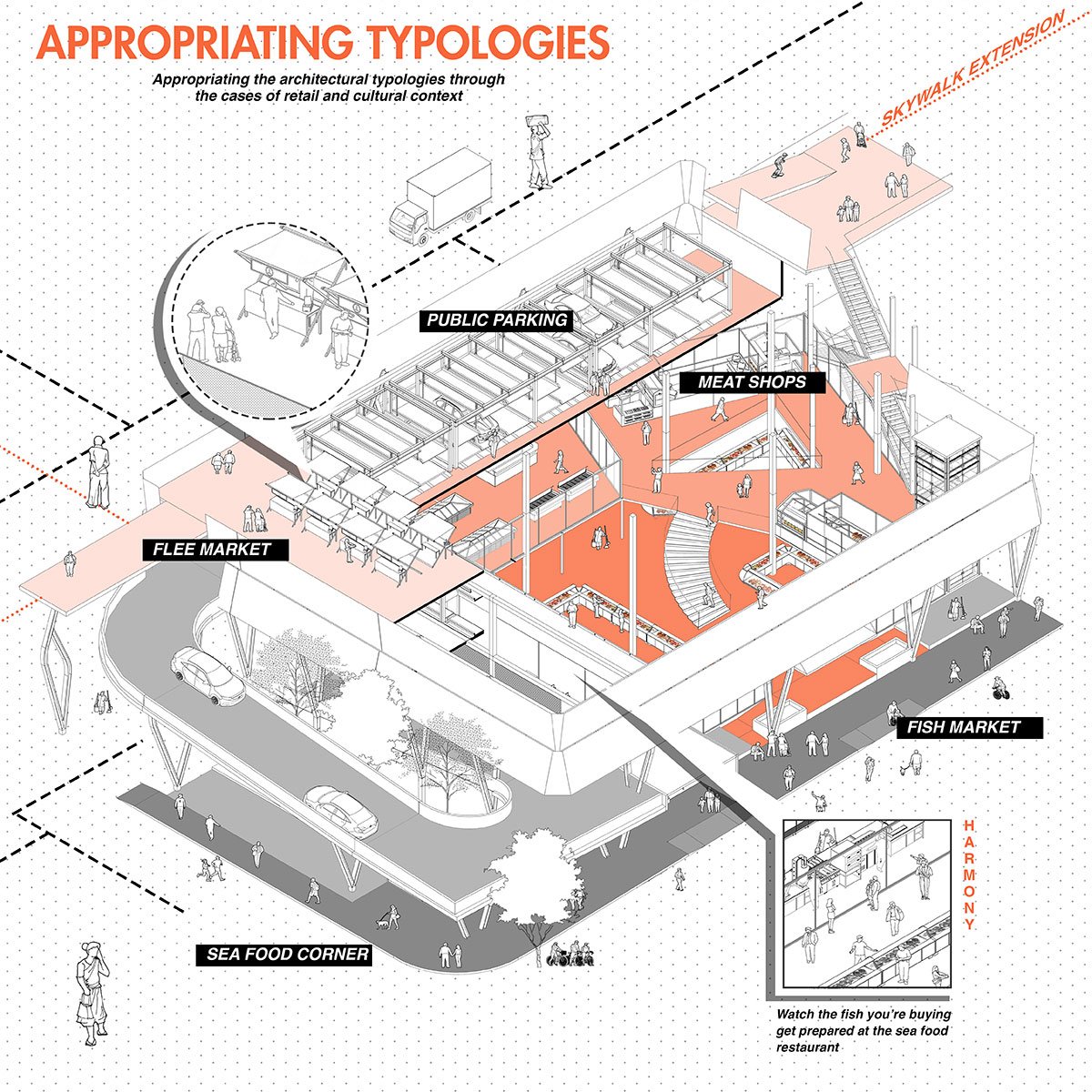
The clothing shops are towards the street and food stalls at the back creating a food hub along with the temporary evening food truck plaza. Adjacent to the central courtyard is the anchor cafe. An open volume is created by the crafts market’s staggered placement relative to the cutlery market underneath.
Section
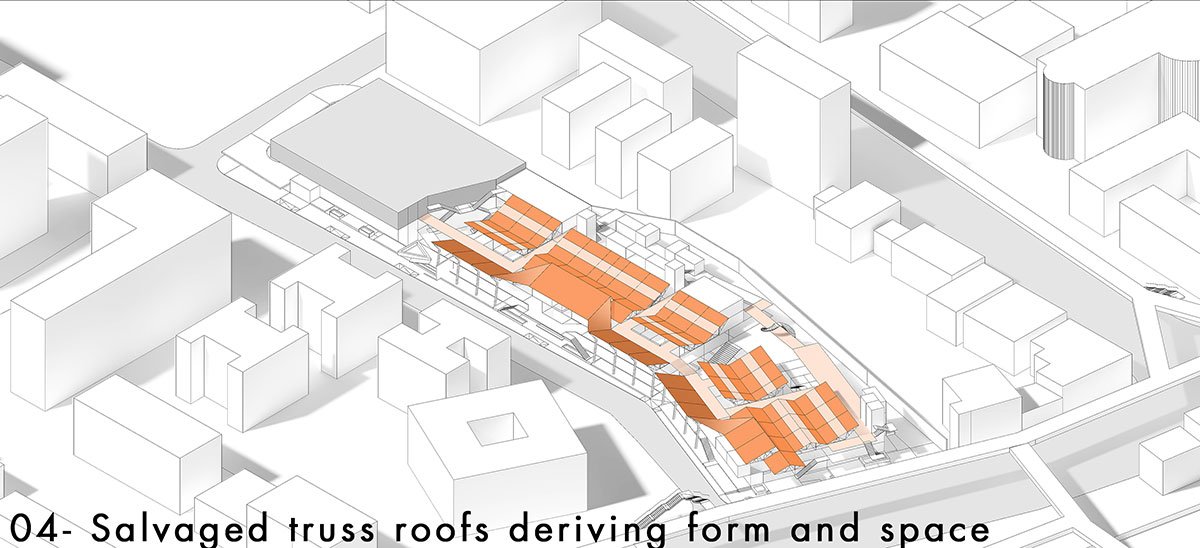
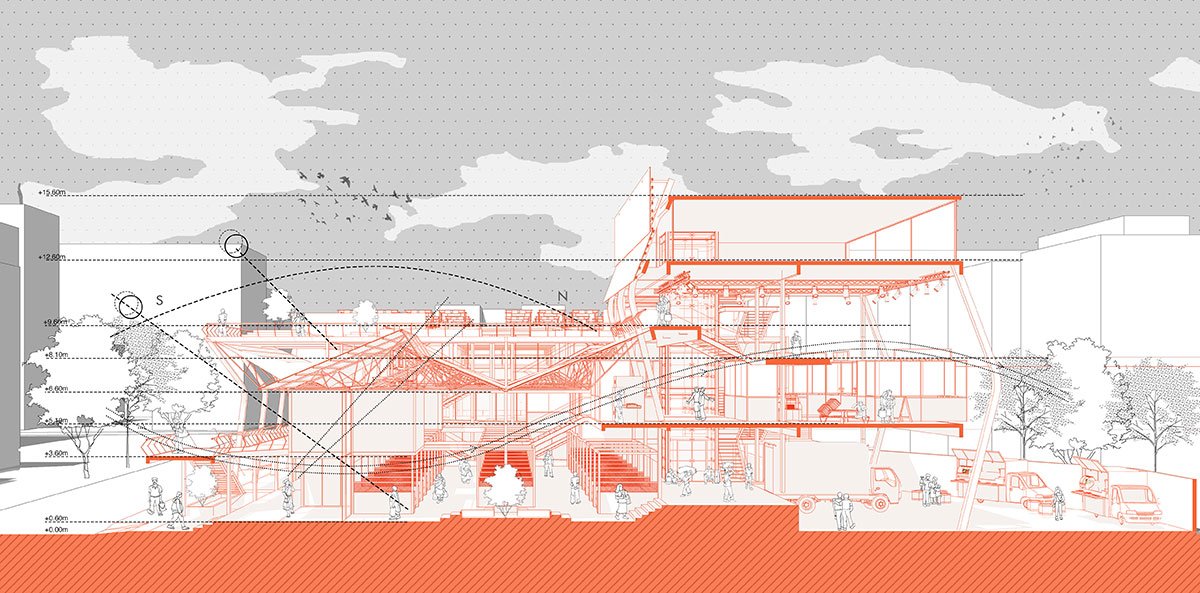
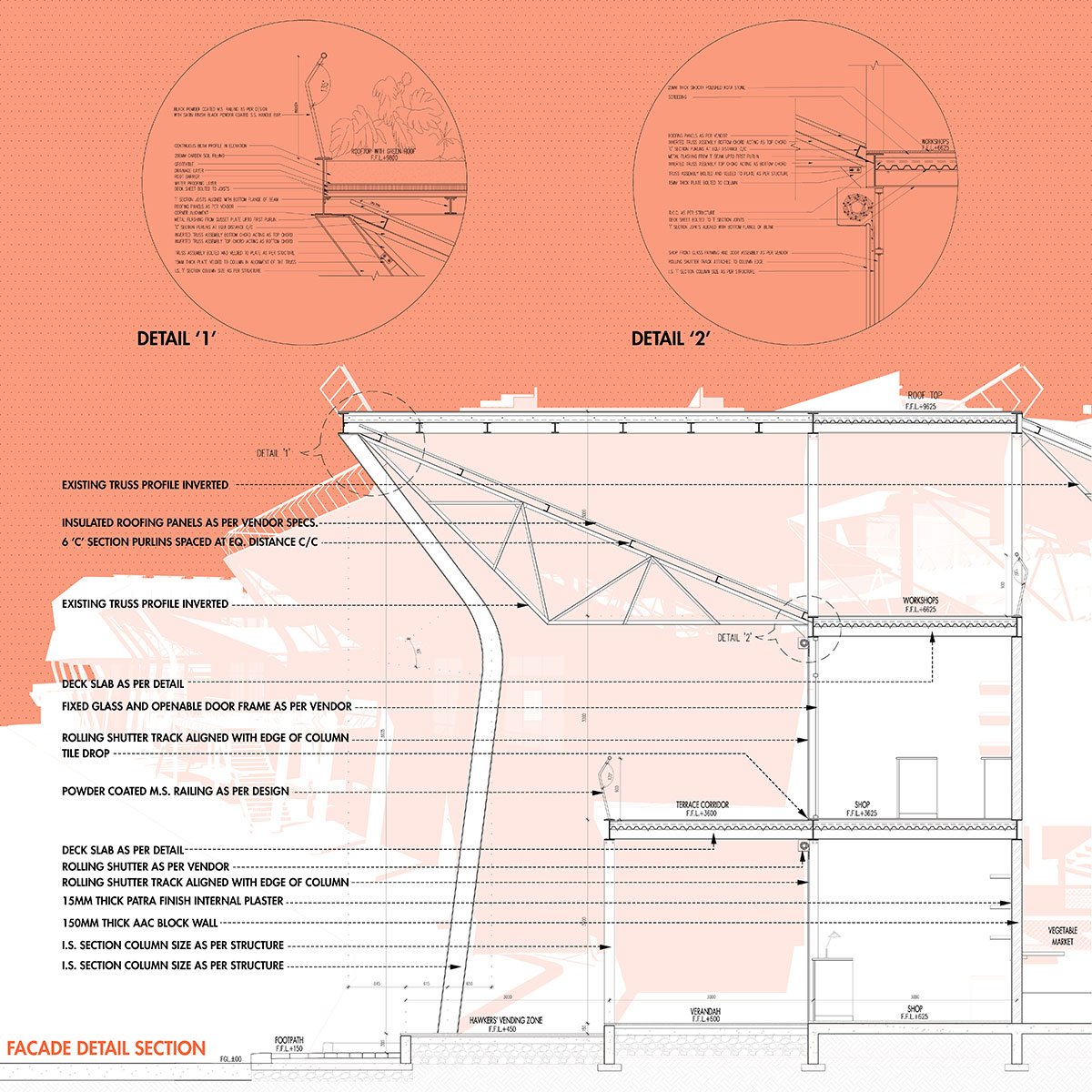
The structure of the roof is such that it can playfully accommodate workshop areas and create a rhythm in its facade that provides shade to the hawkers underneath. The roof is designed using salvaged trusses from the existing market in order to reduce costs and time while simultaneously instilling a sense of memory the place had retained for the past 50 years.
Circulation Diagram | Detail SectionSection
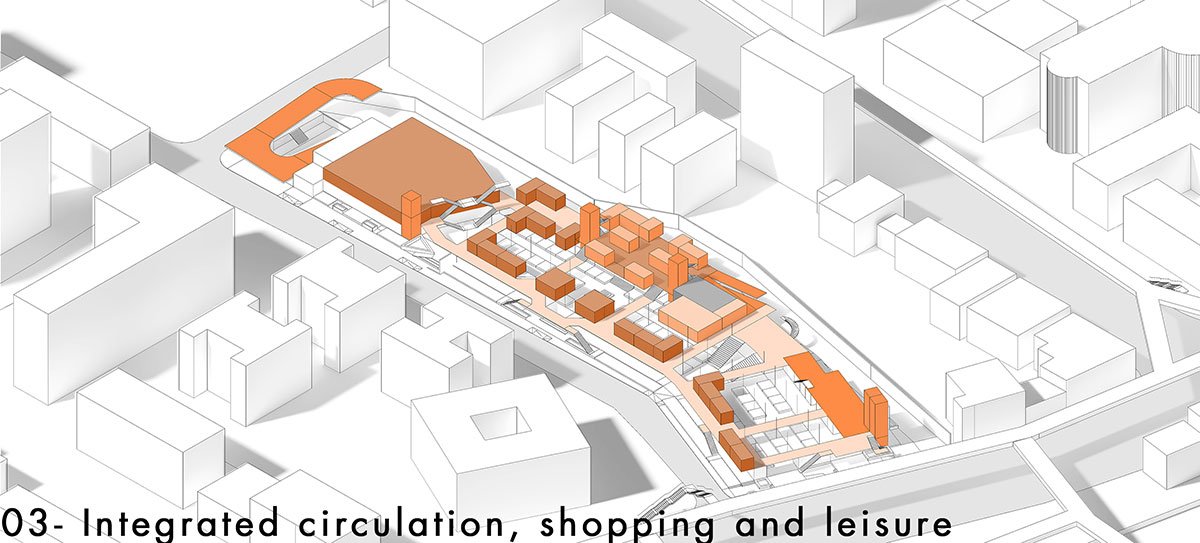
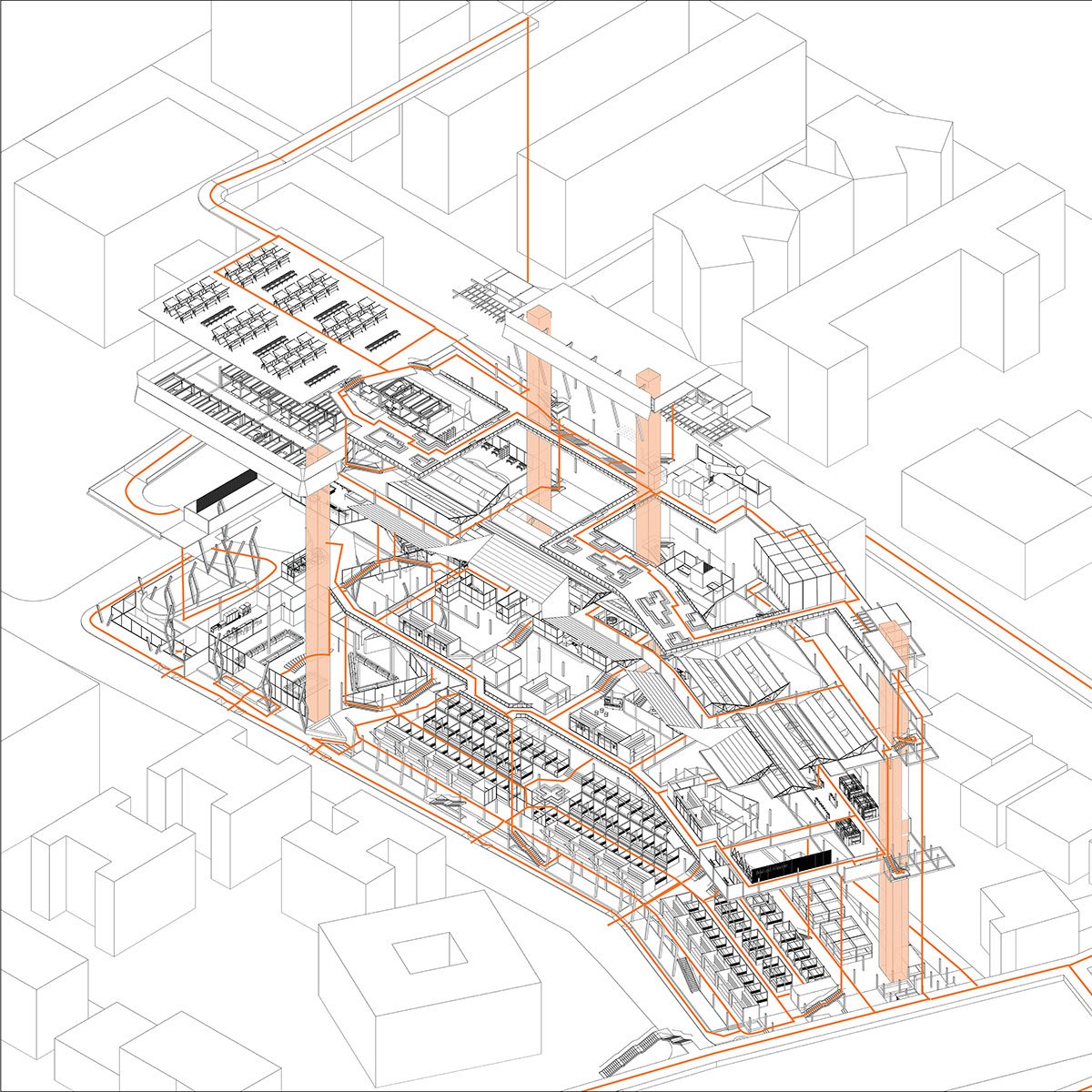
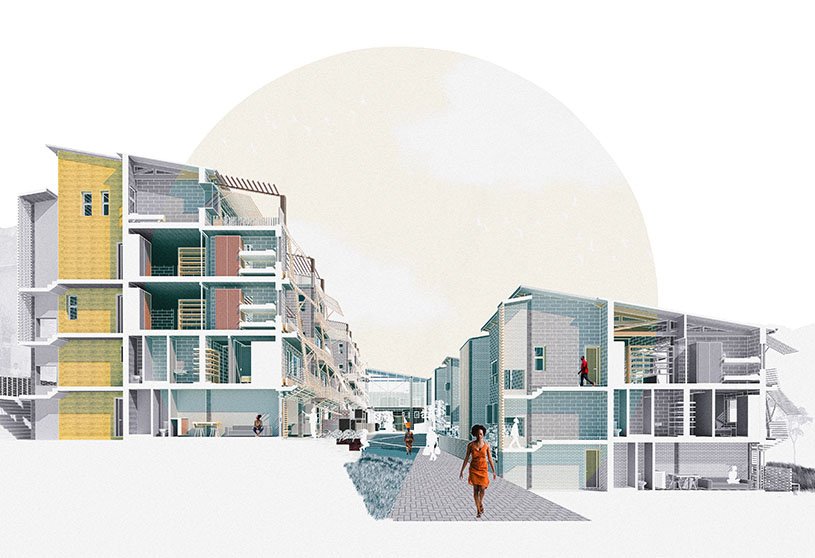
The final form of the design consciously maintains an inward close looped circulation of customers, pedestrians and visitors. In contrast to malls, the design configures its pathways according to the familiar market model, allowing users to enter at any point and exit at any other without being restricted in their movement. Additionally, by maintaining unrestricted circulation at all levels and integrating it with the existing skywalk, it activates the redundant urban infrastructure and unifies the built form with its urban landscape.
Typology Diagram | Market View
Conclusion: This design, classified as “Yathartha”—a culturally appropriate built form in the context of retail architecture—takes a fresh look at the design of retail architecture by identifying numerous pertinent architectural programmes and their juxtaposition on site, based on a thorough analysis of the cultural landscape and retail aspirations.
[This Academic Project has been published with text submitted by the student]
Site Context
Design Process
Final Outcome
To submit your academic project for publication at ArchiDiaries, please visit the following link >> Submit
Get the best of ArchiDiaries, directly in your inbox.
We use cookies on our website to give you the most relevant experience by remembering your preferences and repeat visits. By clicking “Accept All”, you consent to the use of ALL the cookies. However, you may visit "Cookie Settings" to provide a controlled consent.
This website uses cookies to improve your experience while you navigate through the website. Out of these, the cookies that are categorized as necessary are stored on your browser as they are essential for the working of basic functionalities of the website. We also use third-party cookies that help us analyze and understand how you use this website. These cookies will be stored in your browser only with your consent. You also have the option to opt-out of these cookies. But opting out of some of these cookies may affect your browsing experience.
Necessary cookies are absolutely essential for the website to function properly. These cookies ensure basic functionalities and security features of the website, anonymously.
Cookie
Duration
Description
cookielawinfo-checkbox-analytics
11 months
This cookie is set by GDPR Cookie Consent plugin. The cookie is used to store the user consent for the cookies in the category "Analytics".
cookielawinfo-checkbox-functional
11 months
The cookie is set by GDPR cookie consent to record the user consent for the cookies in the category "Functional".
cookielawinfo-checkbox-necessary
11 months
This cookie is set by GDPR Cookie Consent plugin. The cookies is used to store the user consent for the cookies in the category "Necessary".
cookielawinfo-checkbox-others
11 months
This cookie is set by GDPR Cookie Consent plugin. The cookie is used to store the user consent for the cookies in the category "Other.
cookielawinfo-checkbox-performance
11 months
This cookie is set by GDPR Cookie Consent plugin. The cookie is used to store the user consent for the cookies in the category "Performance".
viewed_cookie_policy
11 months
The cookie is set by the GDPR Cookie Consent plugin and is used to store whether or not user has consented to the use of cookies. It does not store any personal data.
Functional cookies help to perform certain functionalities like sharing the content of the website on social media platforms, collect feedbacks, and other third-party features.
Performance cookies are used to understand and analyze the key performance indexes of the website which helps in delivering a better user experience for the visitors.
Analytical cookies are used to understand how visitors interact with the website. These cookies help provide information on metrics the number of visitors, bounce rate, traffic source, etc.
Advertisement cookies are used to provide visitors with relevant ads and marketing campaigns. These cookies track visitors across websites and collect information to provide customized ads.