About Competition
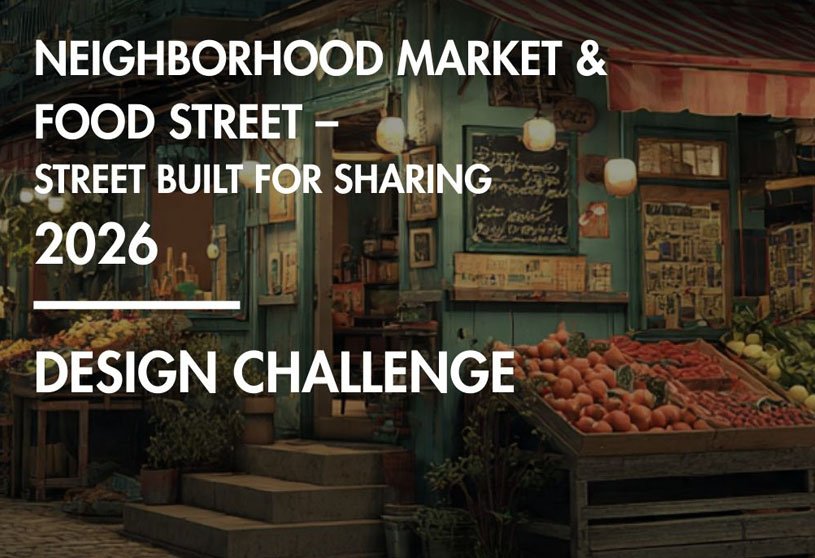
Across cities, streets have always been places of exchange—of goods, stories, smells, and cultures. Neighborhood markets and food streets represent the most vibrant expressions of everyday urban life, where informal commerce, social interaction, and local identity intersect.
The Neighborhood Market & Food Street – Street Built for Sharing design competition invites participants to reimagine a street as a shared civic space that balances vending, dining, walking, resting, and gathering. The challenge is to transform a typical urban street into a people-first environment that supports livelihoods, celebrates food culture, and strengthens community life.
Objective
The objective of this competition is to explore how streets can move beyond traffic corridors to become inclusive, flexible, and socially rich public spaces. Participants are encouraged to propose design solutions that:
- Support local vendors and small food businesses
- Enhance pedestrian experience and safety
- Encourage social interaction and cultural exchange
- Adapt to different times of day, seasons, and events
- Respond to local climate, context, and community needs
The Building Program
Participants may propose a street-scale intervention that includes, but is not limited to:
- Vendor stalls and food kiosks (temporary or permanent)
- Shared seating and dining zones
- Shaded walkways and weather protection elements
- Utility integration (water, waste, power)
- Storage and service zones for vendors
- Lighting, signage, and wayfinding
- Micro-public spaces for performances or gatherings
Designs should emphasize flexibility, modularity, and human-scale design.
Site
The site is a generic neighborhood street context, allowing participants to choose an urban location of their preference—dense city core, residential neighborhood, or transitional urban edge.
Participants should clearly define:
- Street width and length
- Surrounding land uses
- Climate and cultural context
- Existing challenges and opportunities
Both real and hypothetical sites are acceptable.
Fees
| Stage | Start | End | Fees (INR) | Fees (USD) |
| Early Bird | 1st January 2026 | 22nd January 2026 | ₹ 500 | $ 6 |
| Standard Registration 1 | 23rd January 2026 | 8th February 2026 | ₹ 900 | $ 10 |
| Standard Registration 2 | 9th February 2026 | 22nd February 2026 | ₹ 1300 | $ 15 |
| Standard Registration 3 | 23rd February 2026 | 8th March 2026 | ₹ 1700 | $ 19 |
| Standard Registration 4 | 9th March 2026 | 22nd March 2026 | ₹ 2100 | $ 24 |
| Standard Registration 5 | 23rd March 2026 | 8th April 2026 | ₹ 2500 | $ 28 |
| Standard Registration 6 | 9th April 2026 | 22nd April 2026 | ₹ 2900 | $ 32 |
| Late Registrations | 23rd April 2026 | 10th May 2026 | ₹ 3300 | $ 37 |
Jury
The jury panel will consist of experienced architects, designers, educators, and industry professionals from diverse backgrounds. Entries will be evaluated based on:
- Spatial quality and placemaking
- Integration of vendors, food culture, and street life
- Pedestrian experience, accessibility, and safety
- Flexibility, adaptability, and time-based use
- Contextual response, feasibility, and innovation
The jury’s decision will be final and binding.
Eligibility
- Open to all.
- Individual and team entries are allowed
- Team size: minimum 1 – maximum 4 members
- No restrictions on age, nationality, or academic background
To find more details & Register visit HERE
LAST DATE OF REGISTRATION: 10 MAY 2026
LAST DATE OF SUBMISSION: 20 MAY 2026
—–
Note: If you are a Competition/Award/Event organiser, submit your Competition/Award/Event to ArchiDiaries for publication by LOGGING to ArchiDiaries, or by filling up this simple google form>> https://forms.gle/U2KS763eRMY6cGhH7