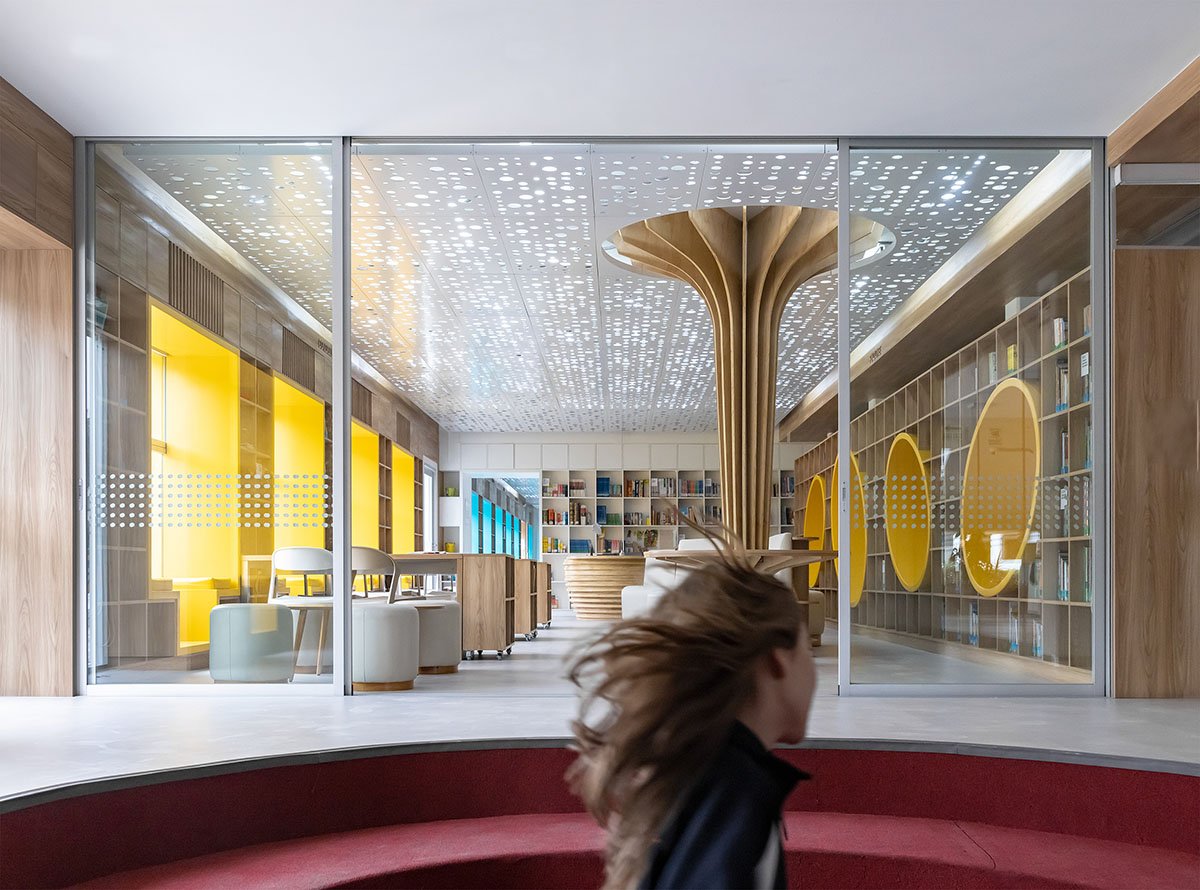
Excerpt: Antonio Raimondi College Library by TERRITORIAL features the transformation of an existing pavilion into a flexible, welcoming space for learning, reading, and interaction. The interior design of the library focuses on enhancing its natural light and comfort throughout the year. Color, adaptable furniture, and integrated storage create dynamic areas for different age groups, fostering creativity, focus, and collaboration.
Project Description

[Text as submitted by architect] The Learning Management Center transforms a study space into a functional and welcoming environment to foster learning, reading, and interaction among students. This project reflects on new ways to occupy space and incorporates typological proposals that adapt to the needs of contemporary design.


The intervention took place in a pavilion of an existing building, respecting its original structure and adapting it to new uses. The decision was made to relocate the library to the north façade, optimizing climatic conditions: in winter, sunlight enters and warms the space, while in summer the library remains protected from its intensity, ensuring a comfortable and naturally lit environment throughout the year.


The ground floor of the pavilion, previously designated for classrooms, was transformed into a versatile environment that maximizes space usage. Walls were widened to integrate them as storage and organization areas, and new windows were opened to improve natural lighting and create cozy corners for reading and conversation. Additionally, a chromatic strategy was incorporated to differentiate educational levels: yellow, linked to creativity and concentration for the youngest, and turquoise, which brings calm and energy for teenagers.

This pedagogical approach involved collaboration with education specialists, who provided ideas on how spatiality influences learning and child development. In this sense, the furniture was designed with accessible heights for both children and adults, and the spaces were planned with the flexibility necessary to adapt to various academic and recreational activities.


The selected materials ensure resistance and durability against daily use. The furniture promotes exploration and movement, allowing children to interact freely with the space. The ceiling, composed of handcrafted perforated aluminum panels, distributes light evenly and hides installations, creating an orderly environment that enhances concentration.

The Antonio Raimondi Library thus becomes a model of an innovative and flexible educational space. Its design integrates hybrid and dynamic areas, such as reading zones, individual cubicles, and a small auditorium. The optimization of existing elements, such as walls turned into programmatic structures, allows for efficient use of space without visually overwhelming it. Through an intervention that balances functionality, comfort, and design, the library manages to connect with its primary users: children, teachers, and the educational community.
Drawings


Images