Excerpt: Complejo Cruzcampo, a rehabilitation project by AYESA Engineering and Architecture, transforms a historic industrial complex into a vibrant, mixed-use cultural and educational space. Emphasizing transparency, openness, and urban integration, the intervention preserves the site’s architectural heritage while introducing modern uses like a hotel school, microbrewery, and event spaces. The unified approach enhances connectivity and public access.
Project Description

[Text as submitted by architect] The iconic Cruzcampo Factory complex in Seville, an integral part of the city’s historical industrial heritage, has been rehabilitated with an intervention that has affected its three main buildings to include new uses as well as to expand the space for pre-existing ones.
AYESA Engineering and Architecture developed the architectural design and construction as well as provided the construction management for the 5,000 m2 destined to house the renovated facilities of a hotel school, restaurant, microbrewery, training workshops, offices, and cultural spaces including a viewing platform for vistas over the city.
The intervention has renovated the neighbourhood by creating greater interaction of the complex with the city as well as providing new circulation flows between the buildings thanks to the elimination of the perimeter wall of the factory that had surrounded two of the intervened buildings.


The original project dates to 1904 and was designed by German architects Wilhelm Wrist and Friedrich Stoltze. It is the first brewery in Seville organized with a complex of buildings for various industrial uses, following Central European manufacturing models.
The Cruzcampo factory complex is located in one of the current nerve centres of Seville, the Nervion neighbourhood. It consists of three historic buildings, one from 1904, called Maestranza, and two built between 1939 and 1940, called Cruzcampo Factory (formerly the Mosaico building) and Cruzcampo Tower (formerly the Palomar –Dovecote– building, included in the catalogue of protected buildings in the city).
As a result of the transfer of beer production to a site outside the urban area, Heineken (owner of Cruzcampo) decided to transform the historic buildings that had housed the old brewery room and the beer fermentation cellar, to make possible new uses related to beer’s cultural and social value and, by extension, to gastronomy and hospitality.


Heineken commissioned AYESA to transform these buildings and the architectural team proposed a project that not only adapts them to their new uses, but also recovers their heritage value and opens them up to the city of Seville with a commitment to transparency and accessibility. There is a clear desire to approach the intervention in a unitary way, to make it more recognizable as a whole, and not individually building by building.
The project has been developed in phases, from 2017 to the present. The first building to be completed was the Cruzcampo Factory, inaugurated in June 2021, followed by the Maestranza, the subject of an intervention that affected its facades, and finally the inauguration of the Cruzcampo Tower on October 15.

Cruzcampo Factory: a building that integrates various restoration programmes
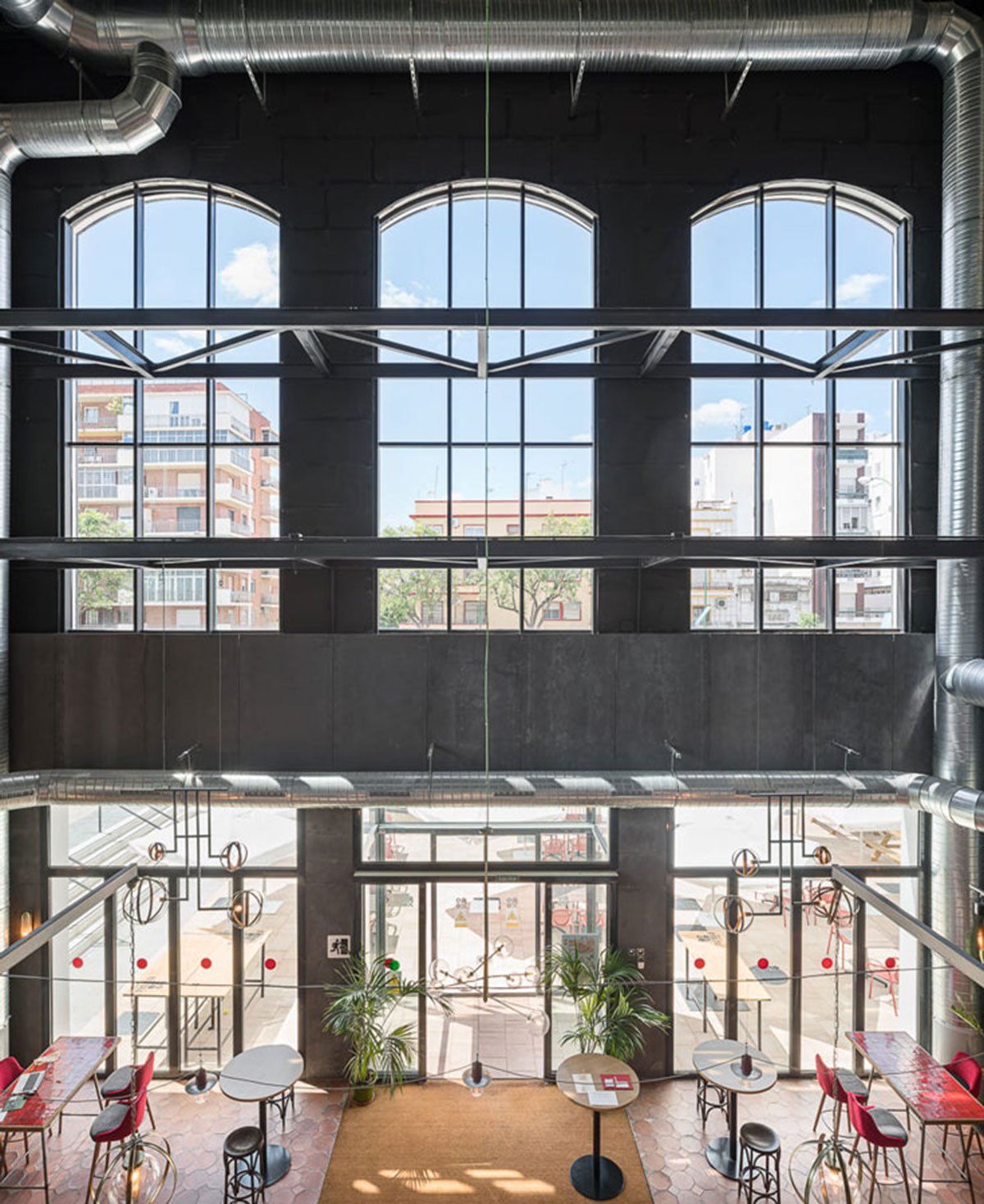
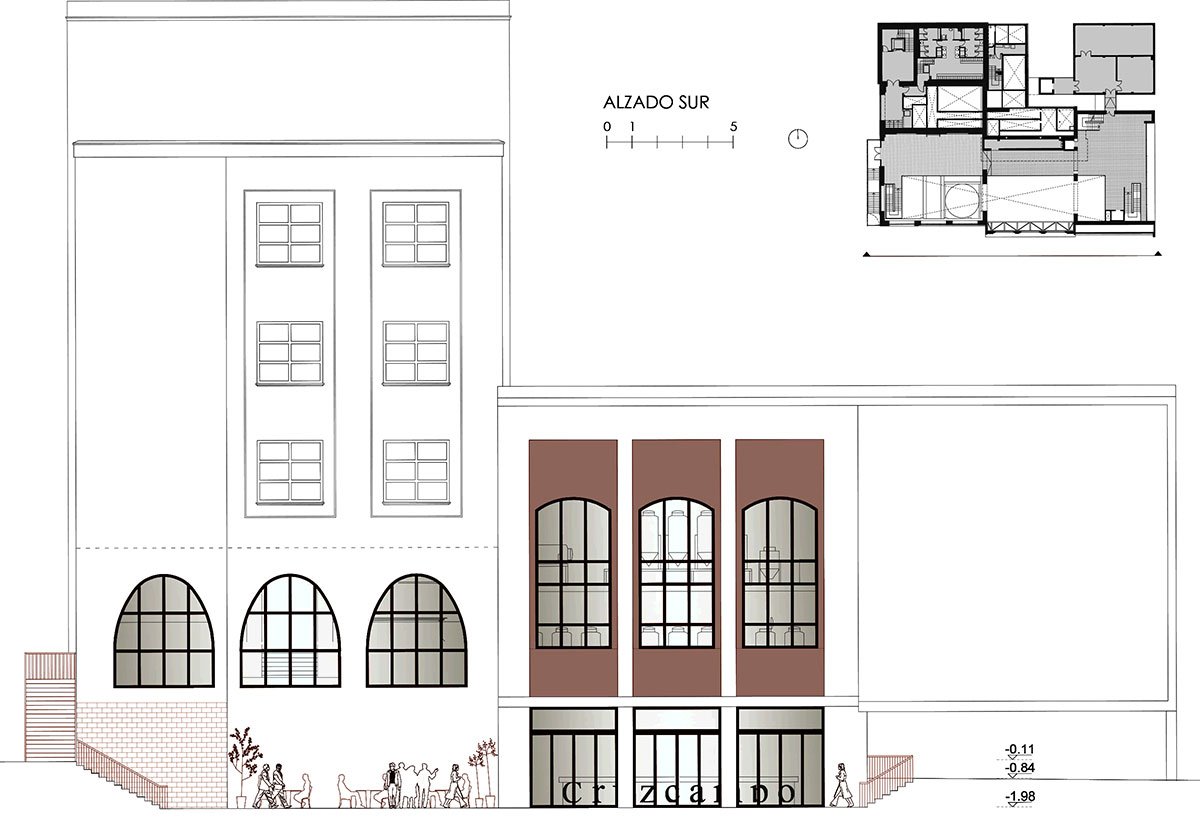
To give greater prominence to all the restoration activity of the Cruzcampo Factory building, its opaque east façade was replaced by a light and transparent one, allowing the interior installations to be visualised at a great distance from the street during the day and become a plane of light at night.
The architectural project complements the transparency of the new façade with the construction of an adjoining recessed plaza that allows the entry of daylight into what originally was a semi-basement level, where the restaurant is located, and also provides direct access to the building, characteristics that reinforce the public character of the facility.


The new building program, in spaces formerly intended for the beer brewing process, asked to resolve the coexistence of different uses related to each other: restaurant, brewery, microbrewery and hotel school. The careful conceptualization of the space in its entirety and the particularity of its different uses resolves the hotel school activity in an orderly way, despite the functional complexity.
Among other solutions, the design dispenses with the kitchen enclosure, which is also extended and reformed so that it is fully integrated into the restaurant dining space, allowing visitors to observe the work and the handling of food.
The project also incorporates a microbrewery that coexists with the restaurant function. Though located in clearly differentiated spaces, the design unifies the interior volumes of the building to provide this programme with a unique character that is highly representative and visible from a multitude of perspectives, both from the outside and from the inside. To achieve this in the Cruzcampo Factory building, the key element is a new mezzanine where the brewery facility is located, generating a double height space that is illuminated by the windows of the main façade.

The rehabilitation of the emblematic Cruzcampo Tower building
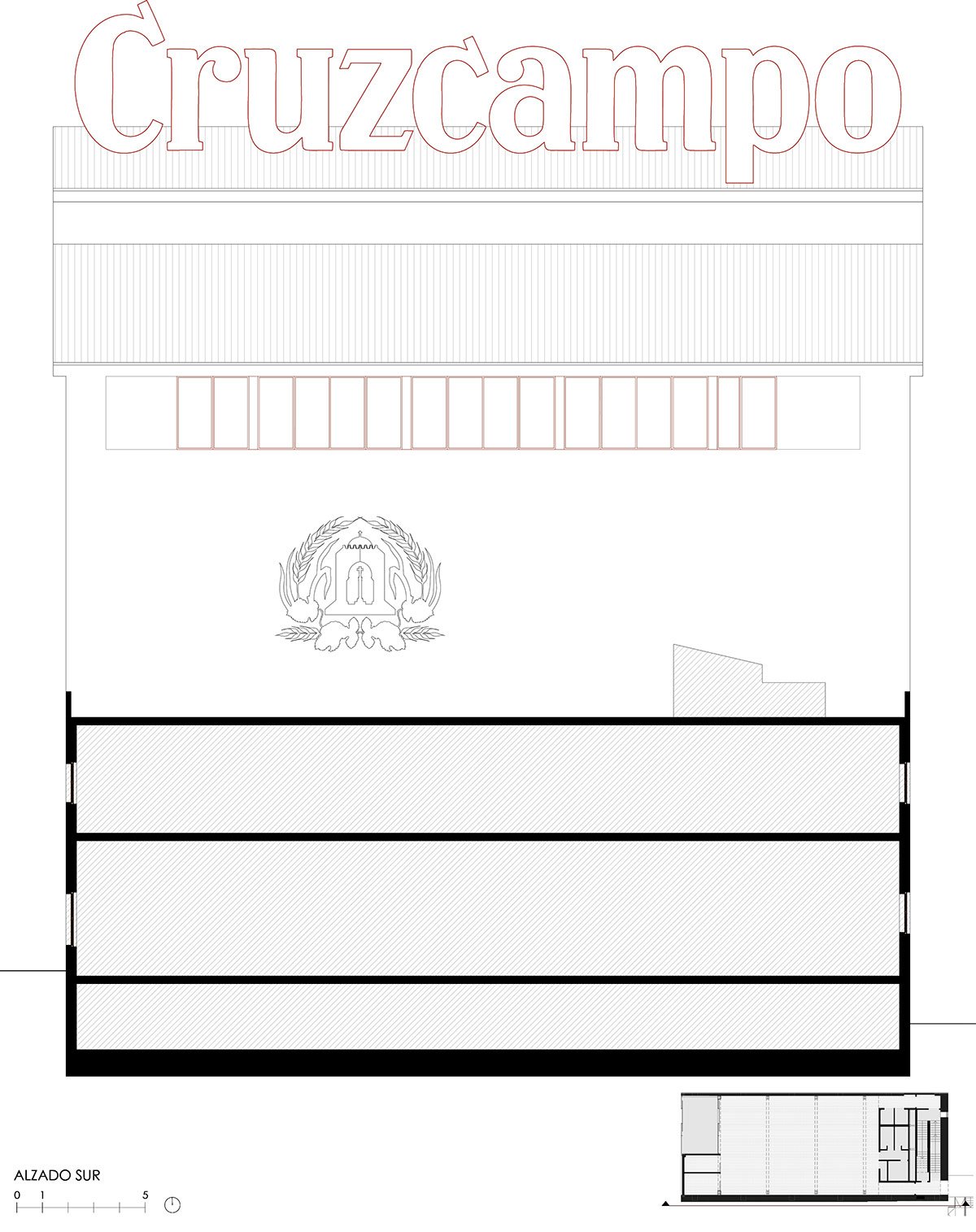
The factory’s old fermentation silo, popularly called Palomar, Dovecote in English, for the presence of these birds on the roof, is a listed building well known in Seville for its height and its gabled roof topped with the iconic Cruzcampo sign.

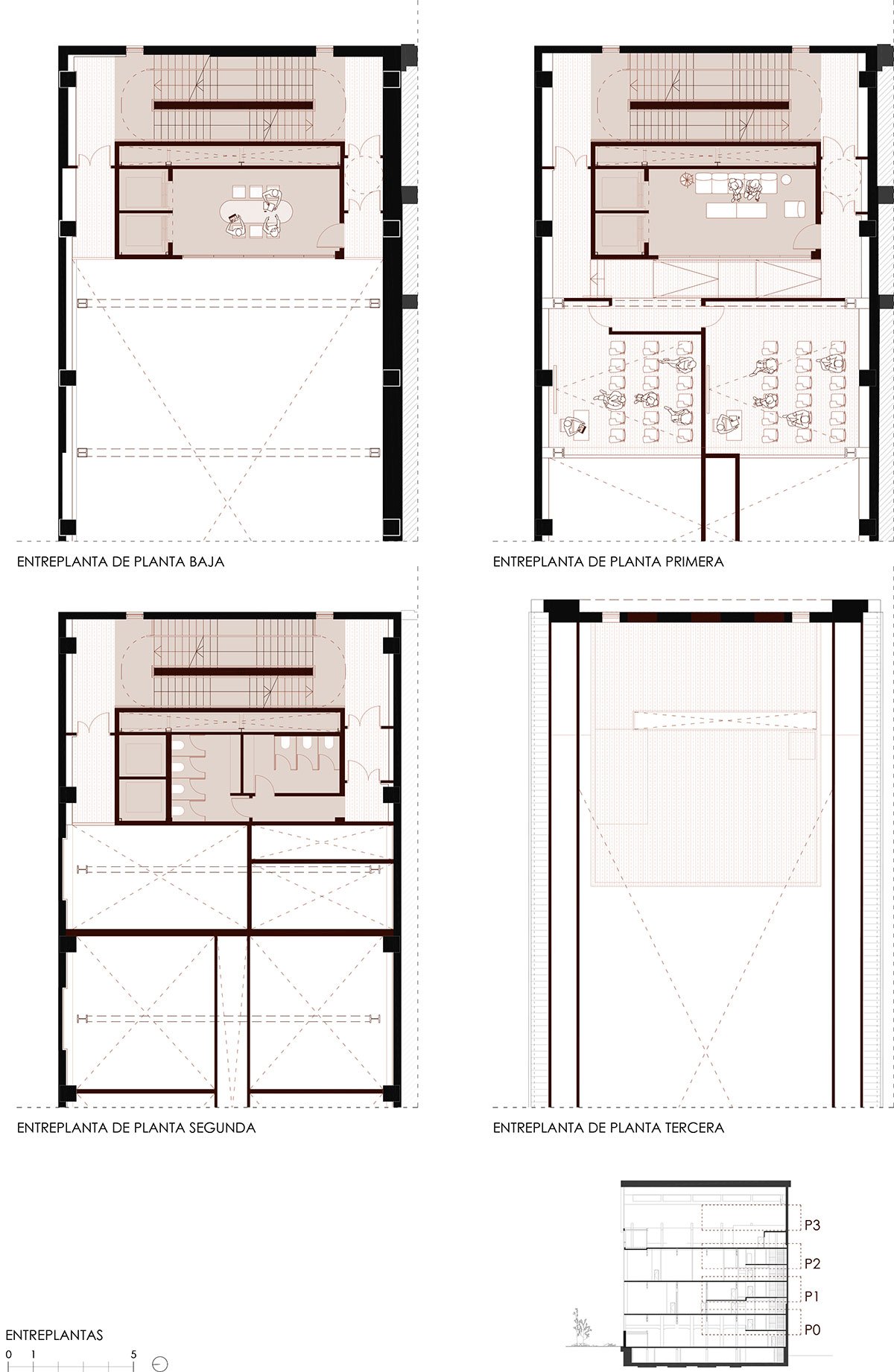
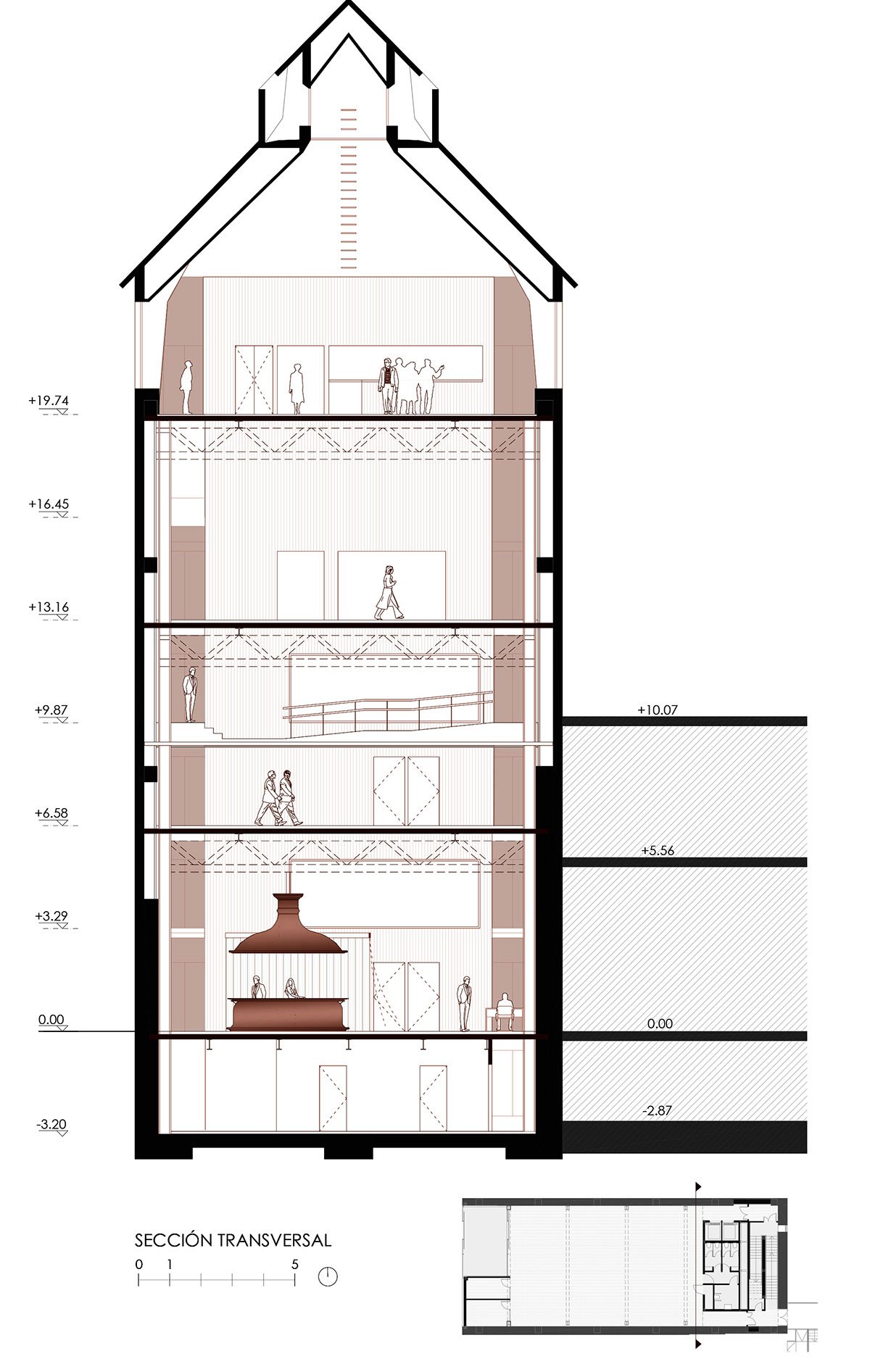
Recently inaugurated, AYESA’s project in this case proposed the complete emptying of the old silo, maintaining its original brick and concrete skin which takes on an aesthetic and historical value when it is shown as it is with the stains of the gases emitted during the fermentation process that took place there. On a technical level, emptying the silo permitted existing slabs to be replaced by new ones, allowing an increase in the clear height of the floors and the elimination of central pillars, an essential action to achieve the necessary versatility of the planned programs including classrooms and training spaces for the promotion of entrepreneurship.
This freeing up of space is helped by the centralisation of vertical communications, with a double staircase and lifts, in a service core arranged at the back of the building. On the top floor there is a space for celebrations and events, a large open-plan room that has a terrace located on the west façade, which thus culminates the effect of transparency for the entire project with an accessible opening that looks to the horizon, the Mirador, providing views of the historic centre of Seville.


Unitary treatment of the façades of the complex and recovery of their historical and heritage value: The rehabilitation of the factory hinges on the façade interventions of the three buildings (Maestranza, Mosaico and Palomar) with similar materials, solutions, and finishes, providing the whole complex with an aesthetic uniformity that enhances the preservation of its heritage and historical value.
However, the beer production process meant that the Mosaico and Palomar buildings had facades characterised by their opacity that isolated the building from the outside, minimising the entry of natural light. The new uses planned led AYESA to propose an intervention in the facilities that, while respecting the preservation of industrial heritage, would also provide them with luminosity and transparency; to this end, the design introduced a self-supporting glazed façade in each of these buildings.

This same solution is applied in two different buildings and coexists with a treatment for the rest of the façades whose objective was to recover their original appearance as much as possible, thus enhancing their historical and heritage value. For this reason, brick is recovered as the original material, whenever its condition allows, and covered with white lime mortar. In the case of the Mosaico building, the intervention on the façade preserves the original mosaic from the 60s, a distinctive and identifying element of the complex since then.
On the building interiors, the project pays special attention to showing the construction aging, the passage of time, and the traces of their previous uses. This criteria lead to maintaining certain construction detail elements used in the current rehabilitation, such as in the Palomar, where the loops and clamps placed at the bases of the concrete ribs have been left visible when demolishing the existing slabs to build the new ones.

More visibility and accessibility: the industrial complex opens up to the public The factory complex was surrounded by a powerful fence made up of grilles, columns and masonry walls, whose function was to clearly delimit the space and separate it from the pedestrian circulation of the surrounding avenues.
The project envisages the removal of part of this wall, making the intervened buildings more accessible and visible, establishing direct contact with the city. To this end, in the Cruzcampo Factory building, the removal of the wall is accompanied by the construction of a recessed plaza that permits direct entrance into what was a semi-basement level, where the restaurant is located, and improves entry of natural light to the space, design moves that reinforce the public nature of the facility. In the case of the Cruzcampo Tower building, the demolition of part of the wall and the urbanization with flowerbeds are essential for the project.
Drawings






Images