
Excerpt: Hotel Bauhofstrasse by VON M is an architecture project that initially appears as a strange white object. The four-story building features a capped mansard roof facing south and east and adopts the height of the directly neighbouring building. The surprisingly strong structure in its abstraction clearly contrasts the complex existing environment but, at the same time, serves the community and the location
Project Description

[Text as submitted by architect] Coming from the south, today the well 90,000 inhabitants counting Swabian City of Ludwigsburg, can be recognized as a typical baroque royal residence city. Hereby one has the option of either taking the stately way to the former residence castle of Duke Eberhard Ludwig from Württemberg or the citizen way through the residential city adjoining in the west which had been designed on the drawing board.
The two ways unite in a fixed point at the end of their axial alignment which in its respective appearance could hardly be of greater difference. Here the baroque representative building of the castle, there the residential tower of the Marstall Centre: a scale-breaking building volume of the 1970s.

Unlike other comparable buildings of that time it misses the charm of a somehow strange testimony. The ground floor is dominated by a shopping mall and other retail trade areas. In the 2010s the mall threatened to fall into disuse. Then an investor was found and through the announcement for the facade somewhat surface cosmetics was put on which partly does its job on the ground floor but – on the whole – cannot adequately serve the sheer mass of the building.


Analogue for facade renovation and reorganisation of the Marstall, the area immediately north of this inner-city giant was declared an urban development area and one decided to build a square called “city terrace” as well as a new hotel. The new hotel building was determined within the scope of a multiple assignment between six architectual offices. The design of the Stuttgart office VON M finally was recommended for realisation.
According to the city of Ludwigsburg the building “should contribute to the revival of the environment” and further be “an important identity-building impulse for the northern quarters and become a showcase project as the first CO2-neutral building in Ludwigsburg”. One operator was ready, and an investor was found in a lengthy, tedious joint search. But how should one build on this site? On the one side opposite the chapel and the western cavalier building of the castle, but on the other side where clearly the city centre ends and where queues of the delivery and visitor traffic build in front of the Marstall facade and multi-storey car park.

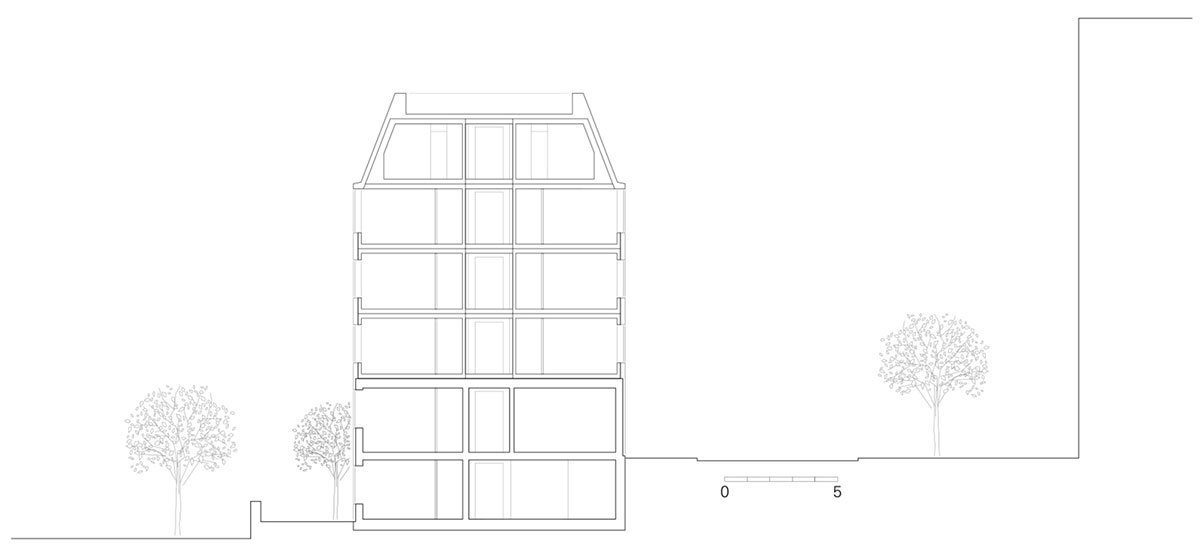
Dennis Mueller, Matthias Siegert and their team of the VON M office have decided on a surprisingly strong structure which in its abstraction clearly contrasts the complex existing environment but at the same time serves the community and the location. The four-storey building with a capped mansard roof facing south and east adopts the height of the directly neighbouring building, but initially appears as a white strange object.


Bright, almost blinding, are facade and roof, the openings are executed as inserted, up- rightly formatted boxes with fixed windows and white opening sashes. Facing north the house which is dug into the slope disposes of one floor more because of the inclined topography.
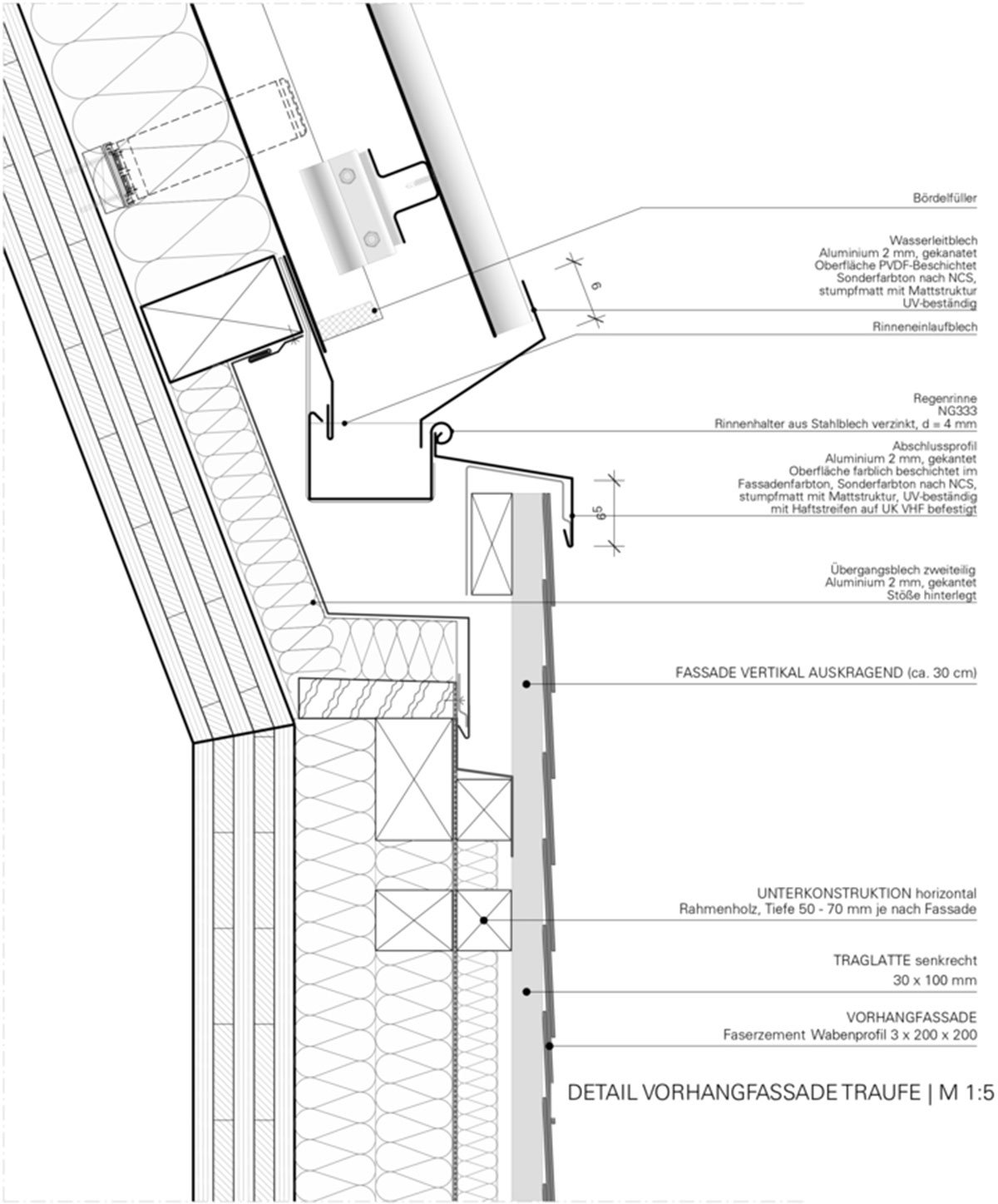
The shingling with white fibre cement plates does not give the slightest hint that this is a wooden building. This cladding in the Semperian sense together with the flush-mounted standing window formats and dormers shrewdly translocate the local building traditions into our time. The local baroque residential houses are also wooden buildings, albeit with plaster-clad walls. They also have windows, almost flatly embedded in the facade; many roofs of that time show dormers.


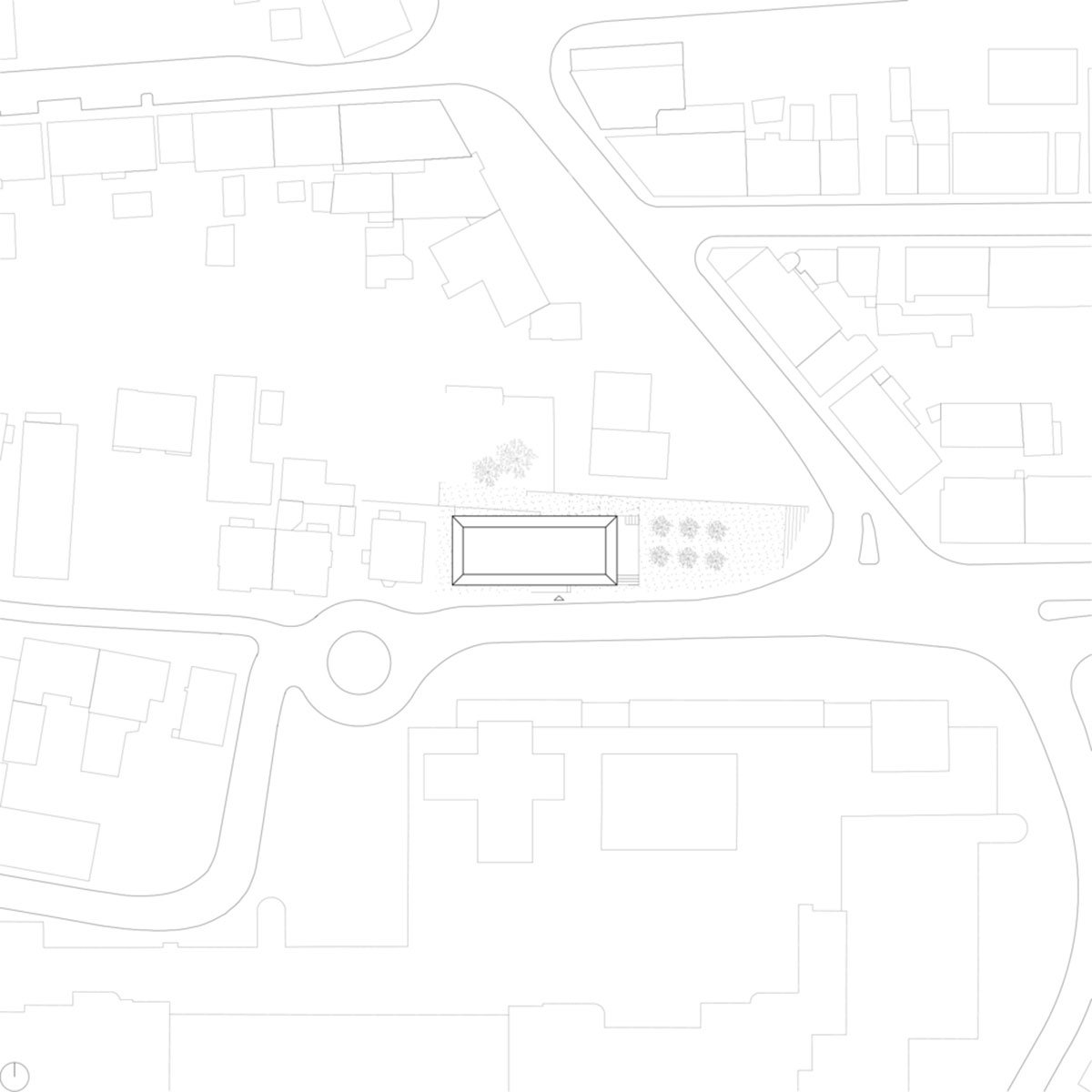
But the adjacent existing buildings of this place of the city are much more heterogeneous than the ones just a kilometre off south. Hardly is there anything from the times of urban development since the 18th century which one cannot detect within sight. Buildings of the seventies, residential buildings from the baroque and Wilhelminian period, everything on a gentle east as well as considerably north sloping terrain.
Therefore theoretically an excellent place for a “city terrace”. But in order to function as such it must be filled with life. Neither can the delivery traffic nor the masses of passenger car traffic in the city centre. The architects have solved this problem for the new hotel building in both an obvious and conclusive manner by locating all public areas of the hotel on the eastern, narrow side of the building thus provoking public interest.


Here, towards the future city terrace, where the building forms a room edge which had sorely been missed so far, bistro and bar area are located, followed by reception and rooms for office and administration as well as baggage storage rooms. Here the architects themselves have designed both bars and counters as well as the tables and had them manufactured from solid ash wood by local craftsmen. The solid parquet flooring is made of the same wood, too. The quality of craftsmanship has an immediately positive effect on the atmosphere of the room, especially on those guests who know the entrance areas of other hotels.


This spatial quality resulting from the material is also to be seen on the other floors. In the basement, apart from three rooms facing north down the slope, there are rooms necessary for waste disposal, bicycle rental, staff entrance and laundry service and delivery, all serving the hotel business and accessible through a ramp, detached from the main entrance.
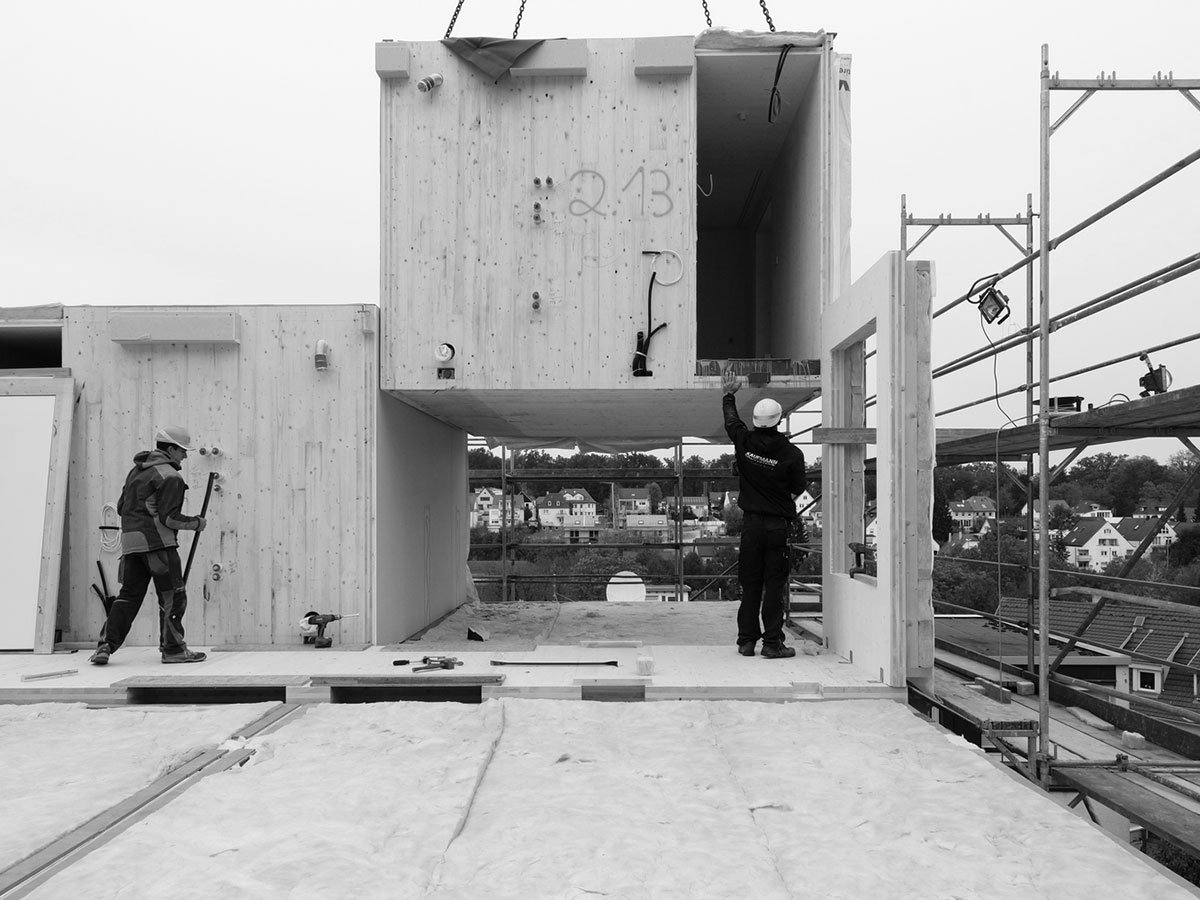
Together with the ground floor this floor functions as a sort of supporting table for the other floors which have been realized by means of prefabricated wooden modules. These modules made from local wood and produced in Vorarlberg / Austria were installed in Ludwigsburg within five working days. The walls, floors and ceilings of the hotel rooms were assem- bled to container-like modules in the factory from cross-laminated timber which had been computer-controlled cut.


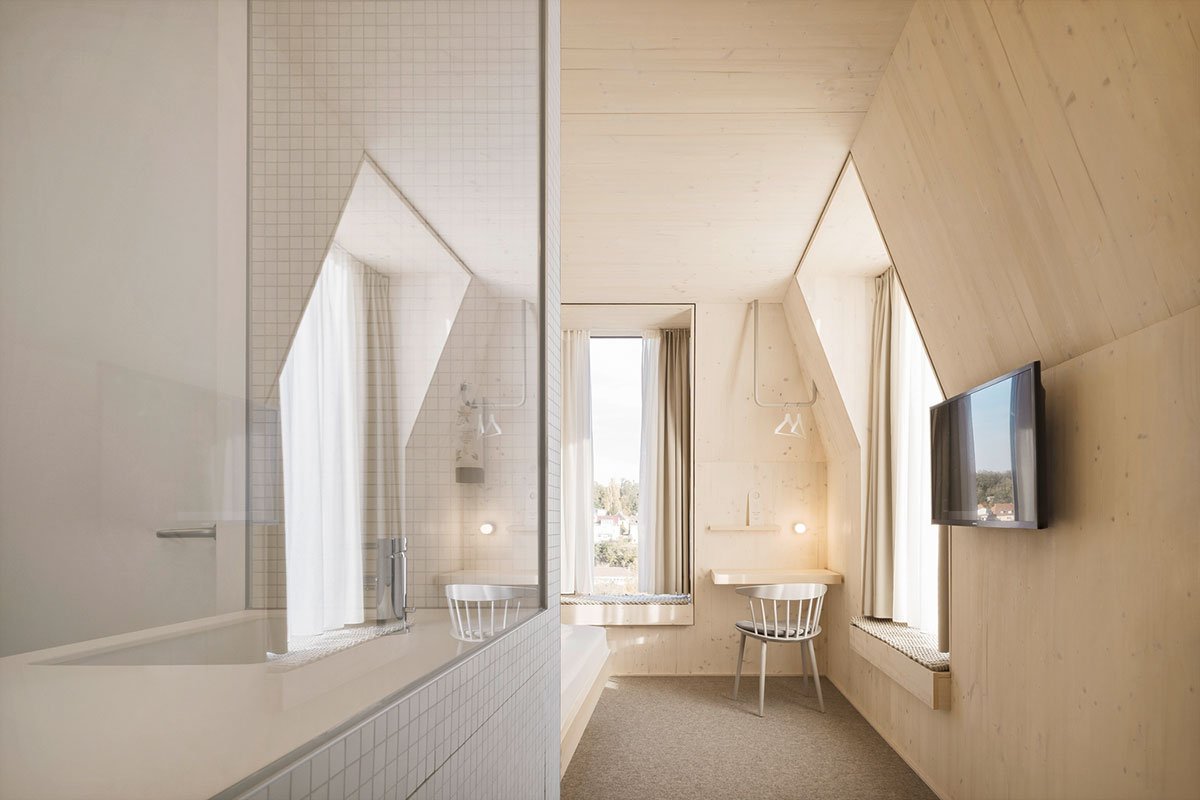
The concrete staircase stiffens the building. Both in the staircase and in the rooms, the surfaces remain visible in their inherent construction: fair-faced concrete and painted metal on the one hand, spruce wood and natural fabrics on the other one. In total 440 cubic meters of wood were used thus permanently extracting a total of 880 tons of CO2 through storage and substitution effects. The use of the CO2-intensive material concrete is compensated for by the wood used: the result is a CO2-neutral building.
Drawings


Images


