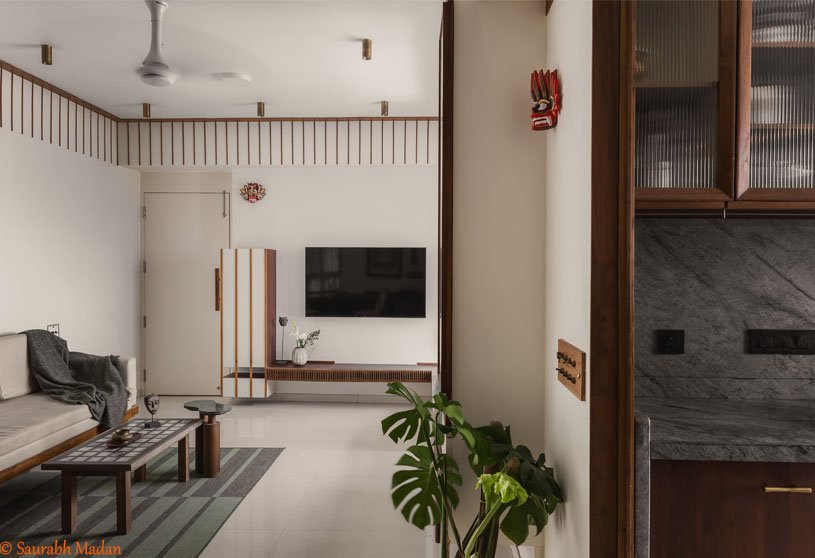
Excerpt: SMLXL by Rust Collective is an interior design project that treats a modest 2BHK as a patient exercise in “making rather than picking.” With a frugal budget and modest footprint, the design resists grandeur and stylistic labels, unfolding through questioning, rethinking, and care. Conceived as a series of micro projects, the home prioritizes clarity, material honesty, and everyday functionality, where craft and intent define intimacy over ornament.
Project Description

[Text as submitted by architect] In the dense fabric of Mumbai’s residential towers, a two-bedroom apartment might easily dissolve into anonymity. But in the hands of the founders, Neel Shah, Pratik Shah and Dhruv Sachala, of Rust Collective, the home for a Gujarati family of five becomes a story of craft, care, and intent—one where every detail is treated as a micro project. With a frugal budget and a modest footprint, the design does not seek grandeur, nor does it follow a stylistic label. Instead, it unfolds as a patient exercise in questioning, making, and rethinking.

The clients—a catering-business family consisting of a couple, their young son, and the grandparents—needed a home that could balance intimacy, privacy, and functionality. What emerged is a space shaped less by ornament and more by clarity. A philosophy of “Making rather than picking” guides the studio’s approach: each element was developed thoughtfully, often made from scratch, rather than picked from stores and catalogues. Wall art, furniture, handles, even hooks and switchboards were custom designed and crafted to suit the space. The result is a design process that feels at once bespoke and deeply intuitive.


The living room becomes the heart of the home. Flooded with excellent ventilation and daylight from a large window, it is both a gathering space and stage for daily life. Here, seating was reconsidered not as bulky additions but as fluid, multifunctional elements. A TV ledge transforms seamlessly into a bench, doubling as storage for the toddler’s toys. This quiet move not only expands seating but also absorbs clutter—demonstrating how design can shift the quality of everyday life without drawing undue attention to itself. The palette throughout the home is restrained: whites, wood, lines, olives, and glimpses of brass.
Within this simplicity, textures, patterns, and handwork bring depth. A pooja unit, seamlessly integrated into the living space, uses bespoke hand-embroidered shutters that subtly evoke the aura of a shrine. In the couple’s bedroom, a wardrobe panel is treated with animated fabric embroidery for their son—a playful detail that personalizes his presence within the shared realm of family furniture. These gestures, modest yet intentional, underscore Rust Collective’s belief that a home is built not through excess but through intimacy and recognition of its users.


Material honesty drives the design. Marble basins in the bathrooms are crafted rather than purchased, brass handles are hand-cast, and even the hooks are custom-made. The dining table, unconventional in its triangular form, emerged from the constraints of space: a standard rectangle proved too tight.
Instead, this rethinking not only solved a functional problem but also added an unexpected playfulness to the everyday act of dining. Storage, always a pressing demand in Gujarati households, was built into the plan—snack storage within reach of the dining table, for instance, acknowledging habits as much as aesthetics. Each room responds to its inhabitant. The parents’ bedroom remains quiet and light-filled, with white and light mauve wardrobes and textured finishes for ease and calm. The couple’s bedroom is darker, more intimate, offering privacy and warmth.


There is a simple desk as well that becomes a workspace for the mother. Even the kitchen was re-dimensioned—customized to the height of the users in the household, making daily routines more comfortable. Small but precise interventions like these reveal the studio’s sensitivity: design as a tool for lifestyle, not decoration. What ties the apartment together is the refusal to treat it as a monolithic design thought.
Instead, Neel, Pratik and Dhruv approached it as ten smaller projects, each with its own nuance, yet part of a larger whole. The continuity of wood, brass, and fabric creates a binding thread, but it is the micro-acts—the crafted switch plates, the custom made lighting, the refurbished 50-year-old Pichwai painting on the dining wall, the textile artwork in the living room—that bring coherence.

For Rust Collective, design is not about chasing a singular visual identity but about pushing boundaries through process and intent. They resist the temptation of aligning themselves with a style, preferring instead to remain open, rigorous, and personal. A home, for them, is not an entity to be bought frequently but a once-in-a-lifetime space deserving care, craft, and responsibility. In this 2BHK, the philosophy becomes evident: raw materials, minimal clutter, personal details, and a belief in design’s ability to shape not only space but also the rhythm of living.

In many ways, this project demonstrates how even within constraints—budgetary, spatial, or procedural—design can remain uncompromised. It also suggests a more democratic reading of design practice: that thoughtful, detailed work should not be reserved for the privileged few but can and should extend to modest apartments, where the impact on daily life is perhaps most profound. This home is not defined by spectacle but by mindfulness. It is in the brass switch, the ledge that doubles as storage, the embroidered shutter, the reimagined dining table. It is, in other words, a home where design quietly transforms the ordinary into something more—personal, intentional, and enduring.
Images


