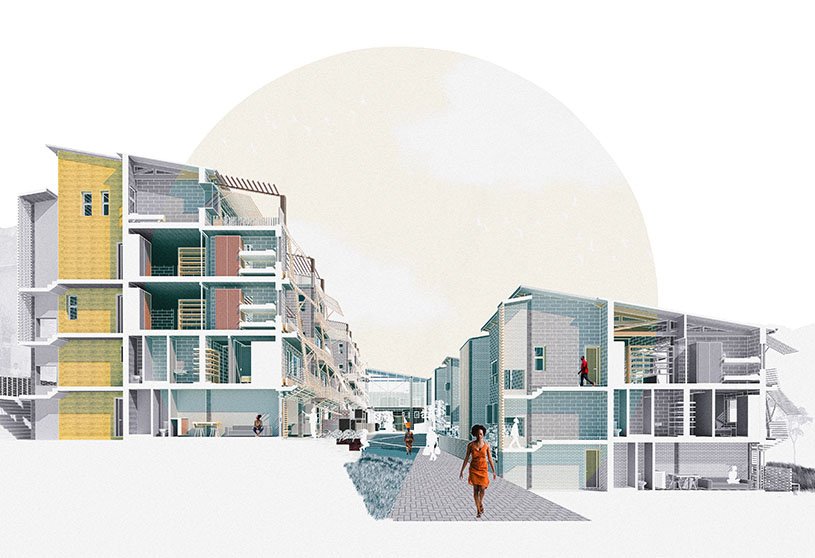
Excerpt: ‘Building a Woman’ is a Masters Design Project by Sarina Patel from the ‘Bartlett School of Architecture – UCL.’ The aim of this project is to provide an alternative to the Maasai Emuratare ritual by creating a rite of passage centered on learning, preserving, and innovating vernacular architecture through the construction of Manyattas. By combining ancestral wisdom with architectural education, the project empowers girls to participate in cultural continuity while fostering sustainable building practices.
Introduction: FGM is regarded by the Maasai as a rite of passage from girlhood to womanhood. For the majority of females, the coming-of-age transition is the only significant life event in which her family, friends, and fellow clan members acknowledge her. Outlawing the practice, however, has backfired somewhat, driving it underground and drawing criticism for being culturally inappropriate.
The aim of this project is to reinterpret the Emuratare ritual of the Maasai people by proposing an alternative rite of passage that involves learning about Manyattas, or traditional Maasai dwellings. Over many generations, vernacular building systems have been refined to use local, natural resources in cost-effective construction methods and passive design to adapt to their individual climates. Through the construction of traditional Maasai homes, women of all ages pass ancestral wisdom from one generation to the next. However, younger Maasai girls are deprived of the generational learning experiences that come with building these dwellings because of the establishment of permanent cities, colonial perspectives on indigenous typologies, and easier access to education.
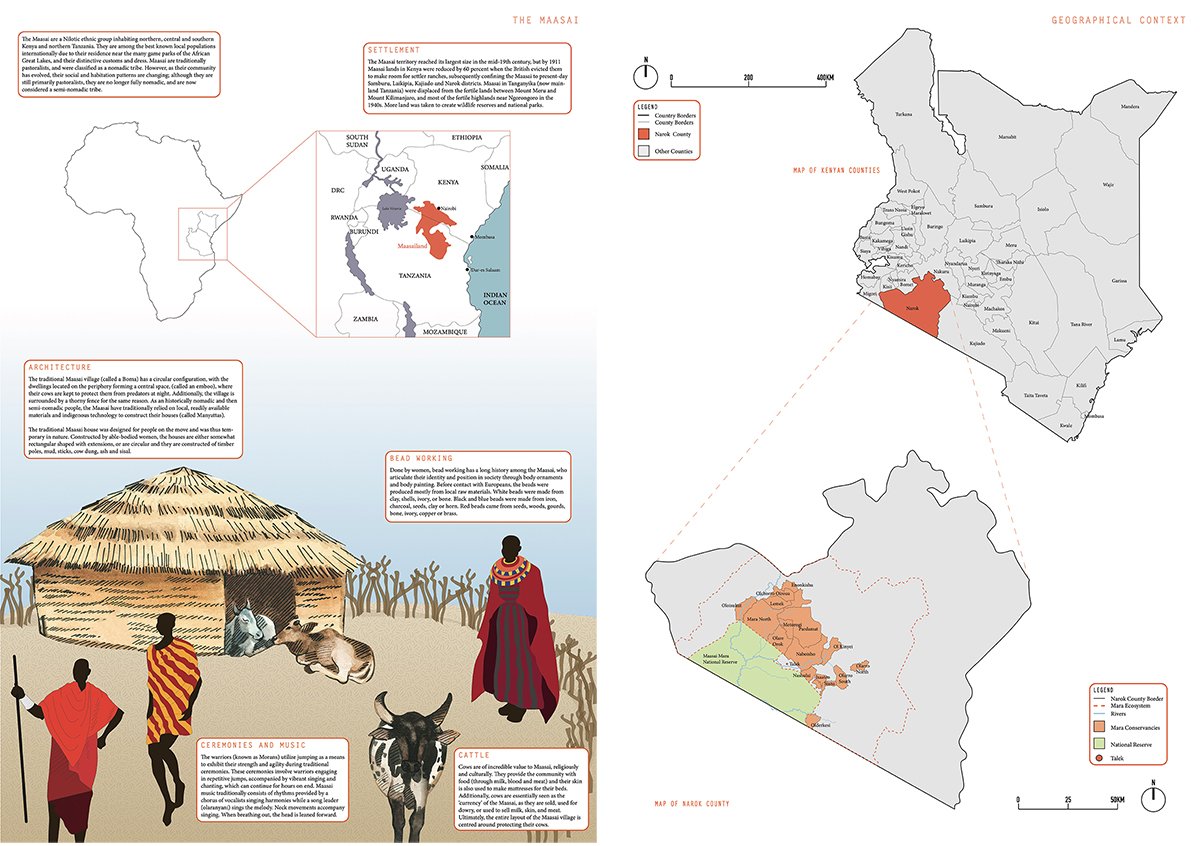
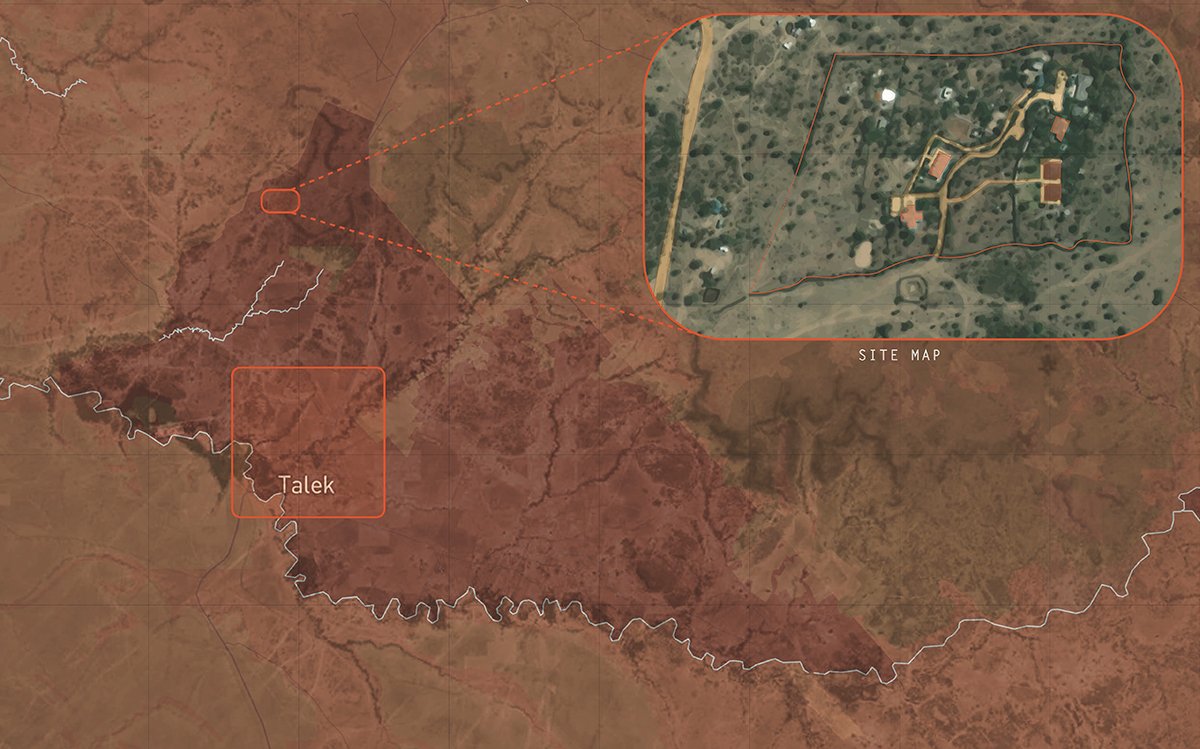
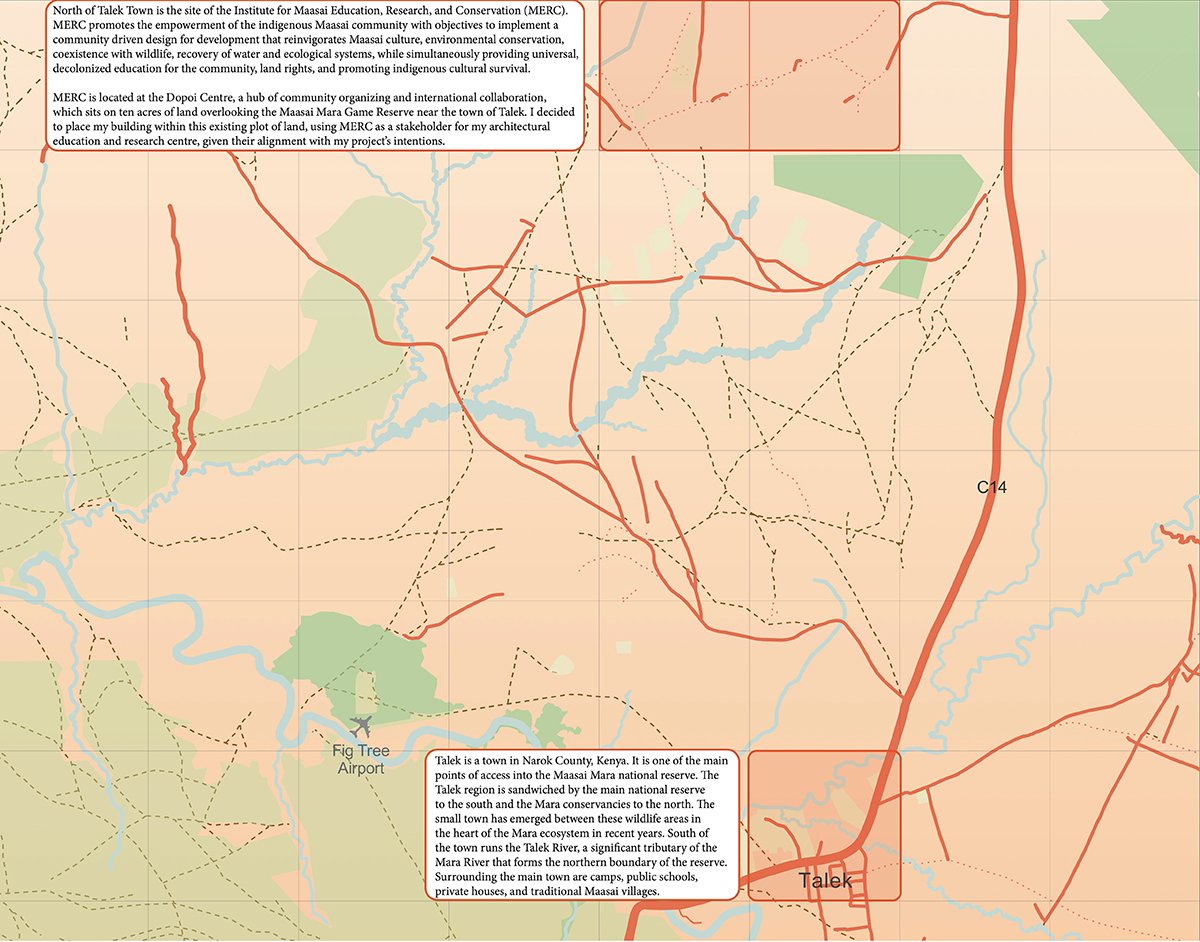
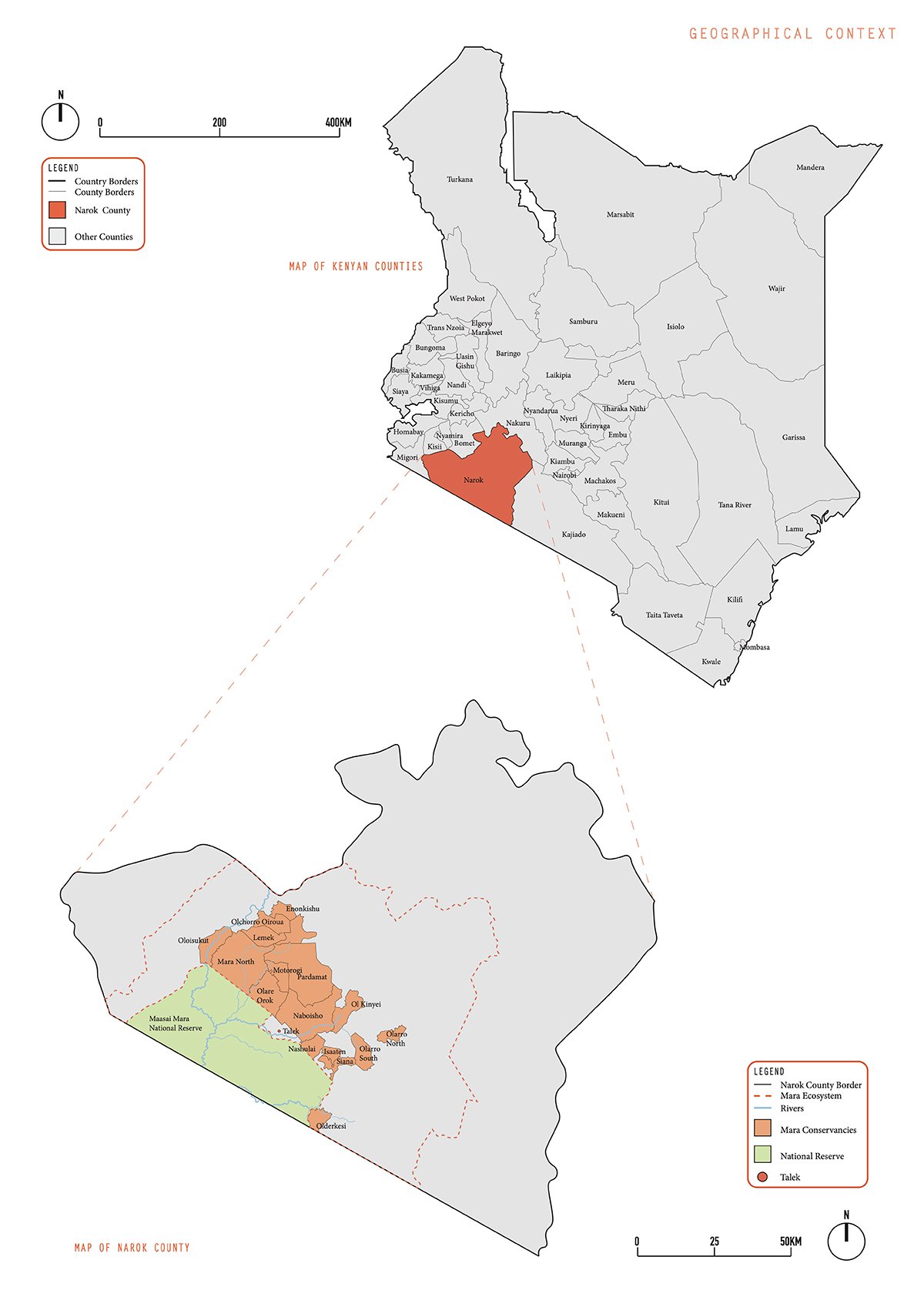
Community Context: The Maasai are a Nilotic ethnic group inhabiting northern, central and southern Kenya and northern Tanzania. | Talek is a town in Narok County, Kenya. Talek region is sandwiched by the Maasai Mara National Reserve to the south and the Mara Conservancies to the north. The small town has emerged between these wildlife areas in the heart of the Mara ecosystem in recent years.Site MapNorth of Talek Town is the site of the Institute for Maasai Education, Research, and Conservation (MERC).
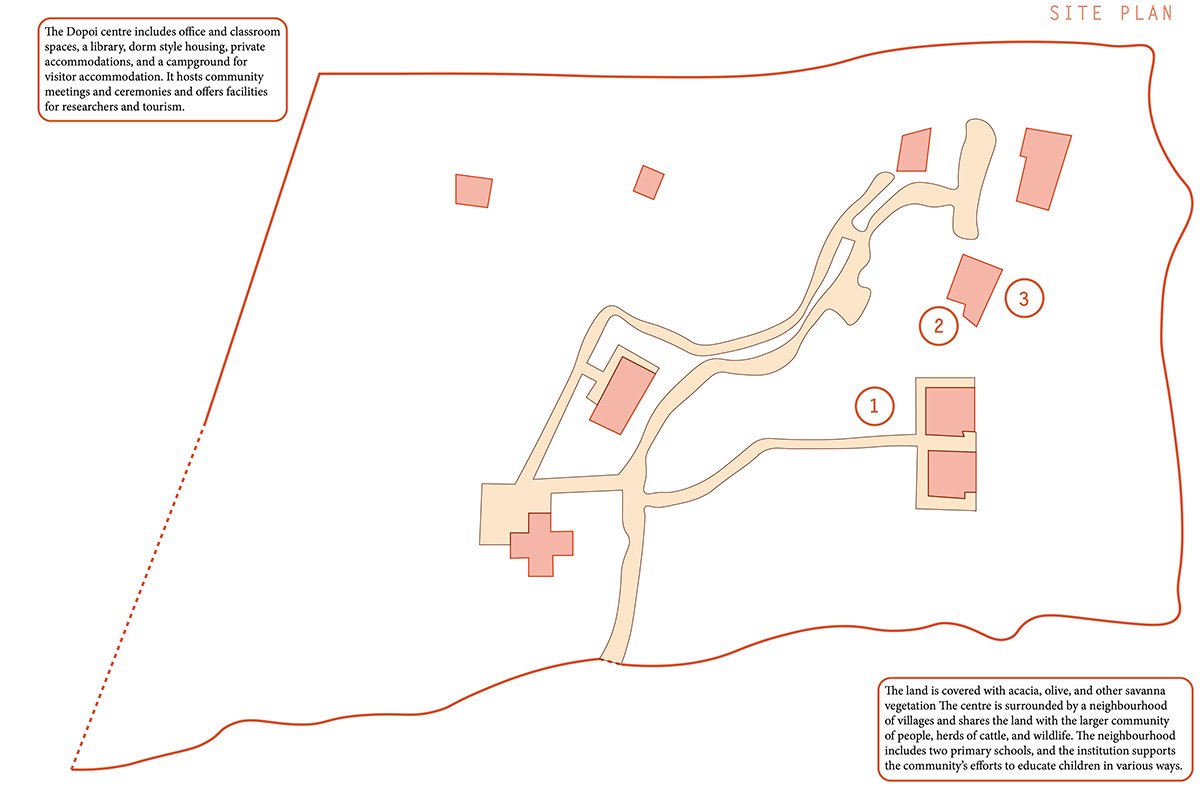
Working in partnership with The Institute for Maasai Education, Research, and Conservation (MERC), the project proposes an architectural education and research center designed using vernacular systems and materials but optimizing design and programmatic requirements. The center sits on the institute’s ten acres of land in a rural and remote high savanna area near the town of Talek in Kenya.
Site PlanThe building is situated on the institute’s ten acres of land in a rural and remote high savanna area.
Girls within the community will be coming to the center to learn how to construct their traditional architecture while experimenting with new methods to make it even better. In order for industry professionals and girls from the community to collaborate on ways to combine tradition and innovation in the pursuit of more sustainable buildings, they will receive support from both the older generation of Maasai women and professional researchers within the larger architectural research center.
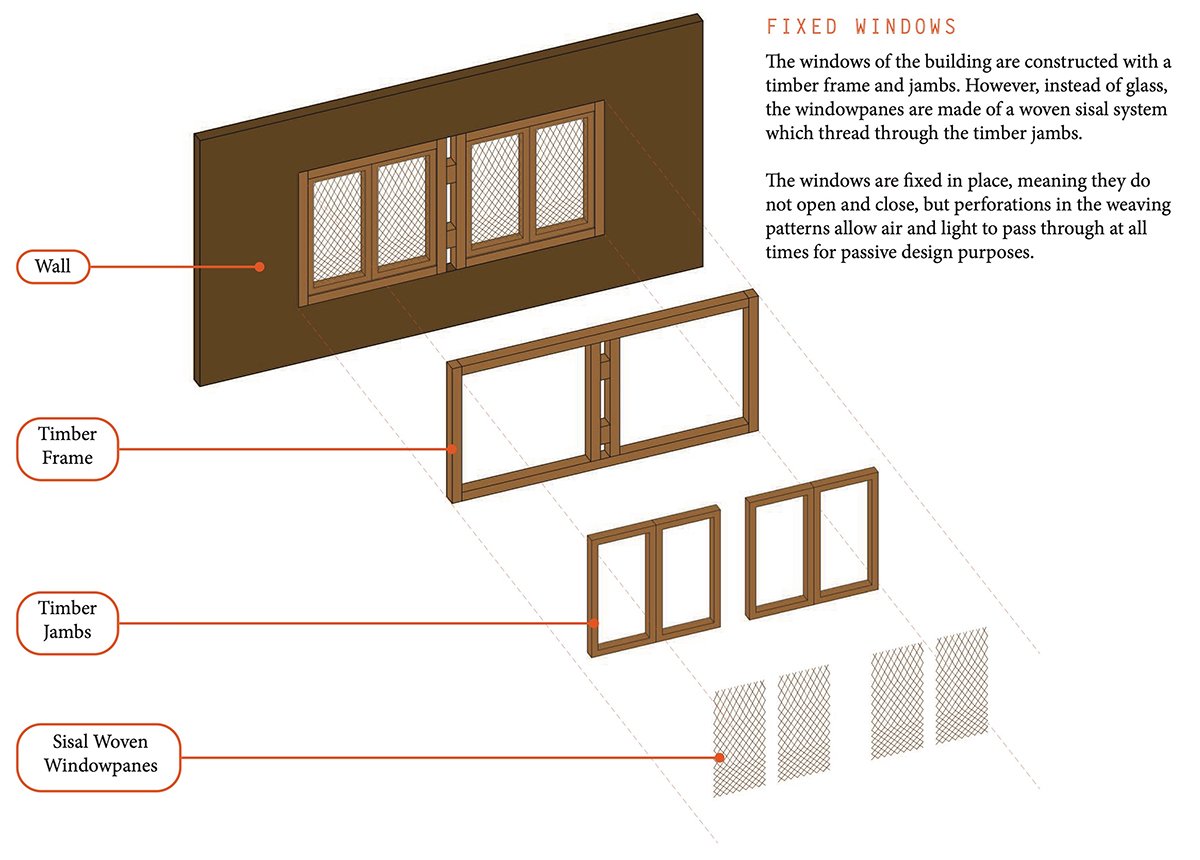
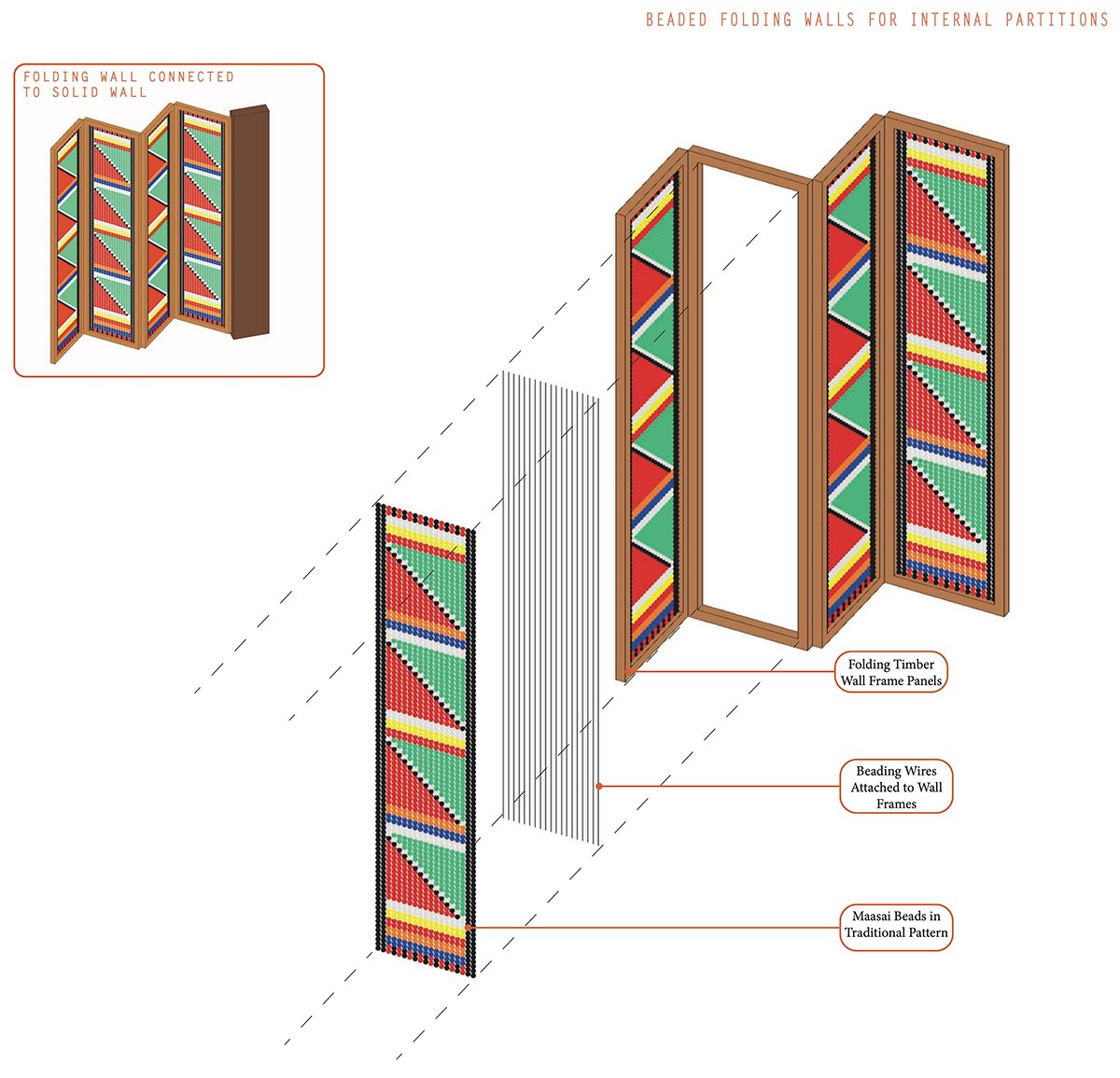
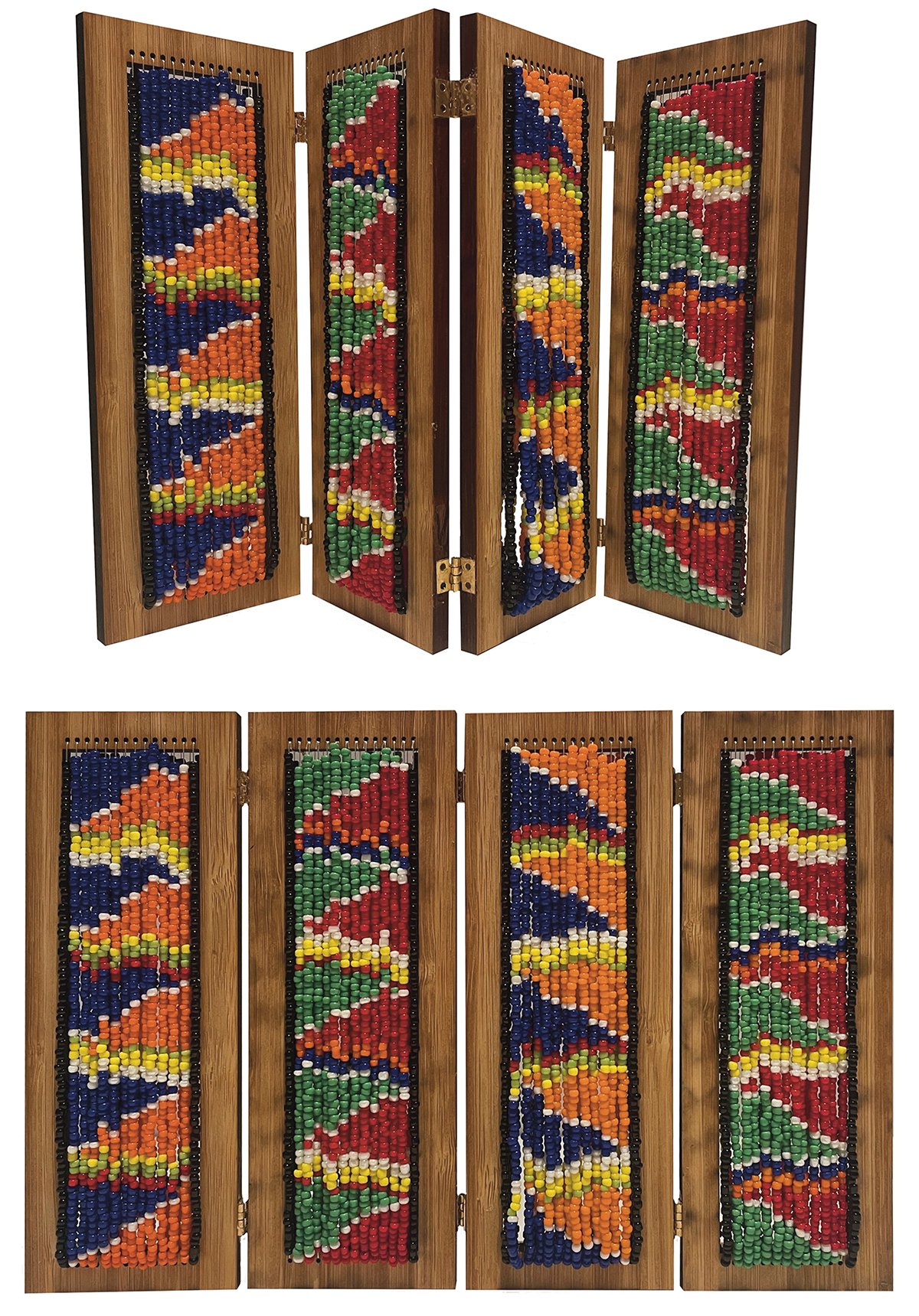
Structural System Of The Free-Standing Solid Walls, Built Using The Construction Systems Of Manyatta WallsDetail Of The Fixed Windows In The Solid Walls | Detail Of The Woven Pivot DoorsDetail Of The Beaded Folding Walls Used For Internal Partitions | Physical Model Of The Beaded Folding Walls Used For Internal PartitionsWoven Pivoting Kinetic Facades
For the walls, vernacular methods inspired by manyattas were adopted, with timber frames bound by sisal rope and plastered with soil and cow dung for cooling. These non-load-bearing walls, configured like puzzle pieces, incorporated fixed windows and woven sisal doors. Beadwork and basket-weaving—crafts rooted in women’s cultural heritage—were integrated through beaded folding partitions for spatial flexibility and a kinetic woven façade with rotating panels.
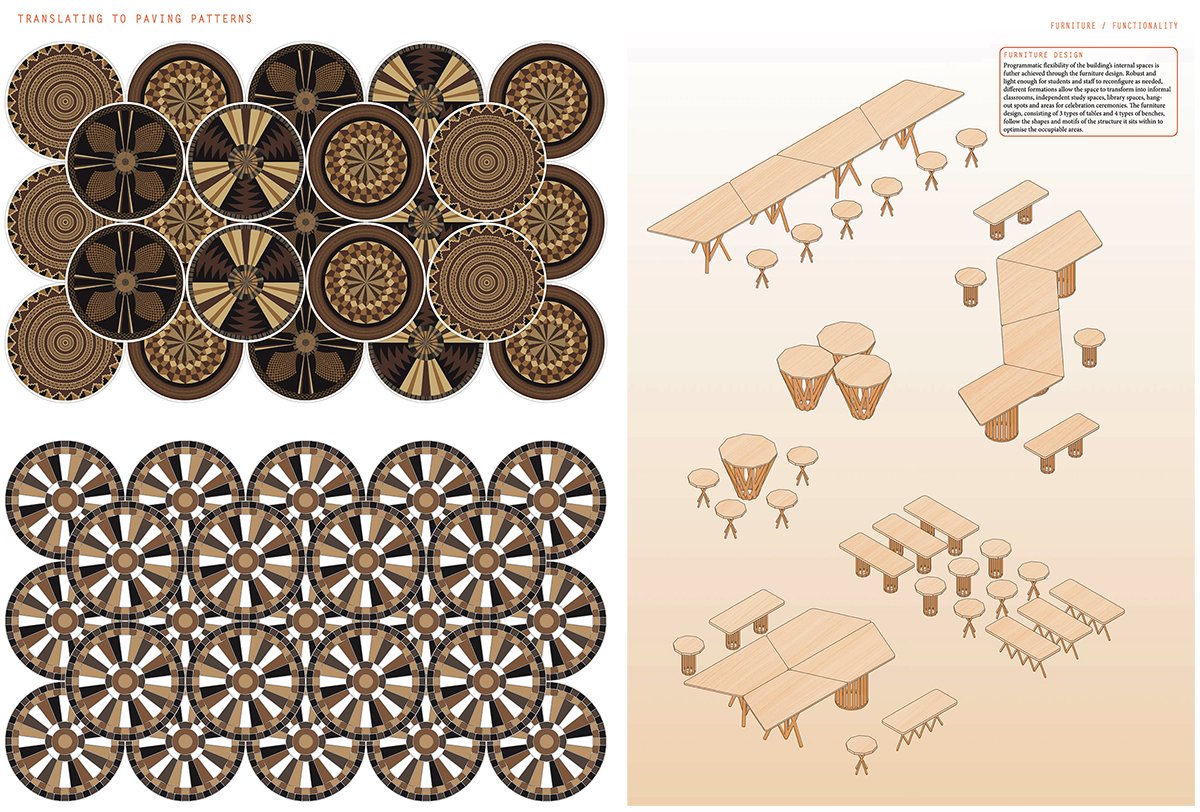
The Maasai ShukaFloor Types: Indoor Tiling Derived From The Patterns Of A Traditional Maasai ShukaMaasai BasketryFloor Types: Pavements Derived From The Patterns Of Traditional Maasai Basketry | Furniture Design For Functionality And Programmatic Flexibility, Inspired By The Traditional Maasai Saruni Ceremonial Stool
Flooring was designed independently, with patterned tiles referencing Maasai Shuka cloth in formal spaces and basket-inspired pavements linking indoors and outdoors. Furniture design drew on the Saruni ceremonial stool tradition, reinterpreted into lightweight, adaptable pieces crafted on-site to support flexible learning environments.
Design Process
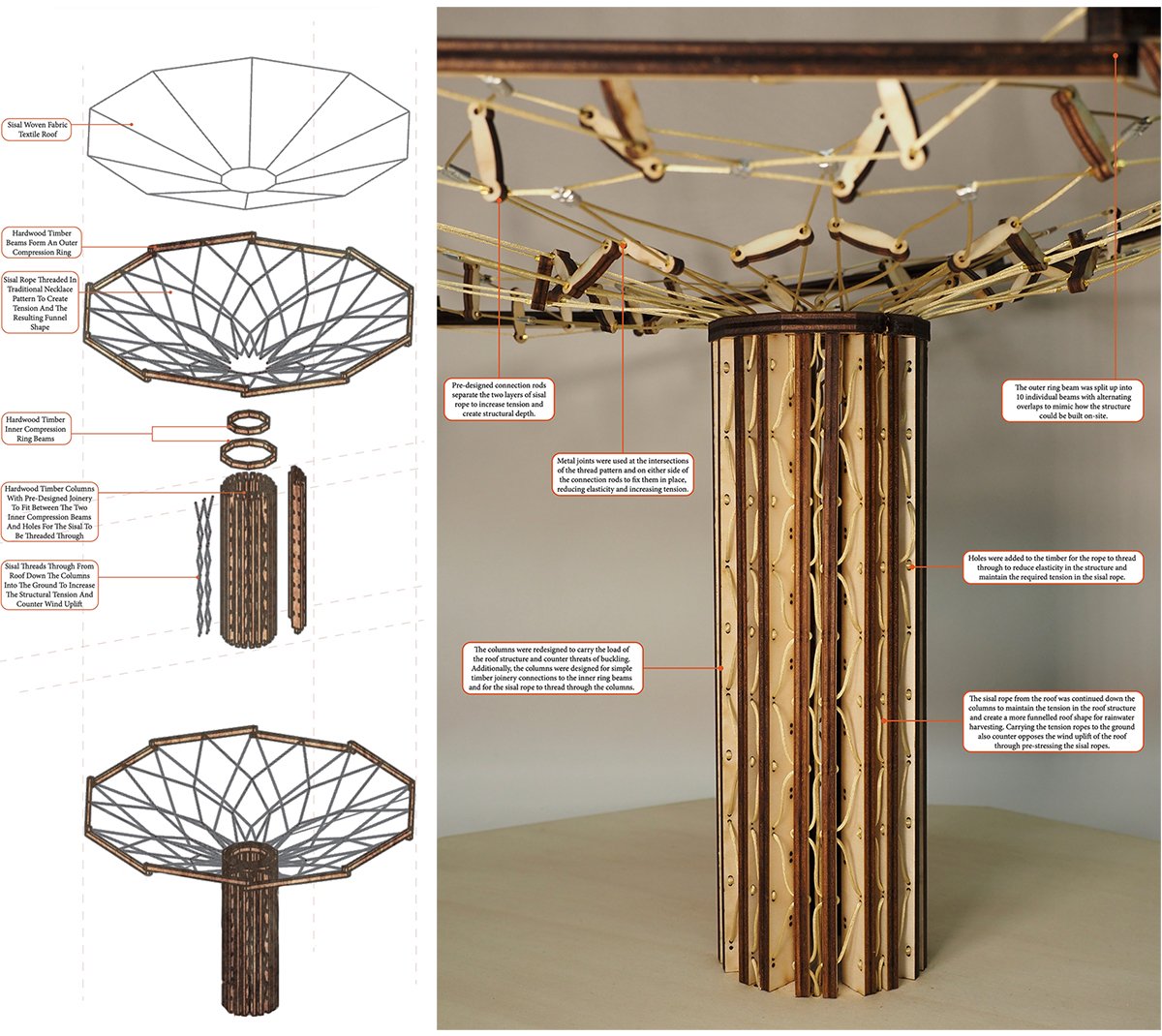
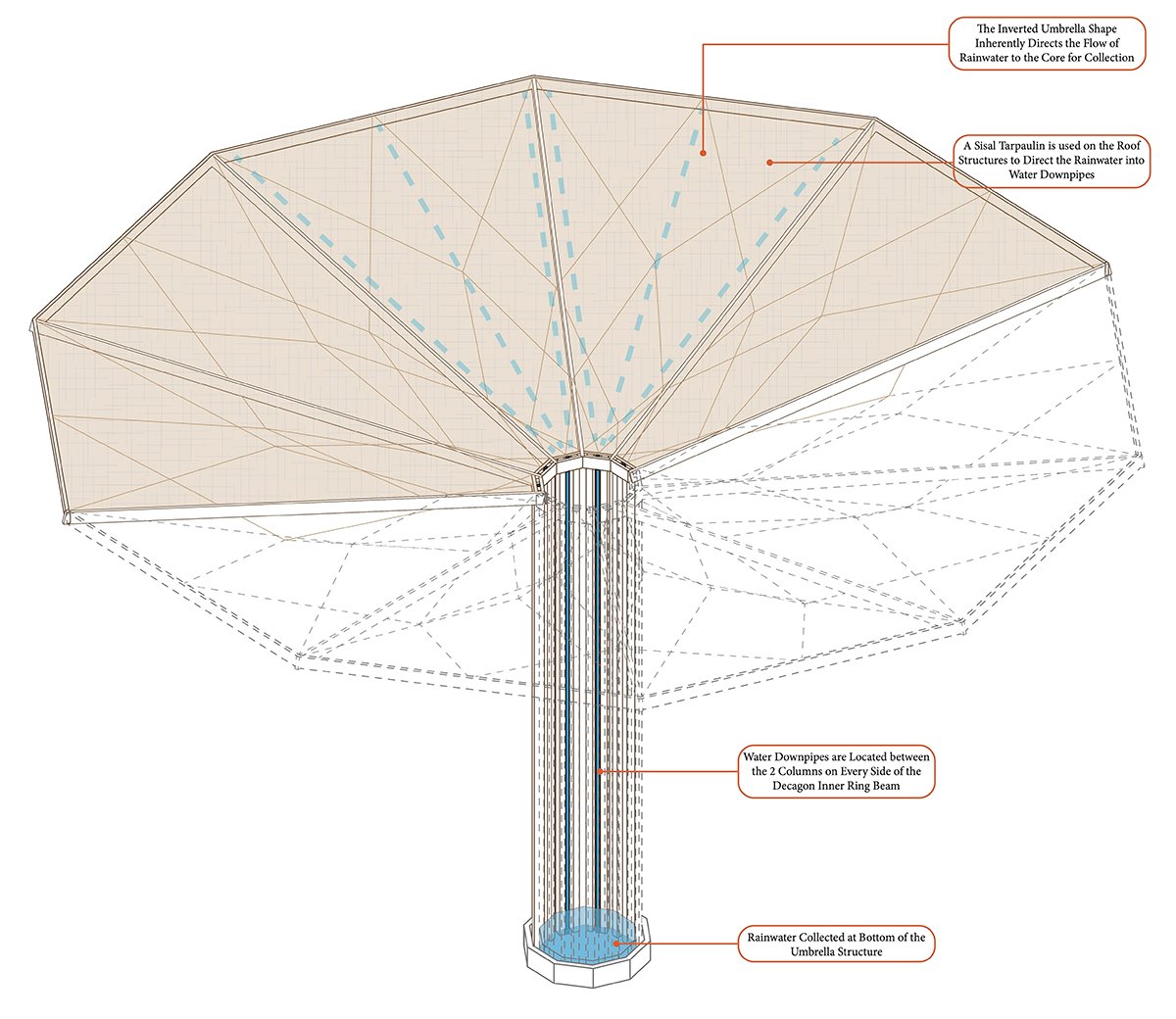
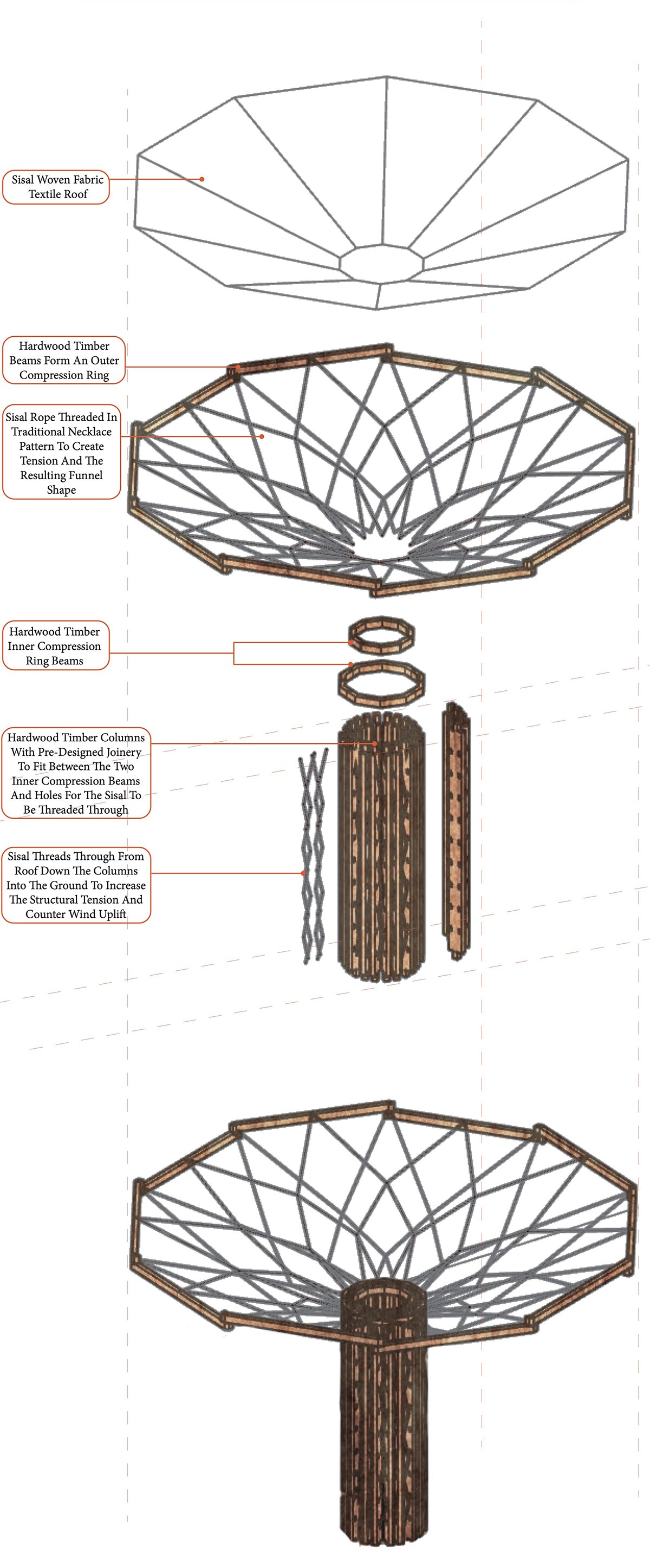
Exploded Diagram Of The Umbrella Roof Structural System | Physical Models Were Used Iteratively To Test And Optimize The Structural Stability Of The Umbrella Roof Structurehe Umbrella Roof Structure For Rainwater HarvestingGlobal Stability: Systematizing The Roof Structure Through Structural Bracing
The design process began with an exploration of a roof structure inspired by Le Ricolais’ Chair and traditional Maasai necklaces, using timber and sisal rope to test a system where members work purely in tension or compression. As the decagonal forms did not tessellate, configurations were developed by connecting “umbrellas” in groups of three or four to create a stable roof. This roof evolved into a funnelled structure to harvest rainwater, with six units channeling water into a central community garden reservoir, addressing gendered challenges of water insecurity.
Final Outcome
Floor plan illustrating the programmatic functions and design decisions of the whole buildingOverall, the building celebrates, in its construction and function, Maasai women and their vernacular construction systems and crafts, by harnessing local labour, skills, and knowledge
The final floor plan brings together all design decisions into a cohesive whole. The north wing houses educational spaces, including flexible study areas and indoor-outdoor learning environments, while the south wing accommodates research facilities with offices, laboratories, and libraries. To the west, a central courtyard integrates a community garden, reservoir, and material forest.
Indoor Learning: classrooms where girls are taught the concepts and principles of manyatta buildingIndoor Learning: individual and collective study spaces
The three wall types define spatial experiences: solid vernacular walls on the east façade and research wing provide enclosure and a maze-like library; beaded folding partitions support adaptability in central learning spaces; and basket-woven kinetic walls along the west façade enable openness and views to the garden. Detached walls and independent flooring enhance permeability, allowing air, light, water, and greenery to flow seamlessly between interior and exterior.
Environmental Strategy: the building is solely designed on principles of passive environmental design and circularityConstruction Process: following the ethos of the building programme itself and due to the site’s remoteness, the building not only relies on local materials, but also on local labour and construction techniques
The building prioritizes passive environmental design, employing natural ventilation, shading, and thermal mass. Rainwater harvesting and circular material cycles sustain irrigation and reduce ecological impact. Materials are grown, harvested, and processed on-site, utilizing vernacular knowledge. Construction relies on community labor and traditional crafts, creating employment and fostering ownership.
Outdoor Learning: interactive learning through building the manyattasOn special occasions, to celebrate the girl’s graduation to womanhood, the community gardens become a place where the celebratory aspects of the traditional emuratare ritual can be performed
Conclusion: Ultimately, the building becomes both a place of learning and cultural transmission, empowering Maasai women and girls while celebrating vernacular construction techniques in a climate-responsive, socially impactful architecture.
[This Academic Project has been published with text and images submitted by the student]
Site Context
Design Process
Final Outcome
To submit your academic project for publication at ArchiDiaries, please visit the following link >> Submit
Get the best of ArchiDiaries, directly in your inbox.
We use cookies on our website to give you the most relevant experience by remembering your preferences and repeat visits. By clicking “Accept All”, you consent to the use of ALL the cookies. However, you may visit "Cookie Settings" to provide a controlled consent.
This website uses cookies to improve your experience while you navigate through the website. Out of these, the cookies that are categorized as necessary are stored on your browser as they are essential for the working of basic functionalities of the website. We also use third-party cookies that help us analyze and understand how you use this website. These cookies will be stored in your browser only with your consent. You also have the option to opt-out of these cookies. But opting out of some of these cookies may affect your browsing experience.
Necessary cookies are absolutely essential for the website to function properly. These cookies ensure basic functionalities and security features of the website, anonymously.
Cookie
Duration
Description
cookielawinfo-checkbox-analytics
11 months
This cookie is set by GDPR Cookie Consent plugin. The cookie is used to store the user consent for the cookies in the category "Analytics".
cookielawinfo-checkbox-functional
11 months
The cookie is set by GDPR cookie consent to record the user consent for the cookies in the category "Functional".
cookielawinfo-checkbox-necessary
11 months
This cookie is set by GDPR Cookie Consent plugin. The cookies is used to store the user consent for the cookies in the category "Necessary".
cookielawinfo-checkbox-others
11 months
This cookie is set by GDPR Cookie Consent plugin. The cookie is used to store the user consent for the cookies in the category "Other.
cookielawinfo-checkbox-performance
11 months
This cookie is set by GDPR Cookie Consent plugin. The cookie is used to store the user consent for the cookies in the category "Performance".
viewed_cookie_policy
11 months
The cookie is set by the GDPR Cookie Consent plugin and is used to store whether or not user has consented to the use of cookies. It does not store any personal data.
Functional cookies help to perform certain functionalities like sharing the content of the website on social media platforms, collect feedbacks, and other third-party features.
Performance cookies are used to understand and analyze the key performance indexes of the website which helps in delivering a better user experience for the visitors.
Analytical cookies are used to understand how visitors interact with the website. These cookies help provide information on metrics the number of visitors, bounce rate, traffic source, etc.
Advertisement cookies are used to provide visitors with relevant ads and marketing campaigns. These cookies track visitors across websites and collect information to provide customized ads.