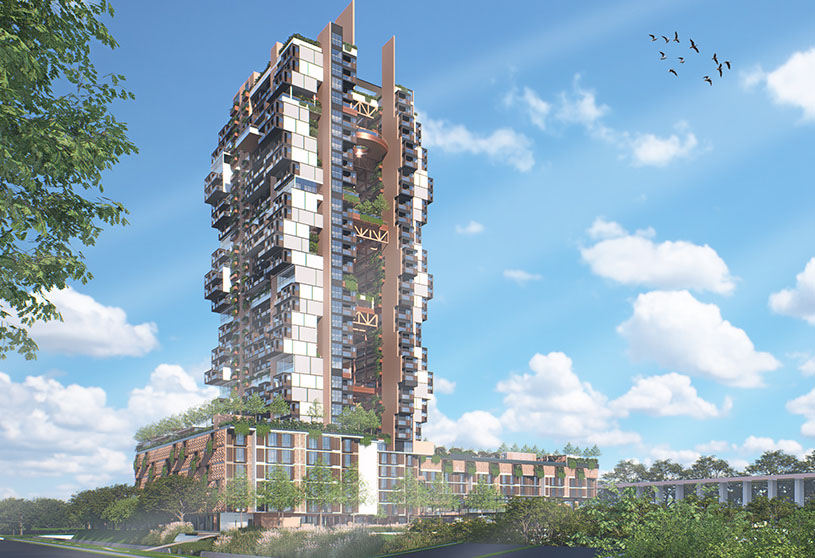
Excerpt: ‘The Second Voyage’ is an architecture thesis by Fouzia Afrose Bushra from the ‘Department of Architecture – Chittagong University of Engineering & Technology (CUET).’ The project aims to reorganize the fragmented Bhatiary Ship-Breaking Material Market into a unified, efficient, and sustainable market complex. Through structured zoning, modern infrastructure, and integrated civic and cultural spaces, the project maximizes commercial value, enhances user experience, and positions Bhatiary as a resilient global ship-recycling hub.
Introduction: The Bhatiary Ship-Breaking Material Market, a vital hub for salvaged ship components in Chittagong, Bangladesh, plays a significant role in the national economy by supplying high-quality, affordable, and durable materials. However, its unplanned linear layout along the Dhaka–Chattogram Highway has resulted in spatial disorganization, inefficient zoning, and poor accessibility, which is preventing the market from becoming the economic hub it could be. In this context, integrating the market into a cohesive structure has become essential to ensure efficiency and mutual benefit for both buyers and sellers.
This thesis proposes to reorganize the Bhatiary Ship-Breaking Material Market into a unified market complex that will enhance the commercial value of salvaged goods while introducing civic and cultural functions into the industrial fabric.
The envisioned market complex maintains the contextual character of Bhatiary while introducing modern infrastructure and environmental considerations, creating a functional, inclusive, and sustainable commercial hub. The outcome is expected to improve operational efficiency, boost trader profitability, and contribute to the long-term socio-economic and environmental resilience of the shipbreaking industry in Bangladesh.
History of Ship-Breaking in BangladeshShip-Breaking Landscape Data
Ship breaking in Bangladesh is a large-scale industry where decommissioned ships are dismantled for scrap metal. After 20–30 years of service, ships are dismantled due to increasing maintenance costs, and nearly 95% of their components are resold as scrap. With nearly 80% of global ship dismantling occurring in Bangladesh, India, and Pakistan, Chittagong’s Sitakunda coast—particularly the 25 km stretch of beach at Bhatiary—has become the largest ship-breaking yard in the world.
Bhatiary’s Shipwreck Material Market
Parallel to this industry, along a 3.5 km stretch of the Dhaka–Chittagong National Highway, an organically grown, informal yet vibrant ship scrap industry market has emerged. Here, salvaged ship products—from the smallest screw to large-scale machinery, furniture, and electronics—are bought and sold. The strip accommodates around 300 shops, supporting the livelihoods of over 1,000 traders and workers.
Understanding The Existing Market ZoningThe Proposed Site
Existing Market Issues: Despite its vibrancy, the market remains fragmented and scattered, with no proper zoning or structured layout. Similar types of shops are scattered, making navigation difficult for buyers. Basic facilities such as parking, loading–unloading zones, and organized circulation are missing. The current layout of the market results in lost customers, inefficient circulation, and reduced sales, preventing the market from becoming the economic hub it could be.
Proposed Market Site: The chosen 8.3-acre site sits within the existing stretch, close to salvage yards and transport routes, making it accessible and contextually appropriate.
Design Process
Market IssuesAim of the Project
The design process began with an in-depth analysis of the existing informal market structure, product typologies, circulation patterns, and safety challenges. Mapping the flow of goods—from shipyards to market stalls—revealed the need for clear zoning, vertical organization, and separate service circulation.
Program FormulationForm Generation
The design adopts a linear, rectangular form that mirrors the existing strip while adopting a vertical zoning system. Products were categorized by weight, leading to a vertical zoning strategy with heavy materials at lower levels and lighter goods above. The mass was divided into two parallel blocks, connected by bridges across levels, creating a central open plaza, improving permeability, daylight, and social interaction. This central plaza becomes the heart of the linear complex—breaking the rigidity of industrialism and inviting pause, interaction, and cultural activation.
Form Generation
Climate responsiveness, reuse of ship-derived materials, and industrial structural systems guided material and façade decisions. Throughout the process, the design remained rooted in contextual realism while exploring architecture’s potential to formalize and elevate an informal industrial economy.
Final Outcome
Proposed Master Plan Of Bhatiary Ship-Breaking Material MarketEast And West ElevationSectional Perspective Of Market
The master plan integrates the marketplace with its surrounding landscape to create a cohesive and inviting environment. The front landscape enhances the customer experience by providing outdoor spaces for relaxation, recreation, and public gatherings. The design prioritizes urban permeability through incorporating separate entries for customers, administration, and service areas, ensuring efficient circulation and access.
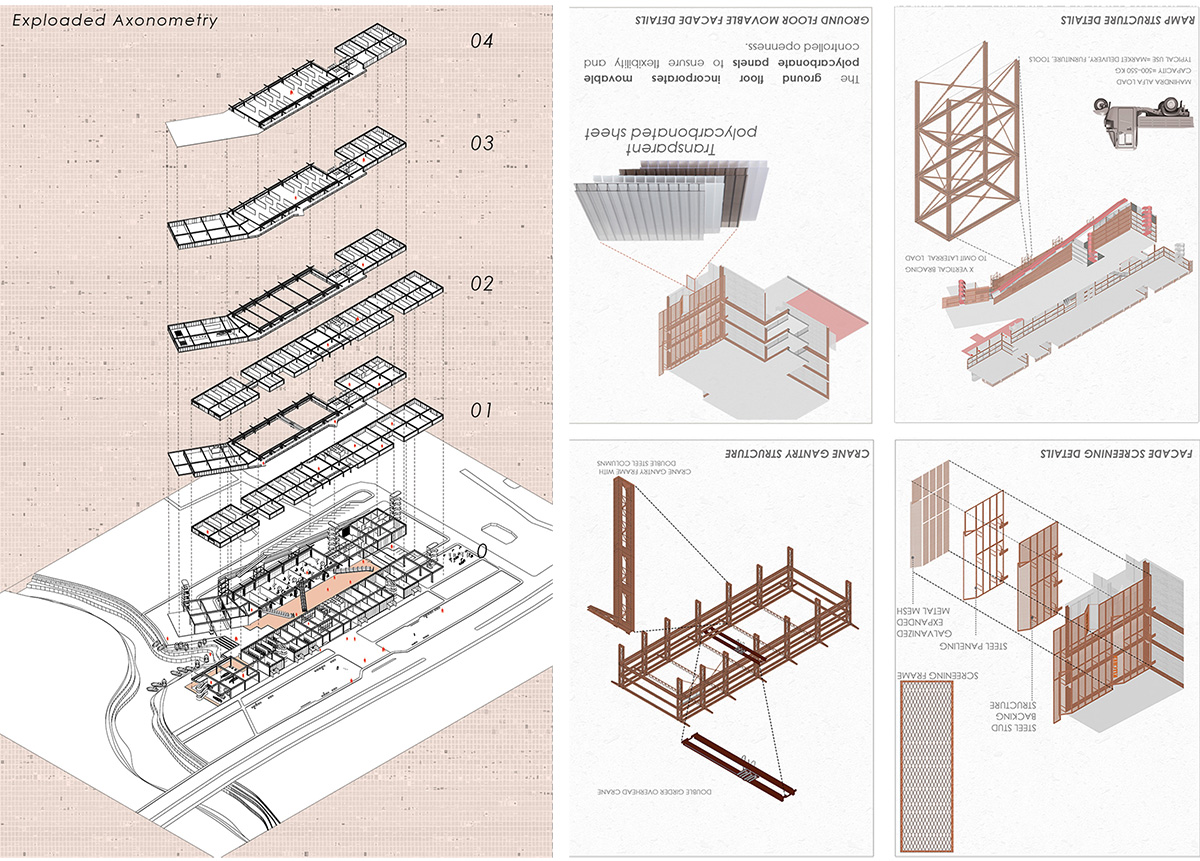
SectionExploded Axonometry | Material And Structural Detail ElementsRendered Views Of InteriorRendered View Of Boat Area
Special provisions are made for large mechanical equipment such as boilers, compressors, and generators, which require greater spatial capacity. These zones are designed with double-height spaces and equipped with overhead crane systems for safe handling, supported by double steel columns and X-bracing to resist lateral loads.
Rendered View Of EntryRendered View Of Gangway PlazaRendered View Of Rear Side Of The Building
On the east and west façades, repurposed ship metal mesh is applied, reflecting the site’s industrial character while promoting sustainability through reuse of materials. To connect commerce with culture, an Experience Center is integrated within the complex, offering visitors insights into the history and significance of the ship-breaking industry.
Physical ModelPhysical Model (Blow Up)
Conclusion: Ultimately, the project aspires to transform Bhatiary into a civic and cultural destination—strengthening livelihoods, improving user experience, and establishing Bhatiary as a vital node in the global ship-recycling economy. Also, this project is not just about market efficiency—it is about demonstrating how architecture can intervene in industrial by-products economies, elevating them into sustainable, inclusive, and culturally resonant spaces.
[This Academic Project has been published with text and images submitted by the student]
Site Context
Design Process
Final Outcome
To submit your academic project for publication at ArchiDiaries, please visit the following link >> Submit
Get the best of ArchiDiaries, directly in your inbox.
We use cookies on our website to give you the most relevant experience by remembering your preferences and repeat visits. By clicking “Accept All”, you consent to the use of ALL the cookies. However, you may visit "Cookie Settings" to provide a controlled consent.
This website uses cookies to improve your experience while you navigate through the website. Out of these, the cookies that are categorized as necessary are stored on your browser as they are essential for the working of basic functionalities of the website. We also use third-party cookies that help us analyze and understand how you use this website. These cookies will be stored in your browser only with your consent. You also have the option to opt-out of these cookies. But opting out of some of these cookies may affect your browsing experience.
Necessary cookies are absolutely essential for the website to function properly. These cookies ensure basic functionalities and security features of the website, anonymously.
Cookie
Duration
Description
cookielawinfo-checkbox-analytics
11 months
This cookie is set by GDPR Cookie Consent plugin. The cookie is used to store the user consent for the cookies in the category "Analytics".
cookielawinfo-checkbox-functional
11 months
The cookie is set by GDPR cookie consent to record the user consent for the cookies in the category "Functional".
cookielawinfo-checkbox-necessary
11 months
This cookie is set by GDPR Cookie Consent plugin. The cookies is used to store the user consent for the cookies in the category "Necessary".
cookielawinfo-checkbox-others
11 months
This cookie is set by GDPR Cookie Consent plugin. The cookie is used to store the user consent for the cookies in the category "Other.
cookielawinfo-checkbox-performance
11 months
This cookie is set by GDPR Cookie Consent plugin. The cookie is used to store the user consent for the cookies in the category "Performance".
viewed_cookie_policy
11 months
The cookie is set by the GDPR Cookie Consent plugin and is used to store whether or not user has consented to the use of cookies. It does not store any personal data.
Functional cookies help to perform certain functionalities like sharing the content of the website on social media platforms, collect feedbacks, and other third-party features.
Performance cookies are used to understand and analyze the key performance indexes of the website which helps in delivering a better user experience for the visitors.
Analytical cookies are used to understand how visitors interact with the website. These cookies help provide information on metrics the number of visitors, bounce rate, traffic source, etc.
Advertisement cookies are used to provide visitors with relevant ads and marketing campaigns. These cookies track visitors across websites and collect information to provide customized ads.




![Factory[n]Certainty: Redefining Industrial Architecture Through Work, Life, and Community | Bachelors Design Thesis](https://archidiaries.com/wp-content/uploads/2026/09/Siam-Rahman_APR_feat_img.jpg)