Home » Academic projects » Interstitium: Transforming Residual Fragments into a Cultural Network in Bogotá’s Las Nieves | Bachelor’s Design Project on Mixed-Use Housing
Interstitium: Transforming Residual Fragments into a Cultural Network in Bogotá’s Las Nieves | Bachelor’s Design Project on Mixed-Use Housing
Excerpt: ‘Interstitium’ is a Bachelor’s Design Project by Simón Tovar Rodriguez from the ‘Facultad de Arquitectura y Diseño – Universidad de los Andes.’ The project aims to revitalize the Las Nieves neighborhood in Bogotá by transforming voids and passages into cultural connectors. It aims to restore the area’s identity as a cultural hub, provide housing and support spaces for artists and students, and foster inclusive public life. The goal is to establish a model of urban regeneration where living, learning, and creating coexist, strengthening community ties and the city’s cultural vitality.
Introduction: “Interstitium” explores the potential of inter-block passages and voids in Bogotá’s Las Nieves neighborhood as cultural and urban catalysts. The project stems from a critical reading of residual urban space fragments left behind by the decline of the historic center and proposes a strategy to activate them as connectors between existing theaters, aiming to rebuild a forgotten cultural cluster. Through an architecture of permanence, encounter, and artistic production, the intervention addresses how small-scale spatial gestures and interstices can trigger broader transformations in the urban fabric. The proposal reimagines underutilized gaps as a network of public and semi-public spaces that foster continuity, community engagement, and a symbolic recovery of a place that once thrived with cultural life.
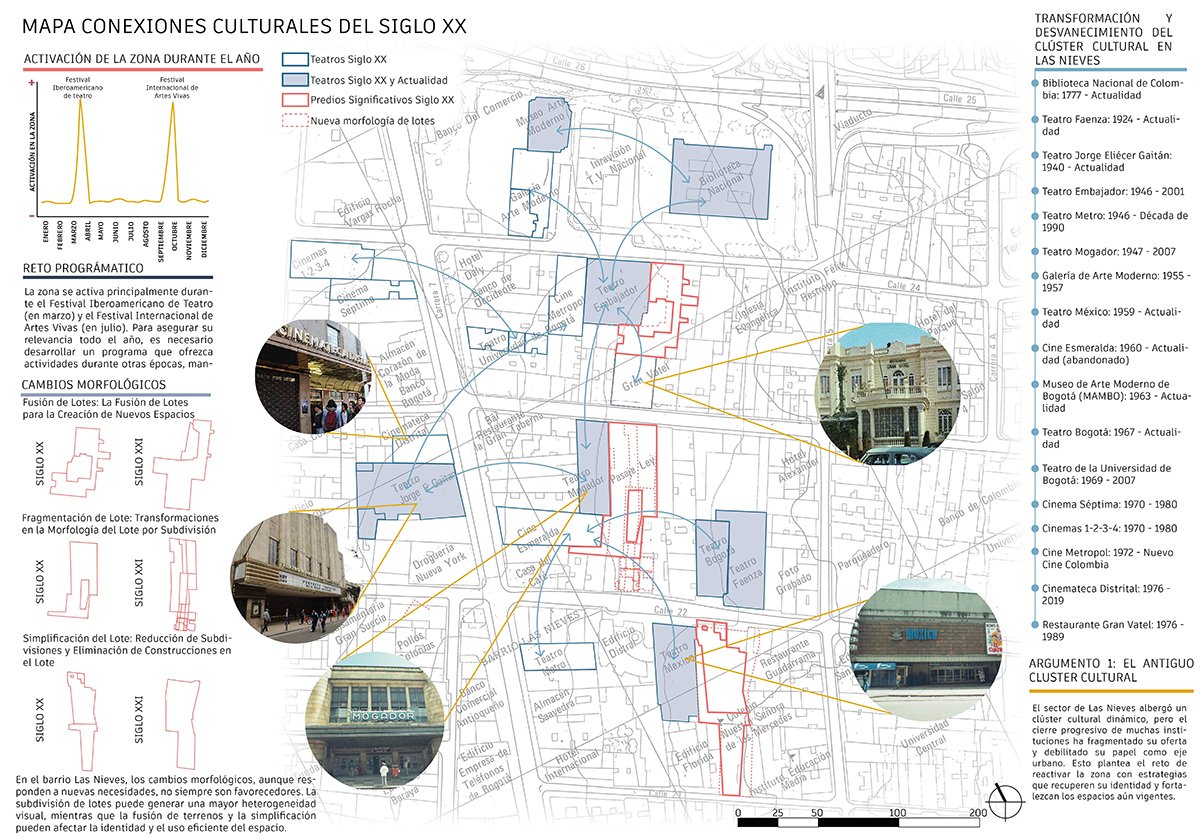
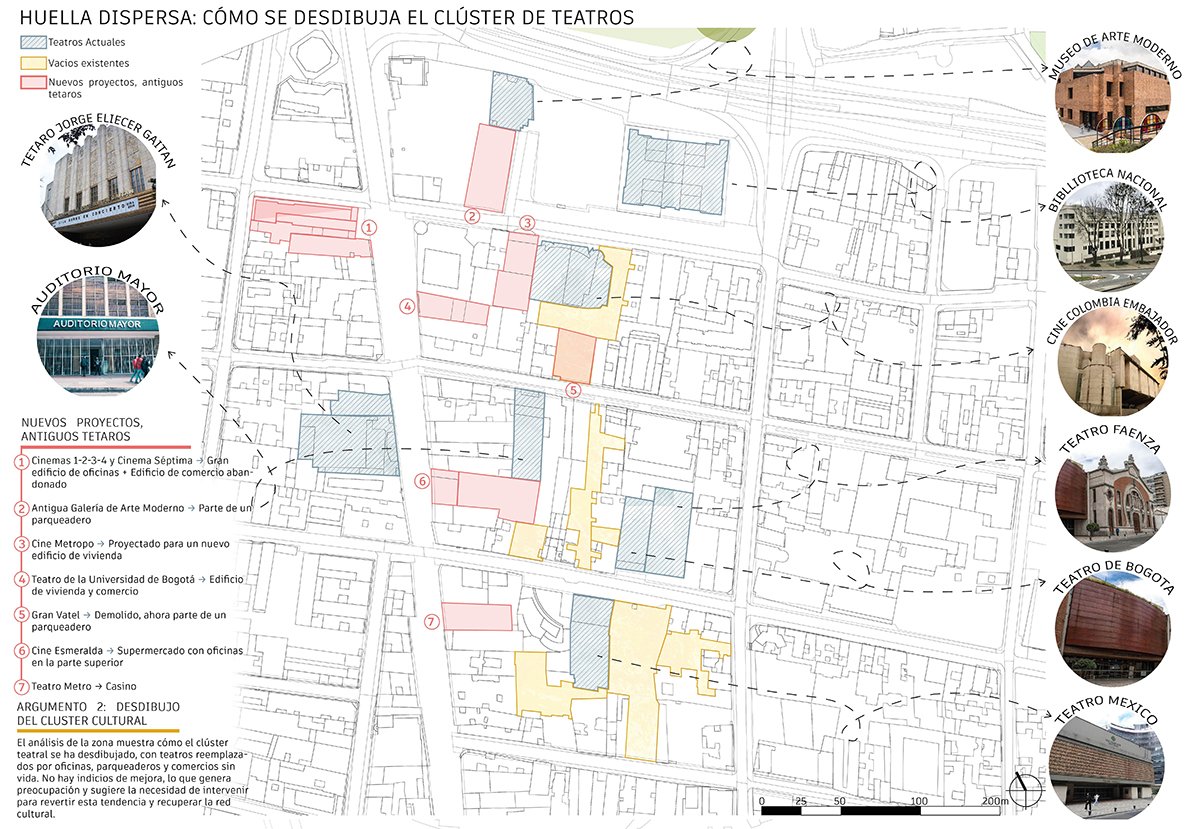
Cluster Cultural Las NievesDispersed Footprint Theater ClusterReinterpretation And Void Recovery
Las Nieves, a central neighborhood in Bogotá, was once a thriving cultural hub but has since suffered from institutional neglect and real estate speculation. The decline of its theaters and performance venues, along with vacant lots and fragmented passages, has weakened its urban identity and disrupted continuity in the area.
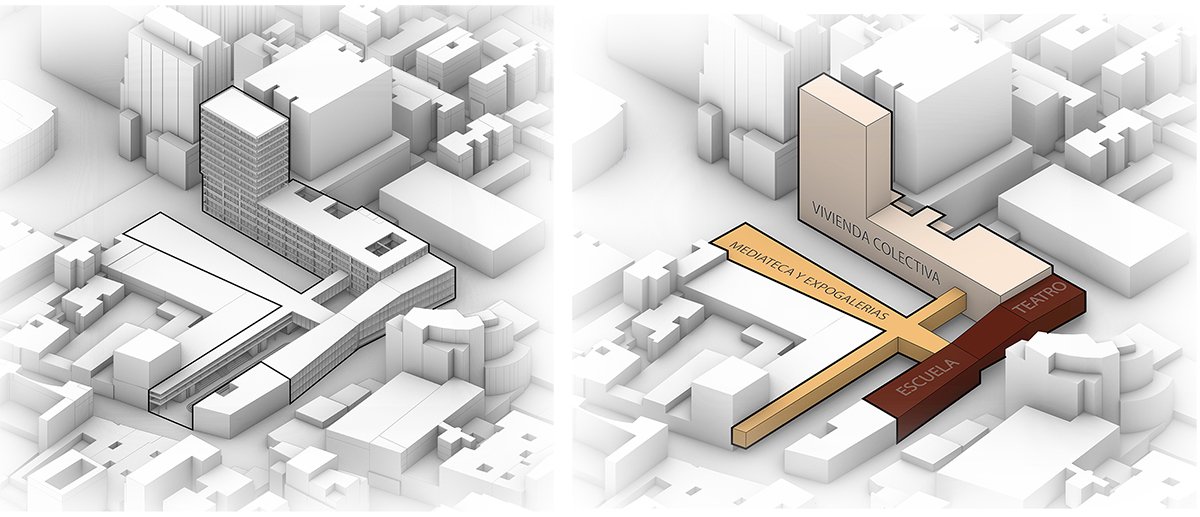
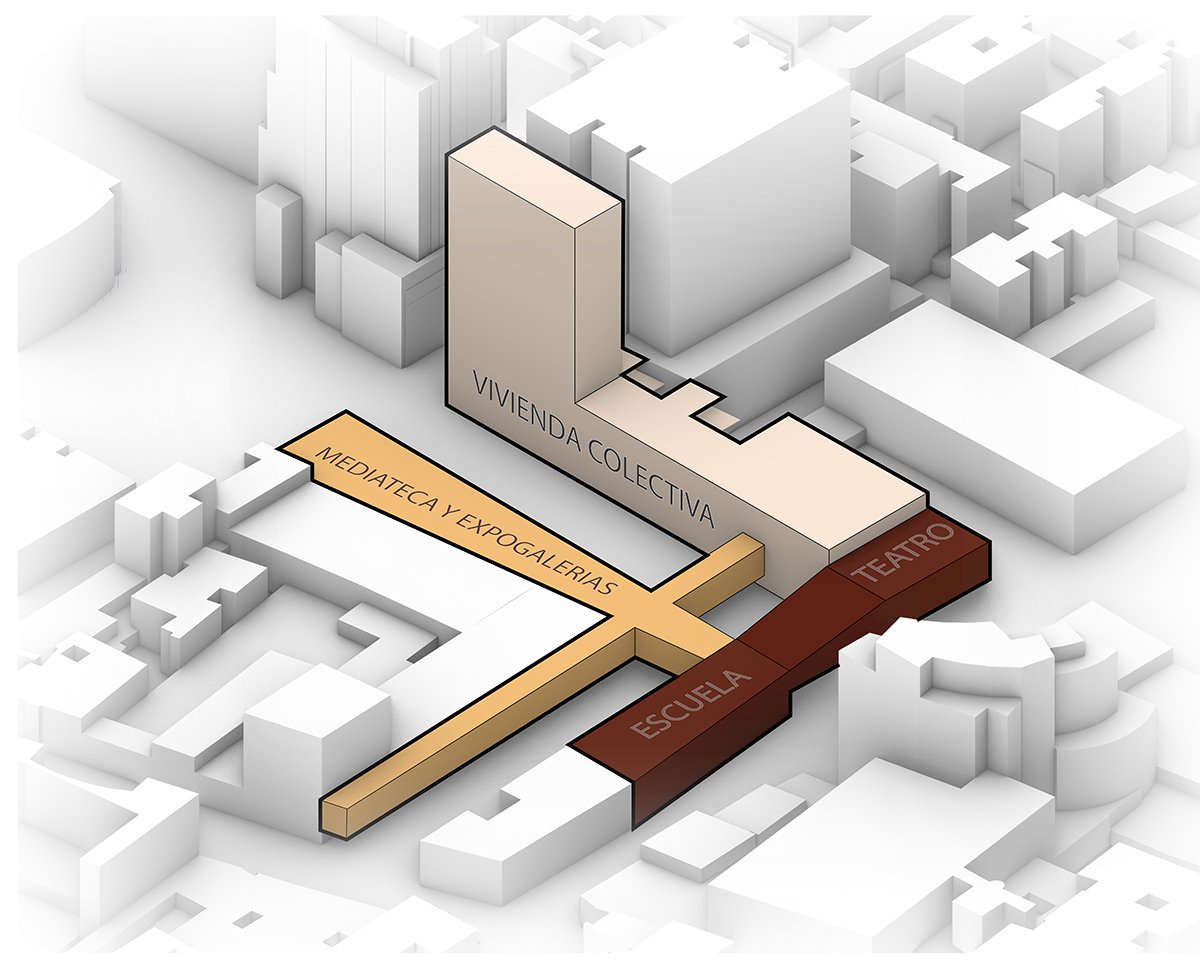
Morphological transformations—through lot merging, fragmentation, and simplification—have produced voids that now represent opportunities for reinterpretation and recovery. The project focuses on two strategic blocks where voids and interstitial passages intersect, proposing a living cultural network that combines housing for artists, co-living units, a performing arts school, an open-air amphitheater, workshops, galleries, and exhibition spaces.
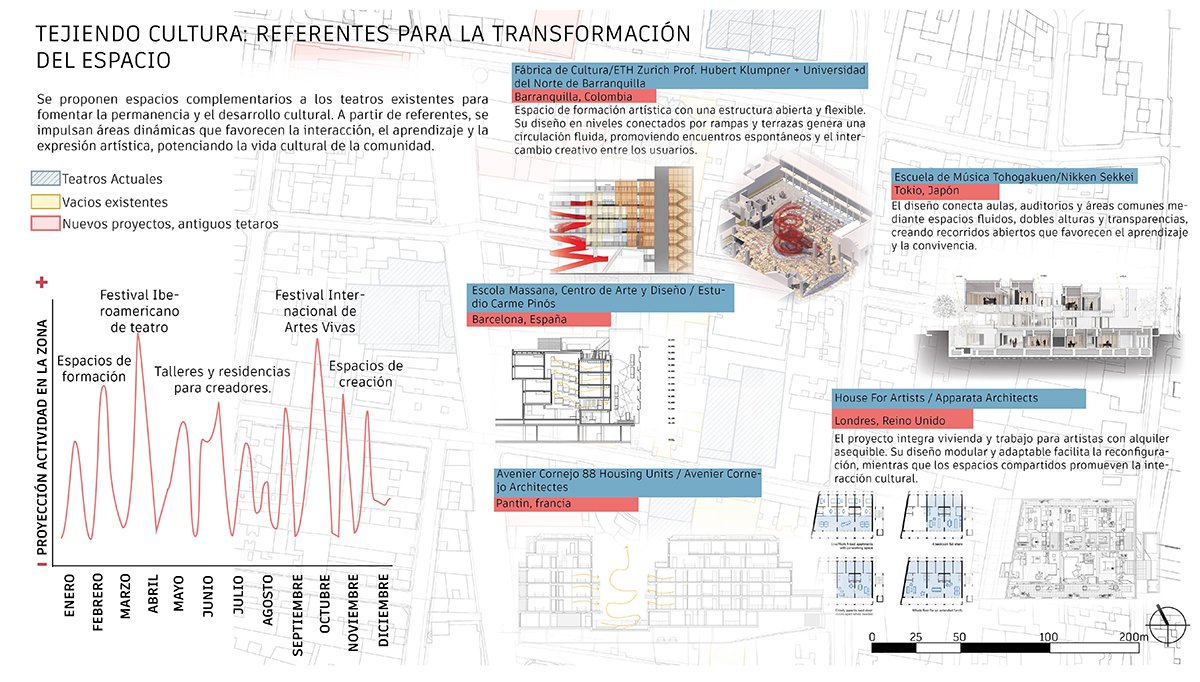
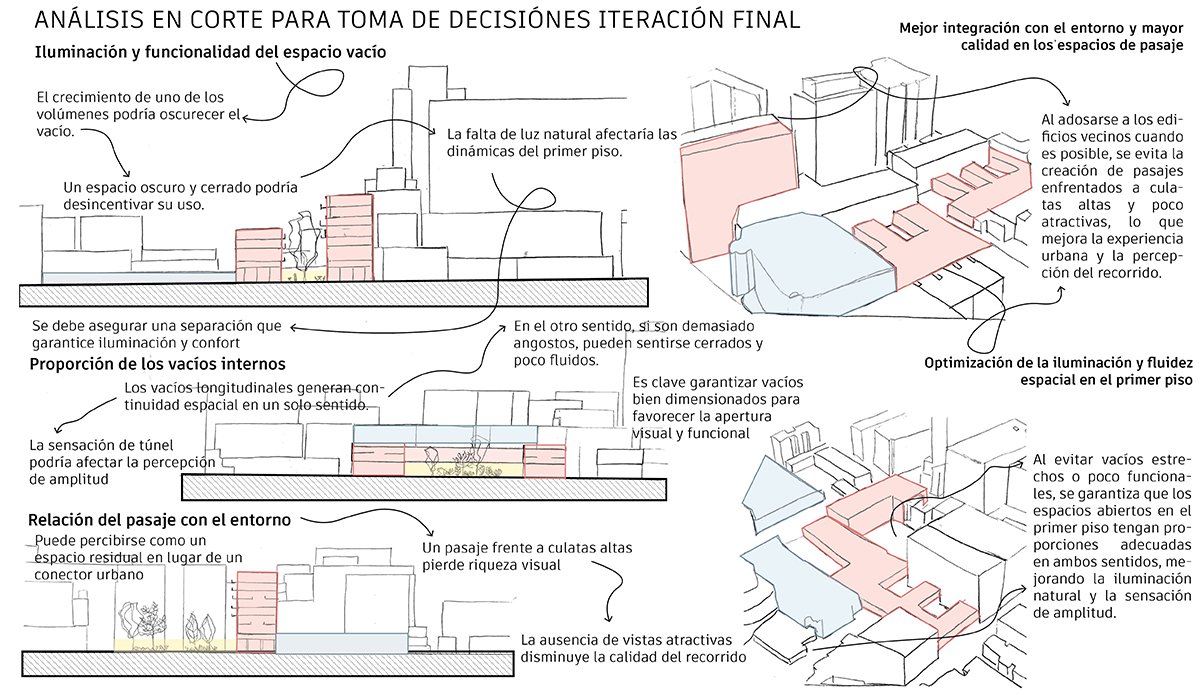
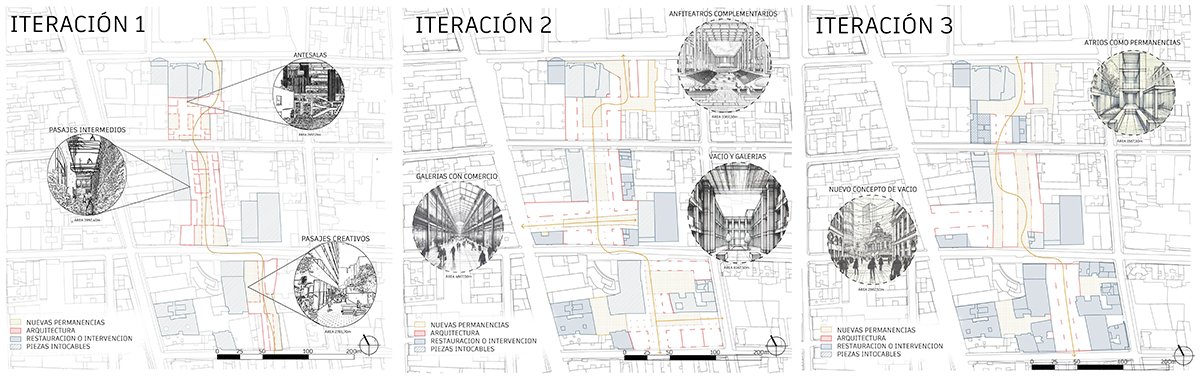
Cultural References And Space TransformationSectional Analysis Final Urban IterationDesign Iterations Urban Strategy
The strategy emphasizes reconnecting existing cultural infrastructure with new uses, guided by sectional studies that prioritize natural light, permeability, and contextual integration. Inspired by international references, the proposal fosters year-round cultural programming and inclusive public spaces that support artistic exchange.
Through iterative design, the intervention balances heritage protection, adaptive reuse, and new insertions, aiming to restore Las Nieves as a dynamic cultural district and reclaim its role as a hub of public life and creativity in Bogotá’s urban core.
Design Process
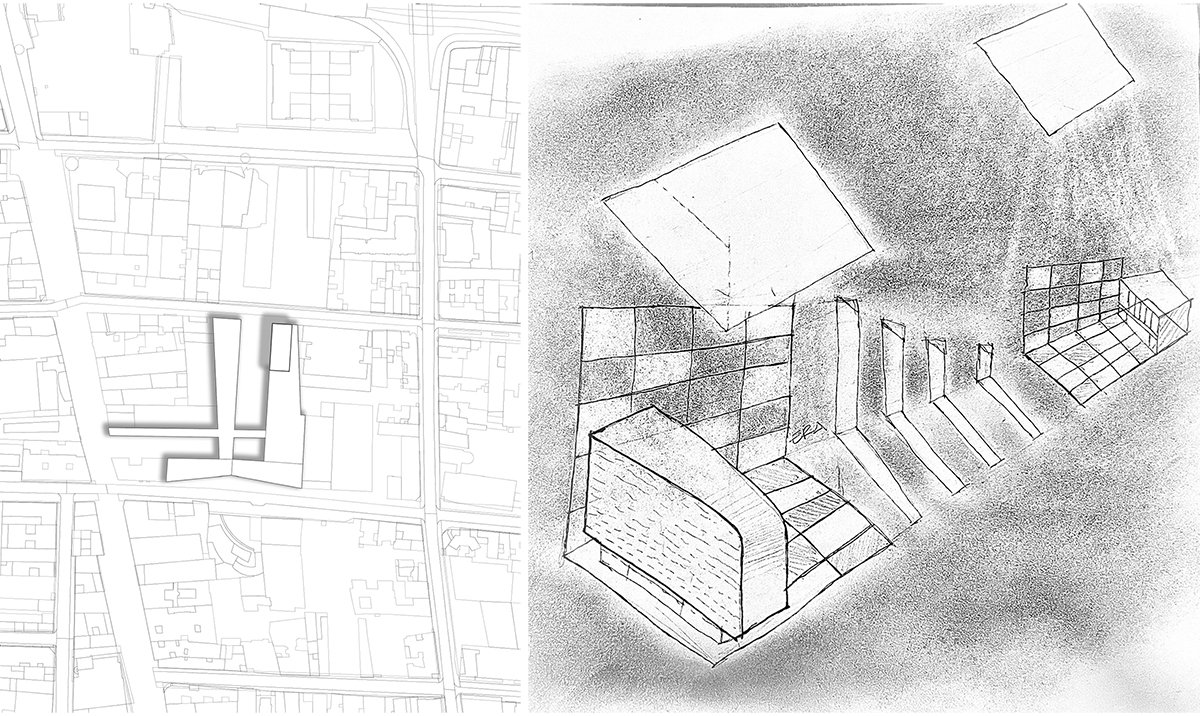
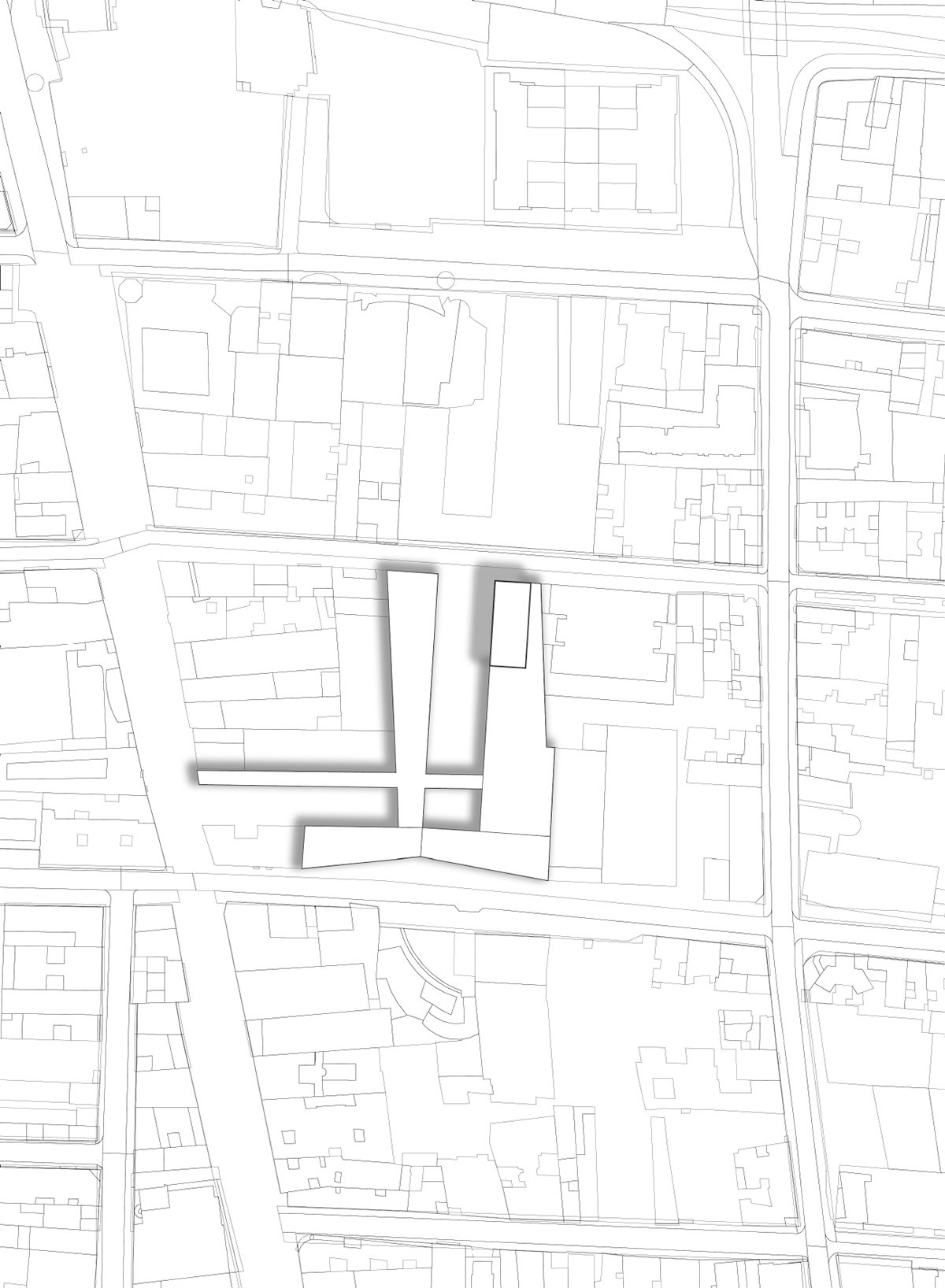
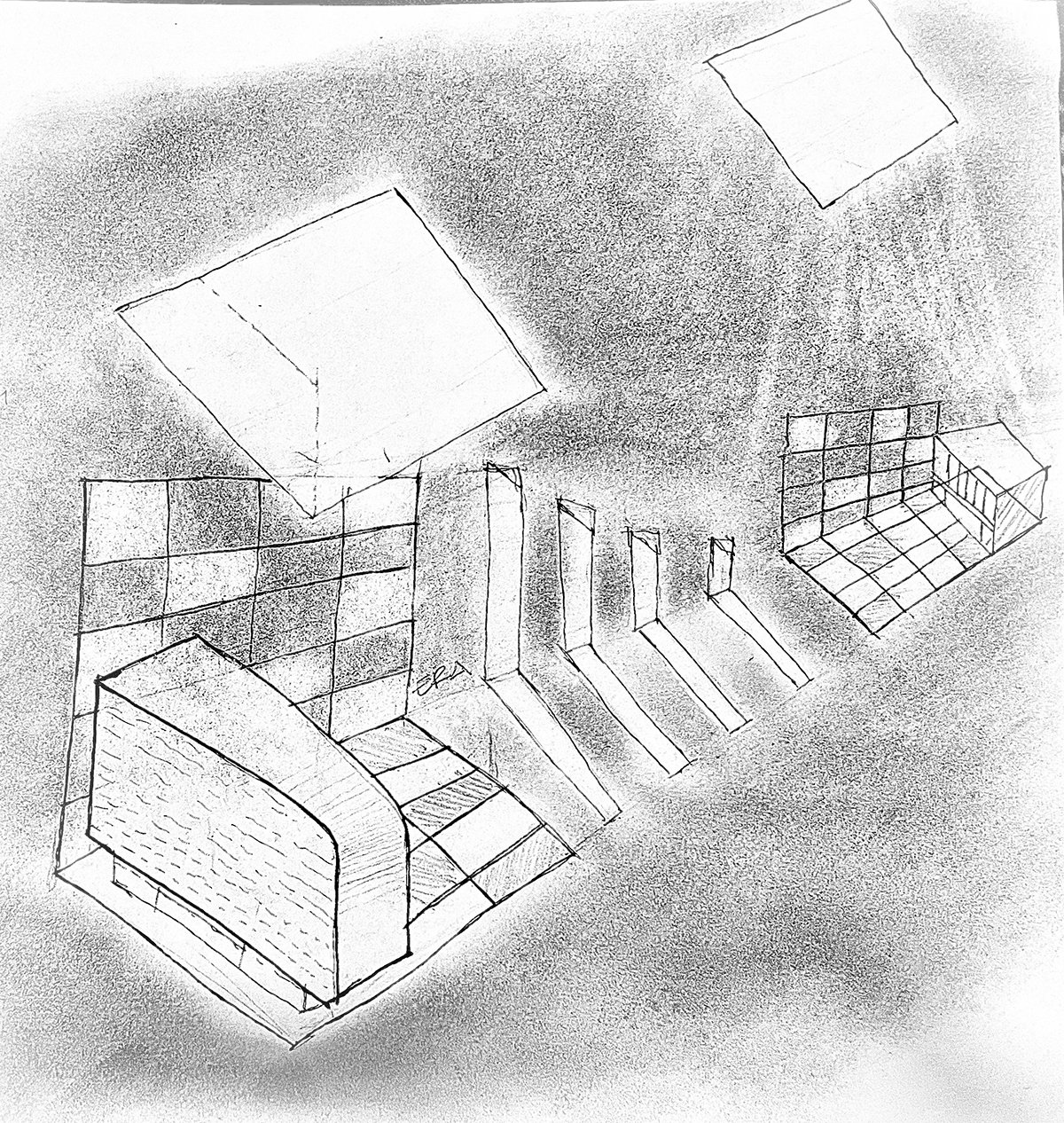
Location Plan | This drawing was part of an early conceptual exercise to define and never lose sight of the project’s core intention. It evokes the idea of a cultural cluster, giving priority to the void as a moment of relief in a saturated city.After testing different arrangements, the project arrived at a volumetric configuration where distinct uses—school, gallery, co-living units, and residences—occupy separate yet interconnected volumes. This strategy responds to neighborhood passages and voids, ensuring porosity and cultural integration.
The design process began with an urban analysis that identified inter-block voids and passages as spatial opportunities to reconnect and reprogram the neighborhood. Through mapping, site visits, and interviews, these spaces were reinterpreted as potential cultural connectors.
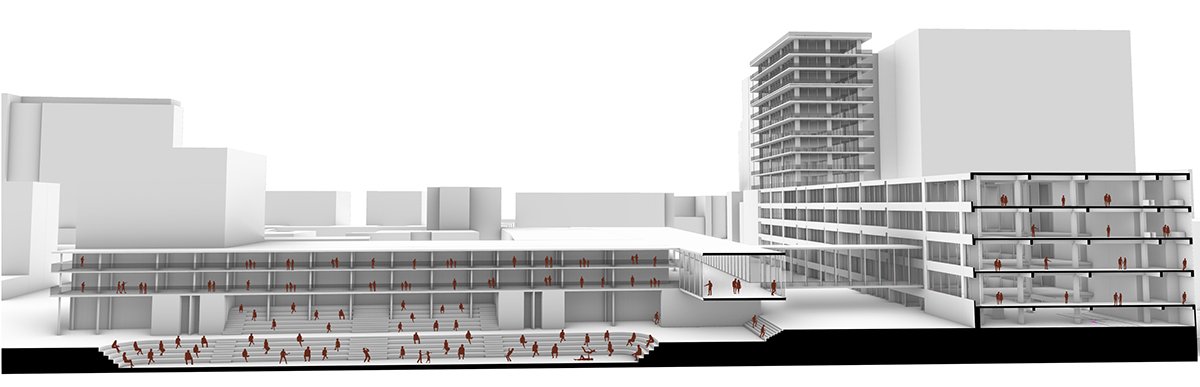
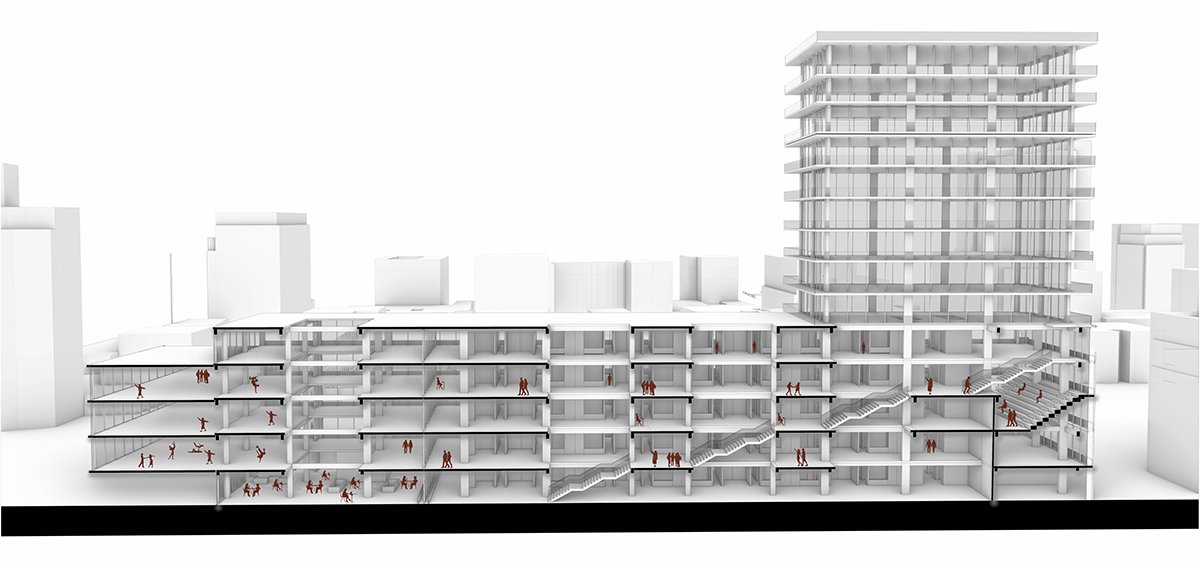
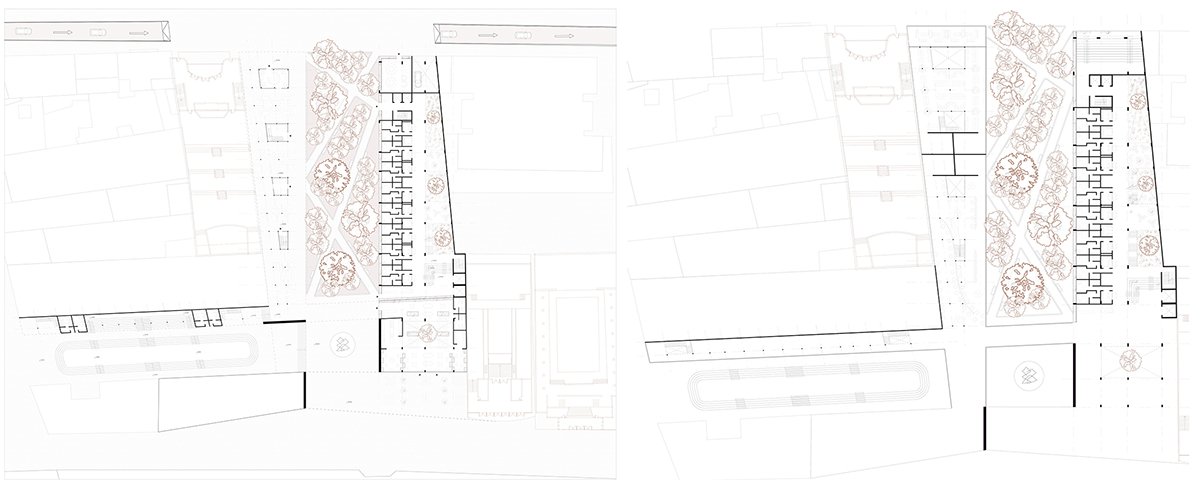
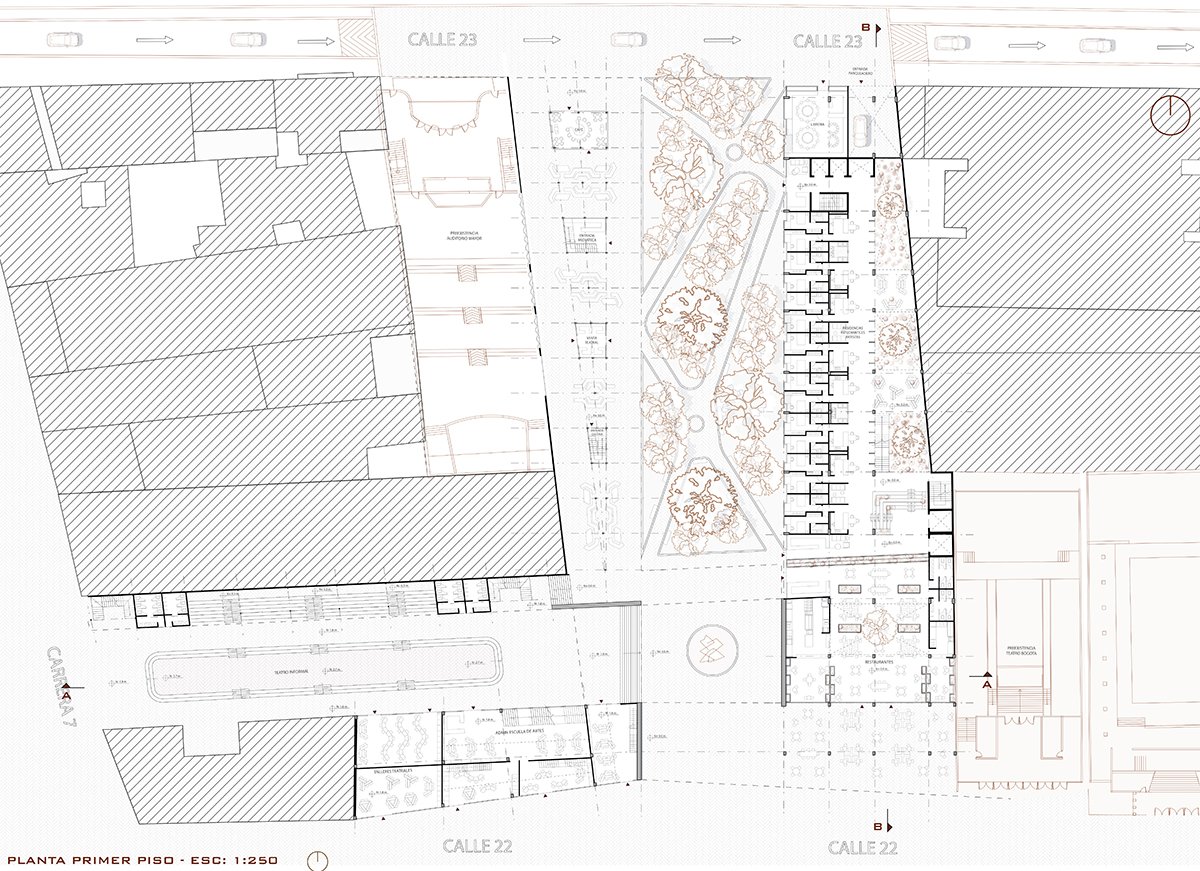
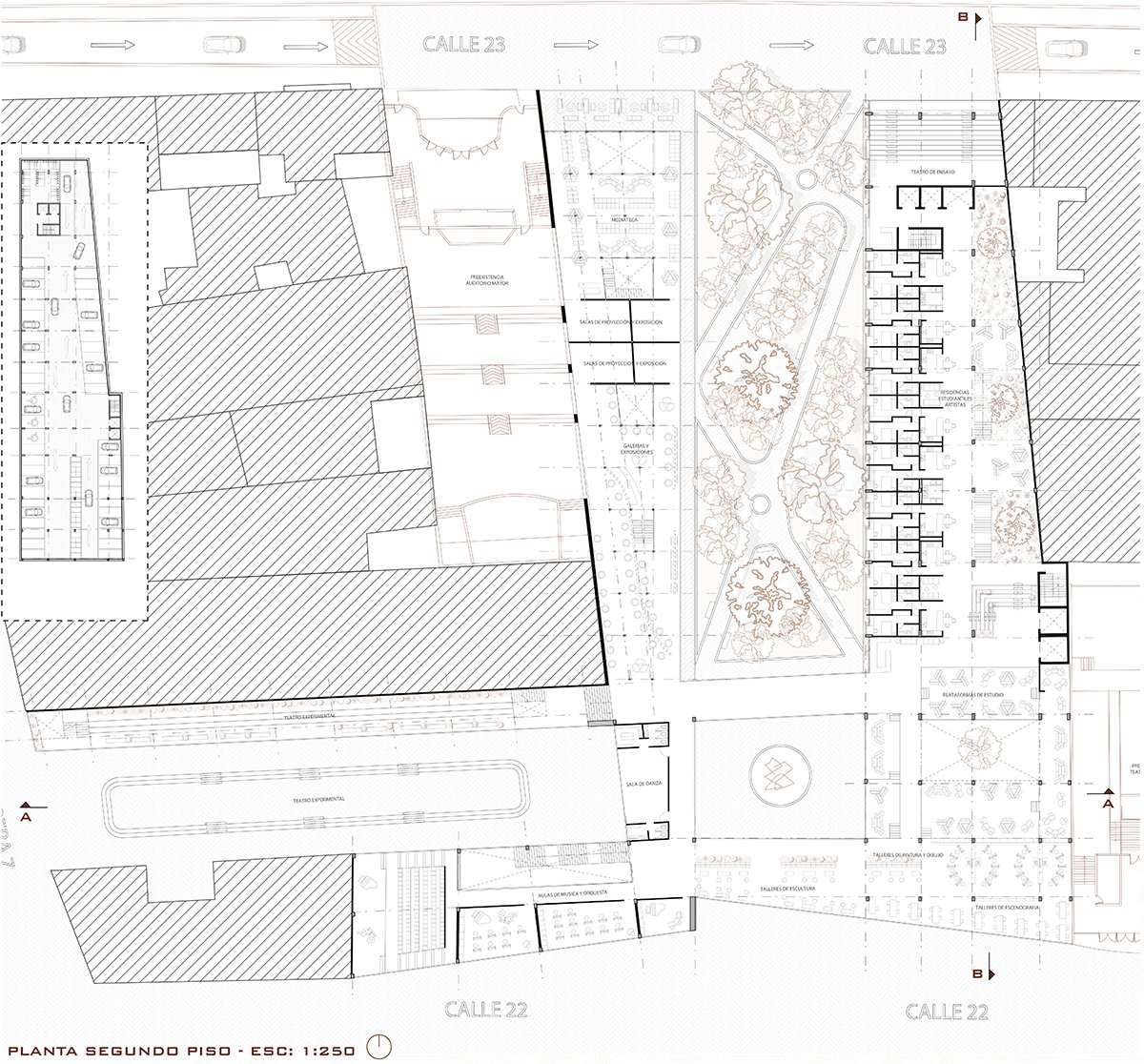
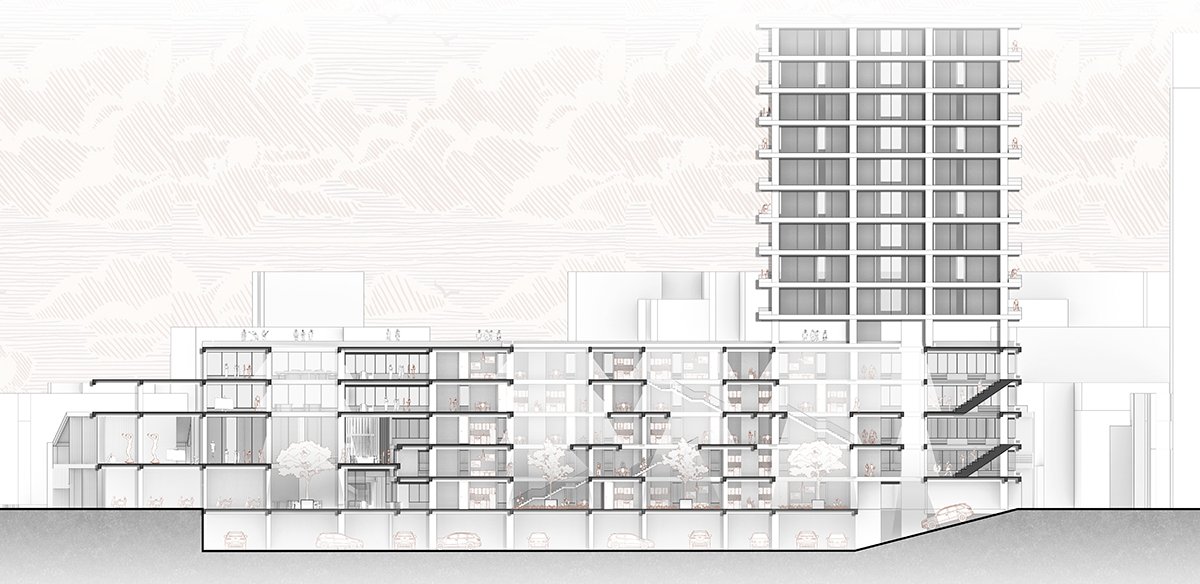
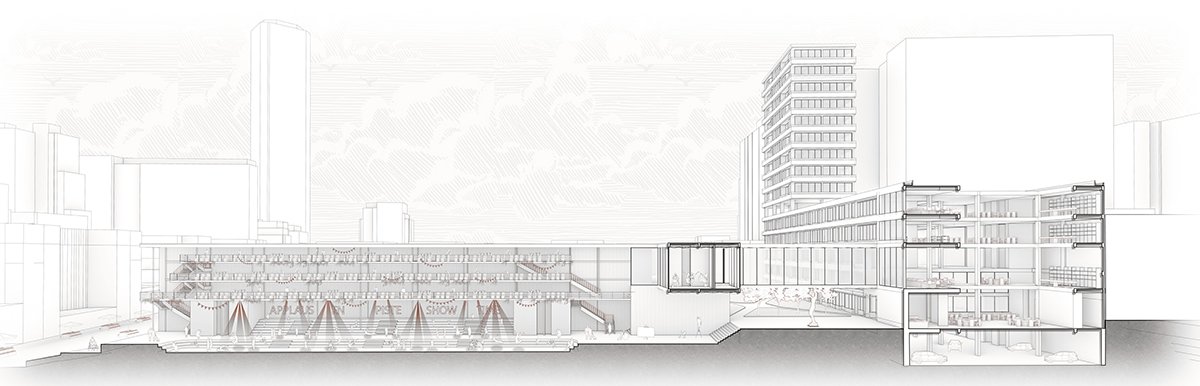
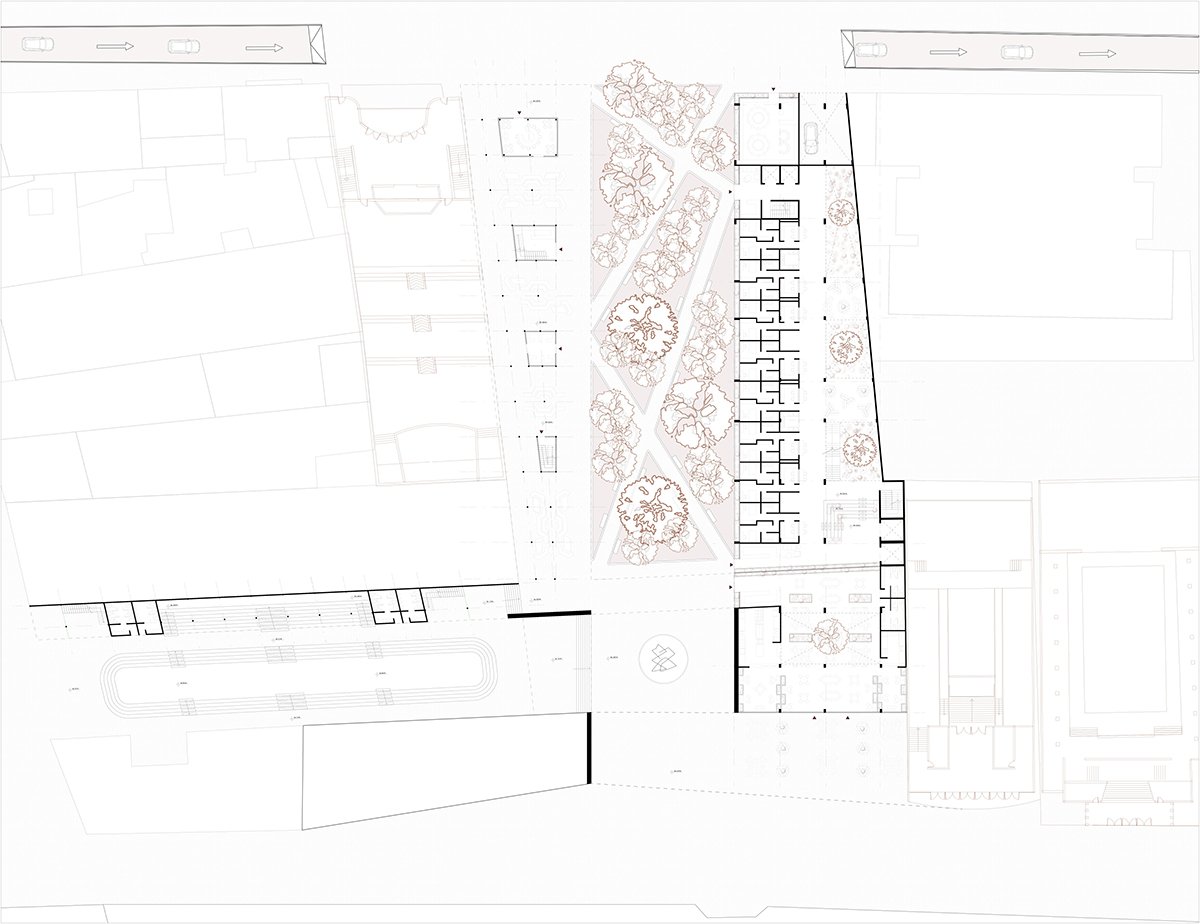
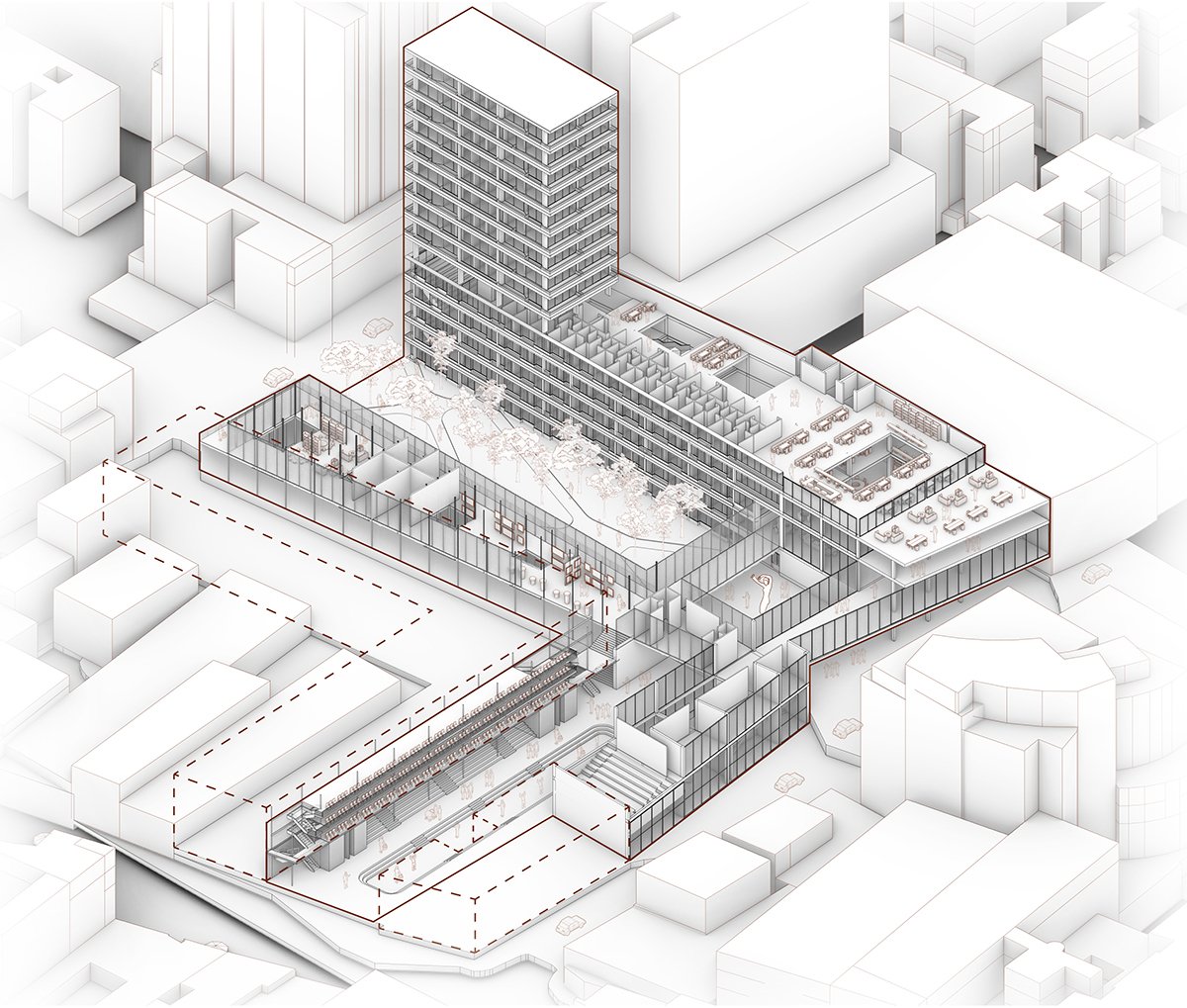
The project’s central idea was crystallized in section: a theatrical agora that links the outdoor amphitheater with indoor cultural spaces. The performing arts school opens toward the city, while the residential tower rises behind, layering programmatic density while maintaining porosity and visual connection.This section explores the dialogue between the vertical and horizontal elements. The school of movement vibrates with activity in double-height rehearsal halls, while workshops and patios create light-filled pauses. Above, the tower houses artist residences, designed to encourage community interaction through shared circulation.The ground floor was designed as a civic platform open to all sides. A cultural corridor, central garden, and tower base structure the level, integrating existing trees and creating a permeable threshold where cultural and everyday life converge. | On the second level, the cultural corridor deepens connections between public and residential spaces. Patios and perimeter galleries encourage encounters, while the tower begins to rise with more private uses, maintaining porosity across scales.
An urban strategy was formulated around two types of interventions: one centered on an interior courtyard and another that reactivates existing passages. From there, the process shifted from the urban to the architectural scale, focusing on the design of diverse housing typologies. These include residences for artists and temporary housing for students of the newly proposed performing arts school.
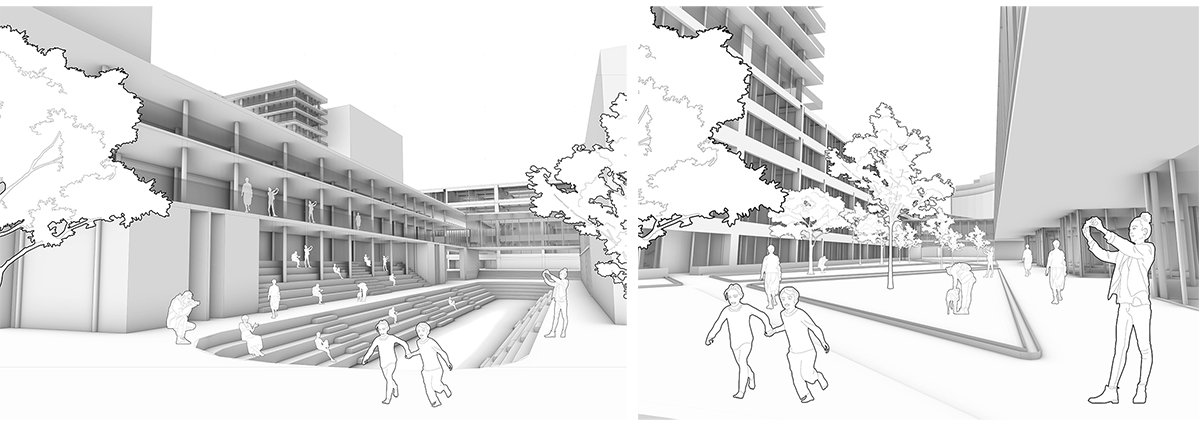
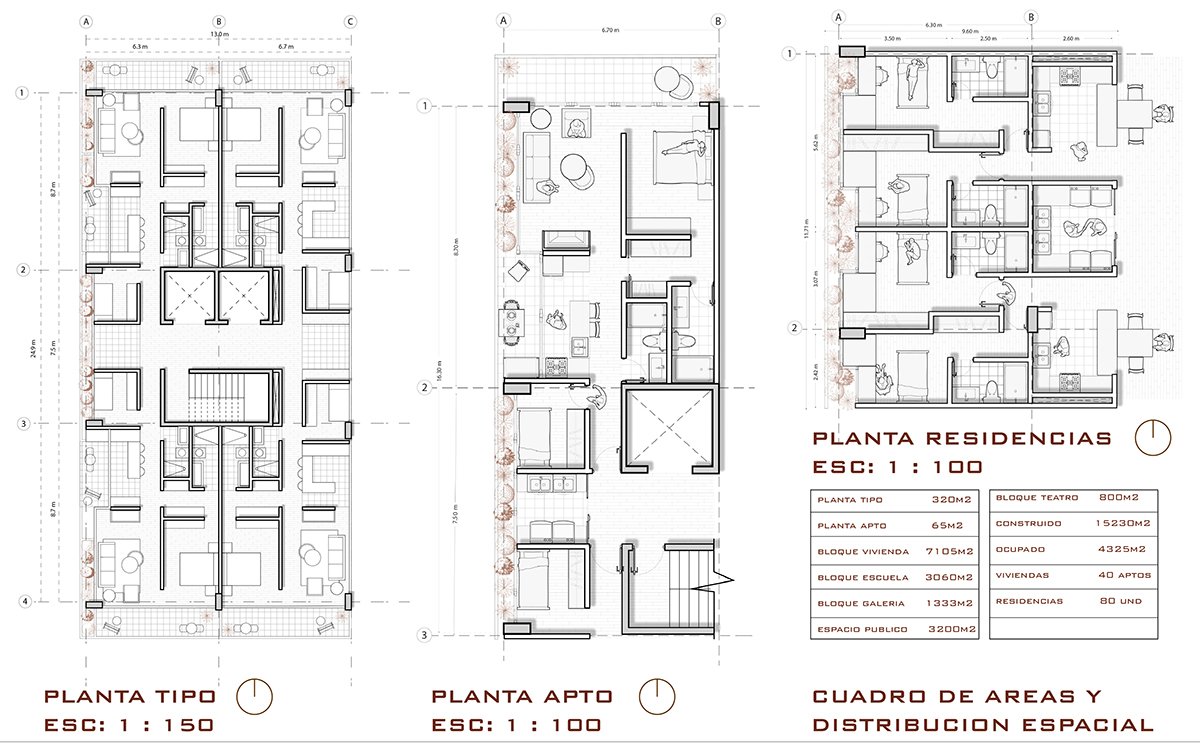
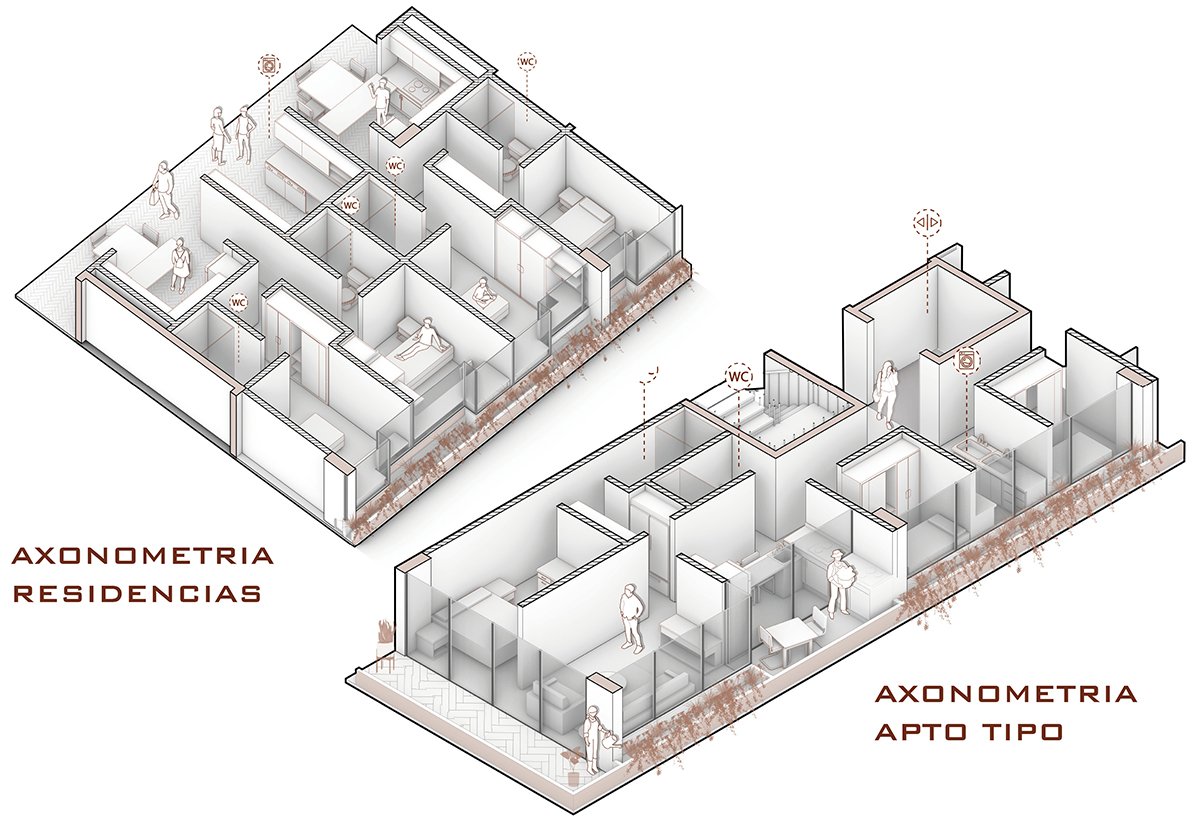
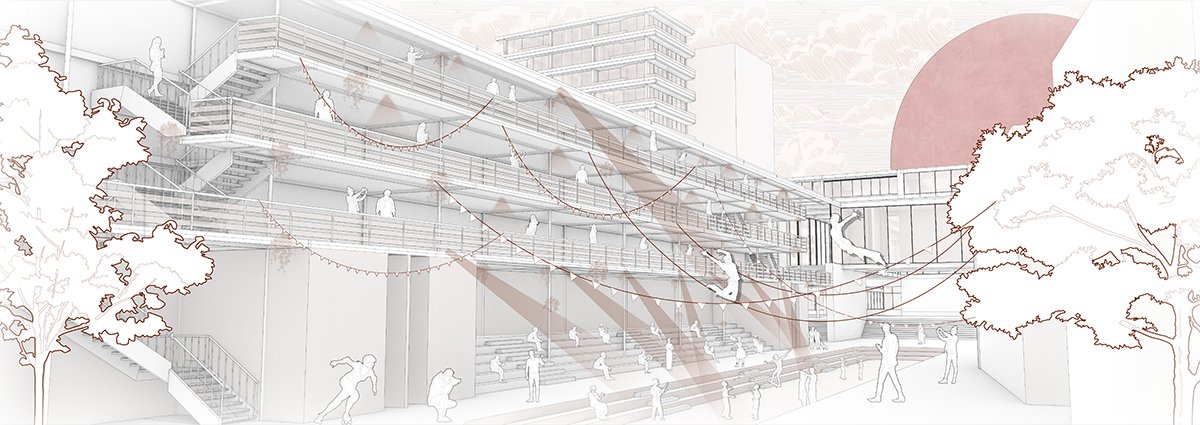
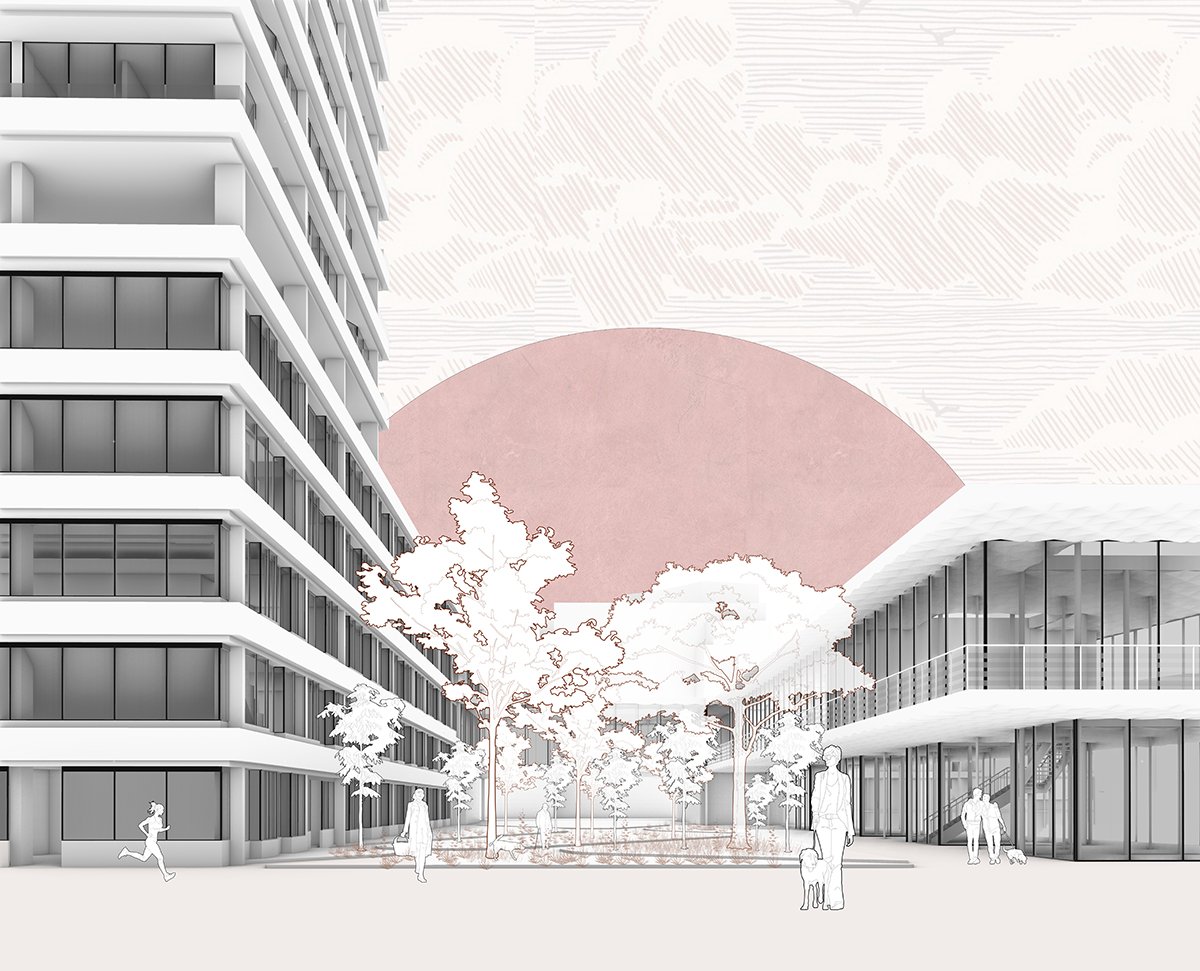
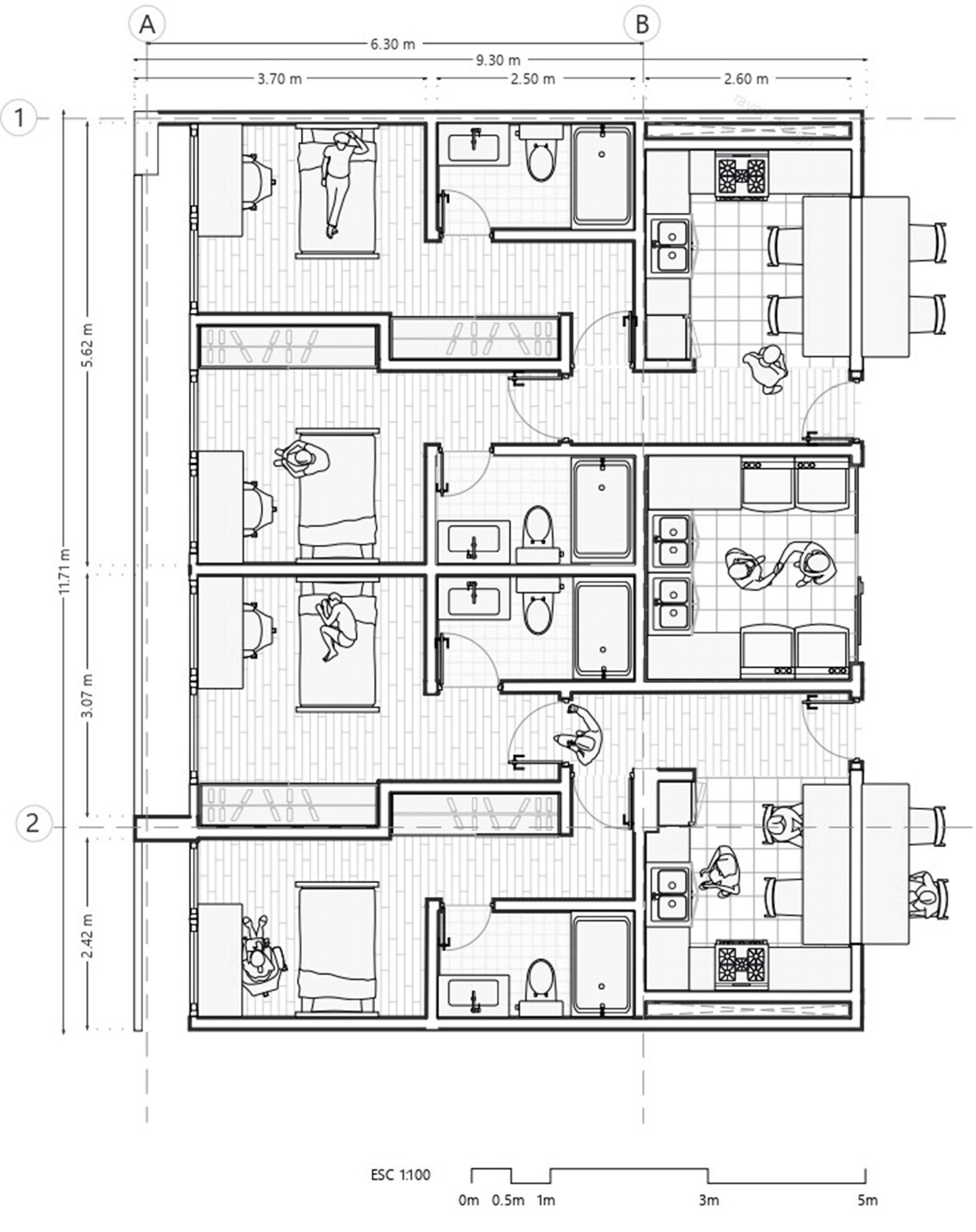
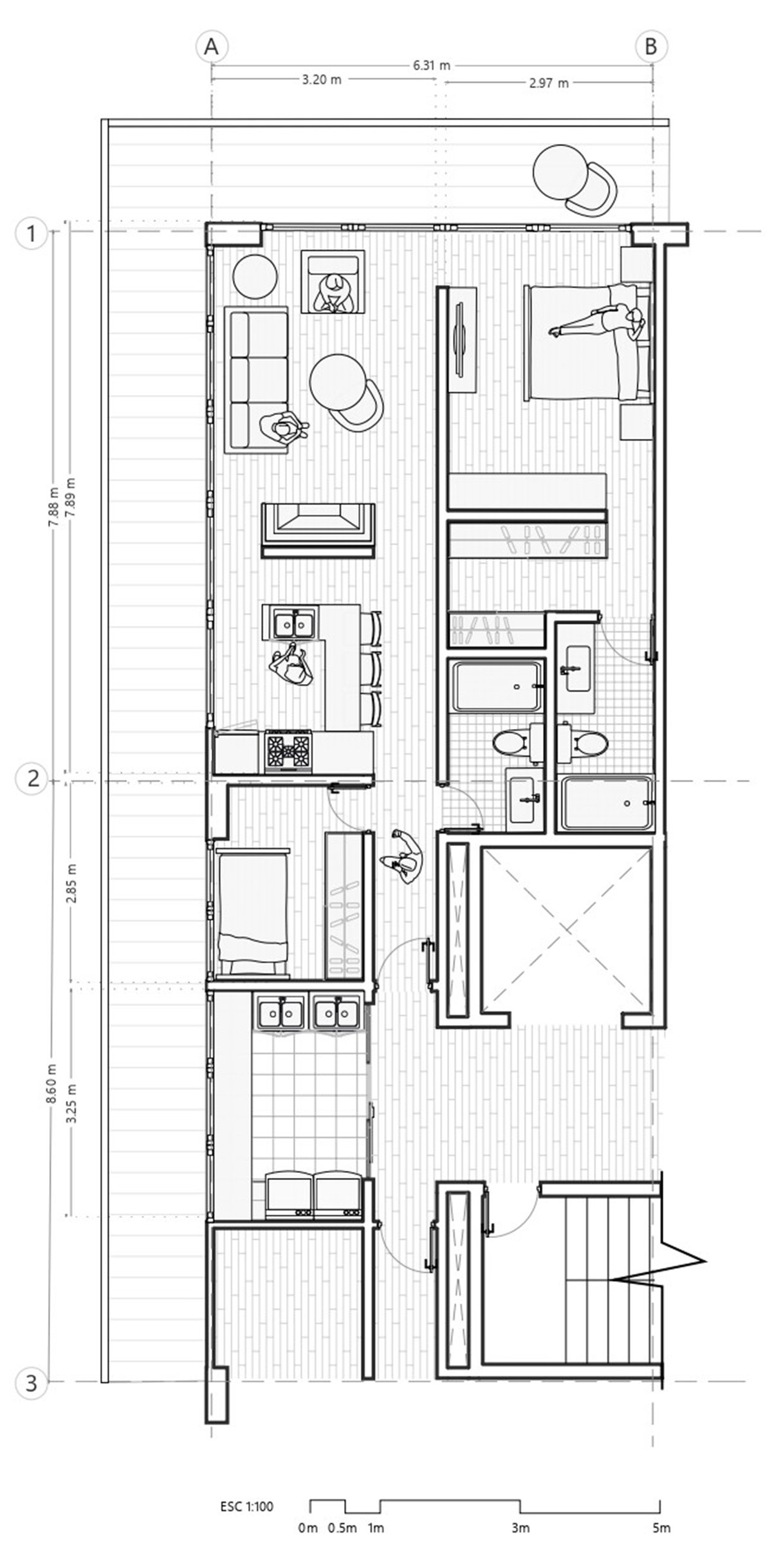
Compact student units are paired with shared kitchens and social spaces, directly linked to the performing arts school. Their arrangement fosters collective living and daily interaction, blending housing with cultural activity. | The tower’s typical floor organizes artist apartments efficiently around central cores, ensuring light and ventilation. Designed for both privacy and coexistence, these units provide the flexibility needed for residents engaged in cultural production.Visual studies tested how residential life and informal performance overlap. The housing platform and open-air theater intersect to create a lively, collective landscape where cultural events and daily life merge. | Another visualization examined the inner courtyard as a green communal anchor. Framed by cultural and residential programs, it supports everyday encounters while integrating nature into the dense urban fabric.
The architectural phase explored spatial relationships between public, semi-public, and private programs using physical models, collages, and digital tools. Material expression, porosity, and community adaptability were prioritized to ensure that each element of the intervention could support cultural life organically over time.
Final Outcome
Ground Floor Plan_Artistic CommonsSecond Floor Plan
The project proposes a system of architectural and urban interventions that reactivates Las Nieves through a dynamic cultural network. Two blocks structure the strategy: one organized around an interior courtyard as a communal heart, the other around reconfigured passages that function as theatrical routes. Together, they integrate housing, workshops, rehearsal rooms, galleries, plazas, and a performing arts school, forming a permeable framework that prioritizes openness, material economy, and community appropriation.
Final Section_Housing Mixed UseFinal Fugado Section Theater Connection
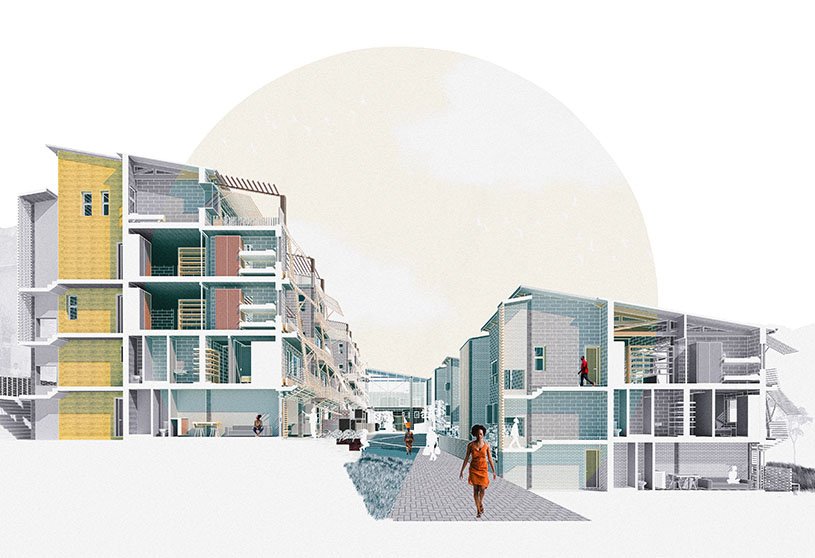
At the urban scale, the design reweaves voids and circulation paths into cultural connectors. At the architectural scale, it develops diverse housing typologies—student residences linked to the school and family housing in a tower—organized around shared courtyards and light wells. Plans and sections highlight fluid circulation, program layering, and spatial porosity, ensuring interaction across public, semi-public, and private realms.
Residential TypologiesAxonometric Views
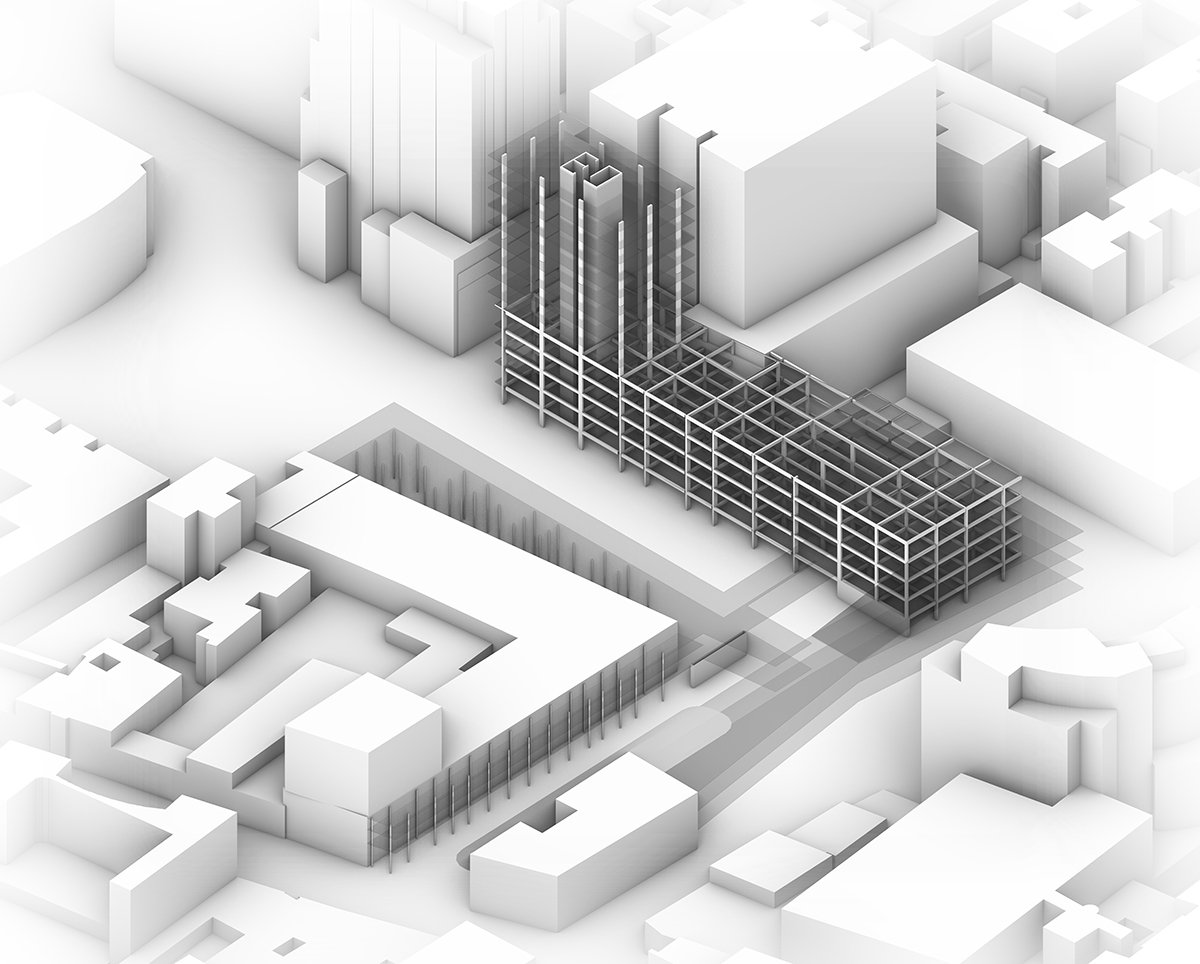
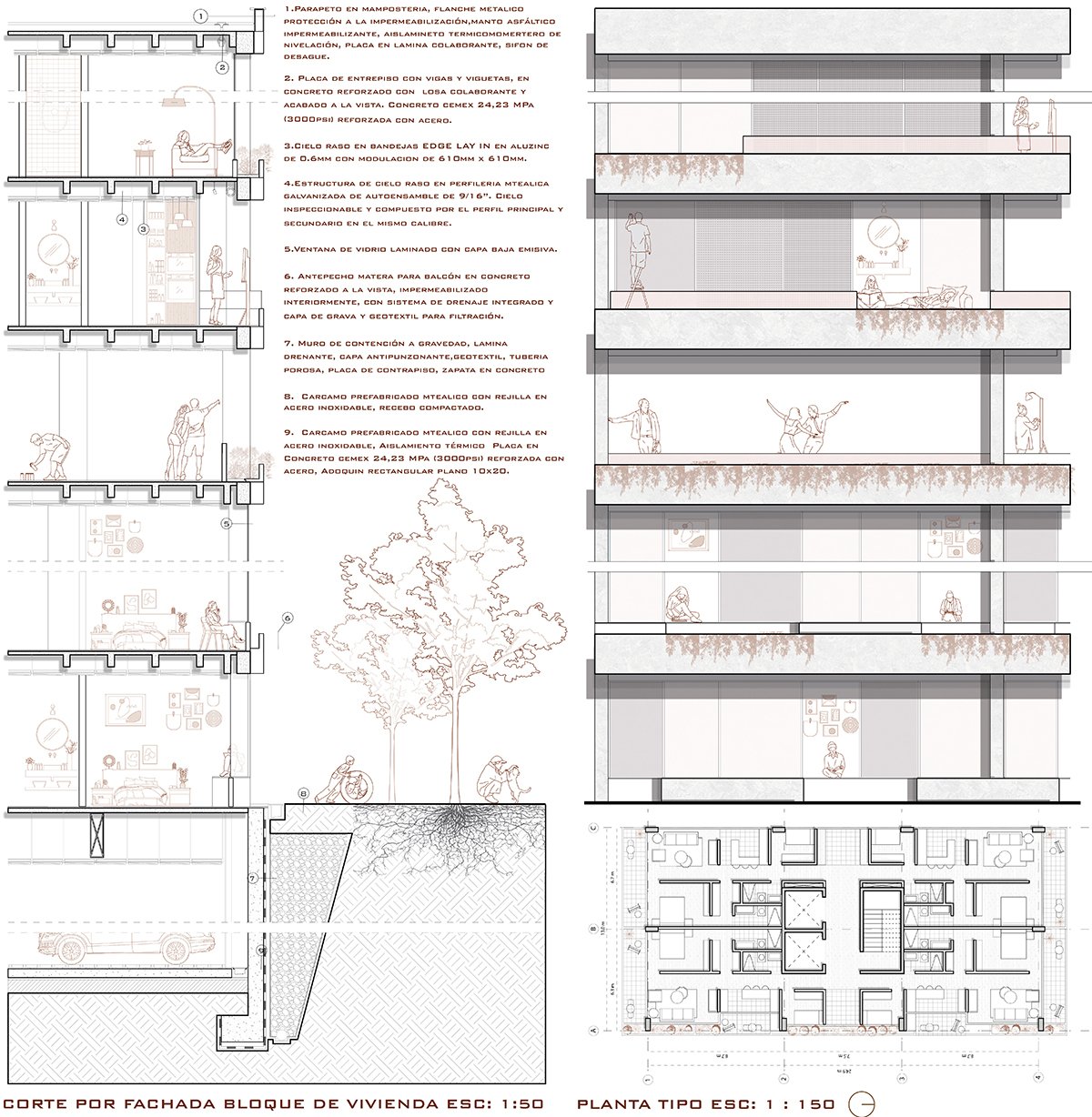
Technical drawings and axonometrics show how modular, flexible housing units foster collective living while integrating shared kitchens, workspaces, and social areas. Facade studies emphasize a balance of robustness and transparency, using local materials and prefabricated systems to enable durability and adaptability.
Housing Facade Section and Material Detail | Final Axometric ViewPublic Space Render Amphitheater and Cultural Passage
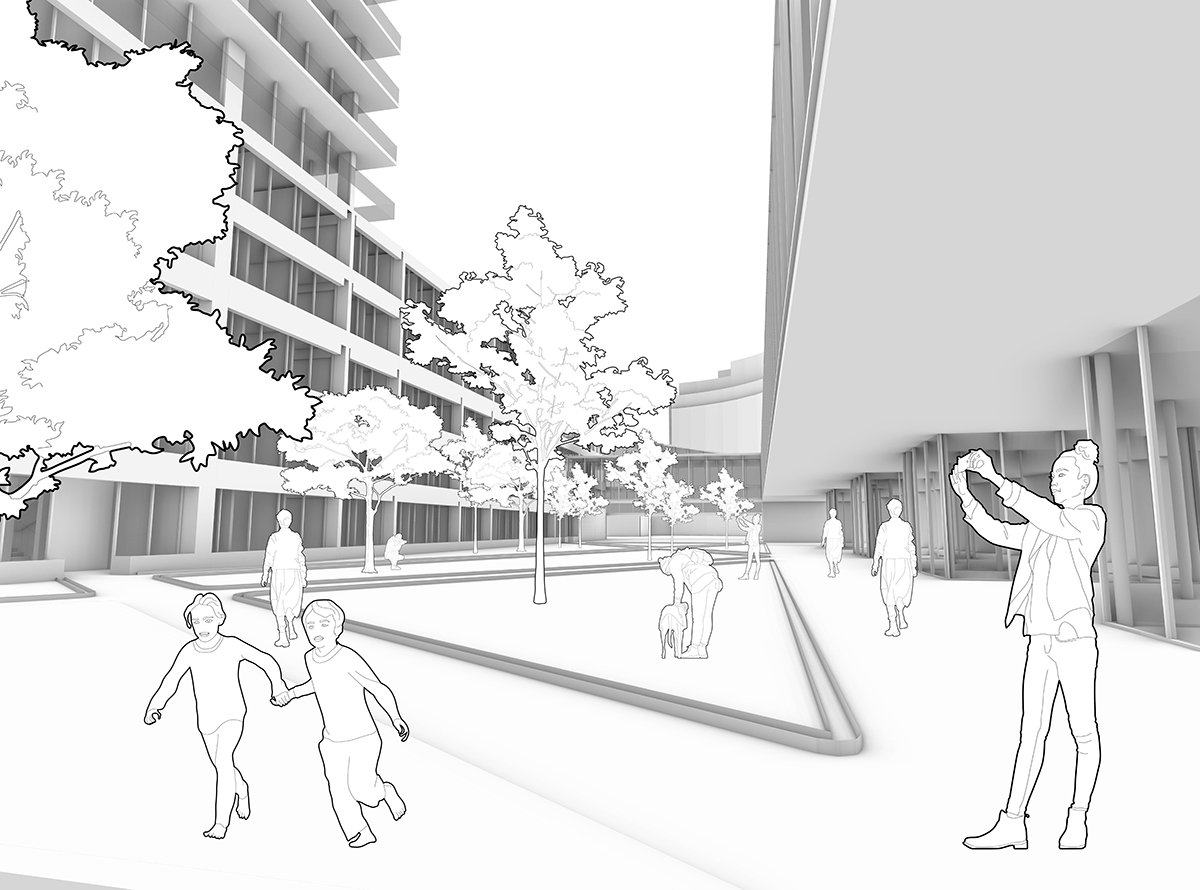
Perspective views illustrate the activation of public space through plazas, an open-air amphitheater, and balconies that link everyday life with cultural events. The central courtyard acts as a threshold where living and creating overlap, reinforcing the project’s vision of urban regeneration from the void—a model that dissolves boundaries between art, community, and the city.
Courtyard Render Park Interface between Housing and Art School
Conclusion: Ultimately, the project transforms Las Nieves’ voids and passages into cultural connectors, integrating housing, education, and public space. It offers a model of urban regeneration that restores identity, supports artistic life, and fosters collective exchange in Bogotá’s historic core.
[This Academic Project has been published with text and images submitted by the student]
Site Context
Design Process
Final Outcome
To submit your academic project for publication at ArchiDiaries, please visit the following link >> Submit
Get the best of ArchiDiaries, directly in your inbox.
We use cookies on our website to give you the most relevant experience by remembering your preferences and repeat visits. By clicking “Accept All”, you consent to the use of ALL the cookies. However, you may visit "Cookie Settings" to provide a controlled consent.
This website uses cookies to improve your experience while you navigate through the website. Out of these, the cookies that are categorized as necessary are stored on your browser as they are essential for the working of basic functionalities of the website. We also use third-party cookies that help us analyze and understand how you use this website. These cookies will be stored in your browser only with your consent. You also have the option to opt-out of these cookies. But opting out of some of these cookies may affect your browsing experience.
Necessary cookies are absolutely essential for the website to function properly. These cookies ensure basic functionalities and security features of the website, anonymously.
Cookie
Duration
Description
cookielawinfo-checkbox-analytics
11 months
This cookie is set by GDPR Cookie Consent plugin. The cookie is used to store the user consent for the cookies in the category "Analytics".
cookielawinfo-checkbox-functional
11 months
The cookie is set by GDPR cookie consent to record the user consent for the cookies in the category "Functional".
cookielawinfo-checkbox-necessary
11 months
This cookie is set by GDPR Cookie Consent plugin. The cookies is used to store the user consent for the cookies in the category "Necessary".
cookielawinfo-checkbox-others
11 months
This cookie is set by GDPR Cookie Consent plugin. The cookie is used to store the user consent for the cookies in the category "Other.
cookielawinfo-checkbox-performance
11 months
This cookie is set by GDPR Cookie Consent plugin. The cookie is used to store the user consent for the cookies in the category "Performance".
viewed_cookie_policy
11 months
The cookie is set by the GDPR Cookie Consent plugin and is used to store whether or not user has consented to the use of cookies. It does not store any personal data.
Functional cookies help to perform certain functionalities like sharing the content of the website on social media platforms, collect feedbacks, and other third-party features.
Performance cookies are used to understand and analyze the key performance indexes of the website which helps in delivering a better user experience for the visitors.
Analytical cookies are used to understand how visitors interact with the website. These cookies help provide information on metrics the number of visitors, bounce rate, traffic source, etc.
Advertisement cookies are used to provide visitors with relevant ads and marketing campaigns. These cookies track visitors across websites and collect information to provide customized ads.