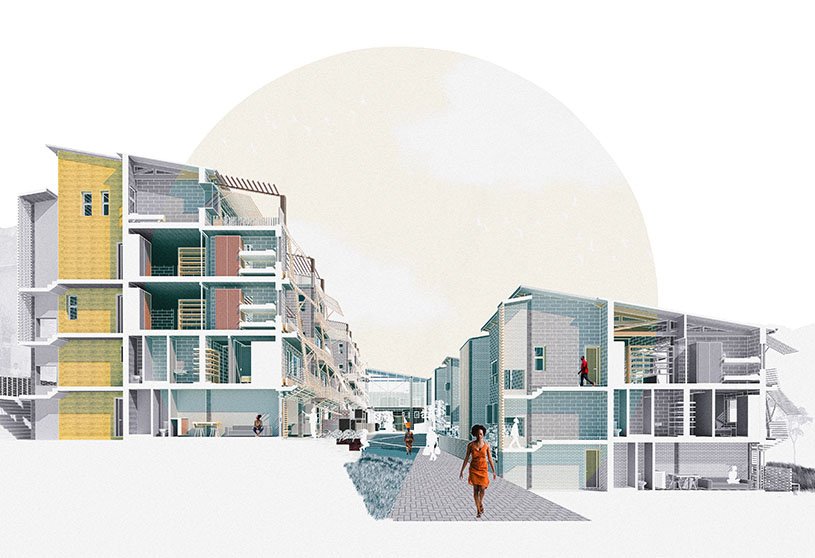
Excerpt: ‘TÀN 58’ is a Masters Design Project by Andrew Cardona, Mingxiang Zheng, Iskandar Habib, and Jeroni Mach Raubert from the ‘Institute for Advanced Architecture of Catalonia (IAAC).’ The project proposes climate-responsive student housing that enhances comfort through material intelligence and passive design. Movable cork modules informed by environmental simulations reduce mechanical demand and adjust to changing conditions while showing how sustainable strategies can transform former industrial sites into an urban space.
Introduction: TÀN 58 is a seven‐storey student housing project in Poblenou, Barcelona, where form, material, and energy converge to create a building designed around human comfort. Developed in IAAC’s Self-Sufficient Buildings Studio, the project explores how architecture can generate comfort through material intelligence and environmental responsiveness rather than relying on mechanical Systems.
The design features a rigid structural frame filled with living units made of movable cork that can be rearranged to improve daylight, ventilation, and thermal comfort. Their placement is guided by simulations of sunlight, heat, and wind, allowing the building to adapt to climate changes. Central atriums promote natural ventilation as warm air rises, while cork walls help regulate temperature. The project shows how materials and parametric, climate-responsive design can turn industrial urban sites into sustainable, livable architecture.
TÀN 58 is located in Poblenou, Barcelona, a district defined by its industrial past and ongoing urban transformation. The site sits within a dense, mixed-use urban fabric where former factories and warehouses are being reimagined as creative and residential spaces. Concurrently, the project investigates the source of its primary material, cork, tracing it back to the forests where it is harvested.
Diagram of Cork Extraction
This approach creates a double landscape: one urban, one ecological. By connecting the city to the natural origin of its materials, the project situated its intervention within broader environmental and social systems, emphasizing the cyclical relationship between extraction, labor, and application. The program includes student housing, designed not only for living but as a point of dialogue between the urban site and its material ecological context.
Through this lens, TÀN 58 engages both the industrial city and the cork forest, grounding architectural work in place-based knowledge and ecological awareness.
Design Process
Isometric Drawing
The design process began with the deconstruction of a domestic appliance—specifically, a space heater—to investigate fundamental energy phenomena. Through this hands-on exploration, the team developed an understanding of convection and heat transfer, observing how air and materials interact to distribute warmth.
They then repurposed the heater’s components to construct a small-scale climatic model, allowing them to recreate and visualize energy flows in a controlled setting. Cork was introduced into this model to test its insulating and thermal storage properties, revealing its capacity to absorb, store, and radiate heat effectively.
Ultraviolet Sensor Test
These insights led to their first architectural experiment: the Machine Room, a study of three cork spaces each maintained at different temperatures. This prototype enabled the team to explore spatial arrangements, material performance, and passive climate strategies in a tangible way.
Ultimately, the lessons learned from the Machine Room were scaled up to inform TÀN 58. The project embodies the culmination of iterative testing, material research, and environmental understanding, translating small-scale experiments into a full-scale, climate-responsive architectural intervention.
Final Outcome
Plan of Extraction ProjectThird Level Climatic Floor PlanSection of Extraction Project
The design of TÀN 58 inhabits a rigid structural frame, within which cork-based living units function as mobile modules. These elements can be repositioned throughout the framework to optimize thermal comfort, daylight access, and ventilation. Guided by computational simulations of sunlight, heat, and wind, the arrangement of these modules allows the building to adapt to shifting climatic conditions while maintaining a comfortable interior environment.
GIF of Floor Plan IterationsBuilding Climatic SectionPerspective of Extraction Project
Natural ventilation and heat regulation are achieved through two central atriums. As warm air rises, the cork walls absorb and later radiate stored heat, creating a thermally stable environment driven by passive performance rather than mechanical systems. In this way, TÀN 58 demonstrates the potential of material intelligence, parametric design, and human-centered climate strategies to transform industrial urban sites into sustainable and livable architecture.
Perspective of Corridor | Perspective of Communal SpacePerspective of UnitPhysical Model
To communicate both the spatial logic and environmental function of the design, the final outcome includes physical models, technical drawings, computational maps, and visualizations. The models make the relationships between cork modules, atriums, and structural constraints physically legible, while the drawings articulate the modular organization and passive systems. Performance maps reveal how light, heat, and wind operate across the site, and visualizations situate the architecture within its urban context, reflecting the ecological origins of its primary material.
Physical ModelPhysical ModelPhysical Model
Together, these representations bridge the gap between experimental research and full-scale application—demonstrating how early material testing and climatic investigation guided the development of the built proposal realized in TÀN 58.
Conclusion: Ultimately, TÀN 58 proposes a future where architecture actively participates in climate moderation—one that prioritizes human well-being while reducing reliance on mechanical resources, and where thoughtful material use becomes a catalyst for ecological renewal.
[This Academic Project has been published with text and images submitted by the student]
Site Context
Design Process
Final Outcome
To submit your academic project for publication at ArchiDiaries, please visit the following link >> Submit
Get the best of ArchiDiaries, directly in your inbox.
We use cookies on our website to give you the most relevant experience by remembering your preferences and repeat visits. By clicking “Accept All”, you consent to the use of ALL the cookies. However, you may visit "Cookie Settings" to provide a controlled consent.
This website uses cookies to improve your experience while you navigate through the website. Out of these, the cookies that are categorized as necessary are stored on your browser as they are essential for the working of basic functionalities of the website. We also use third-party cookies that help us analyze and understand how you use this website. These cookies will be stored in your browser only with your consent. You also have the option to opt-out of these cookies. But opting out of some of these cookies may affect your browsing experience.
Necessary cookies are absolutely essential for the website to function properly. These cookies ensure basic functionalities and security features of the website, anonymously.
Cookie
Duration
Description
cookielawinfo-checkbox-analytics
11 months
This cookie is set by GDPR Cookie Consent plugin. The cookie is used to store the user consent for the cookies in the category "Analytics".
cookielawinfo-checkbox-functional
11 months
The cookie is set by GDPR cookie consent to record the user consent for the cookies in the category "Functional".
cookielawinfo-checkbox-necessary
11 months
This cookie is set by GDPR Cookie Consent plugin. The cookies is used to store the user consent for the cookies in the category "Necessary".
cookielawinfo-checkbox-others
11 months
This cookie is set by GDPR Cookie Consent plugin. The cookie is used to store the user consent for the cookies in the category "Other.
cookielawinfo-checkbox-performance
11 months
This cookie is set by GDPR Cookie Consent plugin. The cookie is used to store the user consent for the cookies in the category "Performance".
viewed_cookie_policy
11 months
The cookie is set by the GDPR Cookie Consent plugin and is used to store whether or not user has consented to the use of cookies. It does not store any personal data.
Functional cookies help to perform certain functionalities like sharing the content of the website on social media platforms, collect feedbacks, and other third-party features.
Performance cookies are used to understand and analyze the key performance indexes of the website which helps in delivering a better user experience for the visitors.
Analytical cookies are used to understand how visitors interact with the website. These cookies help provide information on metrics the number of visitors, bounce rate, traffic source, etc.
Advertisement cookies are used to provide visitors with relevant ads and marketing campaigns. These cookies track visitors across websites and collect information to provide customized ads.