Home » Academic projects » Whom? : The Home Fragmentation and Memory Reassembly in the Thirteen Villages of Kowloon | Bachelors Design Project on Speculative Architecture
Whom? : The Home Fragmentation and Memory Reassembly in the Thirteen Villages of Kowloon | Bachelors Design Project on Speculative Architecture
Excerpt: ‘Whom?’ is a Bachelors Design Project by Wong Hoi Ching Candy from the ‘School of Design – Hong Kong Polytechnic University (PolyU).’ The project explores speculative architecture to preserve and reinterpret the disappearing cultural and spatial memories of Kowloon’s Thirteen Villages through architectural deconstruction and immersive storytelling. By dismantling and reassembling overlooked details, the project seeks to critique urban homogenization, evoke emotional connections to place, and create a living archive that bridges past, present, and future.
Introduction: “Whom is where we find the home we seek.” This narrative project reimagines the Thirteen Villages of Kowloon, highlighting their disappearing histories through architectural deconstruction. As traditional village spaces vanish under urban renewal, cultural memory and identity erode. By dismantling and reassembling “low-value structures,” the project creates a fragmented yet emotional spatial experience. Suggested with projection mapping and transformed architectural drawings, they evoke memory, emphasizing fluid boundaries and immersive storytelling. This approach critiques the homogenization of urban space and the loss of human connection. Rather than replicating the villages, the project honors their often-overlooked details such as bricks, grills, and rhythms, thereby preserving these fragments as integral elements of living narratives. It invites reflection on memory, place, and belonging, offering a dialogue between past and future. Through this, Kowloon’s stories remain visible, resonant, and shared.
Estimated Approximate Locations And Distribution Of The Kowloon’s Thirteen VillagesCurrent Spatial Data And Topographic MapInterview Plot Analysis, Chuk Yuen Village
The project is set in the fading landscape of Kowloon’s Thirteen Villages, a historic cluster once rich with agricultural traditions, community bonds, and unique spatial character. Over time, urban redevelopment and the pressure of modernization have led to the gradual disappearance of these villages, leaving behind only fragments of memories, materials, and cultural imprints. This site embodies the tension between heritage and transformation, where the idea of “home” is constantly reshaped by change.
Potential Materials Analysis, Study Of Applications Insights3d Site AnalysisComponents Of SpaceDeconstructing The Fragments Of Space
The program of the project is less about a singular building and more about constructing an immersive narrative. Through deconstruction and reassembly, it explores how fragmented forms, textures, and spaces can represent memory, resilience, and loss. Functions are expressed in layered installations, drawings, and models that evoke spatial qualities rather than prescribe fixed uses. In doing so, the project transforms absence into presence—reclaiming forgotten details and offering a new way of experiencing Kowloon’s vanishing cultural landscape.
Design Process
Deconstructing The Fragments Of Space_explore Their Undying UnityTransformed Into Tangible Spatial Series
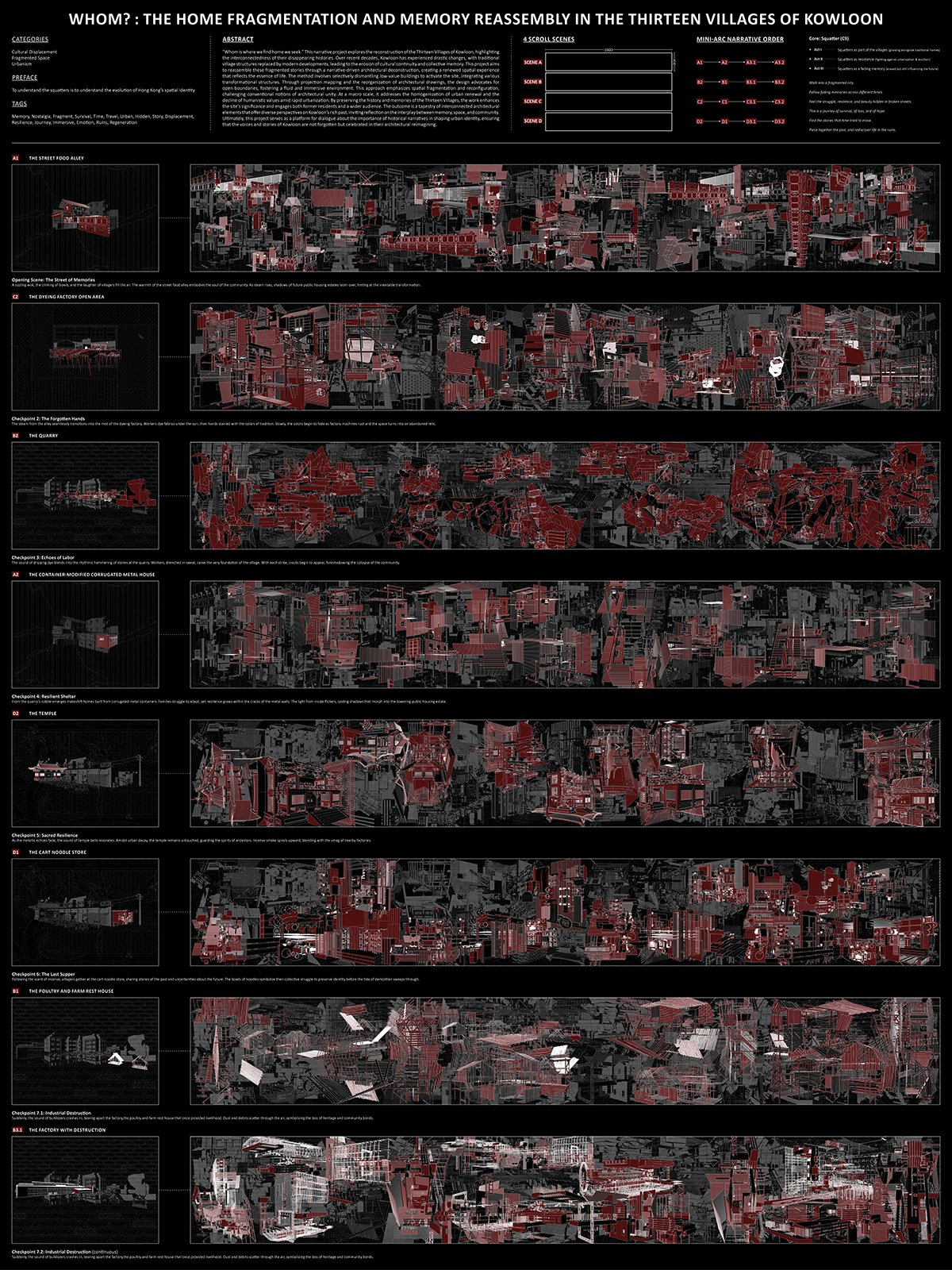
The design process involved multiple visits to the Thirteen Villages, with sketching, mapping, and photographing materials, rhythms, and informal add-ons. Archive and curation catalogued textures and details, selecting 15 architectural components, including walls, floors, grills, doors, tiles, and eaves. Rule-setting established a clear system: deconstruct only by 90° turns and align to the first axis, creating “order in chaos.” A method matrix then matched each checkpoint to the deconstruction logics.
Material Transformation With Analysis And Estimation_the Squatter’s HomeMaterial Transformation With Analysis And Estimation_the Squatter’s HomeScene A CatalogueScene A_Mini Arc Narrative
Abstraction reduced components into modular fragments and tested folding, peeling, stacking, and exploding. Narrative mapping structured 12 checkpoints across 4 scrolls (2800×400 mm), with each scroll running from past to present to future with interludes. Composition studies iterated digital and physical collages, exploring density, void, and tension while keeping the original component hidden at the center.
Scene B CatalogueScene B_Mini Arc Narrative
The color strategy used a limited palette: red for bloodline and struggle, and black and white for loss and emptiness. A projection layer mapped animations of past, present, and future over static drawings. Integration and output produced the final scrolls, annotated checkpoint logics, and a 5-minute video for immersive storytelling.
Final Outcome
Narrative StructureNarrative Structure
The final outcome of the project is an immersive architectural intervention that bridges memory, community, and transformation. Drawing from the fragmented histories of Kowloon’s disappearing villages, the design reinterprets traditional elements such as stone walls, fabric workshops, and street vendor stalls into a layered spatial journey.
Narrative StructureNarrative Structure
The architecture unfolds as a sequence of transitional spaces—from compressed alleys to open courtyards—evoking the rhythm of past village life while responding to contemporary urban needs.
Narrative StructureNarrative StructureThe Evolution Of Each Thematic Strand_ From Vibrant Origins To Institutional TransformationThe Evolution Of Each Thematic Strand_ From Rural Simplicity To Industrial Ruin
The project balances heritage with adaptability, using modular structures and recycled materials to ensure sustainability and flexibility. Immersive installations, memory walls, and interactive community areas allow users to engage both emotionally and physically with the space, reinforcing the narrative of continuity and renewal.
The Evolution Of Each Thematic Strand_ From Ancestral Gatherings To Enduring EchoesThe Evolution Of Each Thematic Strand_ From Culinary Roots To Sacred Community Bonds
Conclusion: Ultimately, the outcome is not only a built form but also a living archive—a place where history, culture, and imagination converge, offering a new collective identity for the disappearing landscapes of Kowloon.
[This Academic Project has been published with text and images submitted by the student]
Site Context
Design Process
Final Outcome
To submit your academic project for publication at ArchiDiaries, please visit the following link >> Submit
Get the best of ArchiDiaries, directly in your inbox.
We use cookies on our website to give you the most relevant experience by remembering your preferences and repeat visits. By clicking “Accept All”, you consent to the use of ALL the cookies. However, you may visit "Cookie Settings" to provide a controlled consent.
This website uses cookies to improve your experience while you navigate through the website. Out of these, the cookies that are categorized as necessary are stored on your browser as they are essential for the working of basic functionalities of the website. We also use third-party cookies that help us analyze and understand how you use this website. These cookies will be stored in your browser only with your consent. You also have the option to opt-out of these cookies. But opting out of some of these cookies may affect your browsing experience.
Necessary cookies are absolutely essential for the website to function properly. These cookies ensure basic functionalities and security features of the website, anonymously.
Cookie
Duration
Description
cookielawinfo-checkbox-analytics
11 months
This cookie is set by GDPR Cookie Consent plugin. The cookie is used to store the user consent for the cookies in the category "Analytics".
cookielawinfo-checkbox-functional
11 months
The cookie is set by GDPR cookie consent to record the user consent for the cookies in the category "Functional".
cookielawinfo-checkbox-necessary
11 months
This cookie is set by GDPR Cookie Consent plugin. The cookies is used to store the user consent for the cookies in the category "Necessary".
cookielawinfo-checkbox-others
11 months
This cookie is set by GDPR Cookie Consent plugin. The cookie is used to store the user consent for the cookies in the category "Other.
cookielawinfo-checkbox-performance
11 months
This cookie is set by GDPR Cookie Consent plugin. The cookie is used to store the user consent for the cookies in the category "Performance".
viewed_cookie_policy
11 months
The cookie is set by the GDPR Cookie Consent plugin and is used to store whether or not user has consented to the use of cookies. It does not store any personal data.
Functional cookies help to perform certain functionalities like sharing the content of the website on social media platforms, collect feedbacks, and other third-party features.
Performance cookies are used to understand and analyze the key performance indexes of the website which helps in delivering a better user experience for the visitors.
Analytical cookies are used to understand how visitors interact with the website. These cookies help provide information on metrics the number of visitors, bounce rate, traffic source, etc.
Advertisement cookies are used to provide visitors with relevant ads and marketing campaigns. These cookies track visitors across websites and collect information to provide customized ads.