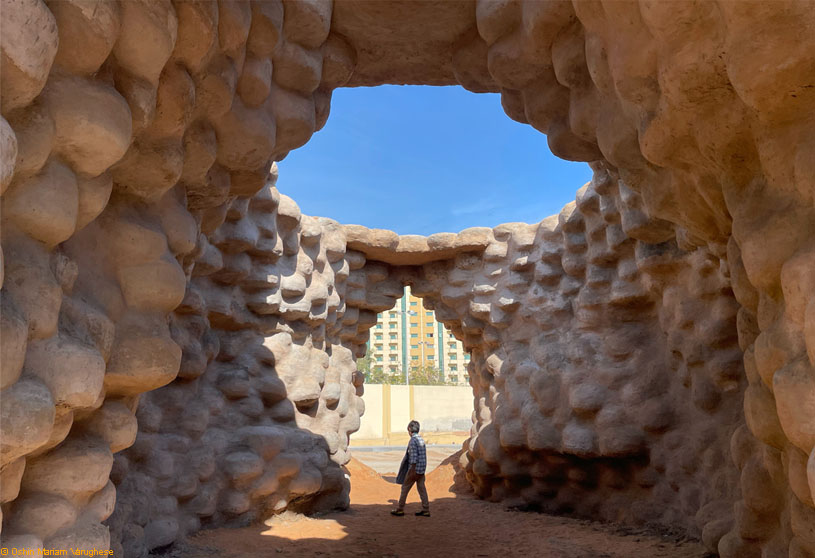
Excerpt: 3 Minute Pavilion by Wallmakers is envisioned as a passage cut through waste tyres that makes visitors contemplate the humongous amount of waste produced daily. Using established sand and tyre masonry, the pavilion transforms discarded tyres and desert sand into a thermally insulated habitable space, proposing waste as a beautiful and sustainable building material for arid regions.
Project Description

[Text as submitted by architect] Globally we are headed towards a disaster with humongous amounts of waste accumulating daily into our eco-systems, poisoning our land and oceans. Among these, contributing to 2% of the total global waste is one of the most toxic objects: discarded tires.

With more than 280 million tires discarded annually and only 30 million of them being retreaded or reused, the remaining 250 million scrap looms like a dangerous eventuality before us. The best way to neutralise this toxic material is to use them as a part of construction. The method of Established Sand and Tyre Masonry, can prove to be a new alternative for our building shortage and prove its mettle as a strong and reliable building material once mud plastered.


This pavilion for the Sharjah Architectural Triennial 2023, curated by Tosin Oshinowo, is envisioned as a passage cut through waste tyres that makes one contemplate on the amount of waste we humans produce on a daily basis: 6,84,931 tyres. The pavilion is made from 1425 tyres which is the number of tyres discarded globally during the 3 minutes walk a visitor makes through the passage .


But the pavilion stands, not just as a horrifying reminder of our problems but also offering a solution to the doom that haunts us, that these waste materials can also become beautiful habitable spaces. The entire pavilion is made with tires collected from different waste facilities in Sharjah and packed with the most commonly available material in that region, that is generally deemed unsuitable for construction: desert sand.

This modified form of masonry will ensure a thermally insulated cooler space inside, that also showcases the possibility of designing buildings in arid regions like the U.A.E , with materials found in its proximity and don’t need active cooling. The idea of the pavilion was to fit in beautifully with the theme of the exhibition: “The Beauty of Impermanence”. From time immemorial men have been fascinated with the impermanence of deserts, entire mounds of sand shifting along with the wind.
Similar to how Buddhist monks destroy sand mandalas made painstakingly with days of extensive work as a reminder of the impermanence of art and life, 95 percent of the pavilion becomes a part of the desert after its use.
Images


