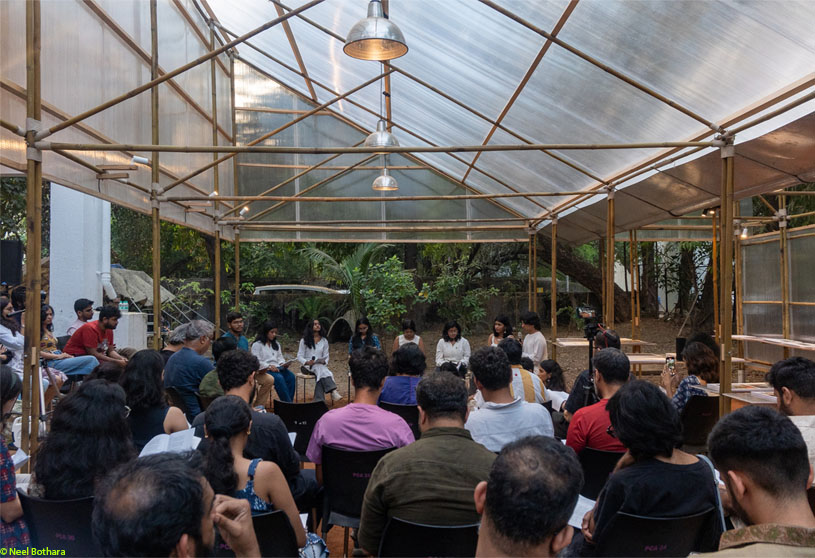
Excerpt: Monsoon Pavilion by Rust Collective explores how one inhabits uncertainty through a space that exists between architecture and landscape, shelter and openness, permanence and impermanence. Conceived as a condition rather than an object, the pavilion responds to Mumbai’s changing climate by embracing adaptability, openness, and flux. It proposes an architecture that absorbs, yields, and coexists with its environment rather than resisting it.
Project Description

[Text as submitted by architect] Amidst Mumbai’s unpredictable skies, the Liminal Pavilion by Rust Collective stands as an inquiry into how one inhabits uncertainty. Conceived not as an object but as a condition, the pavilion as a competition entry, explores the meaning of thresholds: between architecture and landscape, permanence and impermanence, shelter and openness.
It exists as an incremental space — one that absorbs, adapts, and responds to its context like a porous organism in dialogue with its surroundings. Invisible Dust (UK), Raqs Media Collective (Delhi), Goethe Institute and SEA Mumbai (India) came together to mark the school’s 10th anniversary by creating a new pavilion through an open call for young architects and artists under 30.


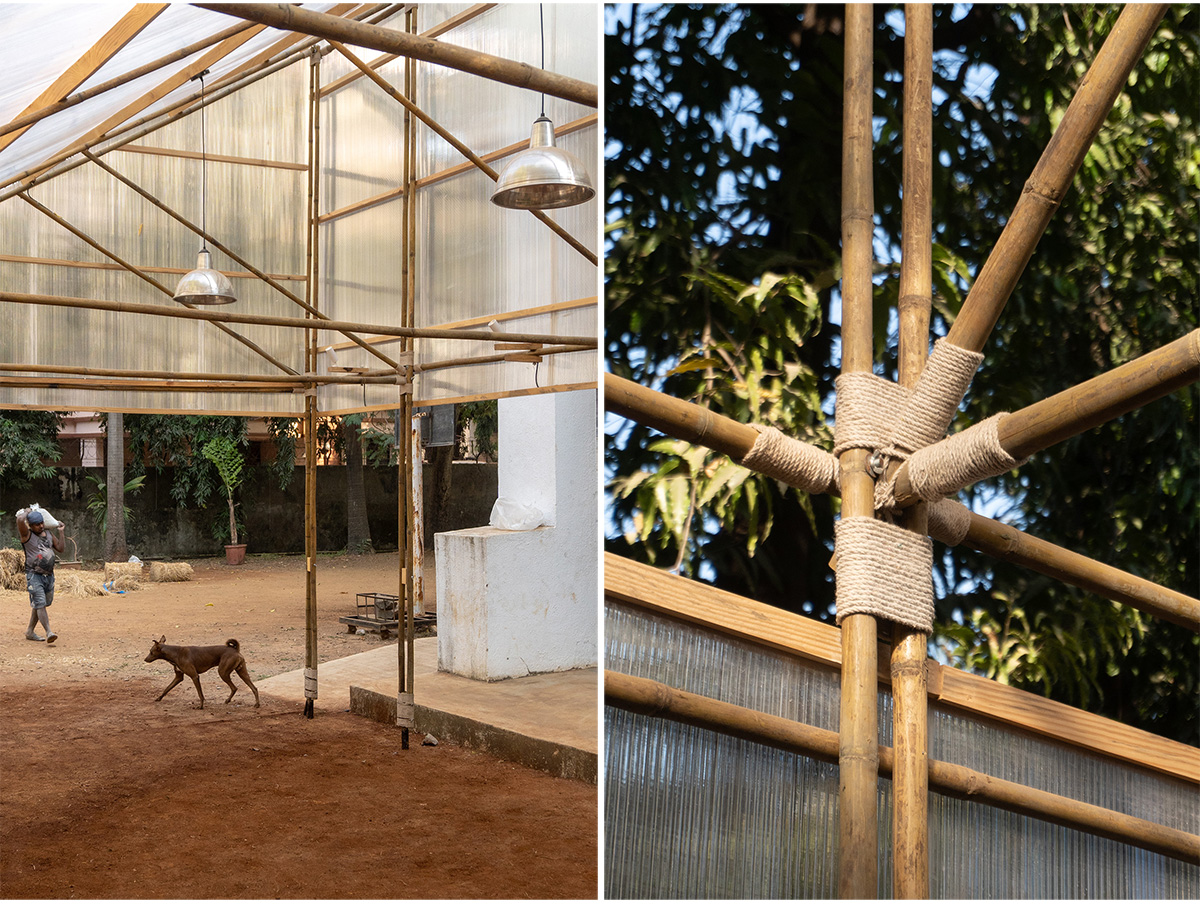
Located within the School of Environment and Architecture (SEA), Mumbai, the pavilion occupies the in-between — a zone often overlooked: the edge between building and boundary wall, between trees and built form. The project stems from a simple yet profound question: How does one inhabit the monsoon? In a city where rainfall dictates rhythm and routine, the pavilion rethinks shelter not as enclosure but as continuity — a spatial and material response to the extended, erratic seasons that climate change has now made inevitable.
Rather than offering a solution, The Liminal Pavilion presents an argument. It is a tactile proposition that challenges the conventional notion of architecture as fixed and impermeable. In a time when warming seas distort rainfall patterns and blur the boundaries between seasons, the pavilion proposes that architecture, too, must learn to absorb, to yield, and to coexist with flux.


The winners of the SEA Pavilion Open Call- Rust Collective, founded in 2022 by Dhruv Sachala and Neel Shah — both graduates of SEA — operate at the intersection of art, architecture, and design. Their practice is deeply collaborative, bringing together artists, engineers, and craftsmen to explore context and materiality. Guided by ongoing research and teaching, they work reflectively and responsively—often as “bricoleurs,” recombining materials, tools, and histories to find meaningful, context-appropriate solutions.
They strive to create things that are simple, beautiful, and timeless. The pavilion embodies this ethos of recombination. Built using bamboo and polycarbonate sheets, it celebrates the logic of the handmade — where material availability and technique become the primary generators of form.
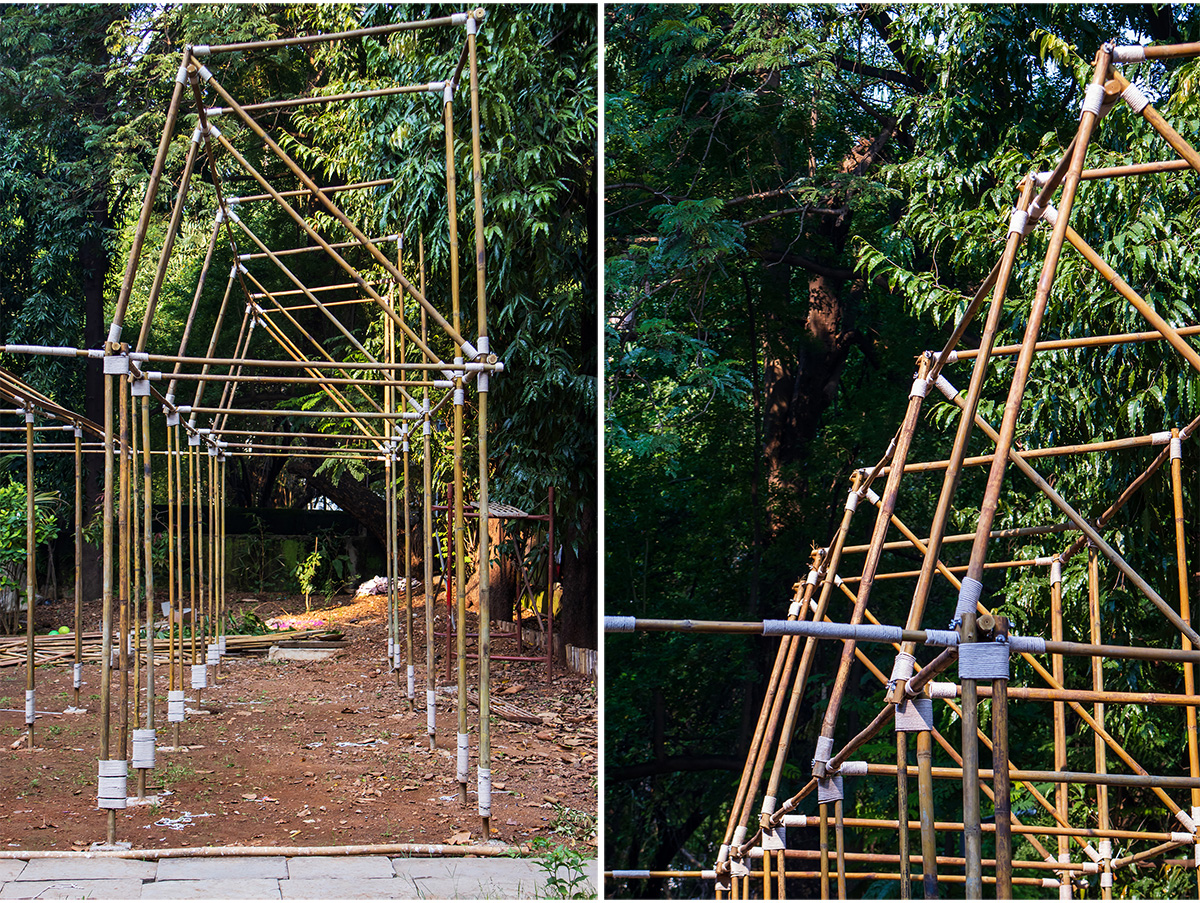


The inverted roof, supported by bamboo stilts anchored in concrete bases, creates a delicate balance between stability and impermanence. Its translucent envelope registers the shifting presence of light, rain, and shadow — blurring the distinction between interior and exterior. The structure resists the impulse to close itself off, instead choosing to remain receptive: to sound, breeze, and movement. Geometry here is structural logic — the golden ratio serves as an invisible framework that lends coherence and rhythm to the composition.
The pavilion opens out from one end, visually extending the built form into the landscape. In doing so, it reactivates a previously residual space on campus — transforming it into a site of collective interaction, learning, and reflection. Programmatically, The Liminal Pavilion is open-ended.
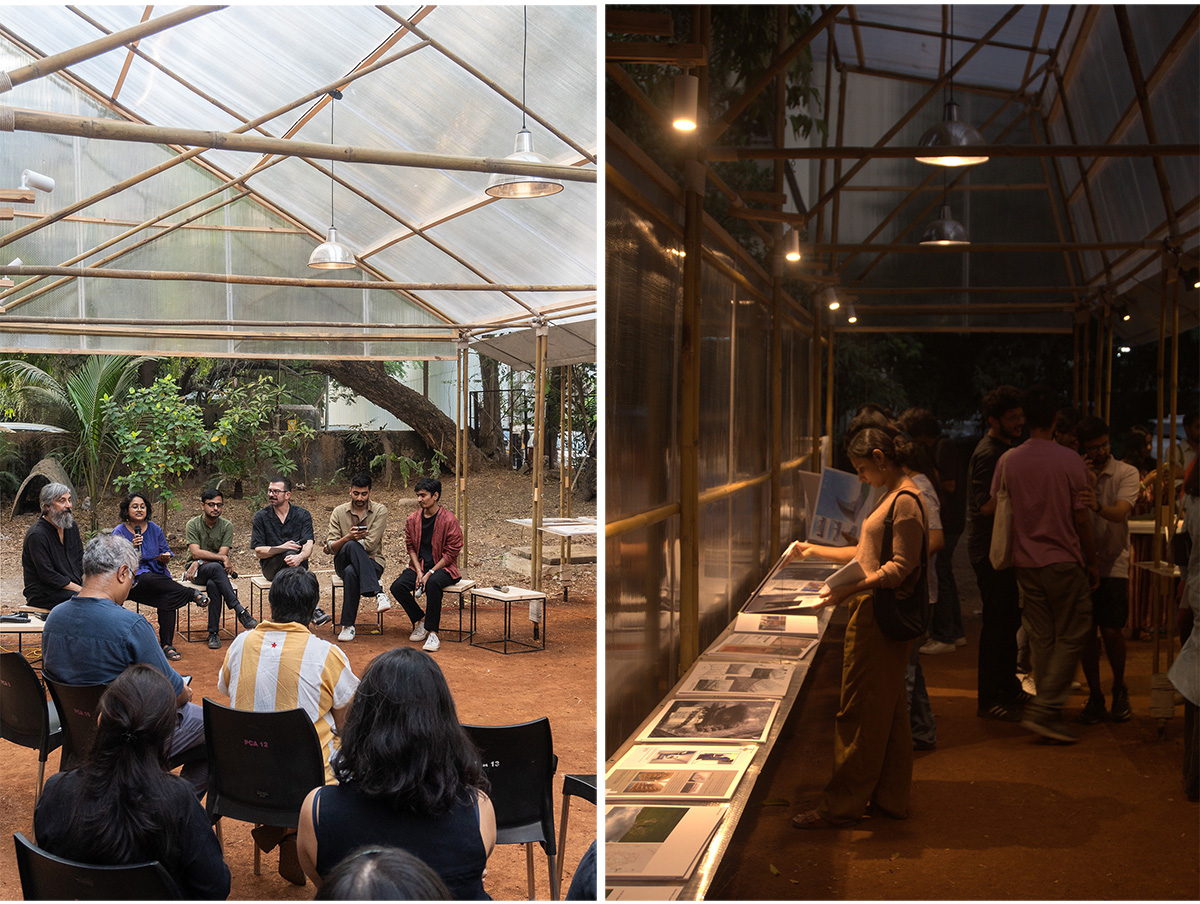

It functions as a space for discussion, dialogue, display, and performance — a neutral yet charged ground that invites occupation rather than dictating it. Its temporality is its strength; the ability to hold shifting uses and emotions becomes central to its identity. Beneath the translucent canopy, the filtered light and constant movement of leaves above create an atmosphere both grounded and ethereal, an architecture that hovers between material and metaphor.
Conceptually, the pavilion explores temporality and resilience, asking how architecture can coexist with cycles of weather, decay, and renewal by embracing openness rather than relying on permanence for its meaning.

It invites rethinking of design pedagogy itself: how can students, practitioners, and citizens collectively imagine forms of living that accommodate uncertainty? The pavilion becomes a laboratory of ideas — a structure that learns as much as it teaches.
Ultimately, it is not a pavilion in the traditional sense. It is a thought made tangible, a threshold made spatial, and a conversation made architectural. In its quiet humility, it demonstrates that architecture’s relevance today lies not in permanence, but in its capacity to evolve — to build not despite the given climate, but with it.
Drawings & Models


Construction Images


Images


