Home » Academic projects » Stories from the Hearth: Intergenerational Co-Housing as Cultural and Social Infrastructure in Chinatown | Interior Architecture Thesis
Stories from the Hearth: Intergenerational Co-Housing as Cultural and Social Infrastructure in Chinatown | Interior Architecture Thesis
Excerpt: ‘Stories from the Hearth’ is a Bachelors Design Thesis by Felicia Angel from the ‘School of Architecture, Building and Design – Taylor’s University.’ This project proposes an intergenerational community center and elderly co-housing model in Jalan Petaling, Kuala Lumpur’s historic Chinatown. It addresses senior social isolation and limited support amid commercialization. Communal spaces, gardens, and cultural hubs foster interaction between generations, improving elderly well-being, preserving cultural identity, and strengthening community ties.
Introduction: This project proposes an intergenerational community center and elderly co-housing model in Jalan Petaling, Kuala Lumpur’s historic Chinatown. It responds to the challenges of social isolation, reduced independence, and lack of support services for seniors in a district increasingly shaped by commercialization. Communal spaces, urban gardens, and cultural hubs encourage interaction between young and old through shared activities such as gardening, storytelling, and cultural exchange. The design improves daily life for the elderly, safeguards cultural identity, and strengthens community ties.
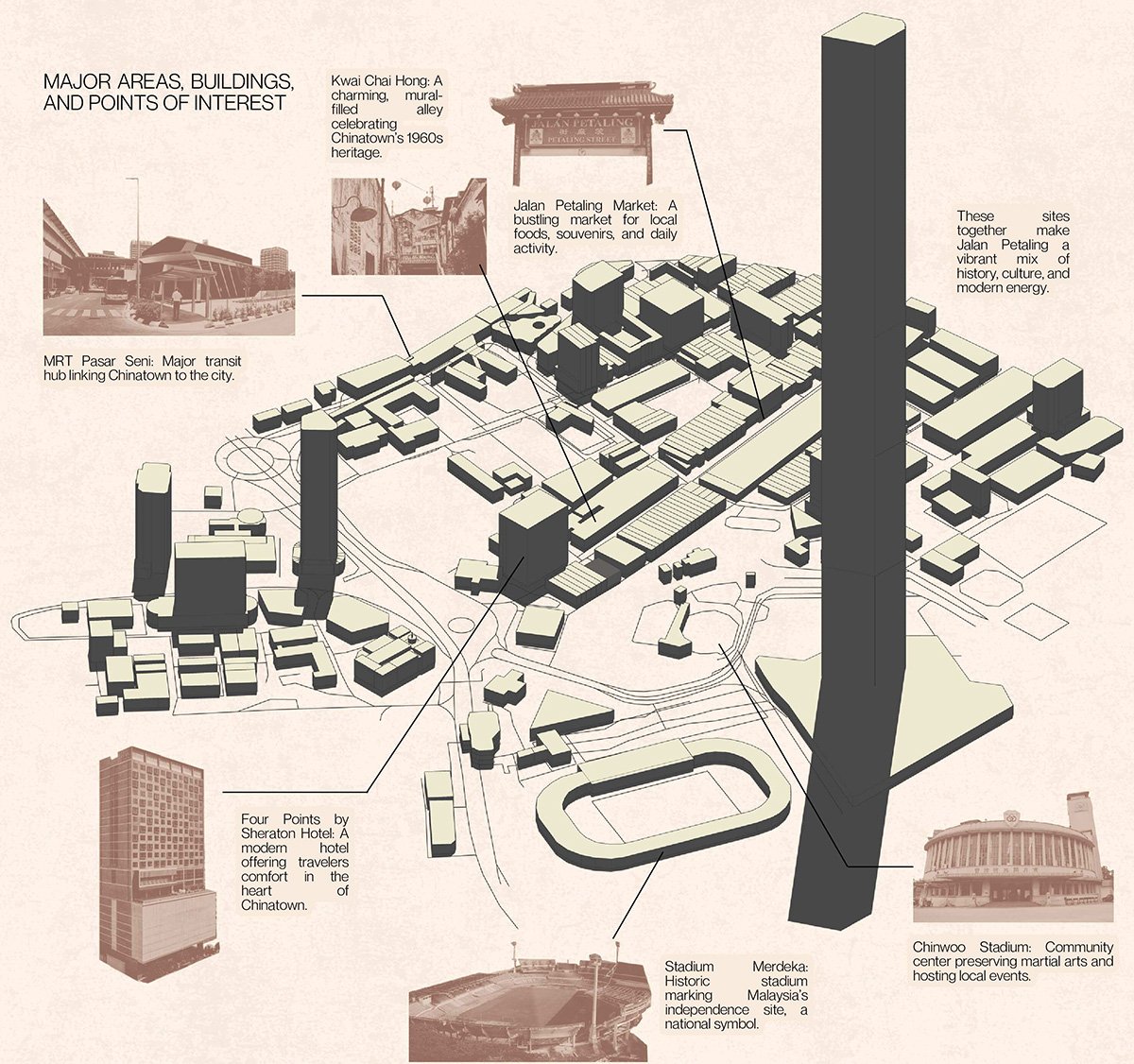
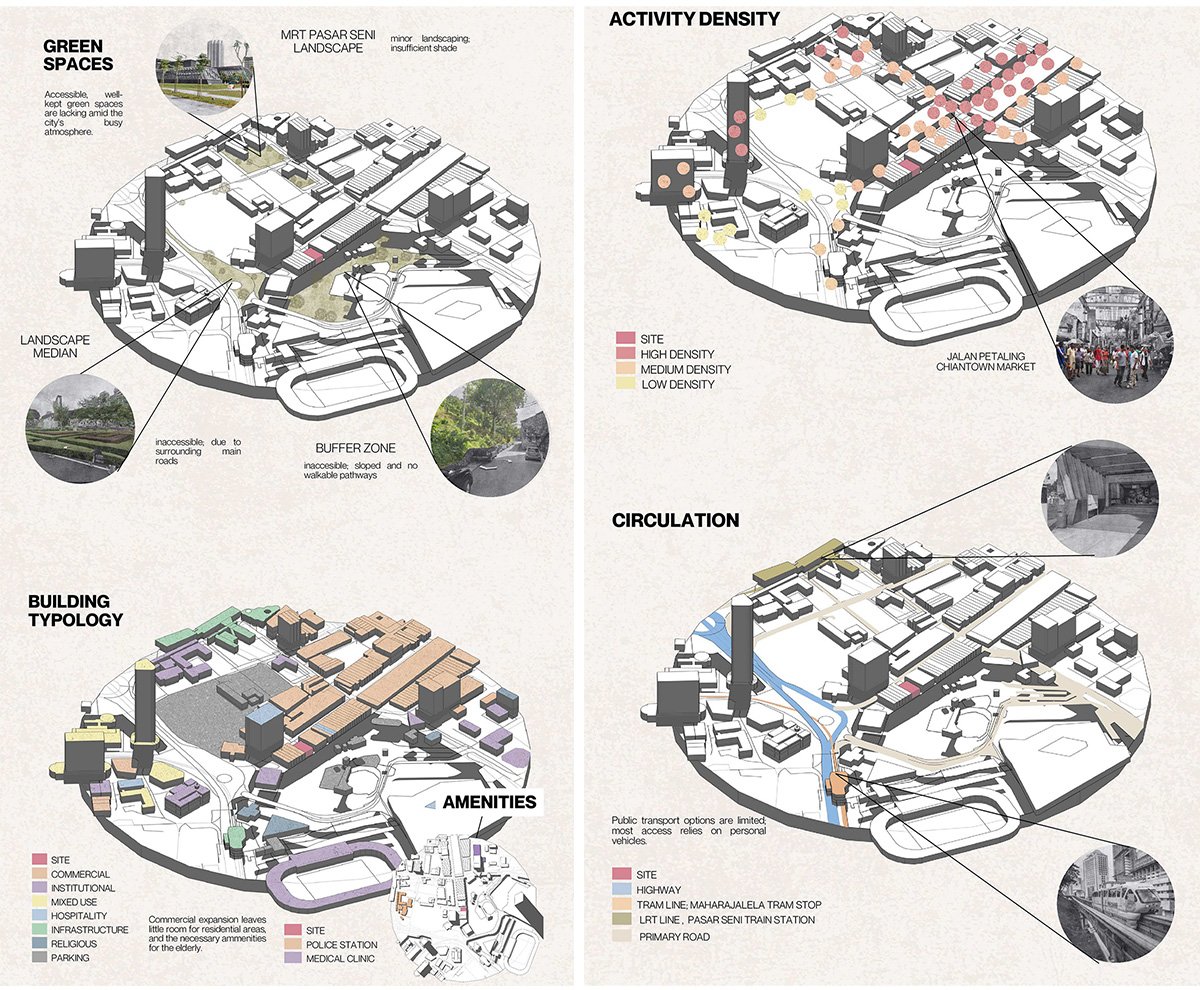
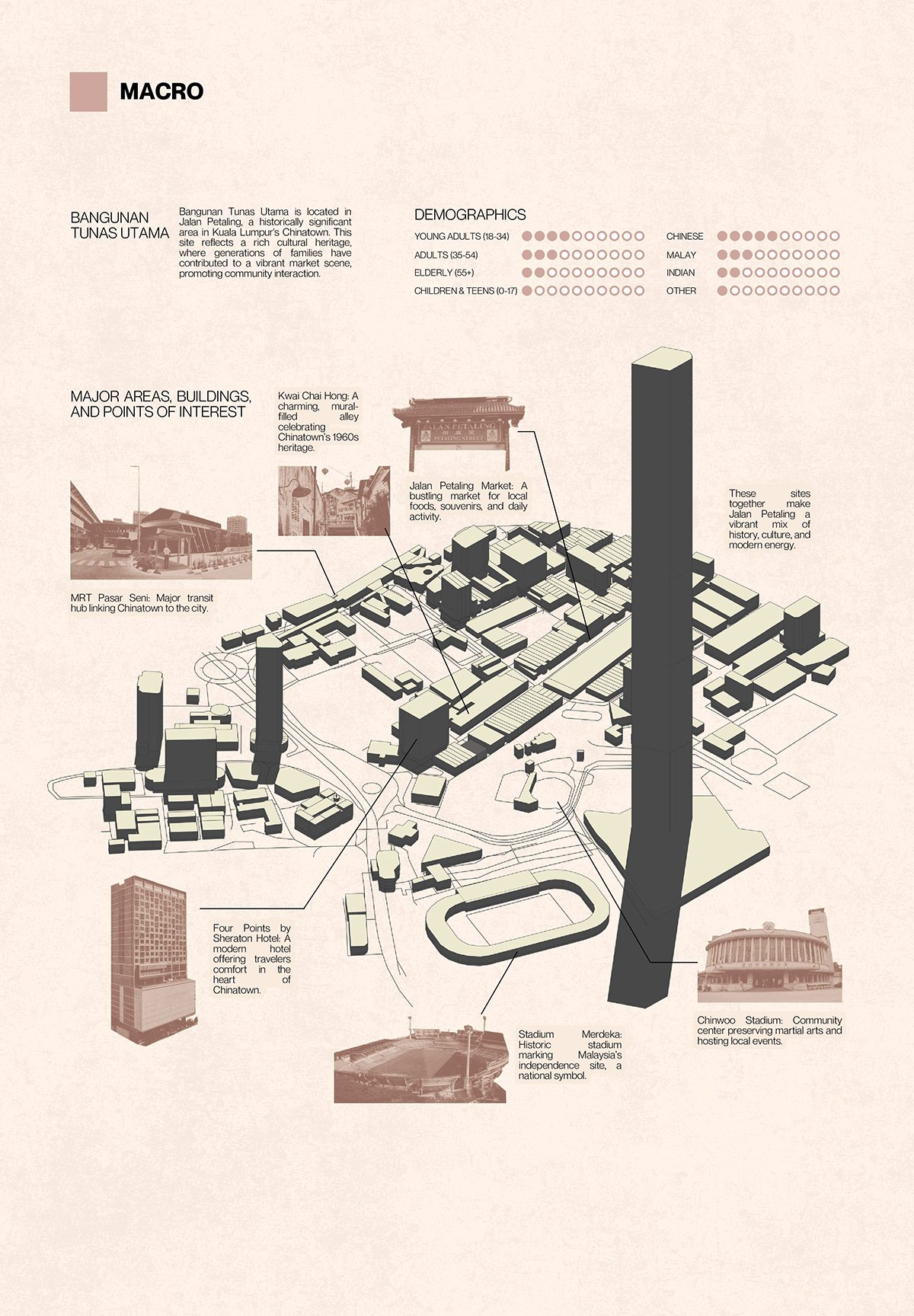
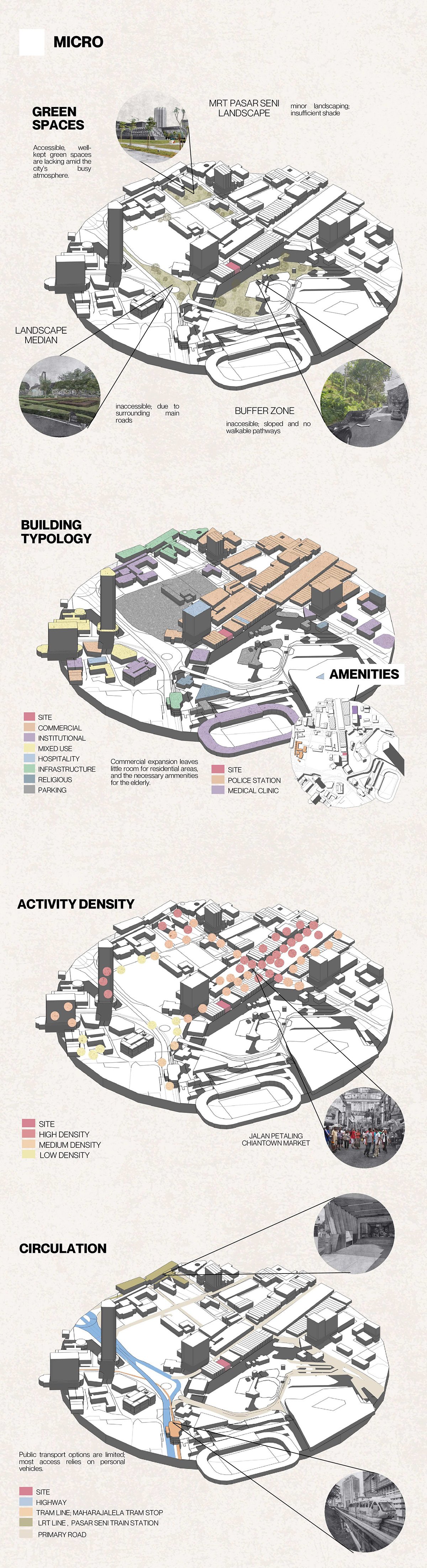
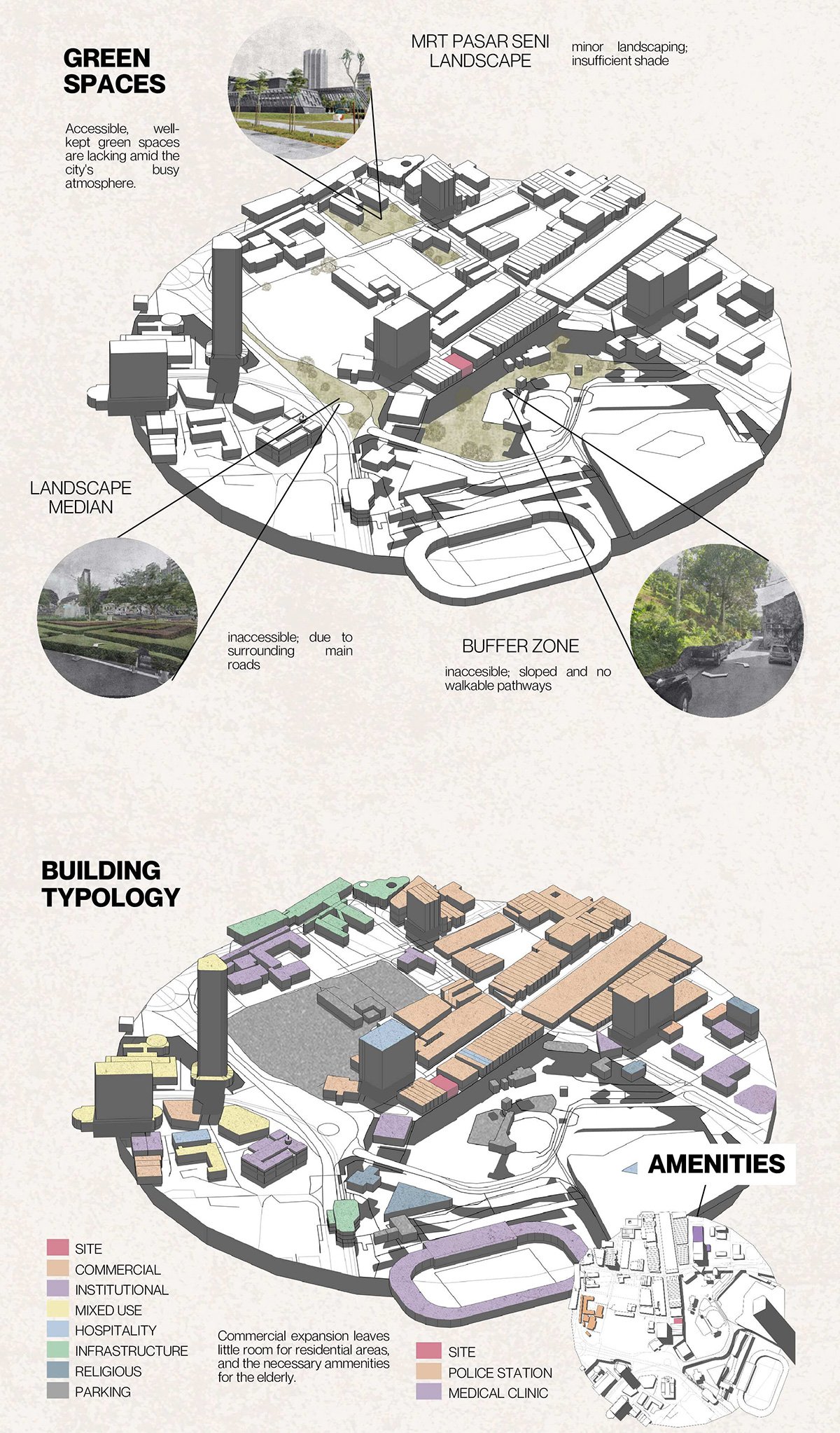
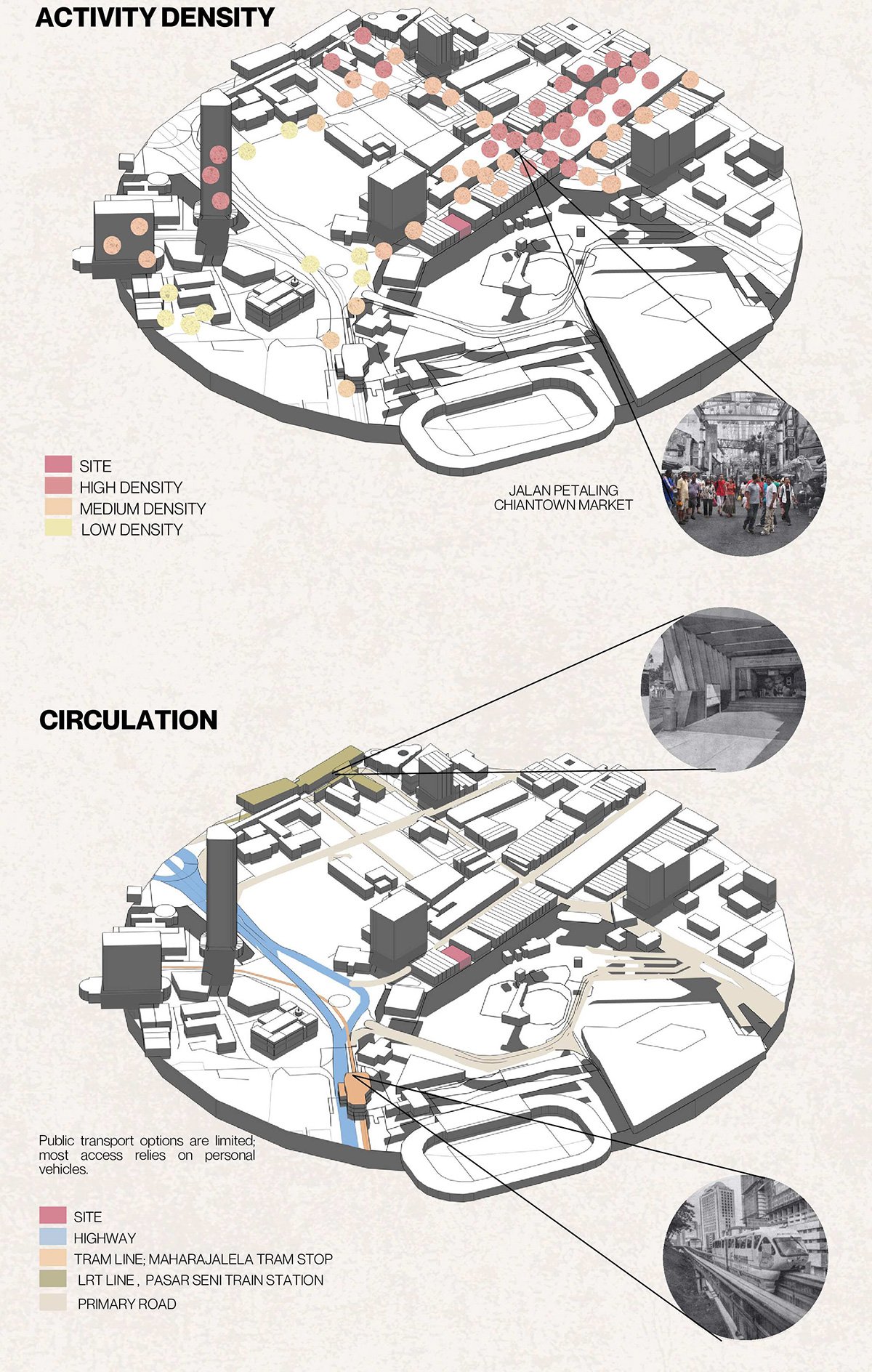
Macro site analysis that identifies key places of interest, site context, and demographic patterns.Micro maps that study green spaces, building typology, activity density, and circulation within the site and its surroundings.
Located along Jalan Petaling in Kuala Lumpur’s historic Chinatown, Bangunan Tunas Utama sits within one of the city’s oldest and most layered urban fabrics. Petaling Street grew from a 19th century market route into a bustling corridor of heritage shophouses, traditional trade, and informal street life. The narrow street grid, covered walkways, and mixed-use buildings still shape everyday circulation. Ground floors remain animated with hawker stalls, small shops, and local eateries, while older upper-level residences hint at the area’s long-standing community roots. Despite increasing tourism and retail pressures, the street’s physical character still reflects decades of social and commercial patterns.
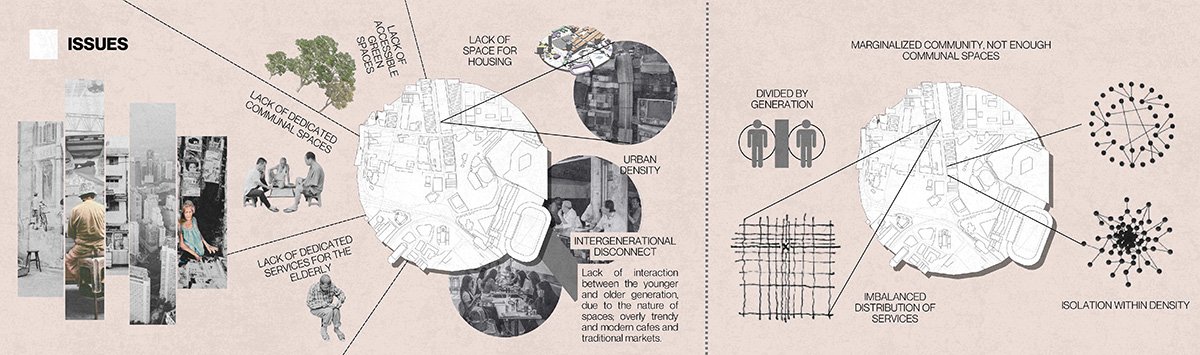
Identification of existing issues present within the site.
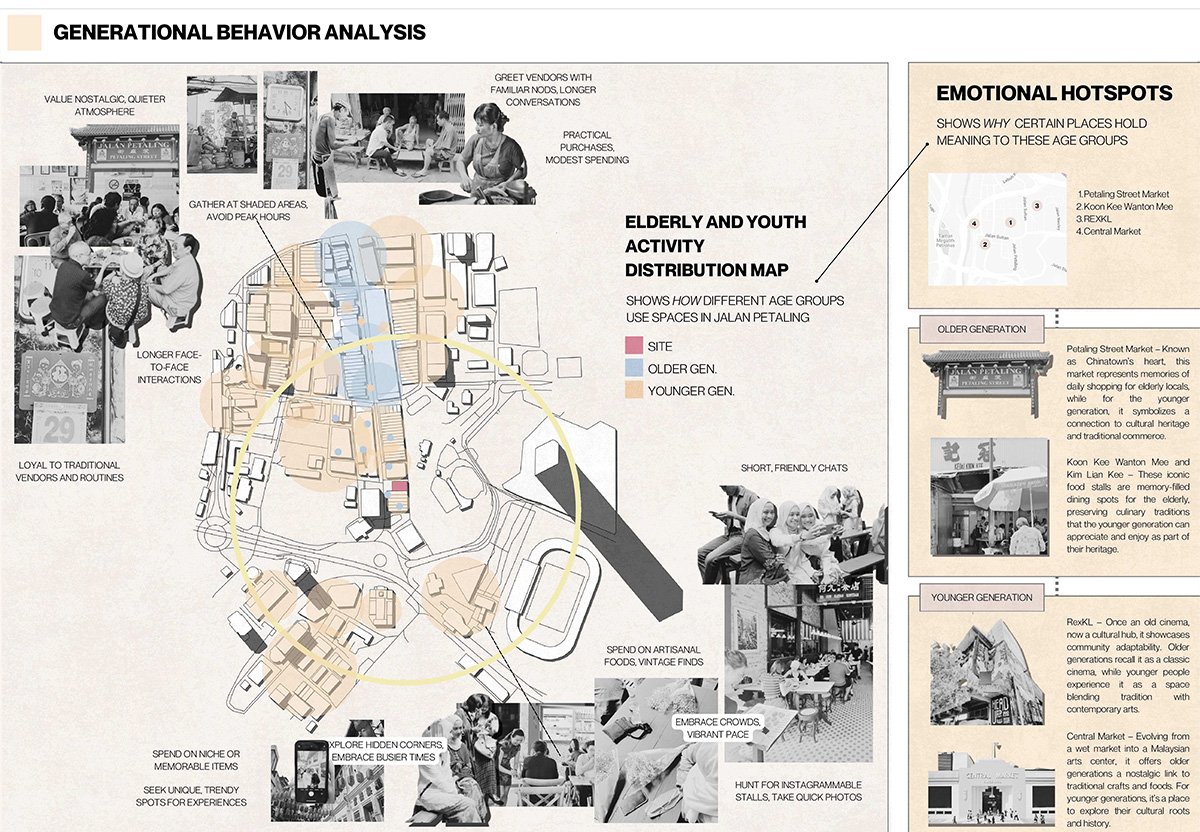
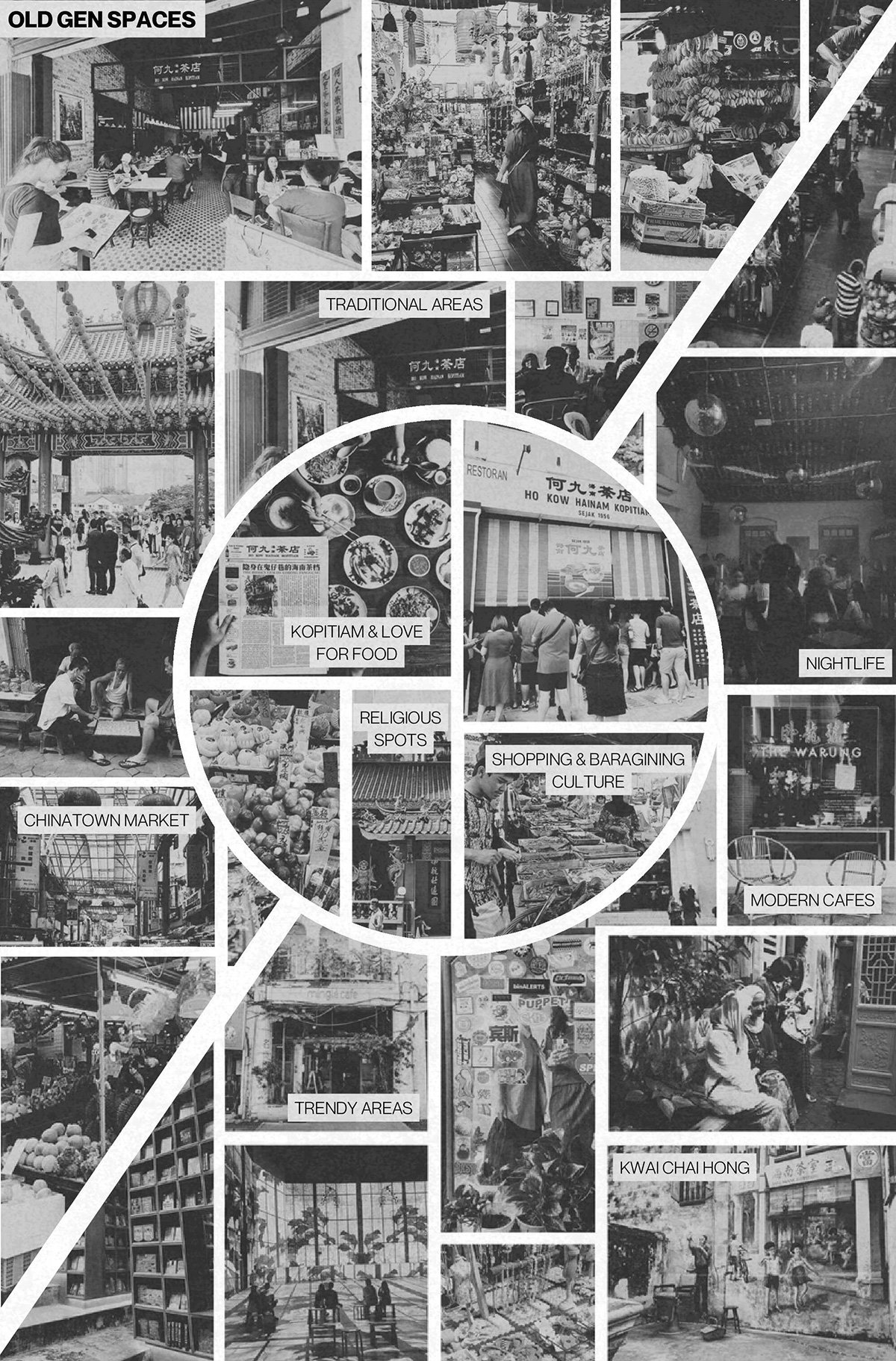
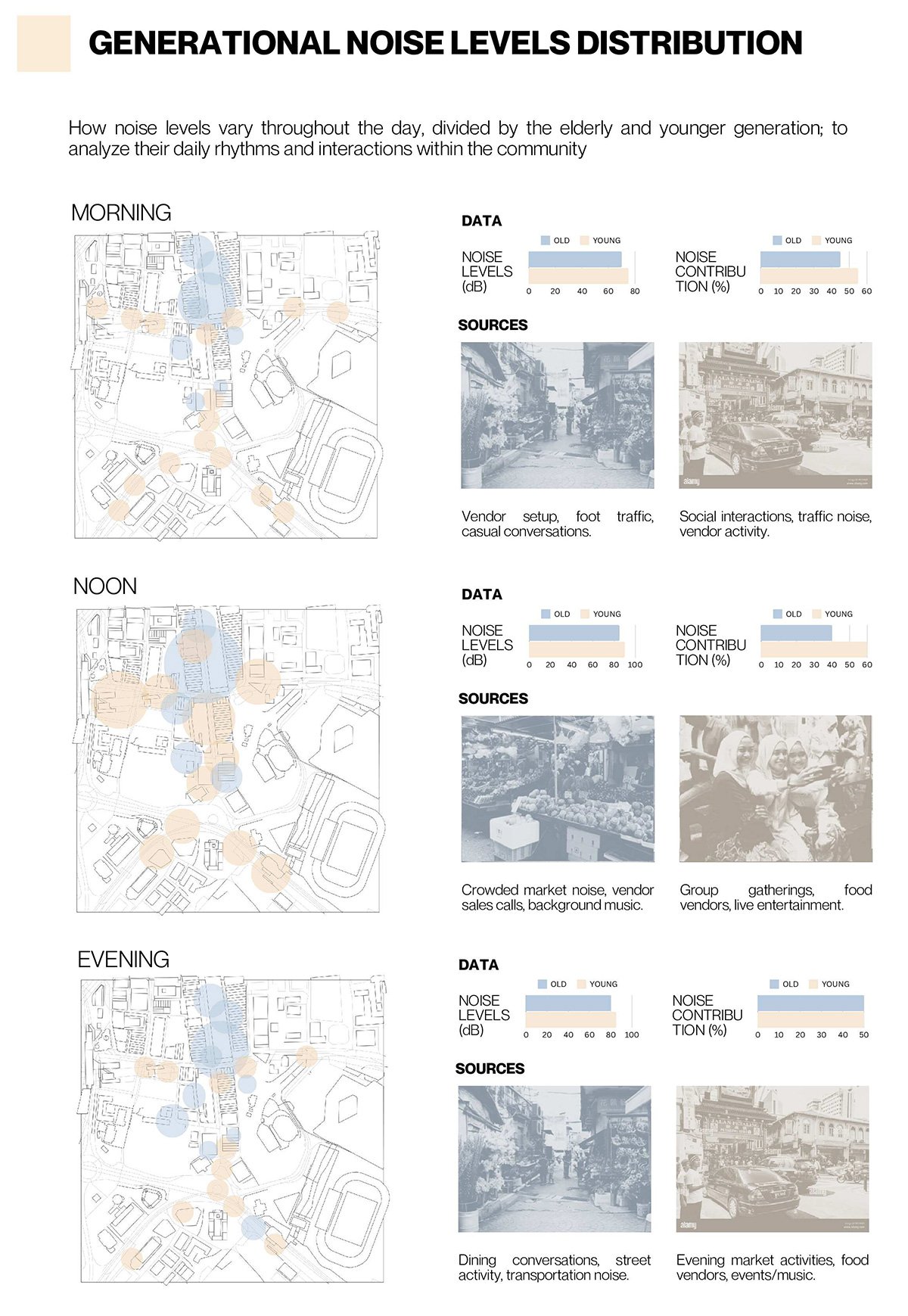
While the street remains lively, its spatial and social patterns reveal a growing generational divide. Long-term elderly residents continue to rely on familiar shops, food stalls, and walkable routes to support their daily independence. In contrast, younger users typically occupy the area temporarily, arriving for work, retail, or leisure before moving on.
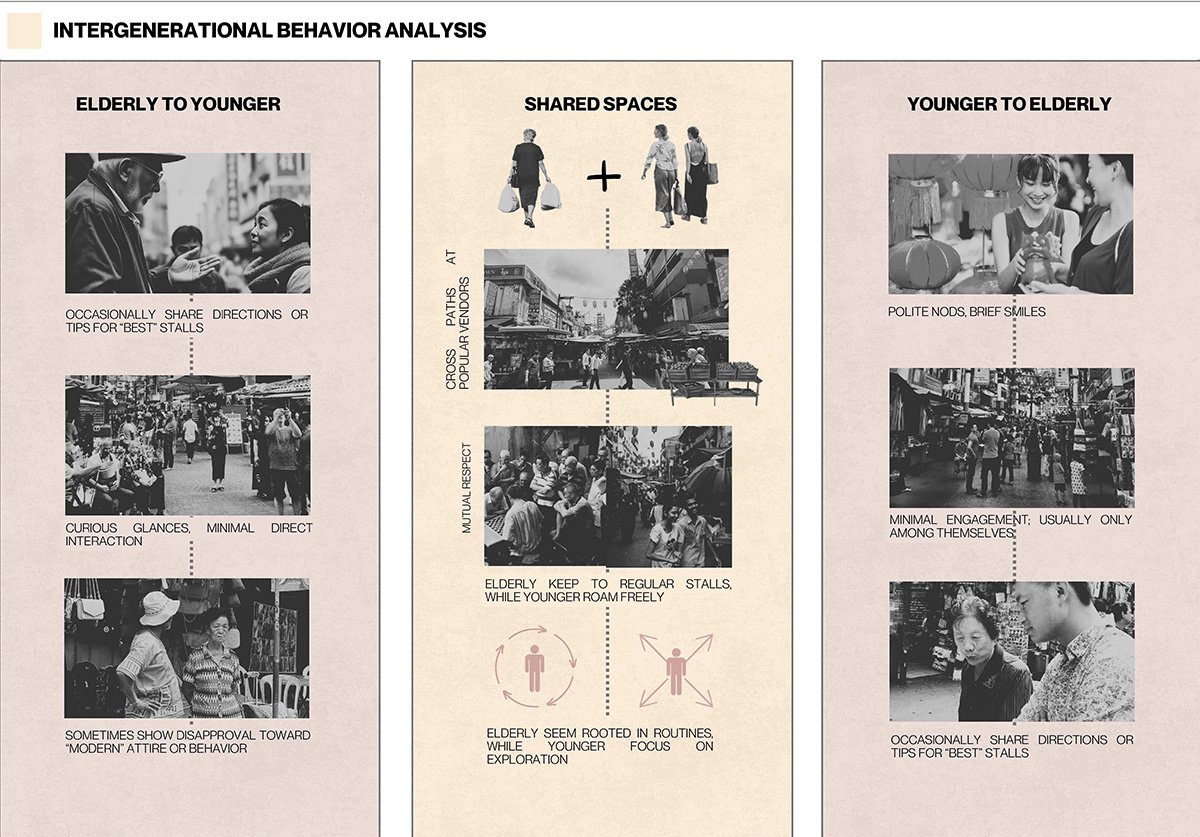
Analysis of behavioral patterns across generational groups, including their preferred places and activities.Analysis of how the two generational groups currently interact within the site area.
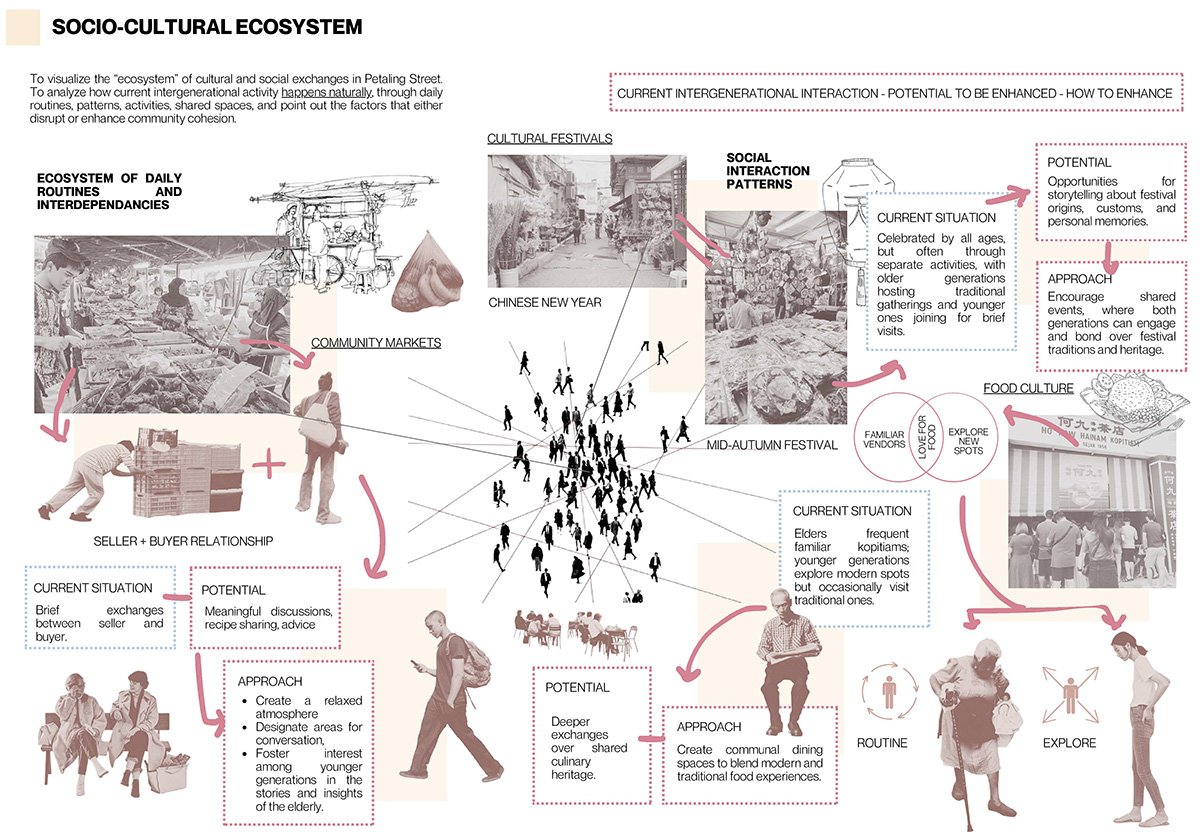
This difference in pace and intention limits meaningful interaction. Spaces that once supported lingering and conversation have gradually been replaced by fast-moving commercial fronts, leaving few settings designed for shared use. As a result, seniors face increasing risks of social isolation despite being surrounded by activity, while opportunities for knowledge transfer and cultural continuity between generations continue to decline.
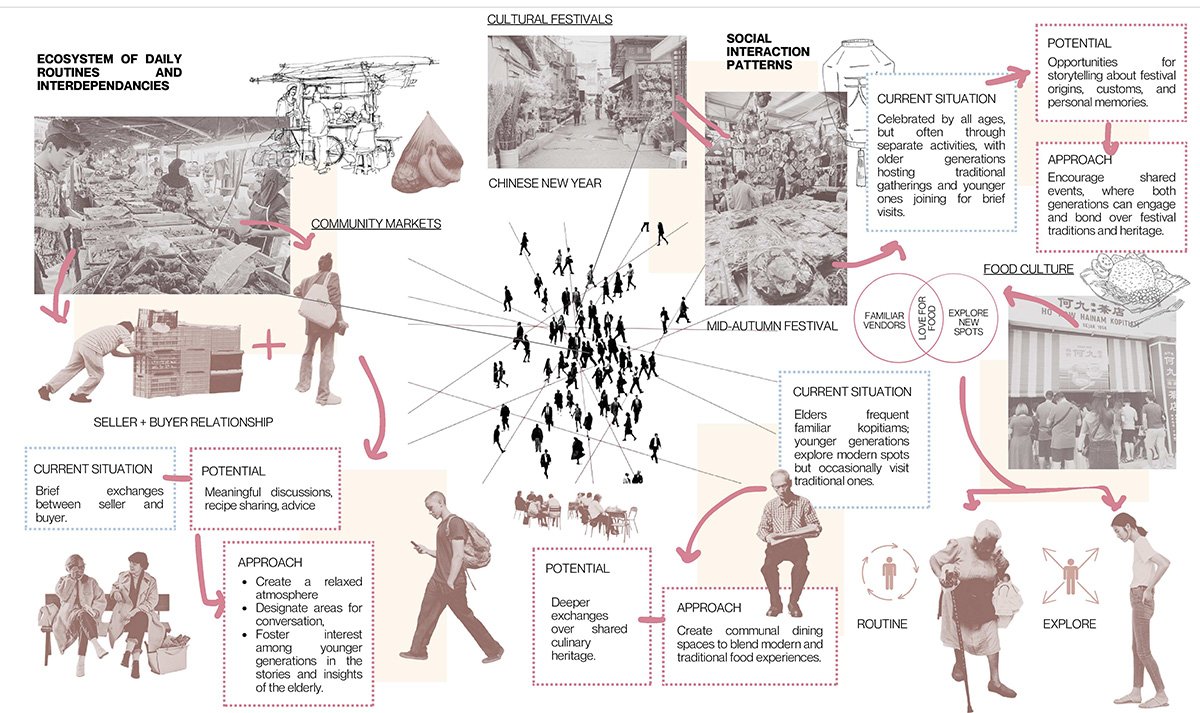
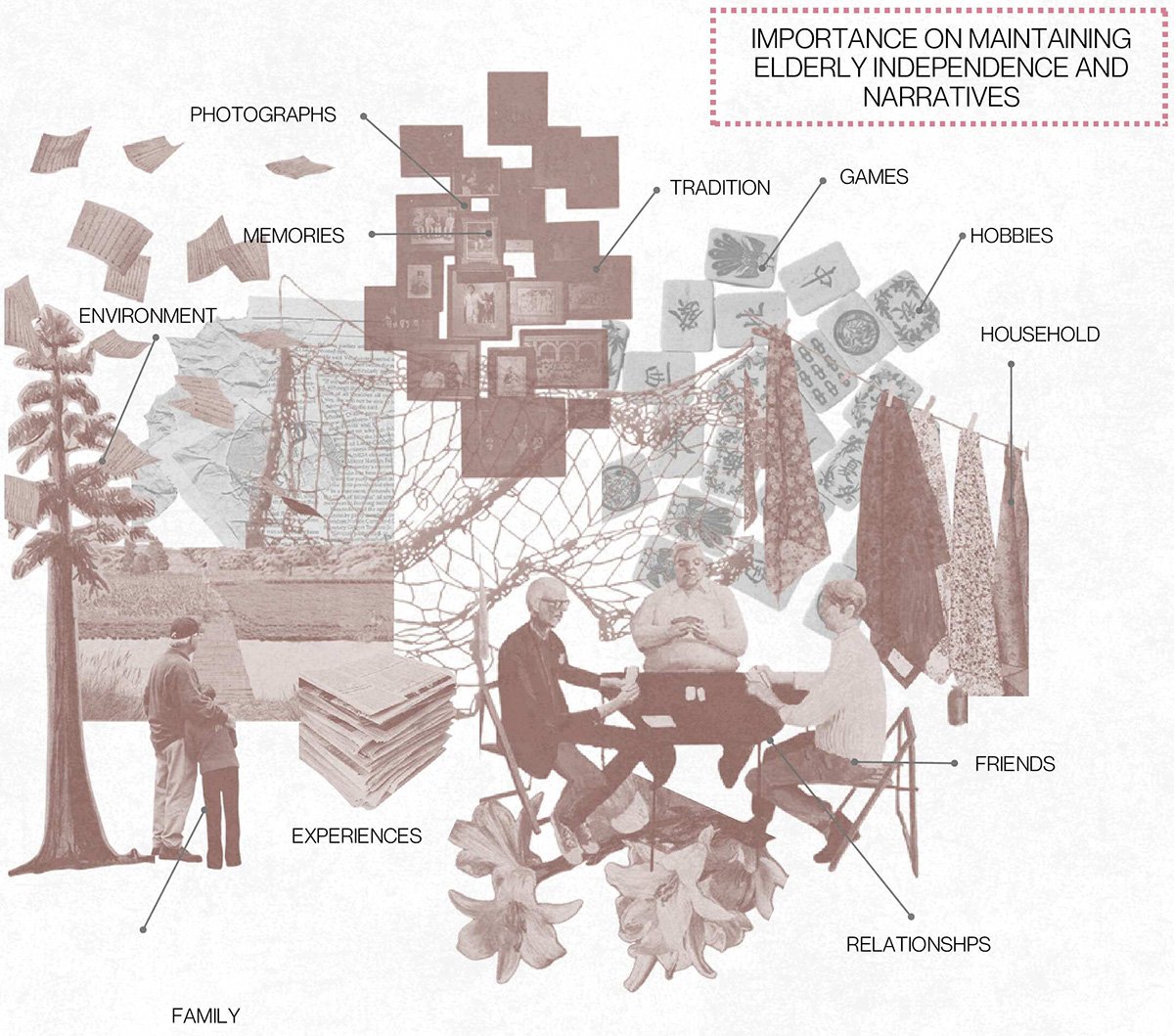
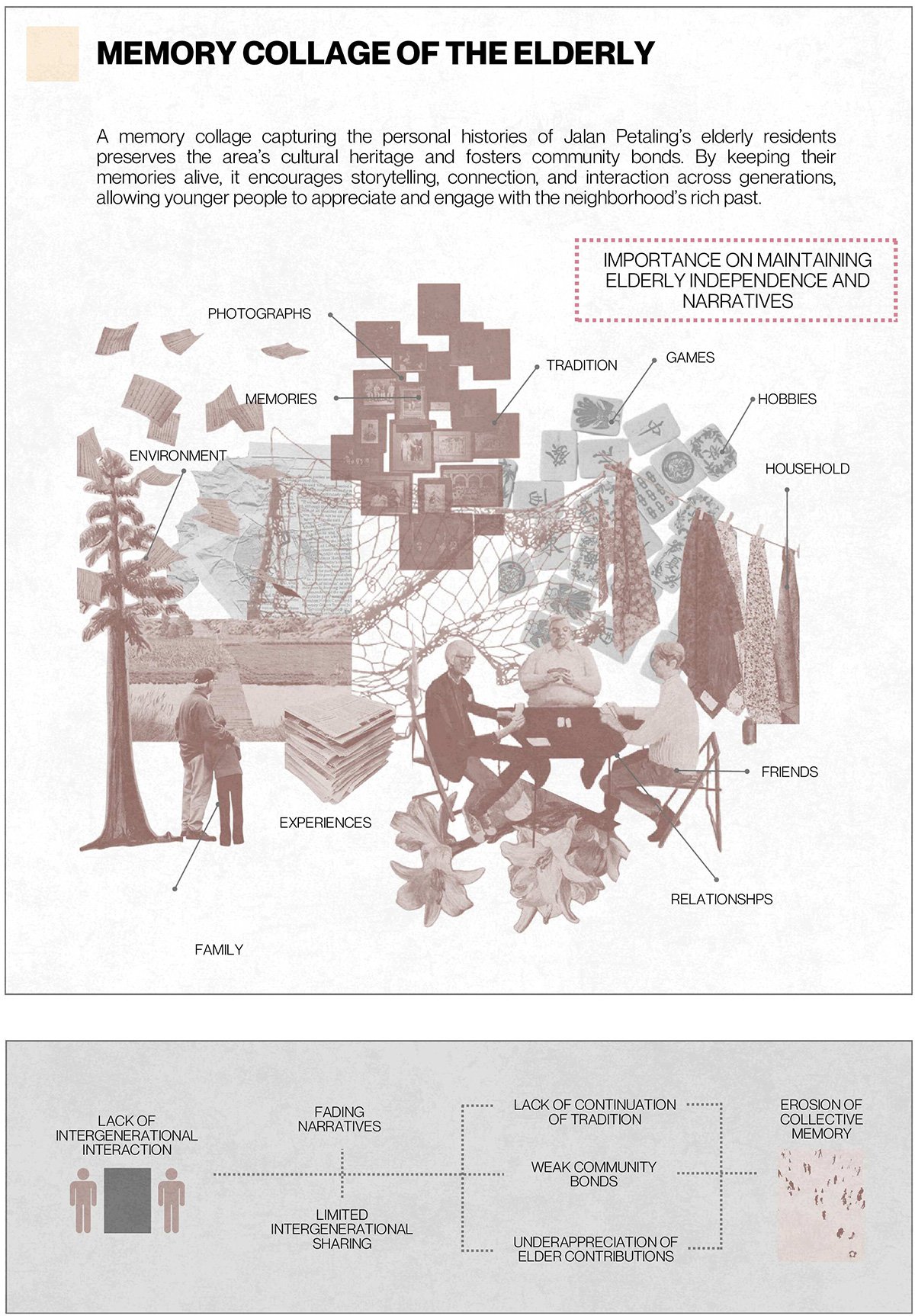
Visualization of social exchanges in Petaling Street to examine and build on interaction potential that occurs naturally.Analysis of existing elements that support the importance of maintaining elderly narratives.
The site therefore presents a clear intergenerational gap, not from a lack of people, but from a lack of spaces that encourage them to stay, engage, and participate together. This condition frames the need for an environment that supports elderly independence while creating everyday opportunities for connection, reinforcing community life within a rapidly changing urban district.
Design Process
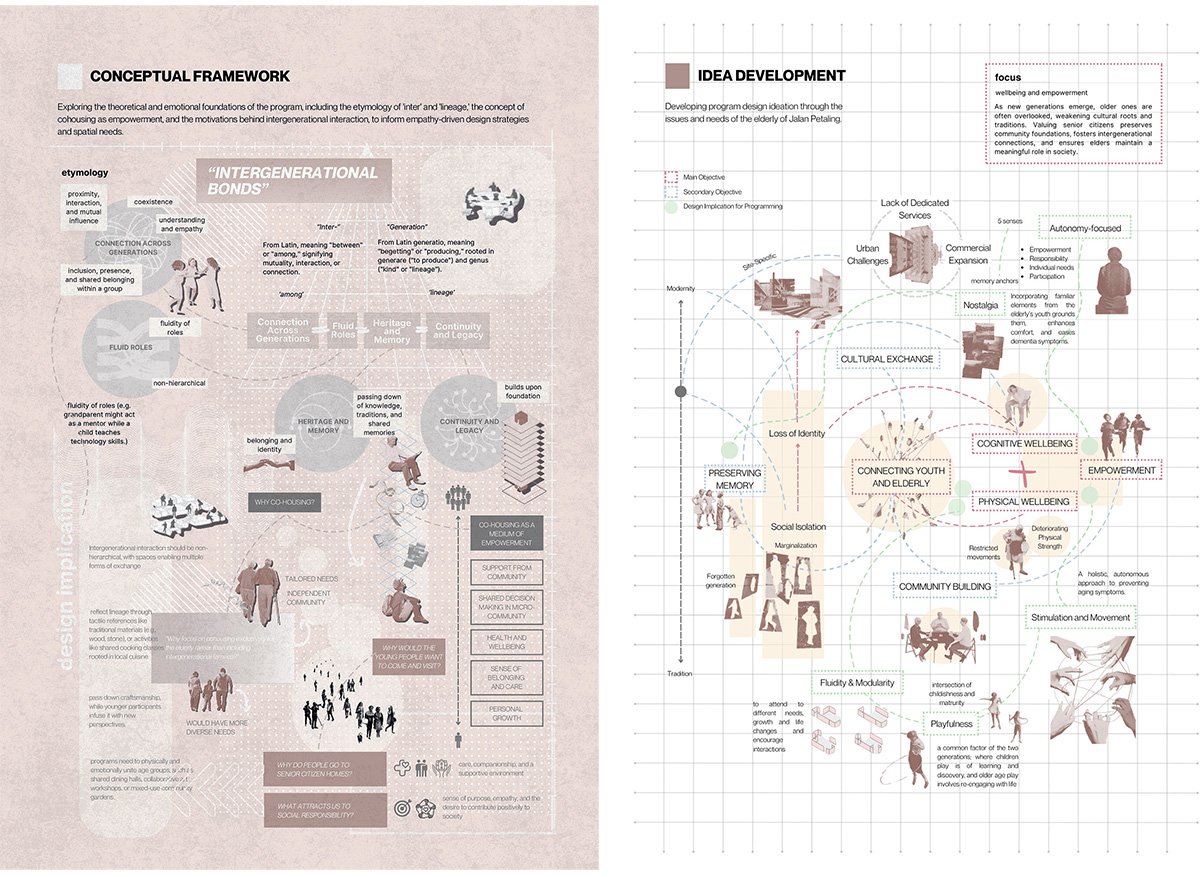
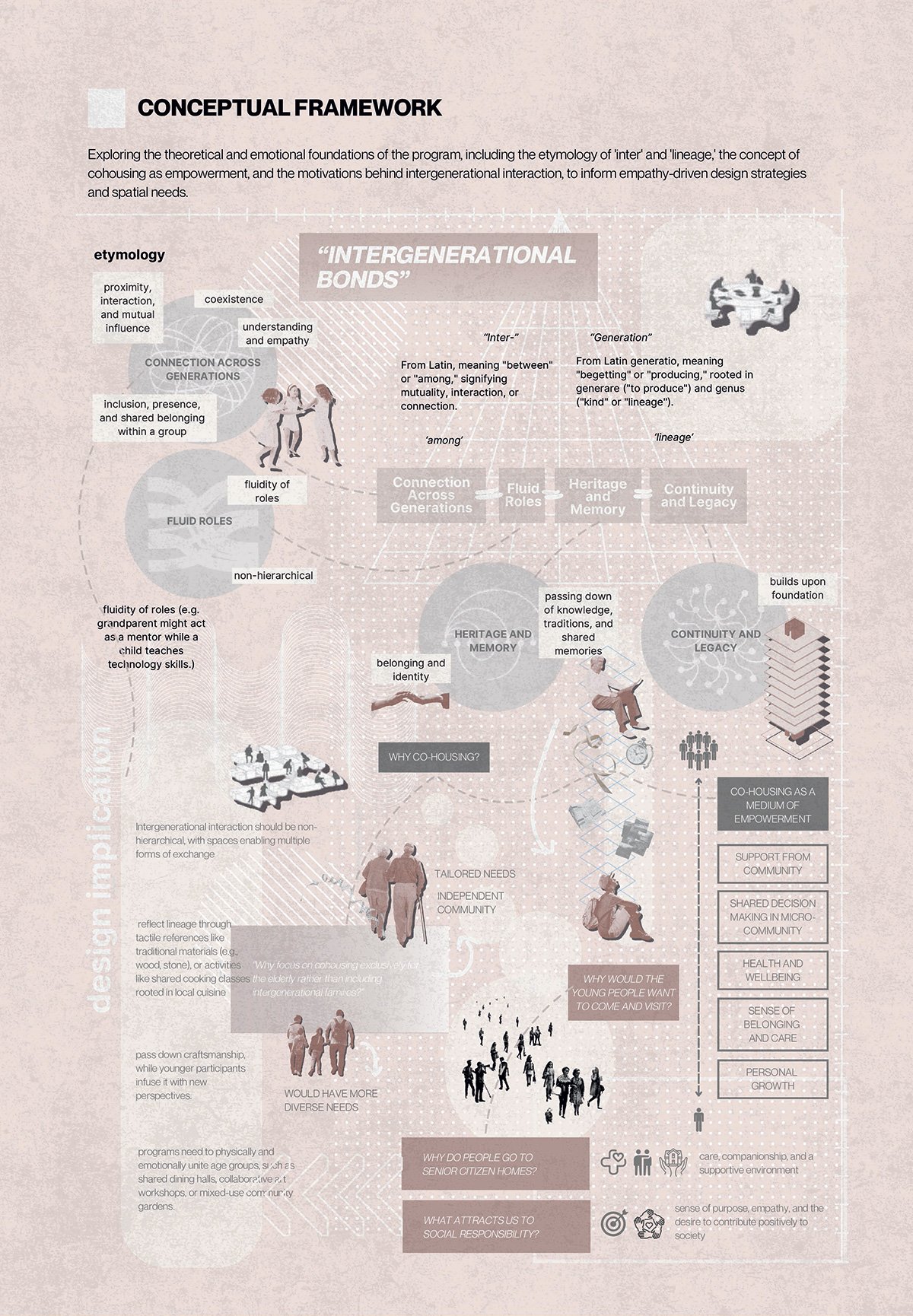
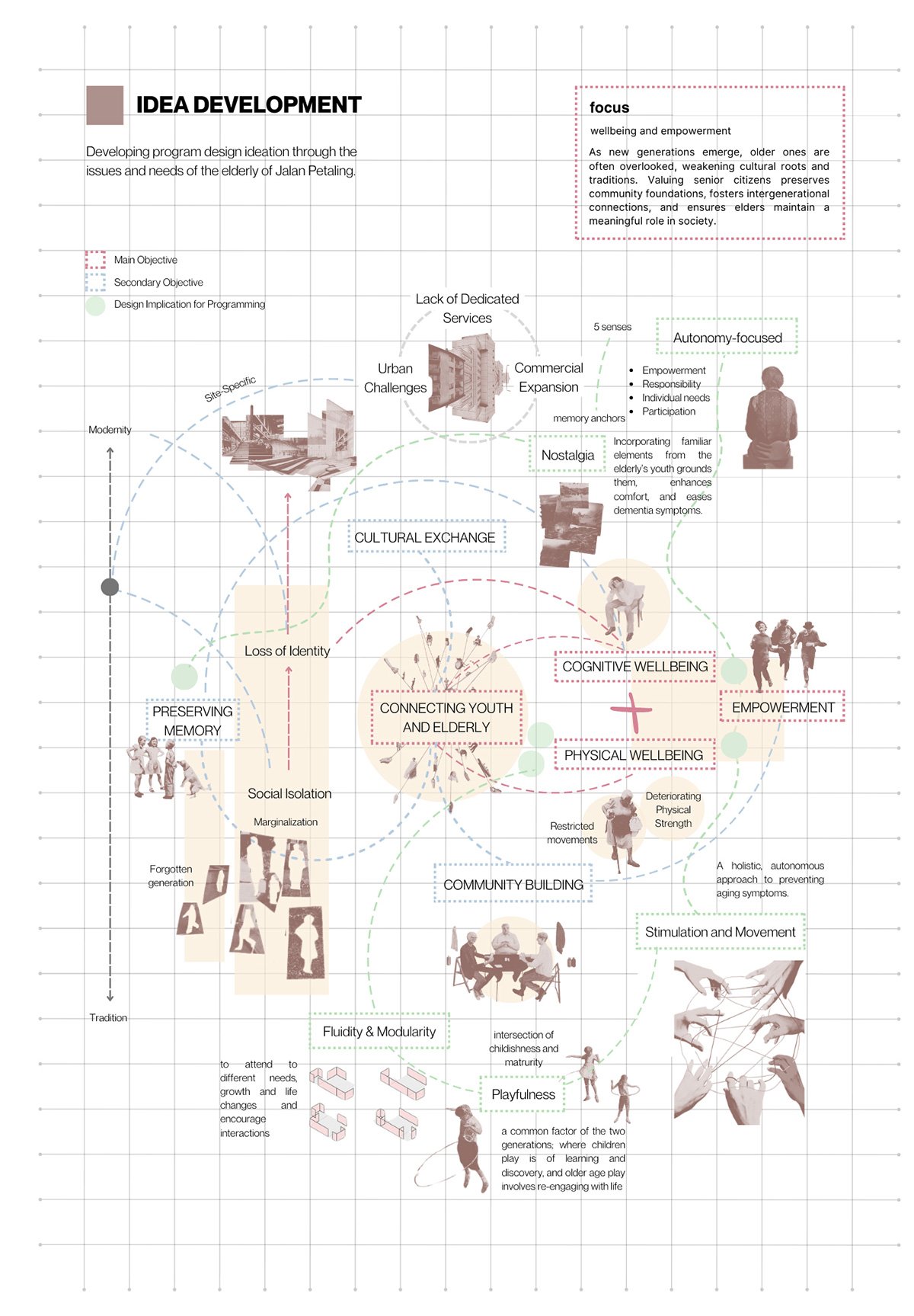
A visual analysis on themes, purpose and the underlying foundations of the concept of intergenerational bonds. | A design ideation map linking issues, objectives, methods to achieve said objectives, and themes and elements to be implemented to the spaces.
Centered on the theme of intergenerational bonds, the design process began by exploring spatial models capable of fostering meaningful and lasting connections between youth and the elderly. This investigation led to the proposal of a co-housing model integrated with a community center. The co-housing environment serves as a medium of empowerment for the elderly, offering community support while fostering a strong sense of belonging and care, yet still allowing independence to flourish through everyday living. By opening shared spaces to the public, the project creates opportunities for intergenerational exchange, where people can learn from the elderly through the sharing of craftsmanship, traditions, recipes, stories, knowledge, and memories—forming a non-hierarchical space rooted in identity.
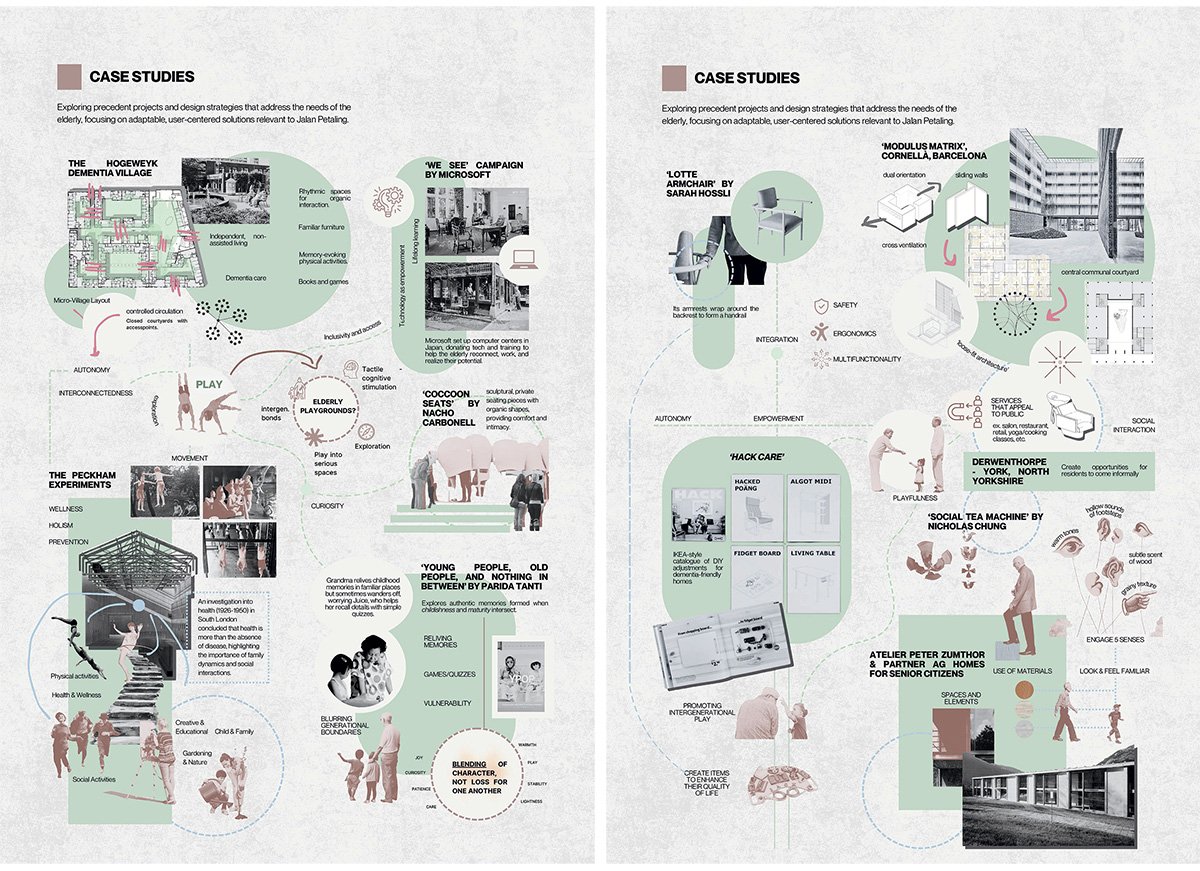
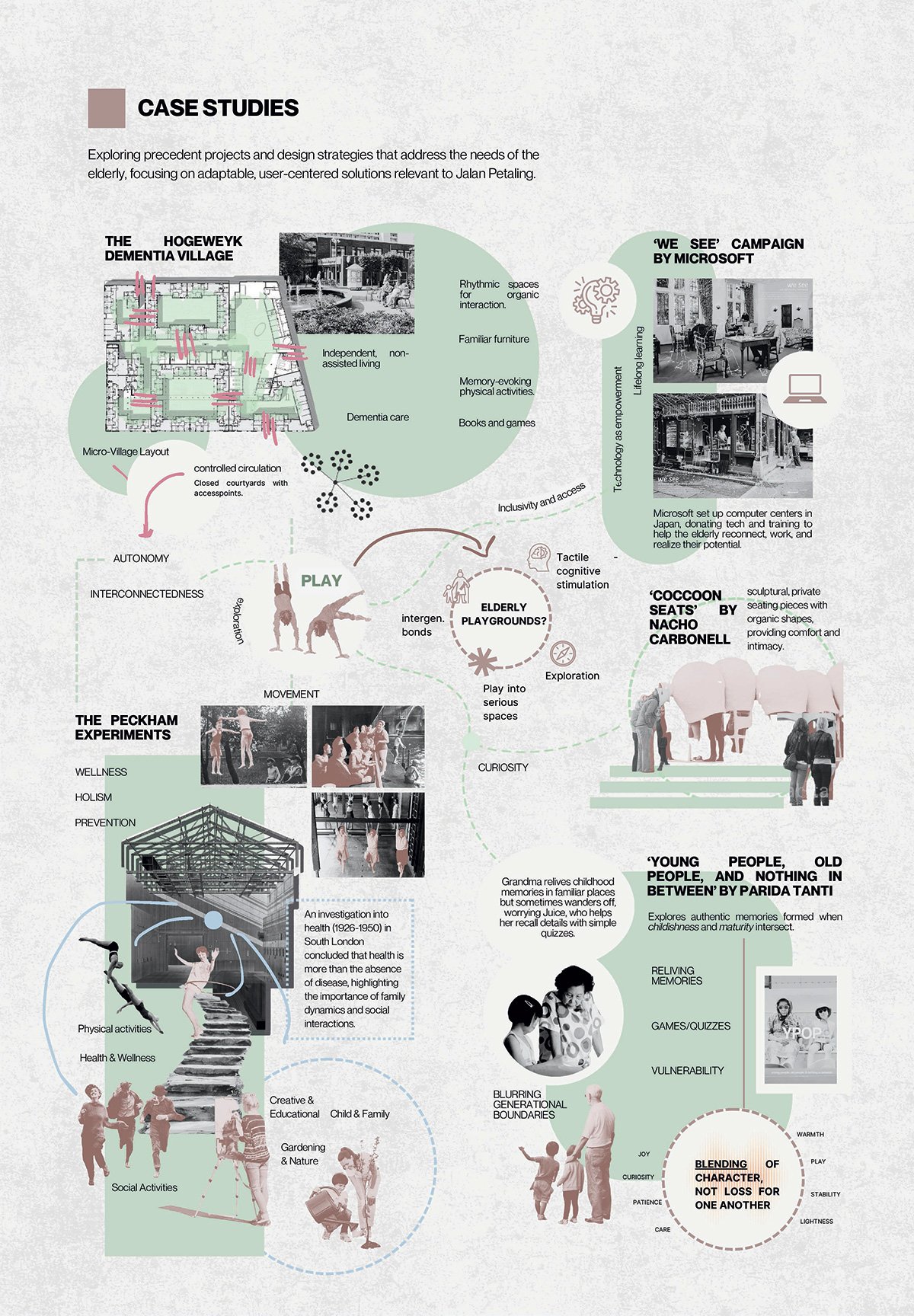
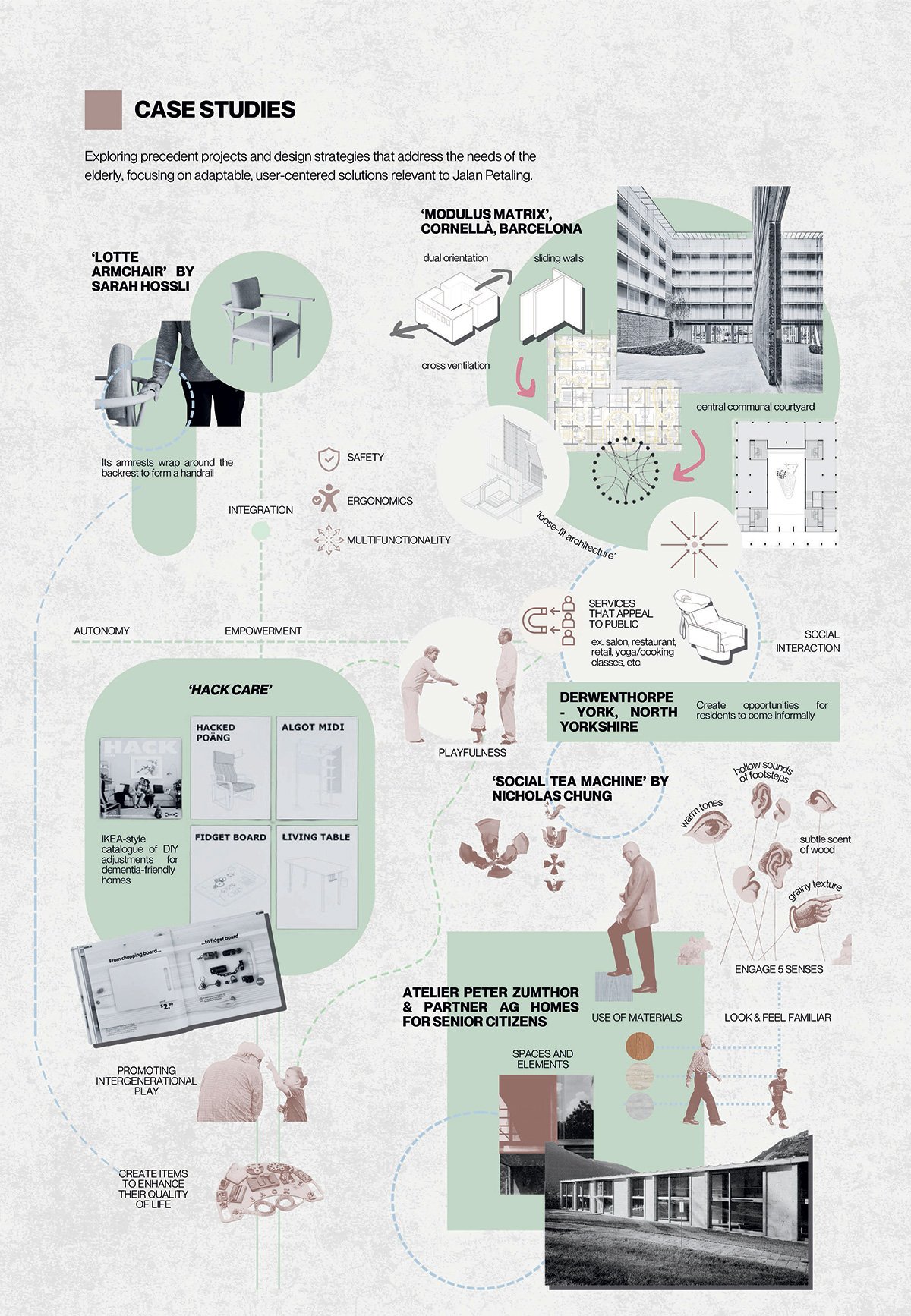
Precedent studies and relevant projects, breaking down methods, elements, forms, and concepts to be studied and applied to Bangunan Tunas Utama.
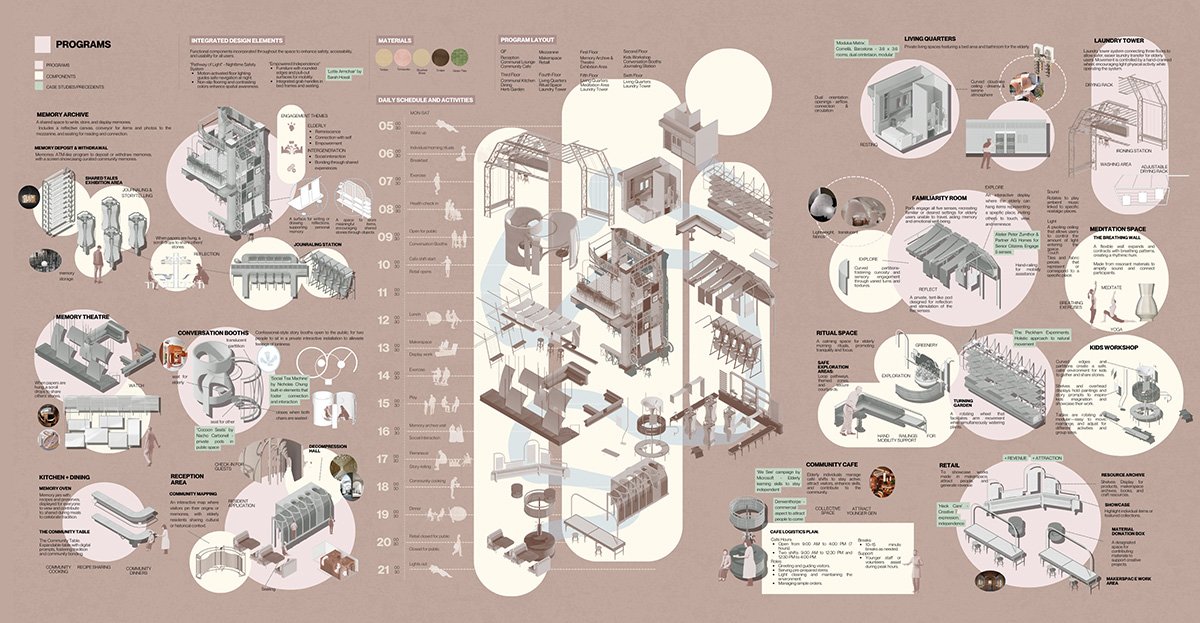
With intergenerational connection as the primary focus, a series of sub-objectives helped define the programs required within the center, including elderly well-being, memory preservation, community building, and cultural exchange. Programs such as the Memory Archive were introduced as spaces for writing, storing, displaying, and sharing memories, encouraging reminiscence while fostering bonds through shared experiences and conversation.
A visual graphic explaining the programs, including their forms, purpose, interaction patterns over time, materials, floor-by-floor organization, and their relationship to previously studied case studies and themes.
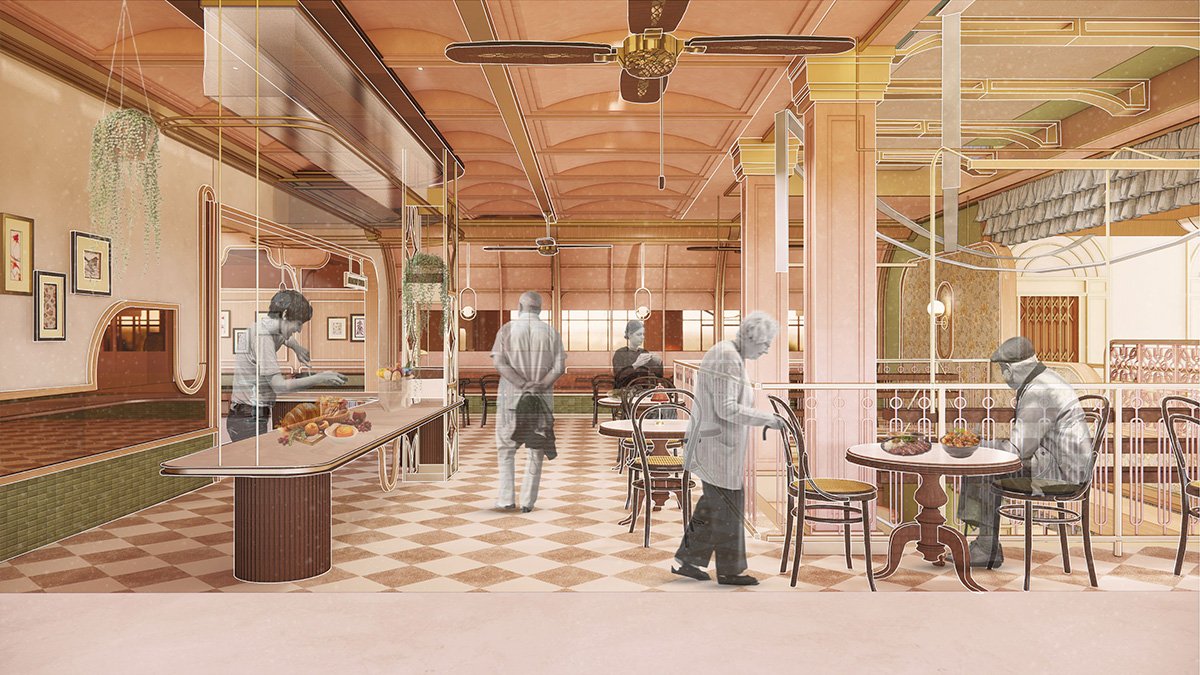
A key consideration throughout the design process was to retain and build upon traditional activities already present on site, rather than replacing them, in order to strengthen community ties and intimacy. Colors and materials draw inspiration from a playful Peranakan aesthetic, combining timber and soft pastel tones with subtle brass details and muted accents. Spatial zoning follows a public-to-private gradient, with communal spaces located on lower levels and co-housing units above.
Final Outcome
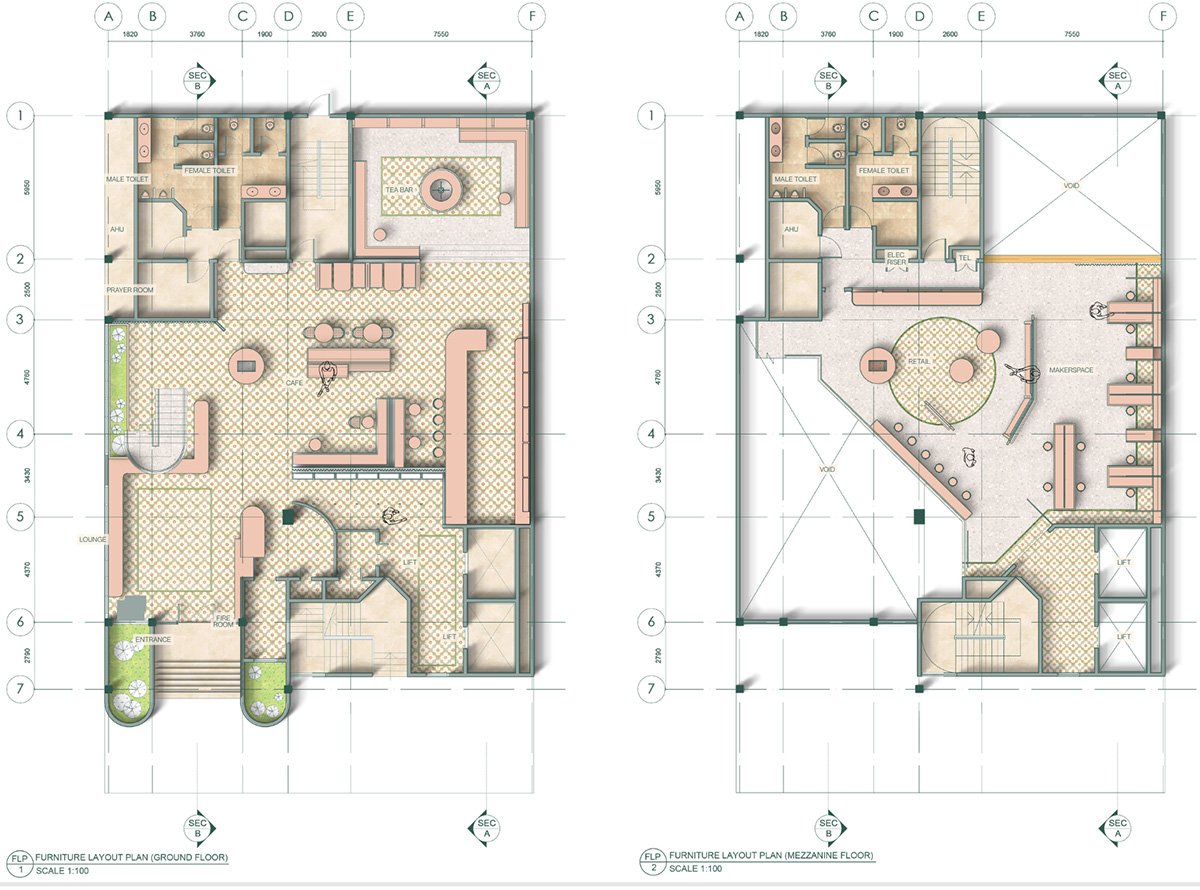
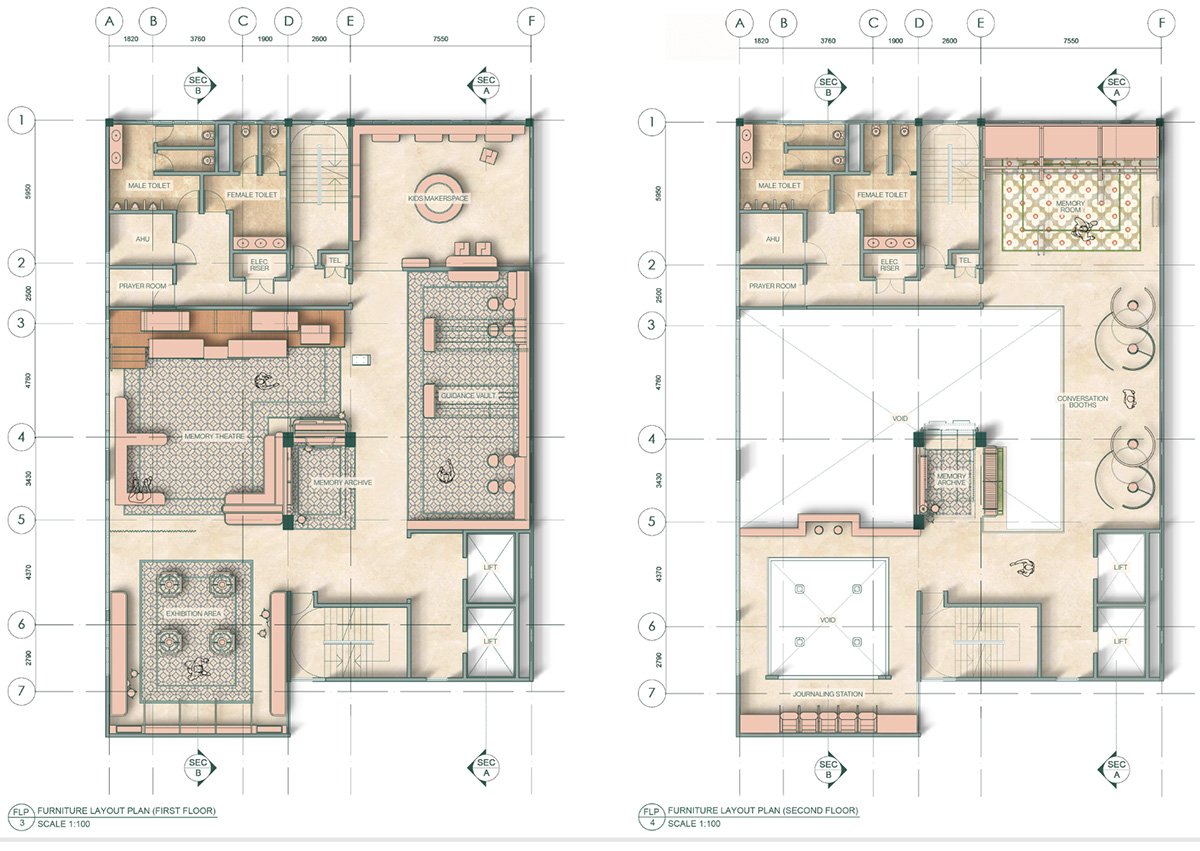
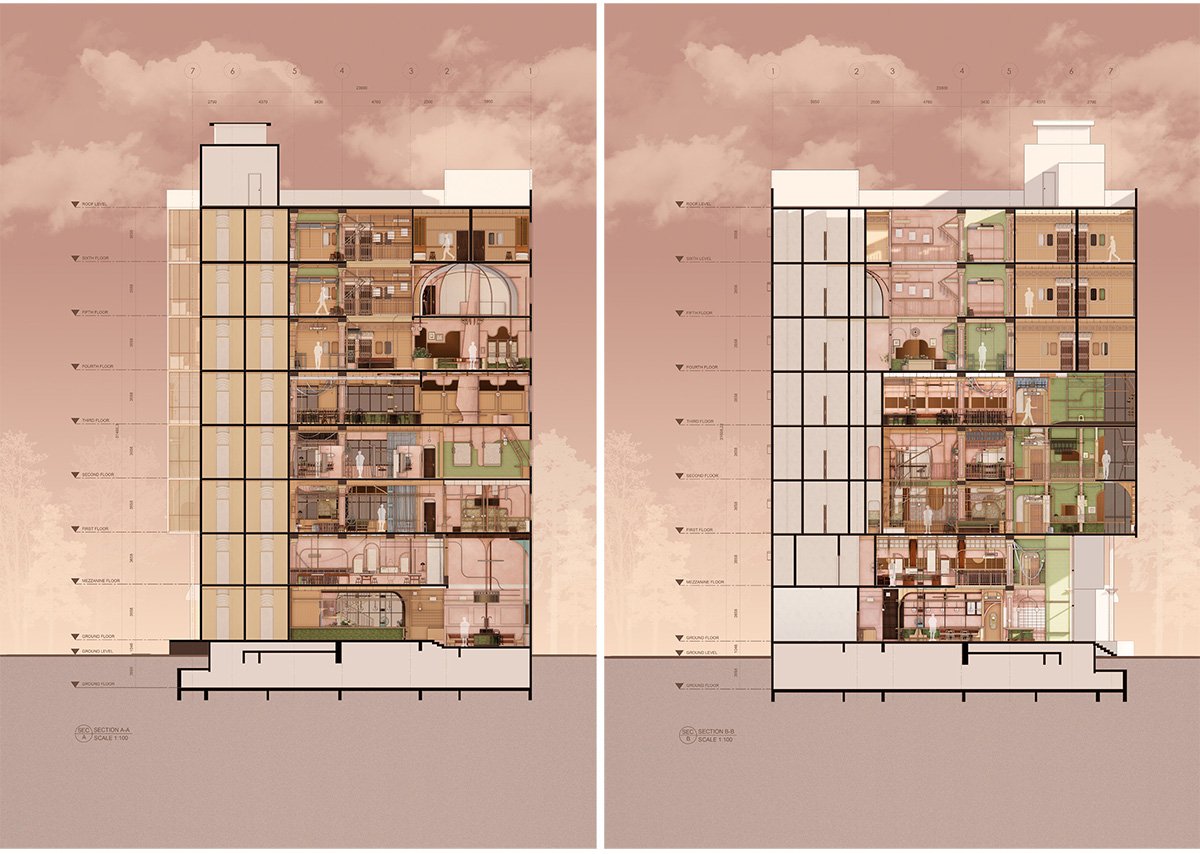
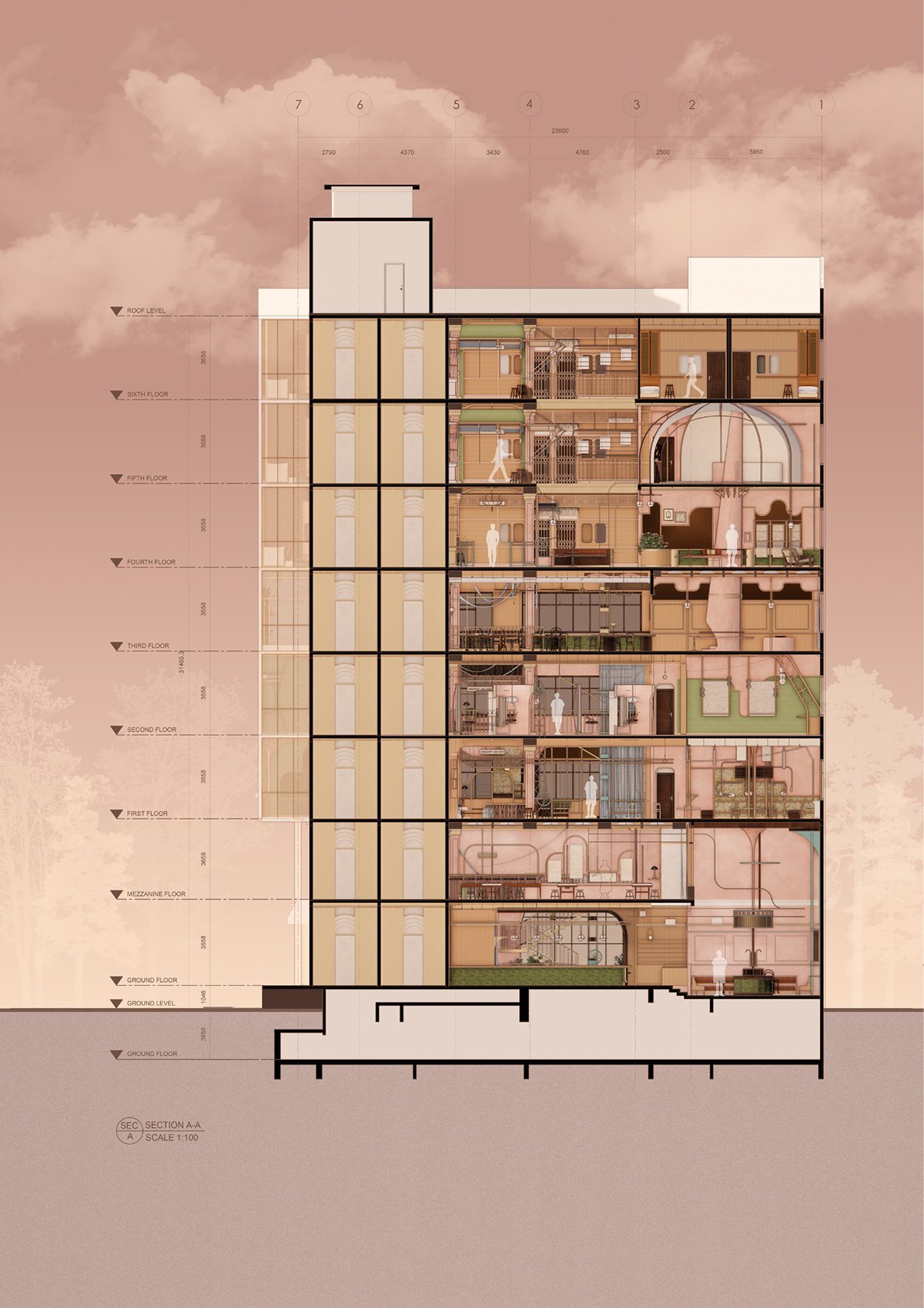
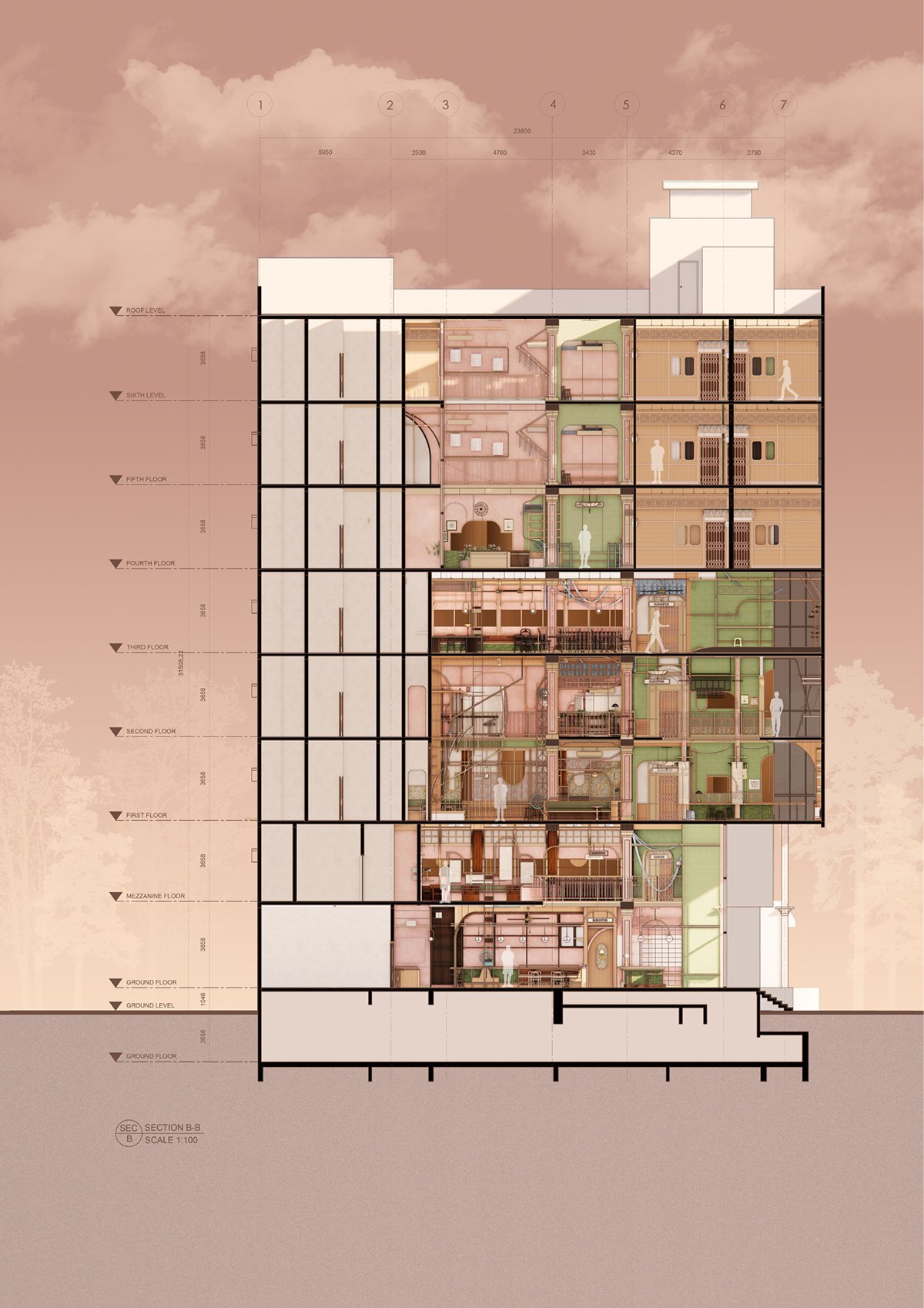
Plan – Ground Floor, Mezzanine FloorPlan – First Floor, Second FloorSection A-A | Section B-B
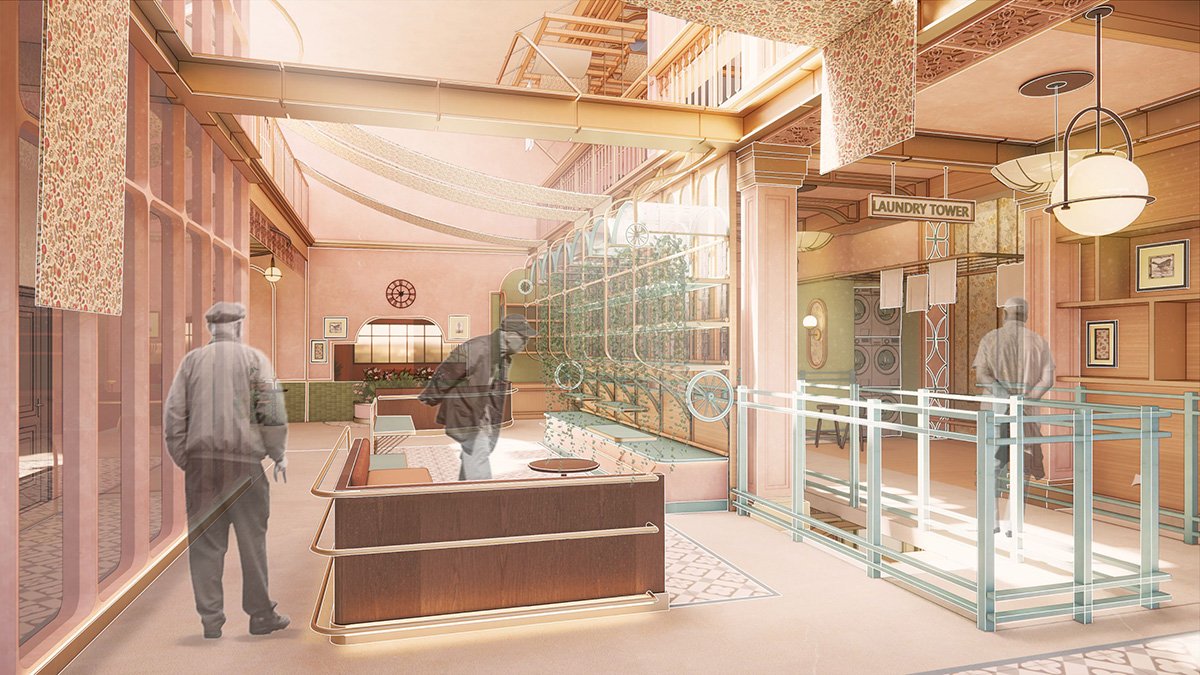
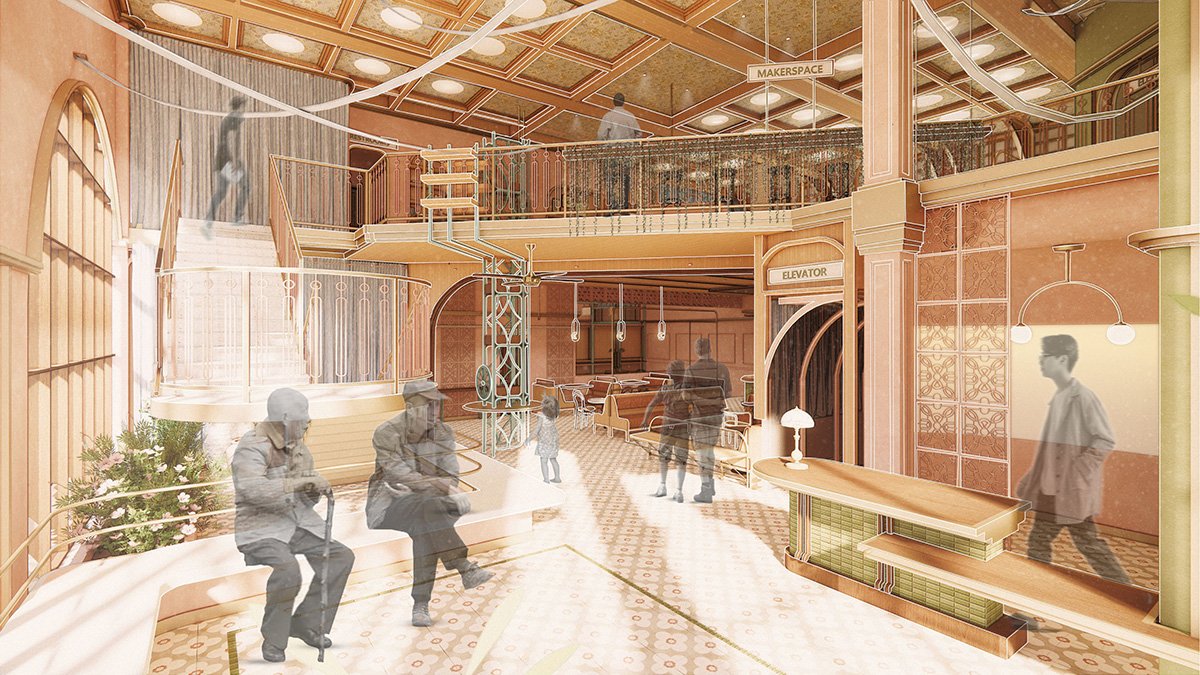
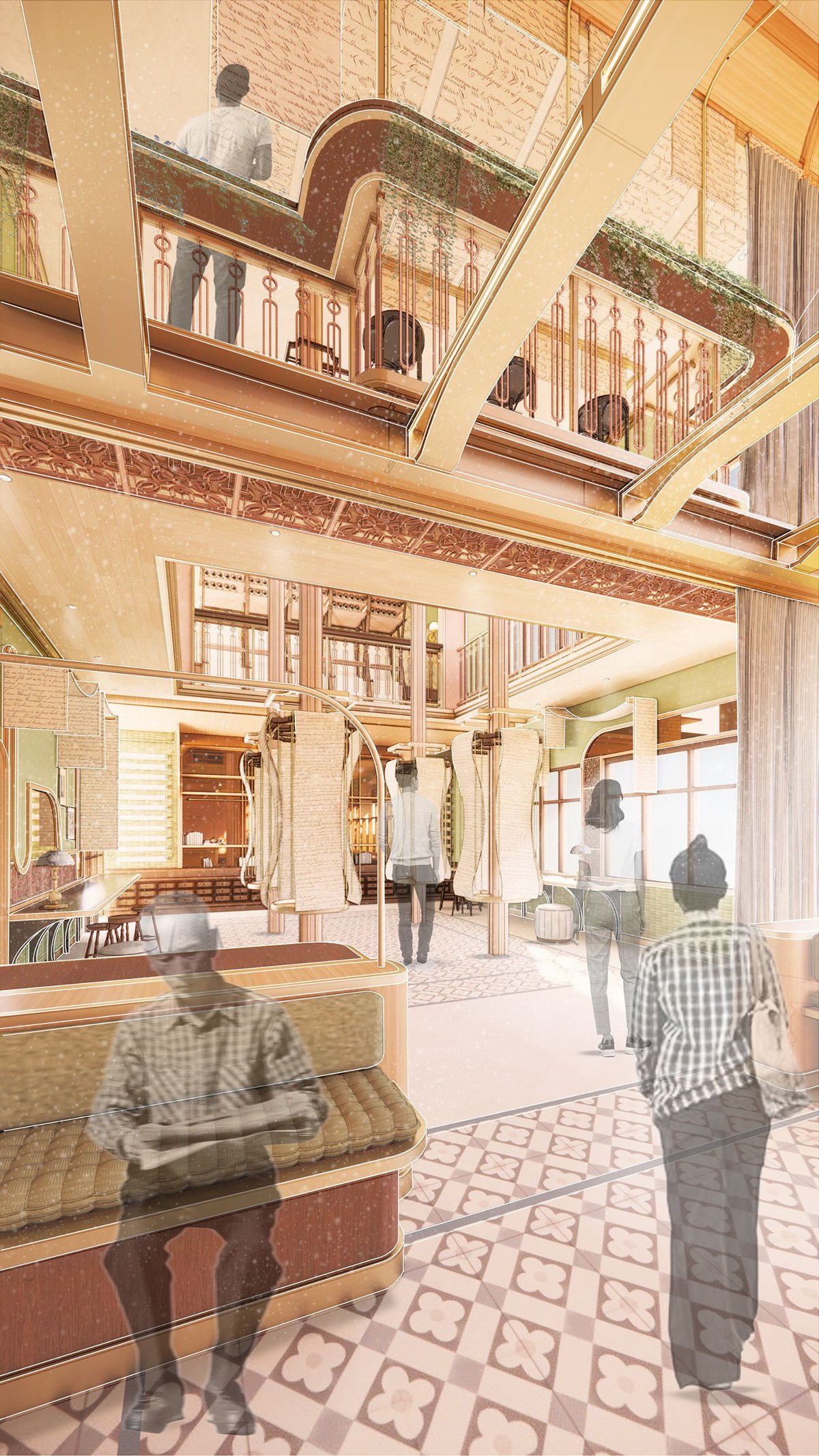
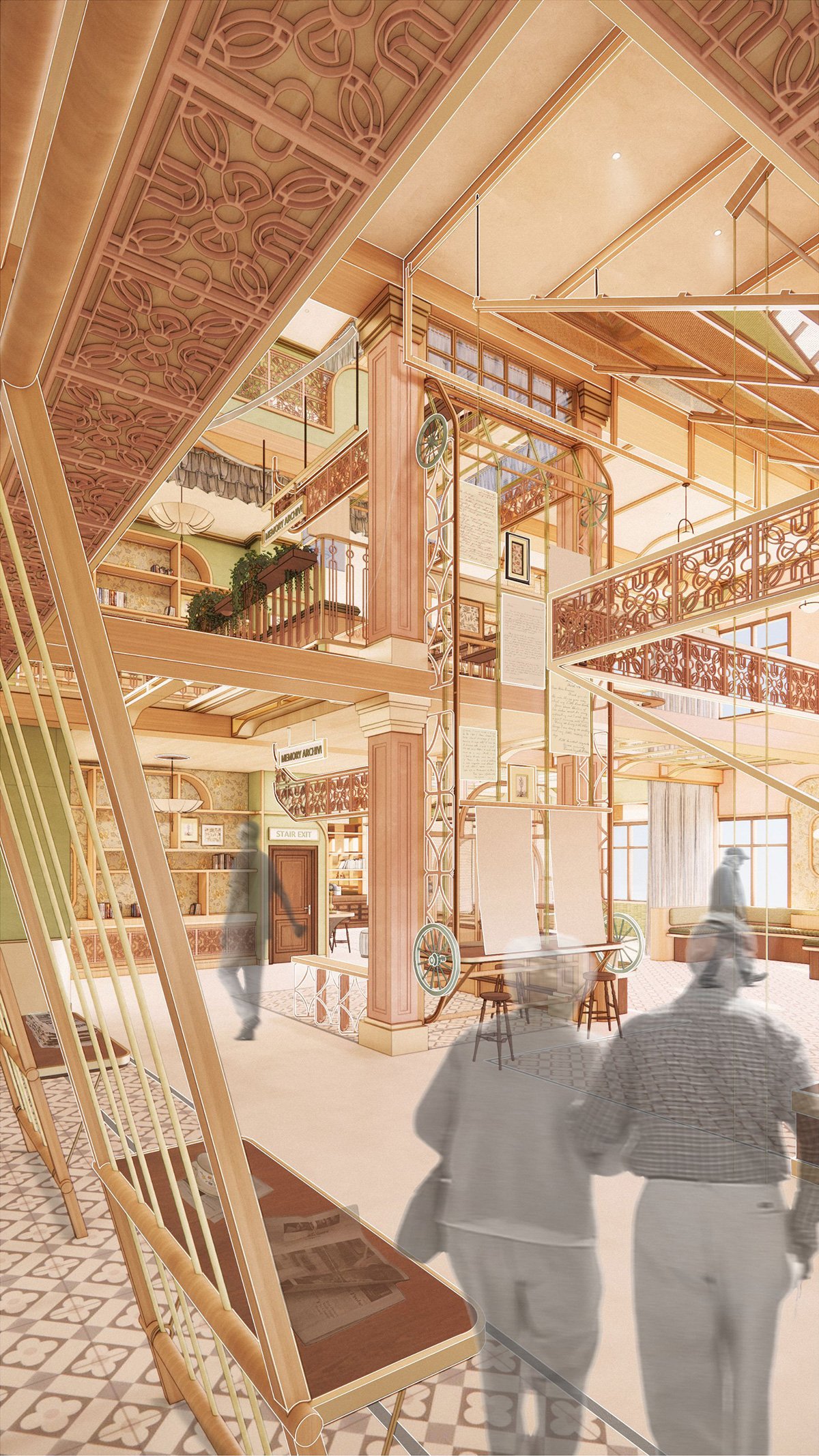
The final design of Stories from the Hearth repositions Bangunan Tunas Utama as an intergenerational living environment where heritage references and contemporary interventions coexist within a continuous social setting. Traditional elements such as floral grills, commonly found in Chinese homes and buildings, are reinterpreted alongside cleaner forms, subtle brass accents, and controlled color contrasts, allowing the building to remain grounded in its context while supporting present-day communal life.
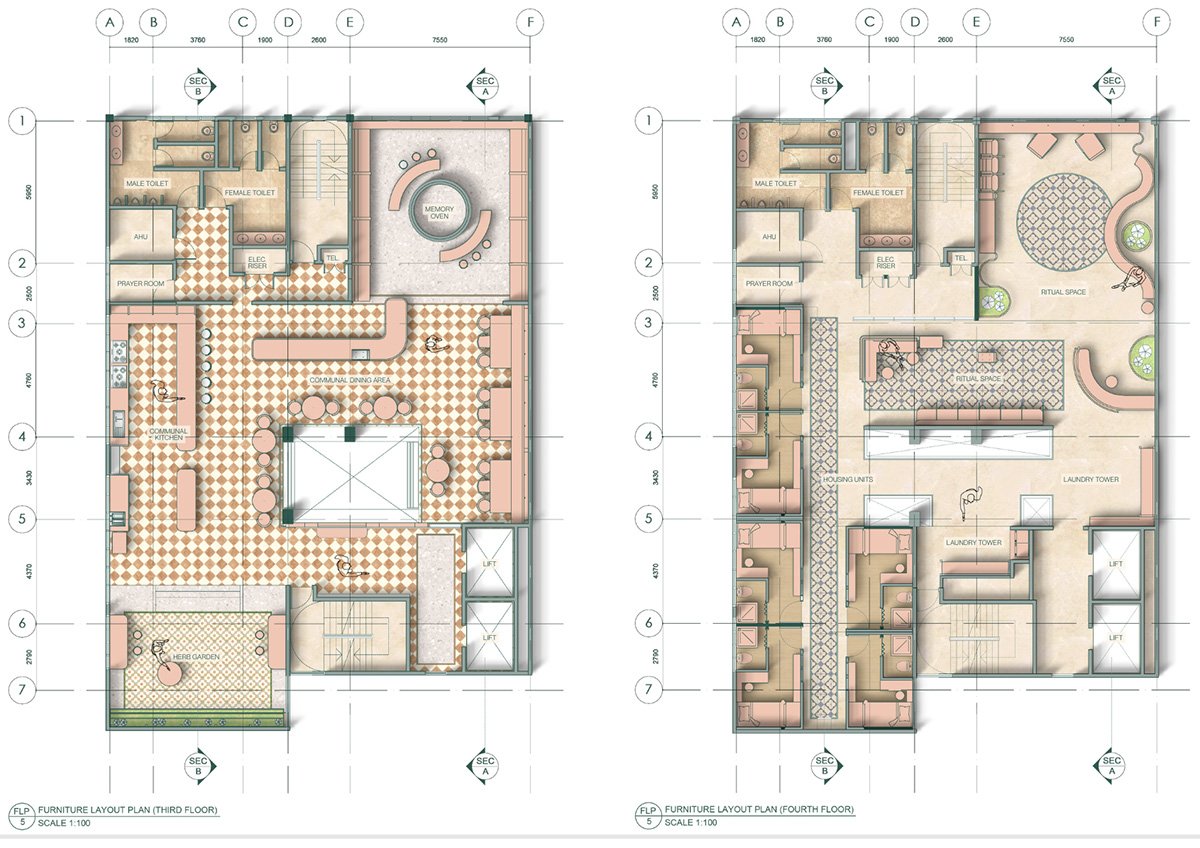
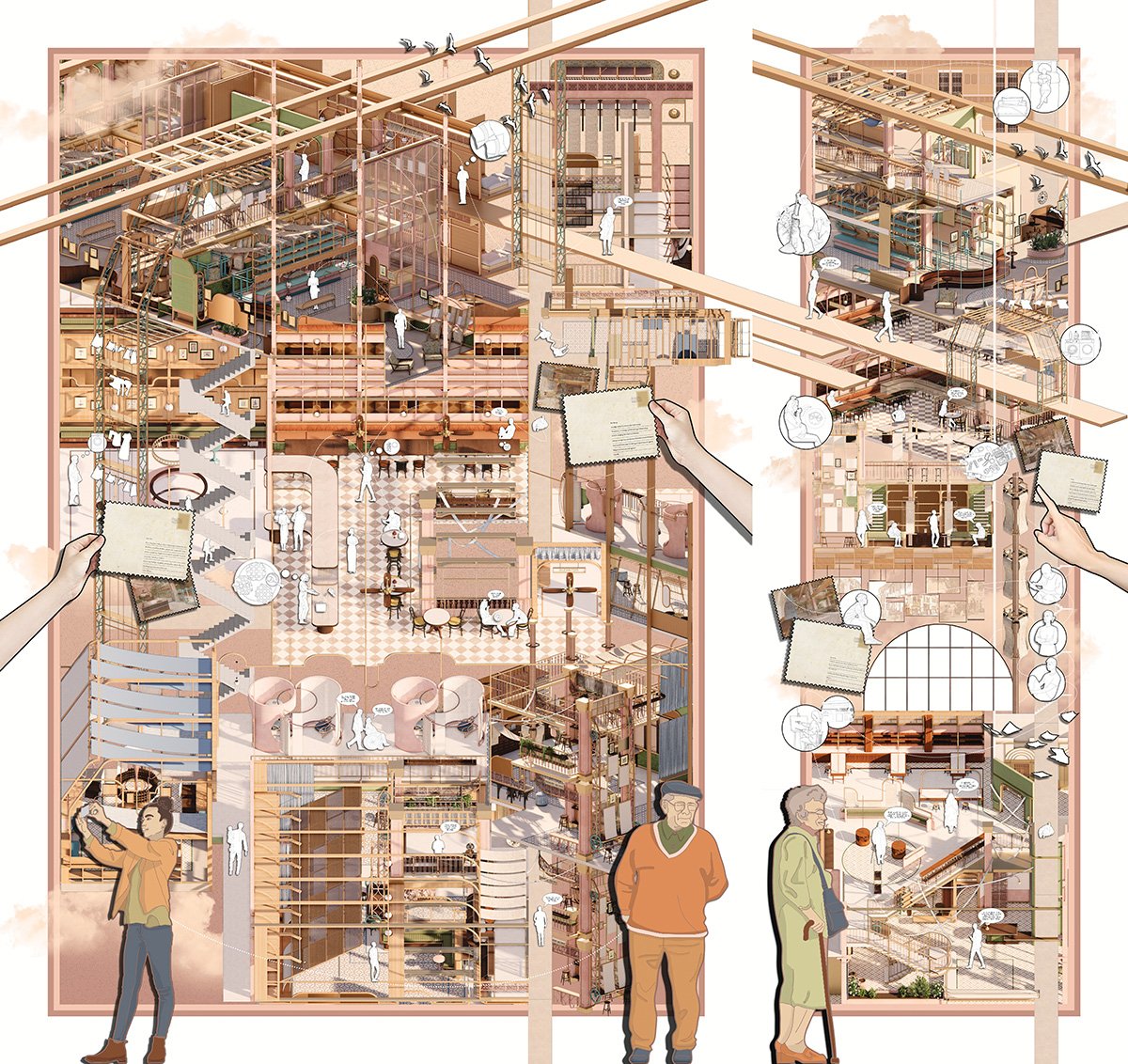
Plan – Third Floor, Fourth FloorA collage that highlights interaction, movement, and shared activity, showing how design supports intergenerational connection and daily life. It reinforces the project’s focus on care, community, and engagement.
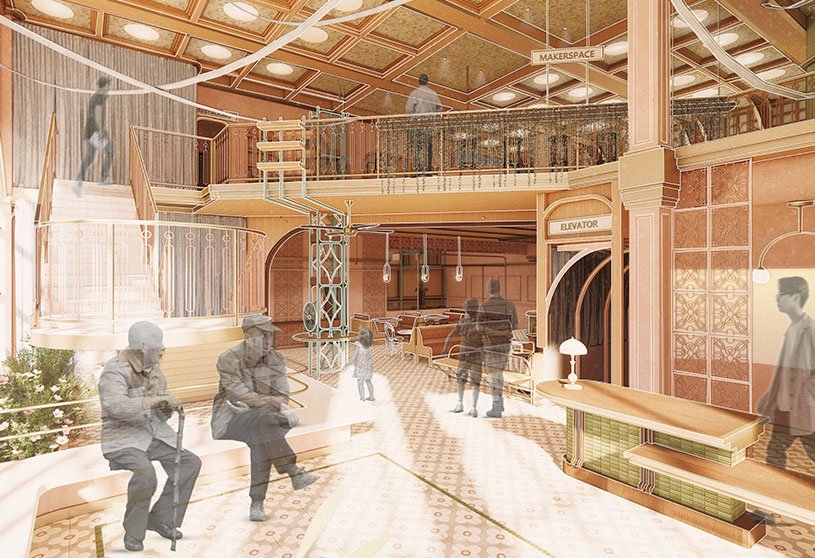
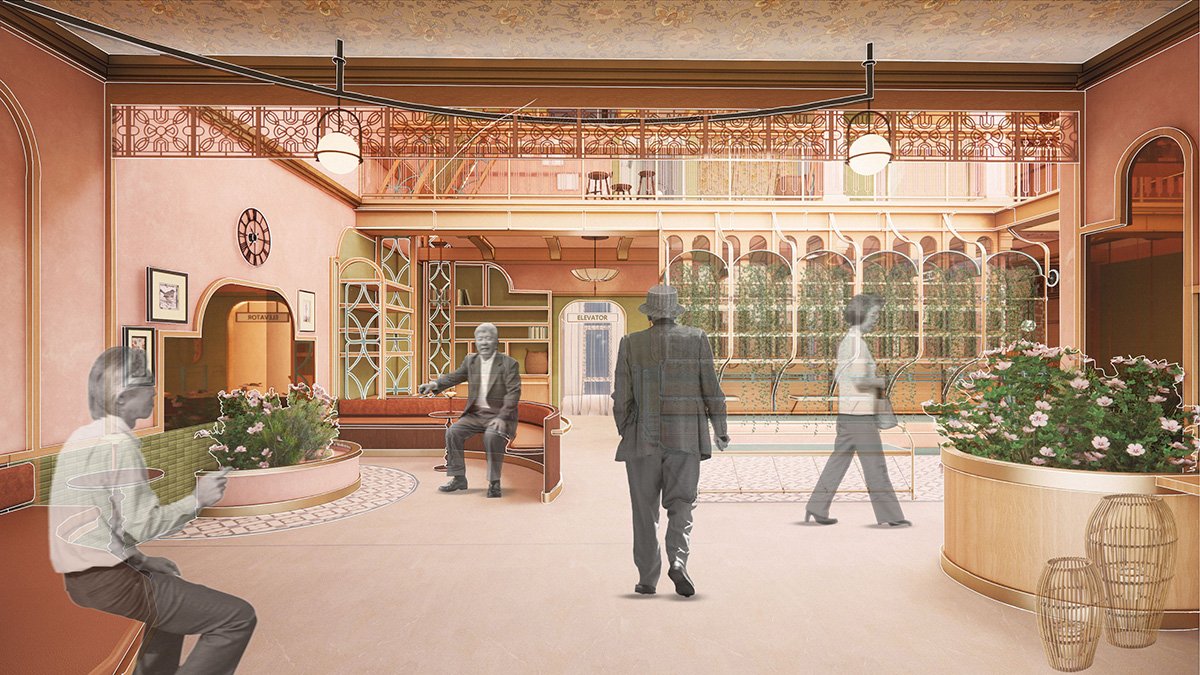
Peranakan-inspired tones, including soft pinks and warm timber finishes, introduce cultural familiarity and social warmth, softening the spatial experience and making shared areas feel approachable. These material decisions shape welcoming points of arrival and extend into collective zones designed for interaction, reflection, and daily routines.
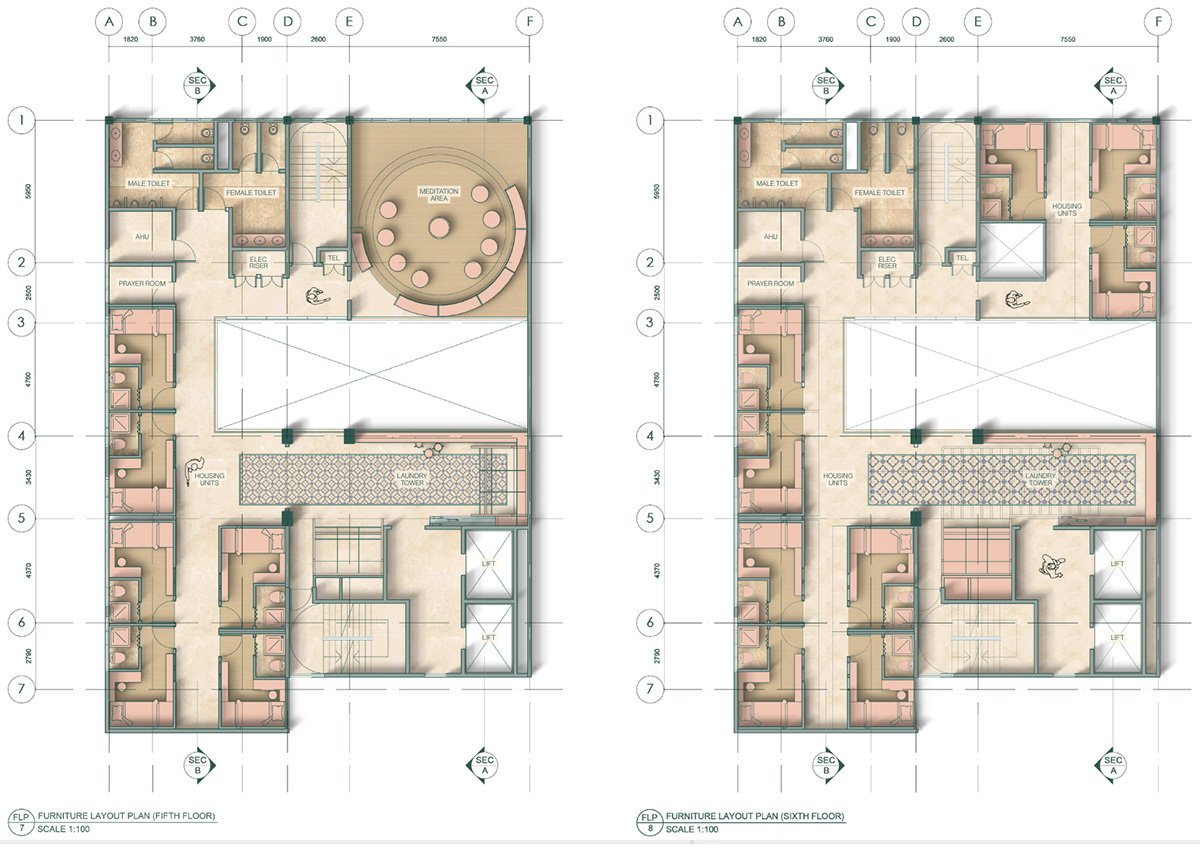
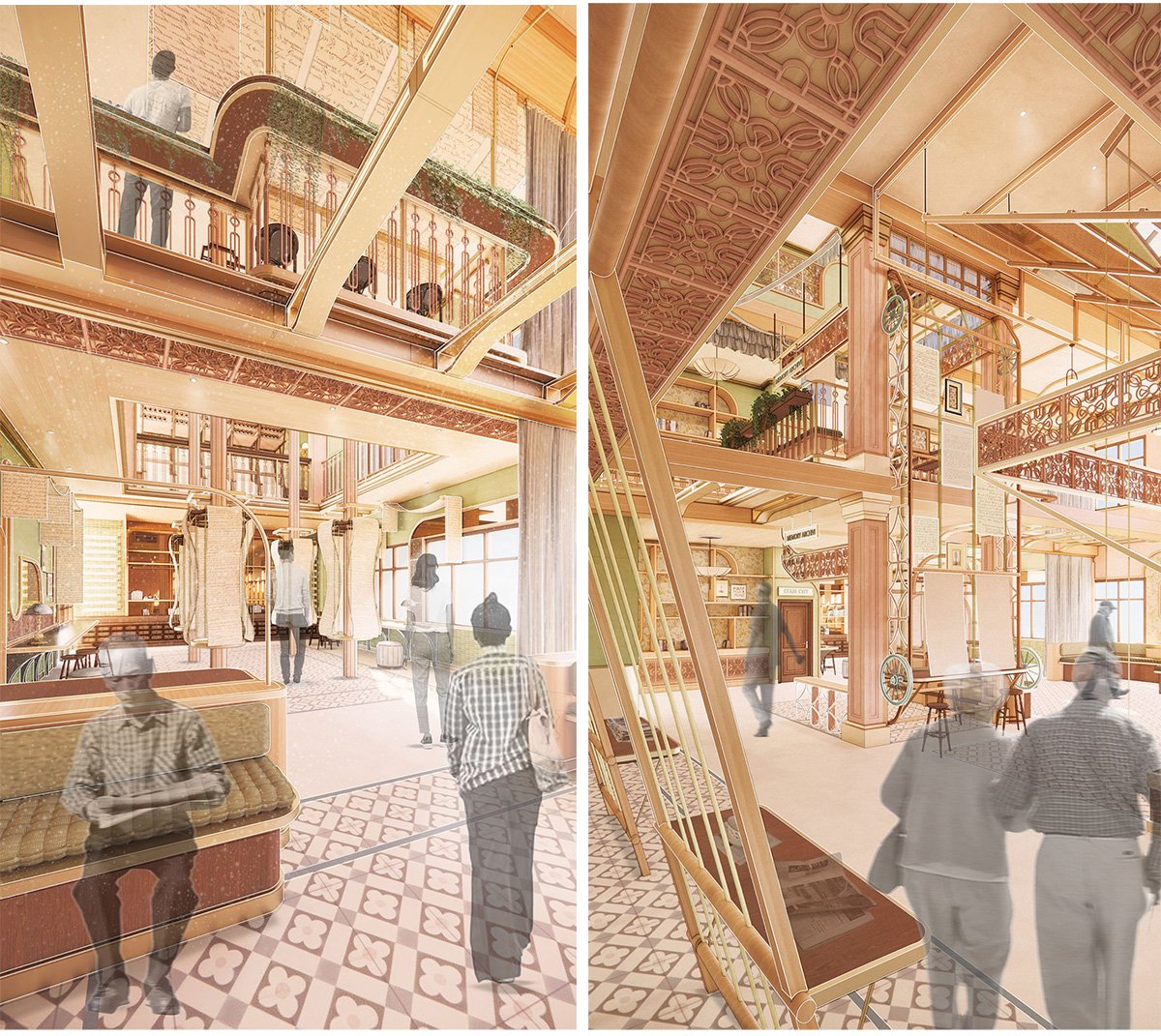
Plan – Fifth Floor, Sixth FloorShared Tales & Exhibition Area: A space featuring a writing desk for recording memory scrolls, functioning as both an archive and exhibition of personal and collective stories. | Memory Archive: A shared space to write, store, and display memories. Includes a reflective canvas, conveyor for items and photos to the mezzanine, and seating for reading and connection.Ritual Space + Living Quarters: A serene living area that supports elderly morning rituals and encourages mindful daily routines.
Layered voids connect multiple levels, strengthening visual relationships between programs and allowing activities centred on storytelling, memory keeping, ritual, and shared meals to remain perceptible throughout the building. Spaces dedicated to recording and exhibiting personal narratives sit within view of communal areas, reinforcing the idea that memory is part of everyday life rather than confined to a private archive. This openness promotes passive engagement, where residents and visitors stay aware of one another’s presence, supporting intergenerational coexistence through proximity rather than obligation.
Ritual Space + Living Quarters: A serene living area that supports elderly morning rituals and encourages mindful daily routines.Communal Kitchen & Dining: A shared kitchen and dining space that encourages cooking, eating, and bonding together.
Vertical cues within the columns and ceiling guide movement upward, transitioning from active public zones toward quieter living environments that support slower, more mindful patterns of inhabitation. Together, the communal kitchen, reflective archive spaces, and calm residential quarters establish a clear gradient from social to intimate.
Reception & Lounge: Welcoming space for arrival and interaction.
Conclusion: Collectively, the programs translate site observations into spatial form, supporting both independent living and shared experience. The outcome is a building that restores social presence within Petaling Street, enabling memory, care, and cultural continuity to remain visible within an evolving urban fabric.
[This Academic Project has been published with text and images submitted by the student]
Site Context
Design Process
Final Outcome
To submit your academic project for publication at ArchiDiaries, please visit the following link >> Submit
Get the best of ArchiDiaries, directly in your inbox.
We use cookies on our website to give you the most relevant experience by remembering your preferences and repeat visits. By clicking “Accept All”, you consent to the use of ALL the cookies. However, you may visit "Cookie Settings" to provide a controlled consent.
This website uses cookies to improve your experience while you navigate through the website. Out of these, the cookies that are categorized as necessary are stored on your browser as they are essential for the working of basic functionalities of the website. We also use third-party cookies that help us analyze and understand how you use this website. These cookies will be stored in your browser only with your consent. You also have the option to opt-out of these cookies. But opting out of some of these cookies may affect your browsing experience.
Necessary cookies are absolutely essential for the website to function properly. These cookies ensure basic functionalities and security features of the website, anonymously.
Cookie
Duration
Description
cookielawinfo-checkbox-analytics
11 months
This cookie is set by GDPR Cookie Consent plugin. The cookie is used to store the user consent for the cookies in the category "Analytics".
cookielawinfo-checkbox-functional
11 months
The cookie is set by GDPR cookie consent to record the user consent for the cookies in the category "Functional".
cookielawinfo-checkbox-necessary
11 months
This cookie is set by GDPR Cookie Consent plugin. The cookies is used to store the user consent for the cookies in the category "Necessary".
cookielawinfo-checkbox-others
11 months
This cookie is set by GDPR Cookie Consent plugin. The cookie is used to store the user consent for the cookies in the category "Other.
cookielawinfo-checkbox-performance
11 months
This cookie is set by GDPR Cookie Consent plugin. The cookie is used to store the user consent for the cookies in the category "Performance".
viewed_cookie_policy
11 months
The cookie is set by the GDPR Cookie Consent plugin and is used to store whether or not user has consented to the use of cookies. It does not store any personal data.
Functional cookies help to perform certain functionalities like sharing the content of the website on social media platforms, collect feedbacks, and other third-party features.
Performance cookies are used to understand and analyze the key performance indexes of the website which helps in delivering a better user experience for the visitors.
Analytical cookies are used to understand how visitors interact with the website. These cookies help provide information on metrics the number of visitors, bounce rate, traffic source, etc.
Advertisement cookies are used to provide visitors with relevant ads and marketing campaigns. These cookies track visitors across websites and collect information to provide customized ads.