Home » Academic projects » re-APPEAR [experience. chaos. possibilities.]: Reimagining The Harem-Haydarpaşa Neighborhood Of Istanbul By Addressing Its Fragmented And Underutilized State | Architecture Thesis On Urban Regeneration
re-APPEAR [experience. chaos. possibilities.]: Reimagining The Harem-Haydarpaşa Neighborhood Of Istanbul By Addressing Its Fragmented And Underutilized State | Architecture Thesis On Urban Regeneration
Excerpt: ‘re-APPEAR [experience. chaos. Possibilities.]’ is an architecture thesis by Humeyra Kanitoglu from the ‘YTU Department of Architecture – Yıldız Technical University.’ The project explores the urban regeneration of the neglected, fragmented residual spaces of the Harem-Haydarpaşa coastline, focusing on their emergence, problems, and potential contributions to urban life. Through the integration of memory, ambiguity, and adaptive reuse, it redefines residual spaces as vital parts of the city, inviting new ways of seeing, moving, and engaging with the urban environment.
Introduction: Standby Spaces: Mending the Cracks in the City
The city represents a complex web of relationships and interactions, where diverse elements mutually influence and transform one another while integrating with urban life. However, amidst this dynamic fabric, there exist neglected, marginalized, and undefined spaces that remain unused and non-functional. These areas, often trapped in a cycle of dysfunctionality, fail to integrate into public life, representing missing facets of the city. They are commonly referred to as residual spaces, recessed areas, or ambiguous territories.
This project focuses on these residual spaces, examining their emergence, the problems stemming from their suspended state, and their potential contributions to urban life. Specifically, the study explores the Harem-Haydarpasa waterfront region, a notable example of such spaces. Starting with the physical analysis of this coastal axis, the project incorporates personalized syntheses based on the area’s contextual knowledge. Within this framework, the specific challenges of the Harem-Haydarpasa region, its physical and perceptual boundaries, and the opportunities arising from these constraints have been identified. Through scenarios envisioning utopias and dystopias, spatial imaginings evolve into a comprehensive change and transformation project, uncovering the latent potentials of the coastline.
Collage Of The CityThe Harem-Haydarpaşa region, located between the districts of Üsküdar and Kadıköy, represents a reclaimed land area that emerged as cities expanded to meet growing urban and population demands. Initially developed as a transit hub, the region evolved with the addition of the Haydarpaşa Train Station, which became a significant node in international railway transportation. Over time, the area expanded further with the gradual inclusion of the Haydarpaşa Port’s reclaimed lands and, later, the Harem Bus Terminal, forming the present-day coastal strip.
The City Is A Collage Of ExperiencesThe City Is A Space Of ChaosToday, this area is excluded from urban life, functioning below its potential due to the inward-focused nature of its uses, the inactivity of structures like the Haydarpaşa Train Station and TMO Silos, and its overall state of decline. From a user perspective, the Harem-Haydarpaşa region acts as a disruptive tumor along the Üsküdar-Moda coastal axis, breaking the continuity of the urban fabric. The artificial topography, added to the natural one, creates a “high city” and “low city” dynamic, disturbing urban relationships and contributing to the area’s complexity and disorder.
The City Is A Universe Of PossibilitiesThe project introduces three propositions to conceptualize and analyze the Harem-Haydarpaşa region. The first, “The city is a collage of experiences,” highlights the region’s failure to integrate into the urban experience despite being a human-made addition. The second, “The city is a space of chaos,” explores the region’s complexity through its significant elements and actors, such as the Haydarpaşa Port, TMO Silos, and Harem Bus Terminal. Lastly, “The city is a universe of possibilities” envisions three scenarios: the reclamation’s removal by 2100, the area’s transformation into a skyline by 2030, and the possibility of living in a 1950s utopia or dystopia imagined in the past. These scenarios are represented through collages, reflecting the layered and speculative nature of the urban environment.
Design Process
Main Design IdeasMain Design IdeasThe project’s core manifesto is to craft a “[re-APPEAR]” scenario, exploring whether “experience, chaos, and possibilities” can coexist to transform the urban landscape. This involves reimagining the Harem-Haydarpaşa area by addressing its fragmented and underutilized state through three phases.
In the first phase, the Harem Bus Terminal, currently inactive and disconnected, is relocated to create a void. This space becomes a focal point for exploring the concept of “experience collage,” emphasizing the interaction between space and user experiences.
Main Design IdeasMain Design IdeasThe second phase focuses on Haydarpaşa Port, an industrial heritage site with iconic visuals like cranes and containers. While its port functions are relocated, its elements are preserved and repurposed. Cranes remain as landmarks, containers are transformed into workshops and kiosks, and warehouses are converted into multi-purpose galleries, maintaining the port’s cultural and visual identity.
Design Sketches | Master Plan: Triangulation of Experience. Harmony in Chaos. A Dream in a Universe of Possibilities.Design Section: “The creation of a timeless and placeless aura within the boundaries of this ambiguity emerges by blurring the perceptual and spatial limits formed in the process of making sense of the city.”The third phase addresses the structural density of TMO Silos, Haydarpaşa Train Station, and the railway tracks connecting to Kadıköy. Recognizing these elements as significant industrial heritage, the silos are repurposed as research hubs, and the train station becomes a Railway Museum. Railway tracks are transformed into a railway garden, featuring installations and heritage displays, enhancing spatial flow and preserving memory.
By integrating these phases, the project seeks to transform a fragmented urban tumor into a dynamic, sustainable, and culturally rich space that harmonizes history, functionality, and innovation.
Final Outcome
Main AxonometricSite Plan | Ground Floor Planthe Alive re-APPEAR in SilhouettesVisualisationThe relationship we establish with the city, in its broad perception, often revolves around an effort to clarify contradictions and ambiguities through a question-and-answer dynamic. However, moving beyond conventional understanding requires disrupting the perception of questions like “Where are we? What are we doing? What do we perceive?” or deepening their meaning to create a timeless and placeless aura. This approach transforms the citizen’s relationship with urban spaces into an innovative and dynamic gain, emphasizing architectural imagination and perceptual ambiguity.
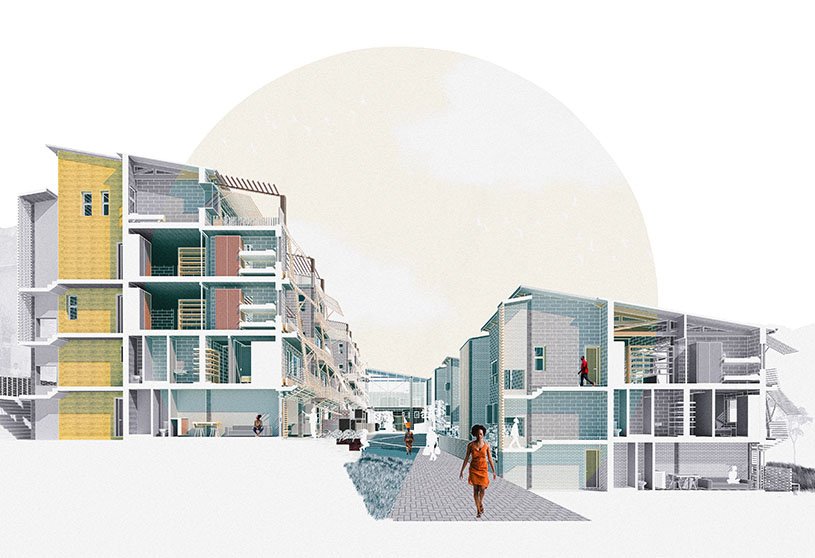
Utilization of Ground Floor Design FeaturesSectionSectionVisualisationTo foster these perspectives, the project employs concepts such as spatial depth, sequential dynamics, distorted relationships within systems, unconventional experiences in familiar spaces, twisted forms, visual stimuli, contrasts, and non-symbolic elements. These create a framework where no single structure dominates as a landmark, instead allowing flow and movement across levels to define the space. Ground-level elements like promenades, bike paths, and nostalgic tram lines contrast with upper-level structures that create secondary flows. This duality generates dynamic interactions, with ambiguity reinforcing the question, “Where am I?”
VisualisationSectionVisualisationThe absence of predefined symbols or meanings in spaces encourages users to experience an equal presence across surfaces, voids, and forms, supporting the timeless aura of the design. Functional and formal reimagining of conventional spaces, such as rethinking the four-walled room, enhances the sense of perceptual ambiguity. The deliberate removal of legends from certain spaces highlights this ambiguity, challenging the understanding of function and form. This spatial chaos ultimately blurs the boundaries of perception, inviting users to redefine their interaction with the city through dynamic and undefined experiences.
VisualisationVisualisationConclusion: Ultimately, the project reclaims the Harem-Haydarpaşa coastline by transforming neglected spaces into dynamic, layered urban experiences. Through the integration of memory, ambiguity, and adaptive reuse, it redefines residual spaces as vital parts of the city, inviting new ways of seeing, moving, and engaging with the urban environment.
[This Academic Project has been published with text and images submitted by the student]
Site Context
Design Process
Final Outcome
To submit your academic project for publication at ArchiDiaries, please visit the following link >> Submit
Get the best of ArchiDiaries, directly in your inbox.
We use cookies on our website to give you the most relevant experience by remembering your preferences and repeat visits. By clicking “Accept All”, you consent to the use of ALL the cookies. However, you may visit "Cookie Settings" to provide a controlled consent.
This website uses cookies to improve your experience while you navigate through the website. Out of these, the cookies that are categorized as necessary are stored on your browser as they are essential for the working of basic functionalities of the website. We also use third-party cookies that help us analyze and understand how you use this website. These cookies will be stored in your browser only with your consent. You also have the option to opt-out of these cookies. But opting out of some of these cookies may affect your browsing experience.
Necessary cookies are absolutely essential for the website to function properly. These cookies ensure basic functionalities and security features of the website, anonymously.
Cookie
Duration
Description
cookielawinfo-checkbox-analytics
11 months
This cookie is set by GDPR Cookie Consent plugin. The cookie is used to store the user consent for the cookies in the category "Analytics".
cookielawinfo-checkbox-functional
11 months
The cookie is set by GDPR cookie consent to record the user consent for the cookies in the category "Functional".
cookielawinfo-checkbox-necessary
11 months
This cookie is set by GDPR Cookie Consent plugin. The cookies is used to store the user consent for the cookies in the category "Necessary".
cookielawinfo-checkbox-others
11 months
This cookie is set by GDPR Cookie Consent plugin. The cookie is used to store the user consent for the cookies in the category "Other.
cookielawinfo-checkbox-performance
11 months
This cookie is set by GDPR Cookie Consent plugin. The cookie is used to store the user consent for the cookies in the category "Performance".
viewed_cookie_policy
11 months
The cookie is set by the GDPR Cookie Consent plugin and is used to store whether or not user has consented to the use of cookies. It does not store any personal data.
Functional cookies help to perform certain functionalities like sharing the content of the website on social media platforms, collect feedbacks, and other third-party features.
Performance cookies are used to understand and analyze the key performance indexes of the website which helps in delivering a better user experience for the visitors.
Analytical cookies are used to understand how visitors interact with the website. These cookies help provide information on metrics the number of visitors, bounce rate, traffic source, etc.
Advertisement cookies are used to provide visitors with relevant ads and marketing campaigns. These cookies track visitors across websites and collect information to provide customized ads.
![re-APPEAR [experience. chaos. possibilities.]: Reimagining The Harem-Haydarpaşa Neighborhood Of Istanbul By Addressing Its Fragmented And Underutilized State | Architecture Thesis On Urban Regeneration](https://archidiaries.com/wp-content/uploads/2025/06/Humeyra-Kanitoglu_feat_img.jpg)
![re-APPEAR [experience. chaos. possibilities.]: Reimagining The Harem-Haydarpaşa Neighborhood Of Istanbul By Addressing Its Fragmented And Underutilized State | Architecture Thesis On Urban Regeneration](https://archidiaries.com/wp-content/uploads/2025/06/Humeyra-Kanitoglu_SC_For-Post-1.jpg)
![re-APPEAR [experience. chaos. possibilities.]: Reimagining The Harem-Haydarpaşa Neighborhood Of Istanbul By Addressing Its Fragmented And Underutilized State | Architecture Thesis On Urban Regeneration](https://archidiaries.com/wp-content/uploads/2025/06/Humeyra-Kanitoglu_SC-2.jpg)
![re-APPEAR [experience. chaos. possibilities.]: Reimagining The Harem-Haydarpaşa Neighborhood Of Istanbul By Addressing Its Fragmented And Underutilized State | Architecture Thesis On Urban Regeneration](https://archidiaries.com/wp-content/uploads/2025/06/Humeyra-Kanitoglu_SC-3.jpg)
![re-APPEAR [experience. chaos. possibilities.]: Reimagining The Harem-Haydarpaşa Neighborhood Of Istanbul By Addressing Its Fragmented And Underutilized State | Architecture Thesis On Urban Regeneration](https://archidiaries.com/wp-content/uploads/2025/06/Humeyra-Kanitoglu_SC-4.jpg)
![re-APPEAR [experience. chaos. possibilities.]: Reimagining The Harem-Haydarpaşa Neighborhood Of Istanbul By Addressing Its Fragmented And Underutilized State | Architecture Thesis On Urban Regeneration](https://archidiaries.com/wp-content/uploads/2025/06/Humeyra-Kanitoglu_DP_For-Post-1.jpg)
![re-APPEAR [experience. chaos. possibilities.]: Reimagining The Harem-Haydarpaşa Neighborhood Of Istanbul By Addressing Its Fragmented And Underutilized State | Architecture Thesis On Urban Regeneration](https://archidiaries.com/wp-content/uploads/2025/06/Humeyra-Kanitoglu_DP_For-Post-2.jpg)
![re-APPEAR [experience. chaos. possibilities.]: Reimagining The Harem-Haydarpaşa Neighborhood Of Istanbul By Addressing Its Fragmented And Underutilized State | Architecture Thesis On Urban Regeneration](https://archidiaries.com/wp-content/uploads/2025/06/Humeyra-Kanitoglu_DP_For-Post-3.jpg)
![re-APPEAR [experience. chaos. possibilities.]: Reimagining The Harem-Haydarpaşa Neighborhood Of Istanbul By Addressing Its Fragmented And Underutilized State | Architecture Thesis On Urban Regeneration](https://archidiaries.com/wp-content/uploads/2025/06/Humeyra-Kanitoglu_DP_For-Post-4.jpg)
![re-APPEAR [experience. chaos. possibilities.]: Reimagining The Harem-Haydarpaşa Neighborhood Of Istanbul By Addressing Its Fragmented And Underutilized State | Architecture Thesis On Urban Regeneration](https://archidiaries.com/wp-content/uploads/2025/06/Humeyra-Kanitoglu_DP-2-3.jpg)
![re-APPEAR [experience. chaos. possibilities.]: Reimagining The Harem-Haydarpaşa Neighborhood Of Istanbul By Addressing Its Fragmented And Underutilized State | Architecture Thesis On Urban Regeneration](https://archidiaries.com/wp-content/uploads/2025/06/Humeyra-Kanitoglu_DP-4.jpg)
![re-APPEAR [experience. chaos. possibilities.]: Reimagining The Harem-Haydarpaşa Neighborhood Of Istanbul By Addressing Its Fragmented And Underutilized State | Architecture Thesis On Urban Regeneration](https://archidiaries.com/wp-content/uploads/2025/06/Humeyra-Kanitoglu_FO-1.jpg)
![re-APPEAR [experience. chaos. possibilities.]: Reimagining The Harem-Haydarpaşa Neighborhood Of Istanbul By Addressing Its Fragmented And Underutilized State | Architecture Thesis On Urban Regeneration](https://archidiaries.com/wp-content/uploads/2025/06/Humeyra-Kanitoglu_FO-2-3.jpg)
![re-APPEAR [experience. chaos. possibilities.]: Reimagining The Harem-Haydarpaşa Neighborhood Of Istanbul By Addressing Its Fragmented And Underutilized State | Architecture Thesis On Urban Regeneration](https://archidiaries.com/wp-content/uploads/2025/06/Humeyra-Kanitoglu_FO-7.jpg)
![re-APPEAR [experience. chaos. possibilities.]: Reimagining The Harem-Haydarpaşa Neighborhood Of Istanbul By Addressing Its Fragmented And Underutilized State | Architecture Thesis On Urban Regeneration](https://archidiaries.com/wp-content/uploads/2025/06/Humeyra-Kanitoglu_FO-9.jpg)
![re-APPEAR [experience. chaos. possibilities.]: Reimagining The Harem-Haydarpaşa Neighborhood Of Istanbul By Addressing Its Fragmented And Underutilized State | Architecture Thesis On Urban Regeneration](https://archidiaries.com/wp-content/uploads/2025/06/Humeyra-Kanitoglu_FO-4-5.jpg)
![re-APPEAR [experience. chaos. possibilities.]: Reimagining The Harem-Haydarpaşa Neighborhood Of Istanbul By Addressing Its Fragmented And Underutilized State | Architecture Thesis On Urban Regeneration](https://archidiaries.com/wp-content/uploads/2025/06/Humeyra-Kanitoglu_FO_For-Post-1.jpg)
![re-APPEAR [experience. chaos. possibilities.]: Reimagining The Harem-Haydarpaşa Neighborhood Of Istanbul By Addressing Its Fragmented And Underutilized State | Architecture Thesis On Urban Regeneration](https://archidiaries.com/wp-content/uploads/2025/06/Humeyra-Kanitoglu_FO_For-Post-2.jpg)
![re-APPEAR [experience. chaos. possibilities.]: Reimagining The Harem-Haydarpaşa Neighborhood Of Istanbul By Addressing Its Fragmented And Underutilized State | Architecture Thesis On Urban Regeneration](https://archidiaries.com/wp-content/uploads/2025/06/Humeyra-Kanitoglu_FO-11.jpg)
![re-APPEAR [experience. chaos. possibilities.]: Reimagining The Harem-Haydarpaşa Neighborhood Of Istanbul By Addressing Its Fragmented And Underutilized State | Architecture Thesis On Urban Regeneration](https://archidiaries.com/wp-content/uploads/2025/06/Humeyra-Kanitoglu_FO-12-14.jpg)
![re-APPEAR [experience. chaos. possibilities.]: Reimagining The Harem-Haydarpaşa Neighborhood Of Istanbul By Addressing Its Fragmented And Underutilized State | Architecture Thesis On Urban Regeneration](https://archidiaries.com/wp-content/uploads/2025/06/Humeyra-Kanitoglu_FO_For-Post-3.jpg)
![re-APPEAR [experience. chaos. possibilities.]: Reimagining The Harem-Haydarpaşa Neighborhood Of Istanbul By Addressing Its Fragmented And Underutilized State | Architecture Thesis On Urban Regeneration](https://archidiaries.com/wp-content/uploads/2025/06/Humeyra-Kanitoglu_FO-13.jpg)
![re-APPEAR [experience. chaos. possibilities.]: Reimagining The Harem-Haydarpaşa Neighborhood Of Istanbul By Addressing Its Fragmented And Underutilized State | Architecture Thesis On Urban Regeneration](https://archidiaries.com/wp-content/uploads/2025/06/Humeyra-Kanitoglu_FO-15-16.jpg)
![re-APPEAR [experience. chaos. possibilities.]: Reimagining The Harem-Haydarpaşa Neighborhood Of Istanbul By Addressing Its Fragmented And Underutilized State | Architecture Thesis On Urban Regeneration](https://archidiaries.com/wp-content/uploads/2025/06/Humeyra-Kanitoglu_FO-17.jpg)
![re-APPEAR [experience. chaos. possibilities.]: Reimagining The Harem-Haydarpaşa Neighborhood Of Istanbul By Addressing Its Fragmented And Underutilized State | Architecture Thesis On Urban Regeneration](https://archidiaries.com/wp-content/uploads/2025/06/Humeyra-Kanitoglu_SC-1.jpg)
![re-APPEAR [experience. chaos. possibilities.]: Reimagining The Harem-Haydarpaşa Neighborhood Of Istanbul By Addressing Its Fragmented And Underutilized State | Architecture Thesis On Urban Regeneration](https://archidiaries.com/wp-content/uploads/2025/06/Humeyra-Kanitoglu_DP-1.jpg)
![re-APPEAR [experience. chaos. possibilities.]: Reimagining The Harem-Haydarpaşa Neighborhood Of Istanbul By Addressing Its Fragmented And Underutilized State | Architecture Thesis On Urban Regeneration](https://archidiaries.com/wp-content/uploads/2025/06/Humeyra-Kanitoglu_DP-2.jpg)
![re-APPEAR [experience. chaos. possibilities.]: Reimagining The Harem-Haydarpaşa Neighborhood Of Istanbul By Addressing Its Fragmented And Underutilized State | Architecture Thesis On Urban Regeneration](https://archidiaries.com/wp-content/uploads/2025/06/Humeyra-Kanitoglu_DP-3.jpg)
![re-APPEAR [experience. chaos. possibilities.]: Reimagining The Harem-Haydarpaşa Neighborhood Of Istanbul By Addressing Its Fragmented And Underutilized State | Architecture Thesis On Urban Regeneration](https://archidiaries.com/wp-content/uploads/2025/06/Humeyra-Kanitoglu_FO-2.jpg)
![re-APPEAR [experience. chaos. possibilities.]: Reimagining The Harem-Haydarpaşa Neighborhood Of Istanbul By Addressing Its Fragmented And Underutilized State | Architecture Thesis On Urban Regeneration](https://archidiaries.com/wp-content/uploads/2025/06/Humeyra-Kanitoglu_FO-3.jpg)
![re-APPEAR [experience. chaos. possibilities.]: Reimagining The Harem-Haydarpaşa Neighborhood Of Istanbul By Addressing Its Fragmented And Underutilized State | Architecture Thesis On Urban Regeneration](https://archidiaries.com/wp-content/uploads/2025/06/Humeyra-Kanitoglu_FO-4.jpg)
![re-APPEAR [experience. chaos. possibilities.]: Reimagining The Harem-Haydarpaşa Neighborhood Of Istanbul By Addressing Its Fragmented And Underutilized State | Architecture Thesis On Urban Regeneration](https://archidiaries.com/wp-content/uploads/2025/06/Humeyra-Kanitoglu_FO-5.jpg)
![re-APPEAR [experience. chaos. possibilities.]: Reimagining The Harem-Haydarpaşa Neighborhood Of Istanbul By Addressing Its Fragmented And Underutilized State | Architecture Thesis On Urban Regeneration](https://archidiaries.com/wp-content/uploads/2025/06/Humeyra-Kanitoglu_FO-6.jpg)
![re-APPEAR [experience. chaos. possibilities.]: Reimagining The Harem-Haydarpaşa Neighborhood Of Istanbul By Addressing Its Fragmented And Underutilized State | Architecture Thesis On Urban Regeneration](https://archidiaries.com/wp-content/uploads/2025/06/Humeyra-Kanitoglu_FO-8.jpg)
![re-APPEAR [experience. chaos. possibilities.]: Reimagining The Harem-Haydarpaşa Neighborhood Of Istanbul By Addressing Its Fragmented And Underutilized State | Architecture Thesis On Urban Regeneration](https://archidiaries.com/wp-content/uploads/2025/06/Humeyra-Kanitoglu_FO-10.jpg)
![re-APPEAR [experience. chaos. possibilities.]: Reimagining The Harem-Haydarpaşa Neighborhood Of Istanbul By Addressing Its Fragmented And Underutilized State | Architecture Thesis On Urban Regeneration](https://archidiaries.com/wp-content/uploads/2025/06/Humeyra-Kanitoglu_FO-12.jpg)
![re-APPEAR [experience. chaos. possibilities.]: Reimagining The Harem-Haydarpaşa Neighborhood Of Istanbul By Addressing Its Fragmented And Underutilized State | Architecture Thesis On Urban Regeneration](https://archidiaries.com/wp-content/uploads/2025/06/Humeyra-Kanitoglu_FO-14.jpg)
![re-APPEAR [experience. chaos. possibilities.]: Reimagining The Harem-Haydarpaşa Neighborhood Of Istanbul By Addressing Its Fragmented And Underutilized State | Architecture Thesis On Urban Regeneration](https://archidiaries.com/wp-content/uploads/2025/06/Humeyra-Kanitoglu_FO-15.jpg)
![re-APPEAR [experience. chaos. possibilities.]: Reimagining The Harem-Haydarpaşa Neighborhood Of Istanbul By Addressing Its Fragmented And Underutilized State | Architecture Thesis On Urban Regeneration](https://archidiaries.com/wp-content/uploads/2025/06/Humeyra-Kanitoglu_FO-16.jpg)