Home » Academic projects » Jardín Encendido (Lighted Garden): Reinterpreting the Chinese Garden as a Landscape of Movement and Water in Shaoxing | Masters Design Thesis
Jardín Encendido (Lighted Garden): Reinterpreting the Chinese Garden as a Landscape of Movement and Water in Shaoxing | Masters Design Thesis
Excerpt: ‘Jardín Encendido (Lighted Garden)’ is an architecture thesis by Alejandra Santamaría Melenchón from the ‘Escuela Politécnica Superior – Universidad CEU San Pablo.’ The project aims to create a sustainable, sensory garden that reconnects people with nature and cultural heritage while revitalizing an underused urban area. It seeks to manage water responsibly, reduce flood risks, and offer spaces for learning, research, and leisure through a contemporary reinterpretation of traditional Chinese gardens.
Introduction: The project “Enlightened Garden,” developed in Shaoxing (China), emerges from the deep connection between Chinese culture, its symbolism, and the landscapes of its gardens, where nature and human beings coexist in harmony. Located in an area shaped by water and flood risk, the project is integrated into a dense urban context, proposing a pathway that connects key parts of the city while revitalizing the area through tourism.
It proposes a Garden Research Center that reinterprets traditional Chinese gardens through a contemporary lens, prioritizing the experience of movement as the main architectural element. The garden is conceived as a labyrinthine, sensory, and personal space where each visitor creates their own experience. Water is the core element of the project, managed through systems of collection, storage, and phytoremediation, reducing flood impact and promoting sustainability. The design includes elevated pavilions protected from flooding, as well as spaces for research, education, and leisure.
The proposal incorporates accessibility strategies, recycled materials, and efficient construction solutions. Overall, the project aims to raise environmental awareness, encourage learning, and restore the connection with nature, proposing a more sustainable and respectful future.
Front PageIntroducing Shaoxing And Its Surroundings
Shaoxing, located in Zhejiang Province, China, is a historic city with over 2,500 years of history, originally founded as the capital of the ancient Yue State. Situated about 200 kilometers from Shanghai, along the Qiantang River, it is home to over five million people and is recognized as an important cultural center. The city is known for its traditional white houses with dark tiled roofs and its strong connection to literature, having been home to many scholars and poets.
Closer Approach
One of Shaoxing’s most distinctive features is its extensive network of interconnected canals, historically used for transport and trade, where traditional covered boats are still in use today. The flat terrain and high humidity are shaped by abundant rainfall and proximity to water. The city also preserves more than 700 ancient bridges, some over a thousand years old.
Chinese Gardens Analysis
The project features multiple entrances, accessible pathways, and parking nearby. Landscaped trails, elevated walkways, and covered connections guide visitors. Controlled-scale pavilions host events, workshops, research, and leisure. Native gardens, ponds, wildlife observation points, and urban furniture enhance the landscape. Sustainable strategies include rainwater reuse, permeable surfaces, and solar energy. Quiet contemplation areas complete the design.
Design Process
Garden Contributed To The Environment
The project aims to reactivate the area by promoting local traditions and creating an inclusive space for everyone. Its main goal is to revive a gradually abandoned zone through a vibrant environment filled with nature, color, and light. The proposal is deeply connected to its surroundings, establishing a pathway that links key tourist points while connecting the southern park with the northern lake.
Water Strategies
Designed as a contemporary reinterpretation of a traditional Chinese garden, the project emphasizes vegetation as the central element, with pavilions integrated within it to host various activities. It offers a sequence of diverse experiences where historical and modern elements coexist.
Active And Passive Strategies
Materiality plays a key role, reinterpreting traditional textures in a modern way while guiding movement through the space and acting as a system of orientation. The result is a natural, labyrinth-like environment composed of sustainable and healthy spaces. Ultimately, the project seeks to revitalize both the territory and its users, creating a place that inspires and awakens the senses day and night.
Final Outcome
General PlanGarden Experiences
The final outcome of the project is a vibrant, multi-sensory Chinese-inspired garden that seamlessly integrates nature, architecture, and sustainability. It revitalizes an abandoned urban area by connecting the northern lake with the southern park through accessible pathways, elevated walkways, and contemplative trails. Vegetation dominates the landscape, creating immersive experiences alongside carefully positioned pavilions for research, workshops, exhibitions, and leisure.
The design emphasizes harmony between past and present, blending traditional garden principles with modern materials, sustainable infrastructure, and interactive features. Water management systems, including rainwater collection, phytoremediation, and ponds, ensure ecological resilience, while solar panels and permeable pavements reduce environmental impact. Public spaces, resting areas, and observation points encourage reflection, education, and social interaction.
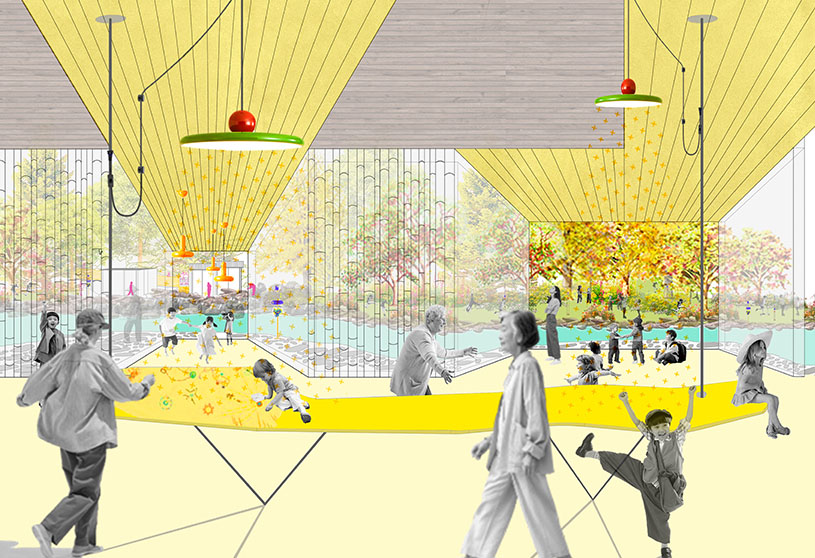
Fun LibraryFinal Exterior Image
Conclusion: By activating both the territory and its users, the project fosters awareness of nature, culture, and sustainability. The “Enlightened Garden” becomes a living, adaptable space that awakens the senses, inspires creativity, and serves as a model for future urban-nature integration.
[This Academic Project has been published with text and images submitted by the student]
Site Context
Design Process
Final Outcome
To submit your academic project for publication at ArchiDiaries, please visit the following link >> Submit
Get the best of ArchiDiaries, directly in your inbox.
We use cookies on our website to give you the most relevant experience by remembering your preferences and repeat visits. By clicking “Accept All”, you consent to the use of ALL the cookies. However, you may visit "Cookie Settings" to provide a controlled consent.
This website uses cookies to improve your experience while you navigate through the website. Out of these, the cookies that are categorized as necessary are stored on your browser as they are essential for the working of basic functionalities of the website. We also use third-party cookies that help us analyze and understand how you use this website. These cookies will be stored in your browser only with your consent. You also have the option to opt-out of these cookies. But opting out of some of these cookies may affect your browsing experience.
Necessary cookies are absolutely essential for the website to function properly. These cookies ensure basic functionalities and security features of the website, anonymously.
Cookie
Duration
Description
cookielawinfo-checkbox-analytics
11 months
This cookie is set by GDPR Cookie Consent plugin. The cookie is used to store the user consent for the cookies in the category "Analytics".
cookielawinfo-checkbox-functional
11 months
The cookie is set by GDPR cookie consent to record the user consent for the cookies in the category "Functional".
cookielawinfo-checkbox-necessary
11 months
This cookie is set by GDPR Cookie Consent plugin. The cookies is used to store the user consent for the cookies in the category "Necessary".
cookielawinfo-checkbox-others
11 months
This cookie is set by GDPR Cookie Consent plugin. The cookie is used to store the user consent for the cookies in the category "Other.
cookielawinfo-checkbox-performance
11 months
This cookie is set by GDPR Cookie Consent plugin. The cookie is used to store the user consent for the cookies in the category "Performance".
viewed_cookie_policy
11 months
The cookie is set by the GDPR Cookie Consent plugin and is used to store whether or not user has consented to the use of cookies. It does not store any personal data.
Functional cookies help to perform certain functionalities like sharing the content of the website on social media platforms, collect feedbacks, and other third-party features.
Performance cookies are used to understand and analyze the key performance indexes of the website which helps in delivering a better user experience for the visitors.
Analytical cookies are used to understand how visitors interact with the website. These cookies help provide information on metrics the number of visitors, bounce rate, traffic source, etc.
Advertisement cookies are used to provide visitors with relevant ads and marketing campaigns. These cookies track visitors across websites and collect information to provide customized ads.


![Factory[n]Certainty: Redefining Industrial Architecture Through Work, Life, and Community | Bachelors Design Thesis](https://archidiaries.com/wp-content/uploads/2026/09/Siam-Rahman_APR_feat_img.jpg)