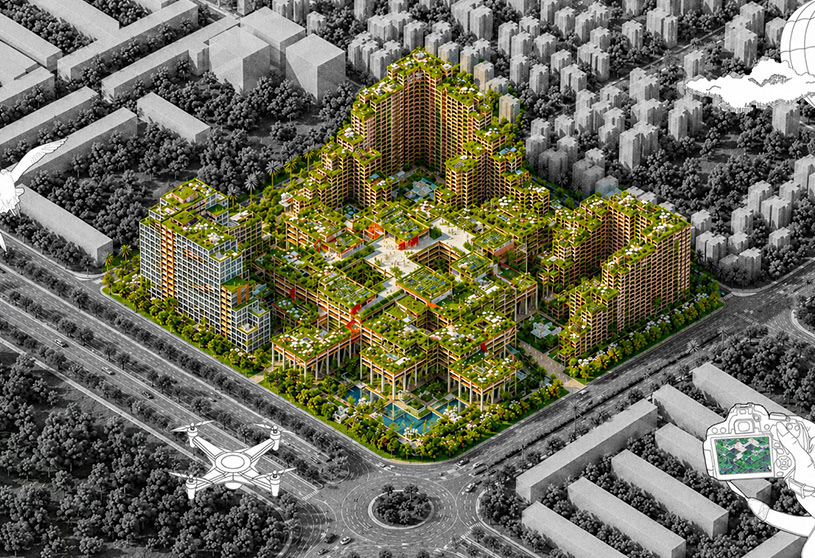
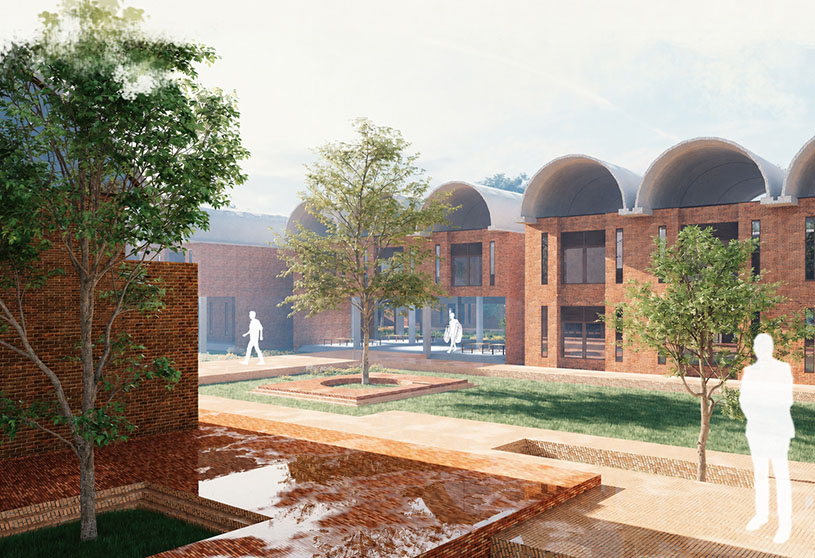
Excerpt: ‘Healing Patch’ is an architecture thesis by Md Samuel Samin from the ‘Department of Architecture – North South University.’ The project aims to redefine urban development by transforming a conventional mixed-use superblock into a regenerative ecological system. Through low-carbon design, renewable energy, green infrastructure, and computational optimization, the project reduces environmental impact while restoring ecosystems, improving urban resilience, and creating people-centered, climate-responsive cities for Bangladesh.
Introduction: Cities are expanding rapidly, yet the built environment continues to drive carbon emissions, resource depletion, and ecological degradation.
Healing Patch proposes a regenerative mixed-use superblock that reimagines architecture as an active ecological infrastructure rather than a passive built form. Located within Purbachal New Town, the project consolidates fragmented commercial plots into a unified urban system integrating residential, office, retail, and public functions. Through computationally optimized massing, low-carbon materials, renewable energy generation, water harvesting, and extensive green integration, the proposal minimizes environmental impact while maximizing ecological performance. Five interconnected strategies—Unify, Regeneration, Edge Matrix, Extended Urban Realm, and Form Matrix—create a flexible framework that balances density with environmental restoration. By transforming setbacks into productive landscapes, terraces into solar parks, and buildings into resource-generating systems, the project demonstrates how future urban development can actively reduce carbon emissions, regenerate ecosystems, and create resilient, people-centered cities for Bangladesh.
The project is situated within Purbachal New Town, Dhaka’s largest planned urban extension developed by RAJUK, on a 20-acre site originally designated as a commercial zone. Strategically located adjacent to a proposed MRT station, a major highway, educational institutions, low-cost housing, and emerging residential neighborhoods, the site is positioned to become a future urban hub.
RAJUK Proposed Future ScenarioSite Images
Rather than following a conventional monofunctional commercial model, the proposal introduces a mixed-use regenerative superblock integrating residential, office, retail, and public functions. This transformation creates a pedestrian-oriented, environmentally responsive development that strengthens connectivity, activates public life, and establishes a scalable prototype for future carbon-responsive urban growth in Bangladesh.
Design Process
Design Strategies
The design process is structured around five interconnected strategies that collectively transform a conventional commercial development into a regenerative urban ecosystem.
Unify
1. Unify – Consolidates fragmented plots into a single superblock, reclaiming underutilized setback spaces as continuous public and ecological infrastructure.
Regeneration
2. Regeneration – Integrates Urban-Healing-Transport (UHT) modules that combine vegetation, renewable energy generation, and water harvesting to actively restore environmental performance.
Edge Matrix
3. Edge Matrix – Reimagines setbacks as productive ecological buffers and civic spaces, enhancing biodiversity, public interaction, and local economic activity.
Extended Real and Form Matrix
4. Extended Urban Realm – Expands public life vertically through accessible terraces, rooftops, and elevated landscapes, creating a multi-layered civic network beyond the ground plane.
Form Matrix ExtendedForm Matrix Extended
5. Form Matrix – Uses computational simulations to optimize building morphology for daylight access, self-shading, wind permeability, and productive surface area. The resulting staggered form minimizes ground coverage while maximizing ecological surfaces, renewable energy potential, and passive environmental performance.
Together, these strategies create a flexible, high-density urban framework that balances environmental restoration, public life, and long-term adaptability, offering a scalable model for future regenerative development.
Final Outcome
Masterplan and Exploded AxonometricOffice Terrain Modules and PropagationOffice Terrain Perspective
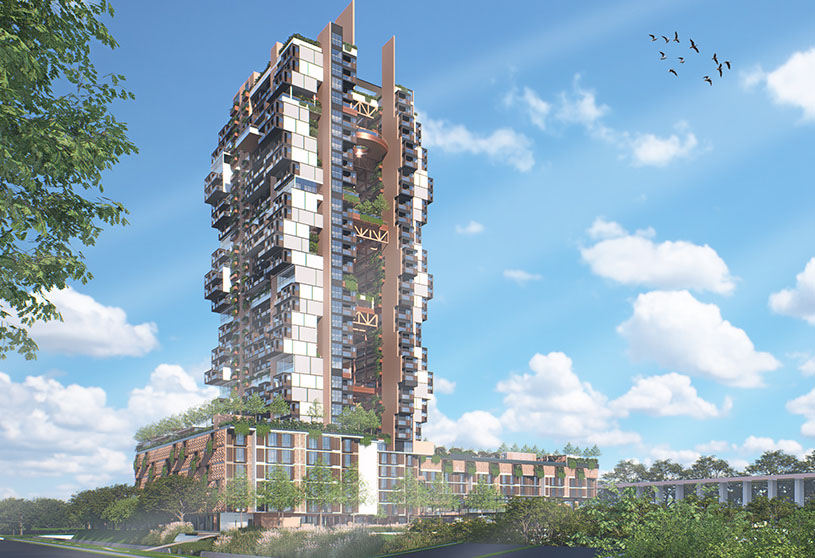
The proposal culminates in a regenerative mixed-use superblock that integrates residential, office, retail, and public functions within a unified ecological framework. Rather than maximizing ground coverage, the development concentrates density vertically, preserving extensive open landscapes, active green setbacks, and publicly accessible spaces that strengthen environmental and social performance.
Retail Courtyard PerspectiveRetail Solar Park Perspective
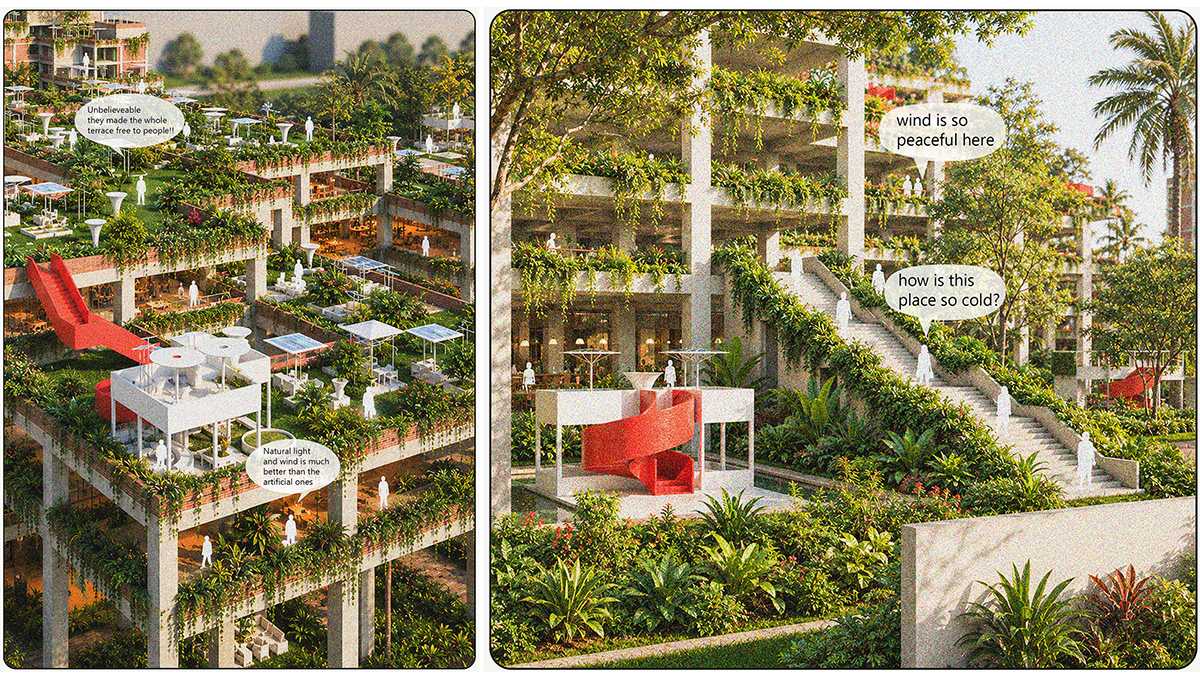
The ground plane becomes a pedestrian-first civic realm, while terraces and rooftops evolve into productive landscapes supporting renewable energy generation, water harvesting, biodiversity, and carbon sequestration. The three interconnected terrains respond to different urban demands while functioning as a single environmental system.
Residential Terrain ExtendedResidential Terraces Perspective 2Residential Central Courtyard
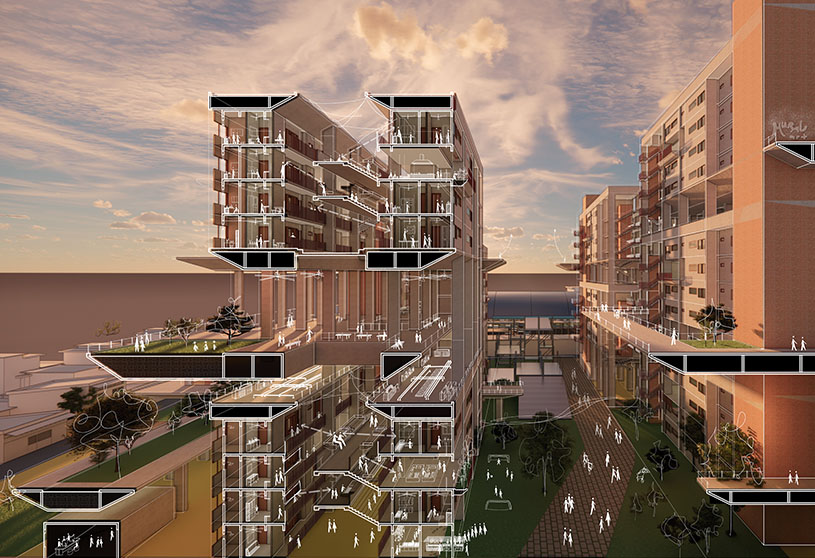
The Residential Terrain promotes adaptable living with regenerative veranda modules, the Office Terrain provides long-term programmatic flexibility, and the Retail Terrain serves as the environmental engine of the development, dedicating over 70% of its roof area to solar farming while enhancing natural ventilation through its massing.
Retail Terrain Plan and IdeologyRetail Terrace Perspective | Edge Perspective 1Edge Perspective 2Model (1)
Computational optimization, passive environmental strategies, low-carbon materials, and integrated UHT modules significantly reduce embodied and operational carbon while improving daylight access, wind permeability, and thermal comfort.
Model (2)Model (3)Model (4)
Conclusion: More importantly, the project demonstrates that architecture can move beyond minimizing environmental impact to actively generating renewable resources, restoring ecological systems, and supporting resilient public life. Healing Patch establishes a scalable prototype where future urban growth becomes a catalyst for ecological regeneration rather than environmental degradation.
This is not a final answer but an adaptive solution for the urban realm of the future.
[This Academic Project has been published with text and images submitted by the student]
Site Context
Design Process
Final Outcome
To submit your academic project for publication at ArchiDiaries, please visit the following link >> Submit
Get the best of ArchiDiaries, directly in your inbox.
We use cookies on our website to give you the most relevant experience by remembering your preferences and repeat visits. By clicking “Accept All”, you consent to the use of ALL the cookies. However, you may visit "Cookie Settings" to provide a controlled consent.
This website uses cookies to improve your experience while you navigate through the website. Out of these, the cookies that are categorized as necessary are stored on your browser as they are essential for the working of basic functionalities of the website. We also use third-party cookies that help us analyze and understand how you use this website. These cookies will be stored in your browser only with your consent. You also have the option to opt-out of these cookies. But opting out of some of these cookies may affect your browsing experience.
Necessary cookies are absolutely essential for the website to function properly. These cookies ensure basic functionalities and security features of the website, anonymously.
Cookie
Duration
Description
cookielawinfo-checkbox-analytics
11 months
This cookie is set by GDPR Cookie Consent plugin. The cookie is used to store the user consent for the cookies in the category "Analytics".
cookielawinfo-checkbox-functional
11 months
The cookie is set by GDPR cookie consent to record the user consent for the cookies in the category "Functional".
cookielawinfo-checkbox-necessary
11 months
This cookie is set by GDPR Cookie Consent plugin. The cookies is used to store the user consent for the cookies in the category "Necessary".
cookielawinfo-checkbox-others
11 months
This cookie is set by GDPR Cookie Consent plugin. The cookie is used to store the user consent for the cookies in the category "Other.
cookielawinfo-checkbox-performance
11 months
This cookie is set by GDPR Cookie Consent plugin. The cookie is used to store the user consent for the cookies in the category "Performance".
viewed_cookie_policy
11 months
The cookie is set by the GDPR Cookie Consent plugin and is used to store whether or not user has consented to the use of cookies. It does not store any personal data.
Functional cookies help to perform certain functionalities like sharing the content of the website on social media platforms, collect feedbacks, and other third-party features.
Performance cookies are used to understand and analyze the key performance indexes of the website which helps in delivering a better user experience for the visitors.
Analytical cookies are used to understand how visitors interact with the website. These cookies help provide information on metrics the number of visitors, bounce rate, traffic source, etc.
Advertisement cookies are used to provide visitors with relevant ads and marketing campaigns. These cookies track visitors across websites and collect information to provide customized ads.