Home » Academic projects » Revival of Muslin: Weaving Tradition and Innovation Through A Research and Training Hub | Bachelors Design Thesis on Cultural Architecture
Revival of Muslin: Weaving Tradition and Innovation Through A Research and Training Hub | Bachelors Design Thesis on Cultural Architecture
Excerpt: ‘Revival of Muslin’ is an architecture thesis by Rajoana Islam from the ‘Faculty of Architecture and Planning – Ahsanullah University of Science and Technology (AUST).’ The project aims to revive Bengal muslin as a living cultural and economic heritage by creating a dedicated center for research, training, weaving, and public engagement. It seeks to support local artisans, preserve traditional knowledge, integrate modern technology, and establish sustainable, climate-responsive conditions for producing high-quality muslin.
Introduction: “Lighter than air, a fabric so fine that you could fit it through a matchbox—such goes the legend of Bengal Muslin.” The “Revival of Muslin” project aims to reinvigorate the traditional art of muslin weaving by establishing a state-of-the-art training and research hub in Dhaka, Bangladesh. This facility is designed to blend historical craftsmanship with modern innovation, supporting local artisans and promoting sustainable practices.
The demand for Bengal muslin declined in the 19th century due to factors like the Industrial Revolution and stories of brutal methods allegedly employed by the British to stop production, including cutting weavers’ fingers. After 200 years, local artisans and the Bangladesh government aim to restore this rich heritage.
Background Study
But creating high-quality muslin requires meticulous attention to specific environmental and technical criteria due to the delicate and intricate nature of the fabric. One of the essential conditions for muslin production is maintaining a humidity level of 60-70% to increase the elasticity of cotton fibers and prevent breakage. Moreover, the yarn is so thin that it is nearly invisible to the naked eye under standard lighting conditions. And integrating advanced research with traditional weaving workshops has been challenging, but adhering to these criteria can revive and sustain the ancient art, preserving its legendary quality and beauty.
Site LocationSite SurroundingsSite SurroundingsSite Surroundings
Sonargaon is one of the old capitals of the historic region of Bengal and was an administrative center of eastern Bengal. It corresponds to the Sonargaon Upazila of Narayanganj District in Dhaka Division. It was also a river port. It’s hinterland was the center of the muslin trade in Bengal, with a large population of weavers and artisans.
Design Process
Concept DevelopmentMassing Development
The design process began by exploring the historical significance and unique production requirements of Bengal muslin. The project was developed around the journey of muslin—from cotton cultivation and research to weaving, learning, exhibition, and public engagement. This process informed the spatial organization and architectural form, creating a connection between traditional craftsmanship, contemporary research, and public interaction. The result is an integrated environment that supports the production, learning, and revival of Bengal muslin.
Final Outcome
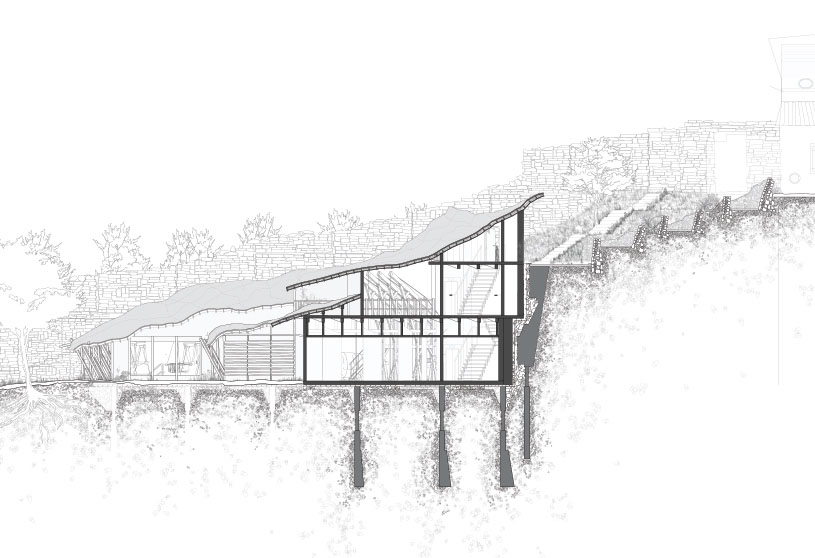
Floor PlanElevation and SectionExploded Diagram
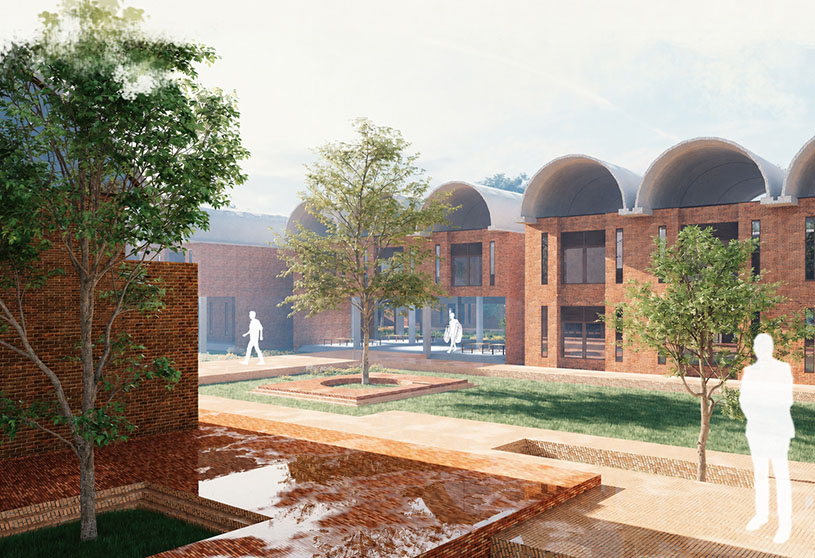
The project incorporates sustainable and climate-responsive strategies to create an optimal environment for muslin production. Locally sourced clay bricks provide thermal mass, while polystyrene insulation reduces heat transfer and energy consumption.
Nature-integrated Muslin Production Processing ZoneShaded WalkwaysDrying Zone
Vaulted roofs enhance natural lighting and support passive cooling, while advanced humidification systems maintain the required 60–70% humidity for high-quality weaving. Rainwater harvesting and water-recycling systems reduce freshwater consumption and wastewater discharge, while solar panels provide clean, renewable energy and lower the project’s overall environmental impact.
Breakout SpaceWeaving ZoneDyeing ZoneExhibition and Retail Space
The final design establishes a contemporary architectural identity rooted in the cultural legacy of Bengal muslin. Through its spatial experience, environmental responsiveness, and connection to the surrounding context, the project creates a setting where heritage is not merely preserved but given a renewed presence. The architecture ultimately becomes a symbol of continuity—linking a remarkable past with new possibilities and allowing the legacy of Bengal muslin to remain relevant in the future.
Workshop CorridorWorkshop CourtyardCotton Field
Conclusion: The project revives Bengal muslin by combining traditional craftsmanship, contemporary research, and sustainable architecture. Rooted in Sonargaon’s heritage, it creates a climate-responsive environment that supports weaving, learning, and innovation, ensuring this delicate cultural legacy continues into the future.
[This Academic Project has been published with text and images submitted by the student]
Site Context
Design Process
Final Outcome
To submit your academic project for publication at ArchiDiaries, please visit the following link >> Submit
Get the best of ArchiDiaries, directly in your inbox.
We use cookies on our website to give you the most relevant experience by remembering your preferences and repeat visits. By clicking “Accept All”, you consent to the use of ALL the cookies. However, you may visit "Cookie Settings" to provide a controlled consent.
This website uses cookies to improve your experience while you navigate through the website. Out of these, the cookies that are categorized as necessary are stored on your browser as they are essential for the working of basic functionalities of the website. We also use third-party cookies that help us analyze and understand how you use this website. These cookies will be stored in your browser only with your consent. You also have the option to opt-out of these cookies. But opting out of some of these cookies may affect your browsing experience.
Necessary cookies are absolutely essential for the website to function properly. These cookies ensure basic functionalities and security features of the website, anonymously.
Cookie
Duration
Description
cookielawinfo-checkbox-analytics
11 months
This cookie is set by GDPR Cookie Consent plugin. The cookie is used to store the user consent for the cookies in the category "Analytics".
cookielawinfo-checkbox-functional
11 months
The cookie is set by GDPR cookie consent to record the user consent for the cookies in the category "Functional".
cookielawinfo-checkbox-necessary
11 months
This cookie is set by GDPR Cookie Consent plugin. The cookies is used to store the user consent for the cookies in the category "Necessary".
cookielawinfo-checkbox-others
11 months
This cookie is set by GDPR Cookie Consent plugin. The cookie is used to store the user consent for the cookies in the category "Other.
cookielawinfo-checkbox-performance
11 months
This cookie is set by GDPR Cookie Consent plugin. The cookie is used to store the user consent for the cookies in the category "Performance".
viewed_cookie_policy
11 months
The cookie is set by the GDPR Cookie Consent plugin and is used to store whether or not user has consented to the use of cookies. It does not store any personal data.
Functional cookies help to perform certain functionalities like sharing the content of the website on social media platforms, collect feedbacks, and other third-party features.
Performance cookies are used to understand and analyze the key performance indexes of the website which helps in delivering a better user experience for the visitors.
Analytical cookies are used to understand how visitors interact with the website. These cookies help provide information on metrics the number of visitors, bounce rate, traffic source, etc.
Advertisement cookies are used to provide visitors with relevant ads and marketing campaigns. These cookies track visitors across websites and collect information to provide customized ads.


![Factory[n]Certainty: Redefining Industrial Architecture Through Work, Life, and Community | Bachelors Design Thesis](https://archidiaries.com/wp-content/uploads/2026/09/Siam-Rahman_APR_feat_img.jpg)
