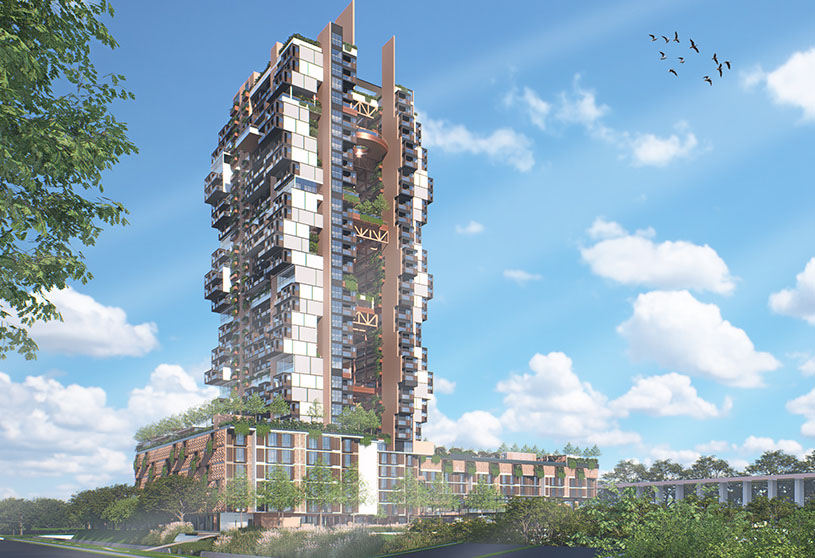
Excerpt:‘A Tale of the Twin Cities’ is an architecture thesis by Wajahat Asim from the ‘School of Architecture, Design and Urbanism – IAC.’ The project aims to translate the tension between order and chaos into architecture, using Friedrich Nietzsche’s Apollonian–Dionysian duality as a framework. It creates a multi-sensory space where music is experienced through form, movement, and vibration, enabling spatial perception beyond sound, including for the deaf.
Introduction: This thesis explores architecture as a critical act rather than a resolved object, using Friedrich Nietzsche’s concept of the Apollonian and Dionysian as a framework to examine conflict, tension, and meaning in space. The Apollonian represents order, structure, and control, while the Dionysian embodies chaos, instinct, and lived intensity. Instead of attempting to reconcile these opposing forces, the project positions their coexistence and friction as a productive condition for architectural inquiry.
In The Birth of Tragedy, Nietzsche describes this duality as fundamental to art and human experience. Music, he argues, is the purest expression of this tension—Dionysian in its immersive intensity, yet Apollonian in its rhythm and structure. This raises a critical question: what happens when music is not heard, but felt?
At the heart of this project lies an inquiry: can this Nietzschean duality be translated into architecture? Can space itself behave like music—structured yet fractured, ordered yet immersive? And more importantly, can architecture allow those who cannot hear music to still experience it?
Rather than designing a conventional concert hall, the project envisions a space where music is transformed into a multi-sensory experience. Sound is replaced by rhythm, movement, light, and material, allowing architecture itself to perform. It becomes an exploration of how space can embody vibration and perception, creating an environment where silence is not emptiness, but resonance.
The project is grounded in the twin cities of Islamabad and Rawalpindi, whose urban conditions reflect contrasting social, political, and cultural realities.
Islamabad, as a planned capital, embodies an Apollonian logic—defined by grids, hierarchy, and institutional control. In contrast, Rawalpindi, particularly Androon Pindi, reflects a Dionysian condition of density, informality, and organic growth. These differences are not abstract—they are lived tensions embedded in everyday urban experience.
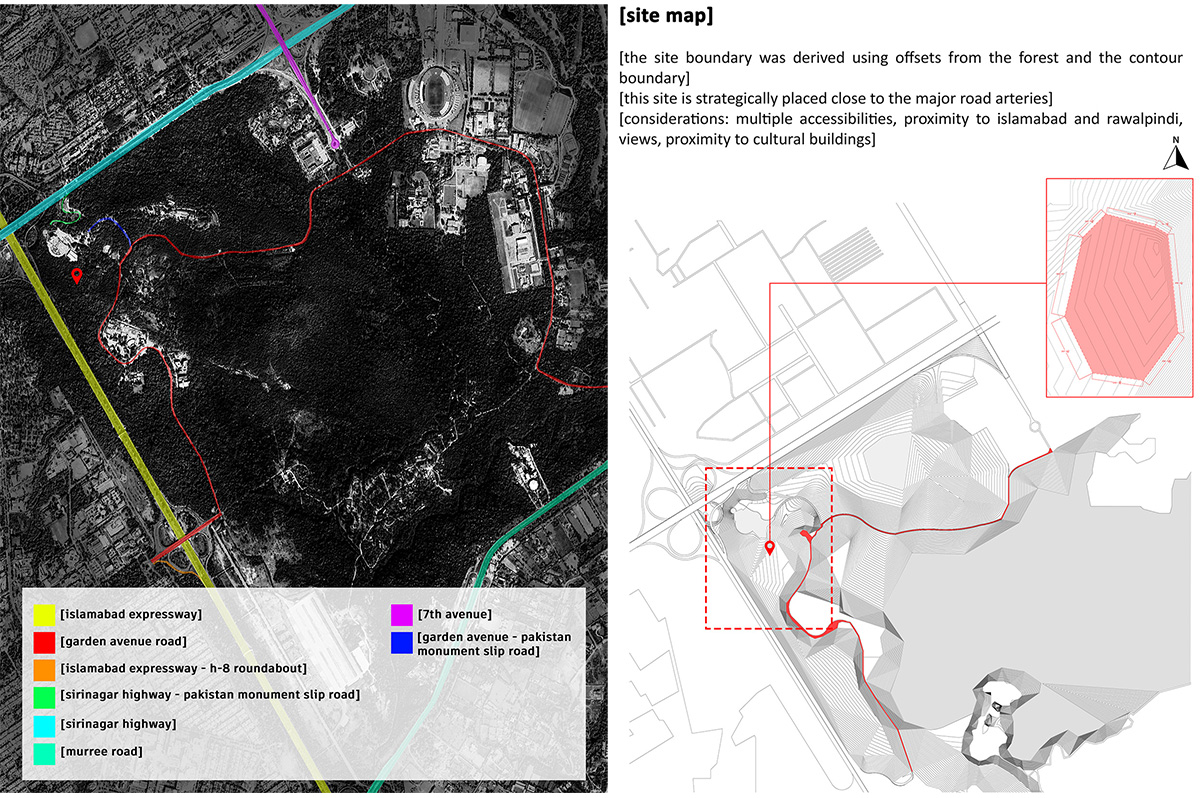
Site AnalysisSite Analysis
Despite Islamabad hosting cultural institutions such as Pakistan National Council of the Arts, Lok Virsa, and Pak-China Friendship Center, the city lacks a dedicated, well-designed space for experimental musical and sensory experiences. Existing venues are either acoustically inadequate or functionally limited.
The selected site, Shakarparian, is a significant cultural hub that includes landmarks such as:
Lok Virsa Museum
Pakistan Monument
Site AnalysisDyonisian and appollonian concepts
The site falls under the jurisdiction of the Capital Development Authority, ensuring feasibility in terms of infrastructure and regulation. Its cultural centrality makes it an ideal location for a project that engages with national identity and artistic experimentation.
Design Process
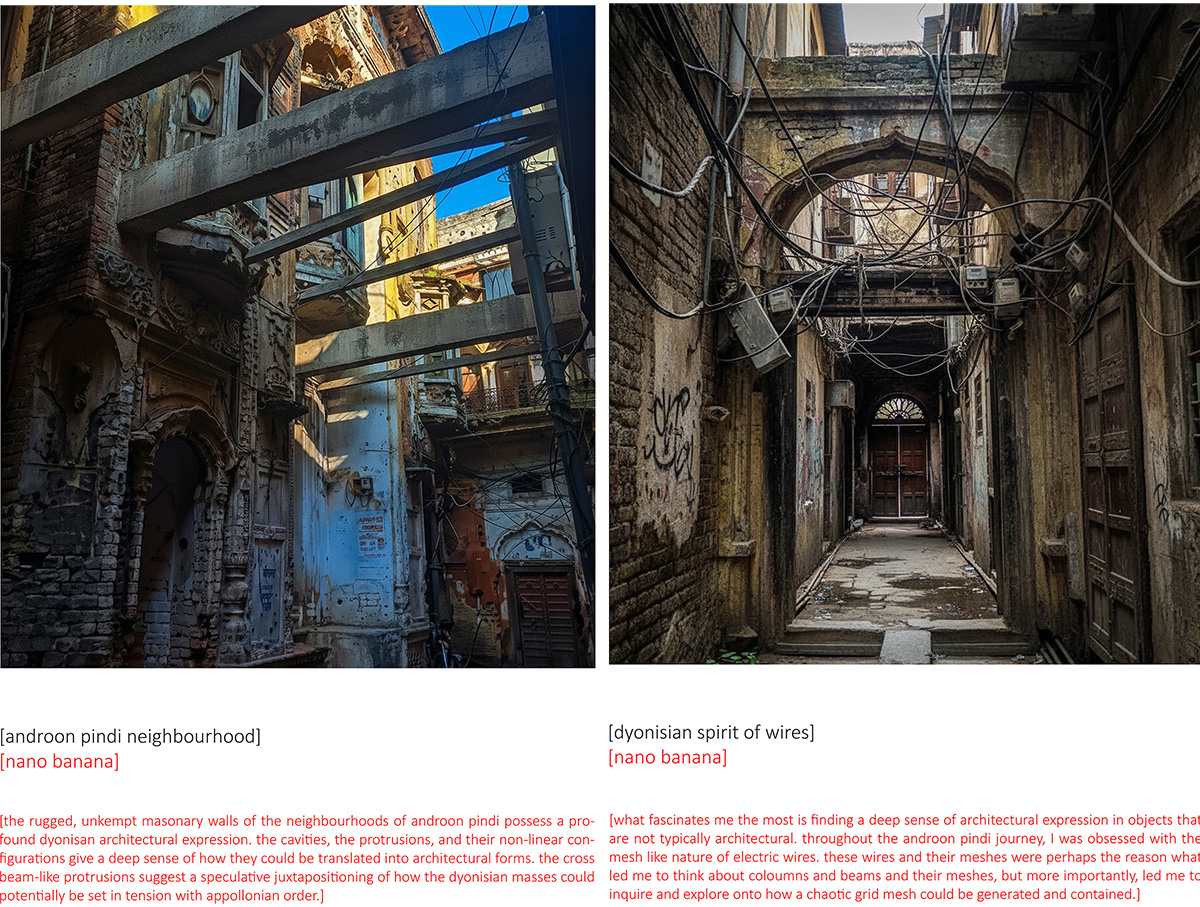
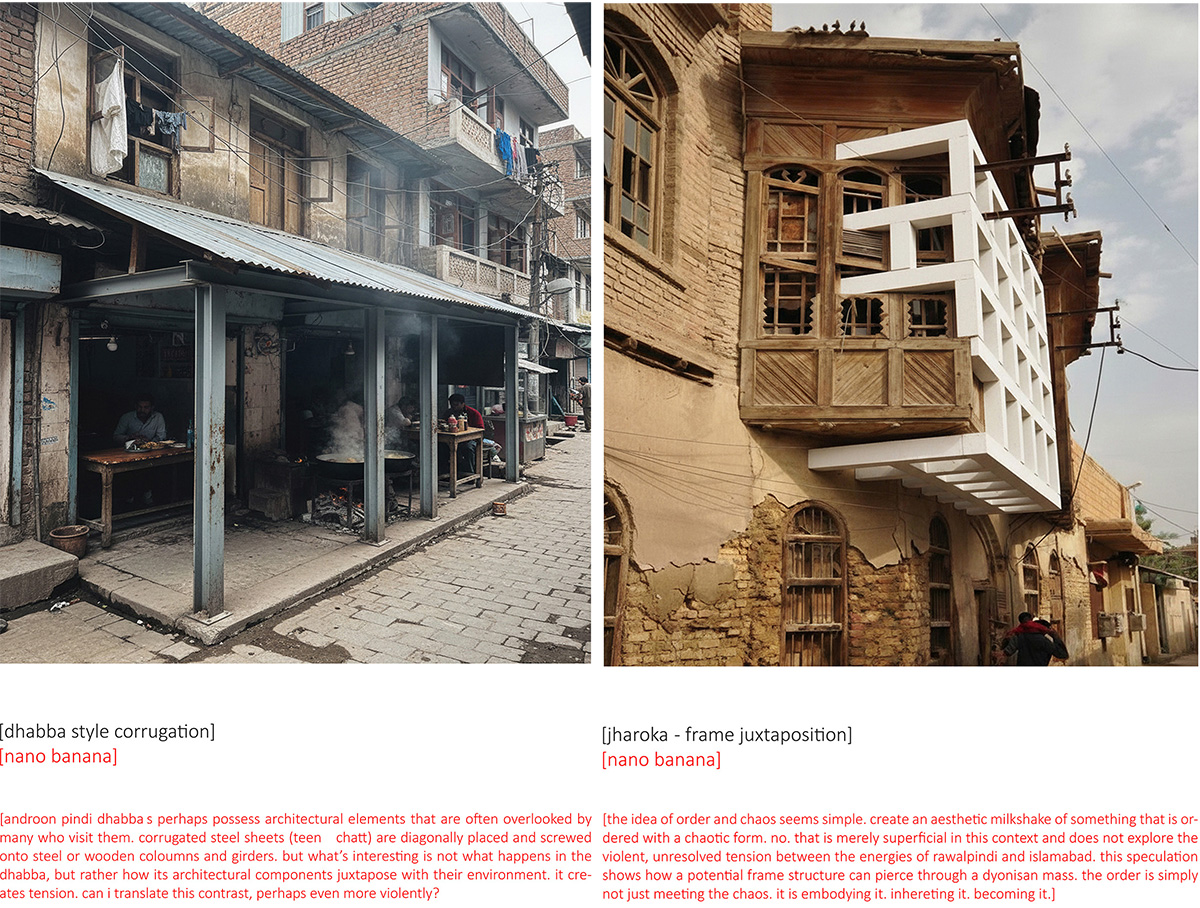
AI SpeculationAI SpeculationAI Speculation
The design process begins with a speculative inquiry into the tension between Islamabad and Rawalpindi—not just as urban forms, but as social and cultural conditions. AI-generated explorations of Androon Rawalpindi were used to reinterpret and abstract its spatial qualities, allowing elements to be reimagined, juxtaposed, and reconfigured. Rather than creating harmony, the project intentionally develops a language rooted in conflict.
Layer OneLayer OneLayer One
Layer 1: Grid Construction
A foundational framework is established through the superimposition of multiple grids:
Islamabad’s linear Cartesian grid
A secondary grid derived from the site’s heptagonal geometry
Internal connections between site vertices
Projection of the Islamabad Expressway–Kashmir Highway intersection onto the site
These systems ground the design within both geometry and urban context.
Layer TwoLayer Three
Layer 2: Formal Conflict
Apollonian and Dionysian elements are translated into planes, lines, and protrusions. Their collision generates spatial tension, producing an architecture that reflects the essence of the twin cities through abstraction rather than imitation. This stage challenges conventional notions of form and space.
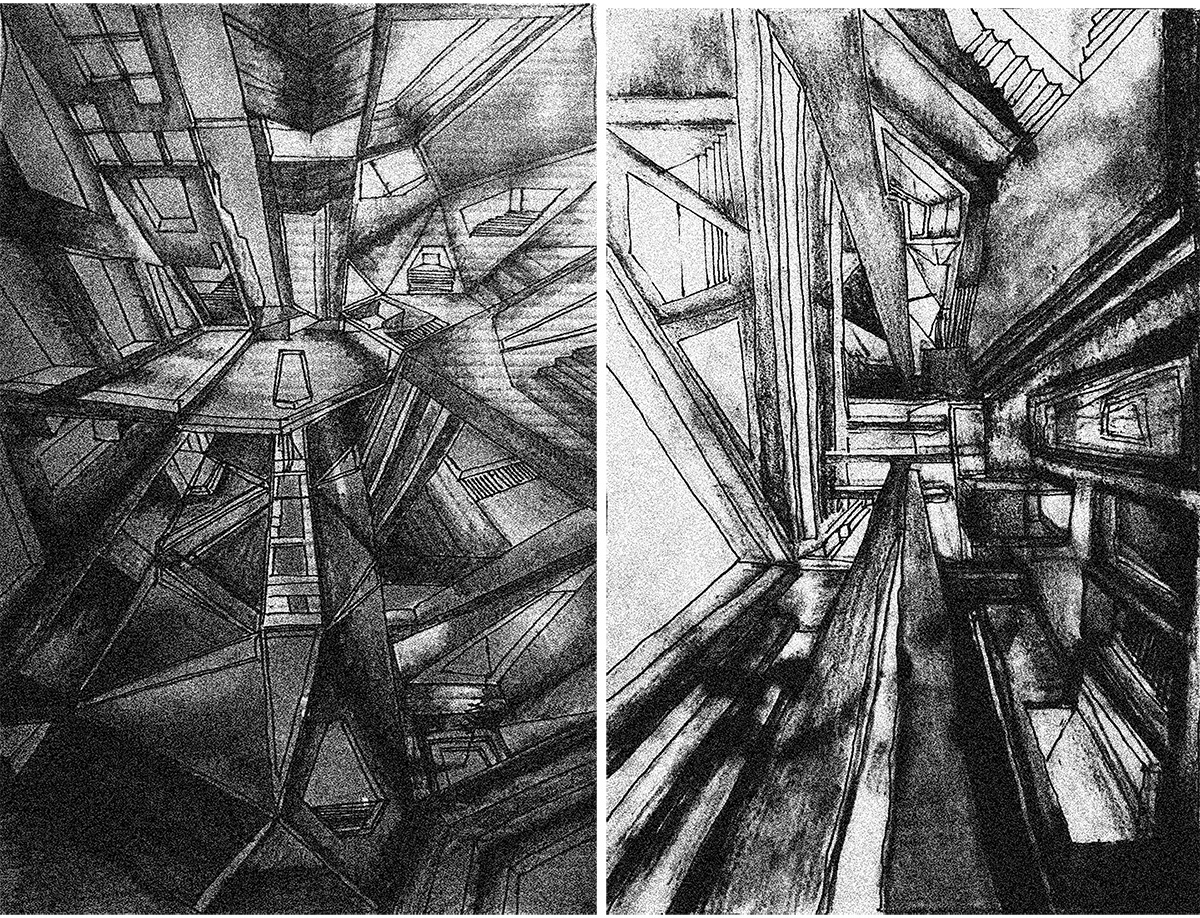
The project shifts toward experiential design, particularly considering how deaf individuals perceive space. Fragmented forms and internalized spatial pockets emerge as speculative interpretations of non-auditory perception. These disjointed conditions mirror the rhythm and dissonance of music, translating sound into spatial experience.
Throughout the process, the project rejects superficial aesthetics and instead searches for a new architectural language driven by context, conflict, and perception.
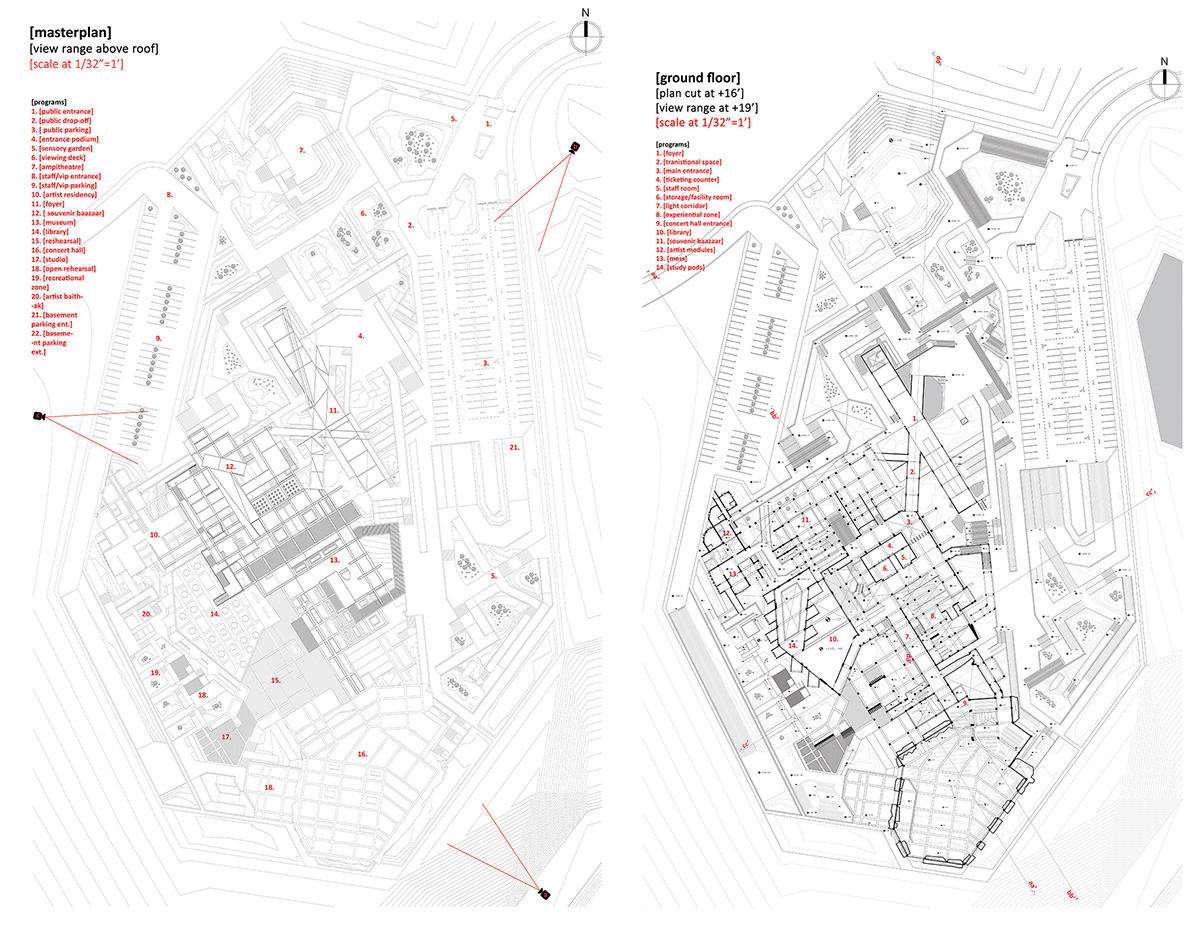
The final design is driven by the superimposition of conflicting geometries: the rigid grid of Islamabad and the irregular geometry of the site. Their intersections generate architectural ruptures that define the spatial experience.
SectionSectionAxonometricAxonometric
While floor plans remain relatively simple for clarity of movement, the project’s intensity is expressed in section. Vertical shifts, voids, and volumetric distortions create a visceral experience where “silent music” is felt through the body rather than heard.
AxonometricElevationSection
The elevations avoid literal references to either city. Instead, they emerge from an inside-out process, acting as direct manifestations of internal spatial logic rather than applied aesthetic decisions. The façade becomes a record of conflict rather than a designed image.
AxonometricAxonometricAxonometric
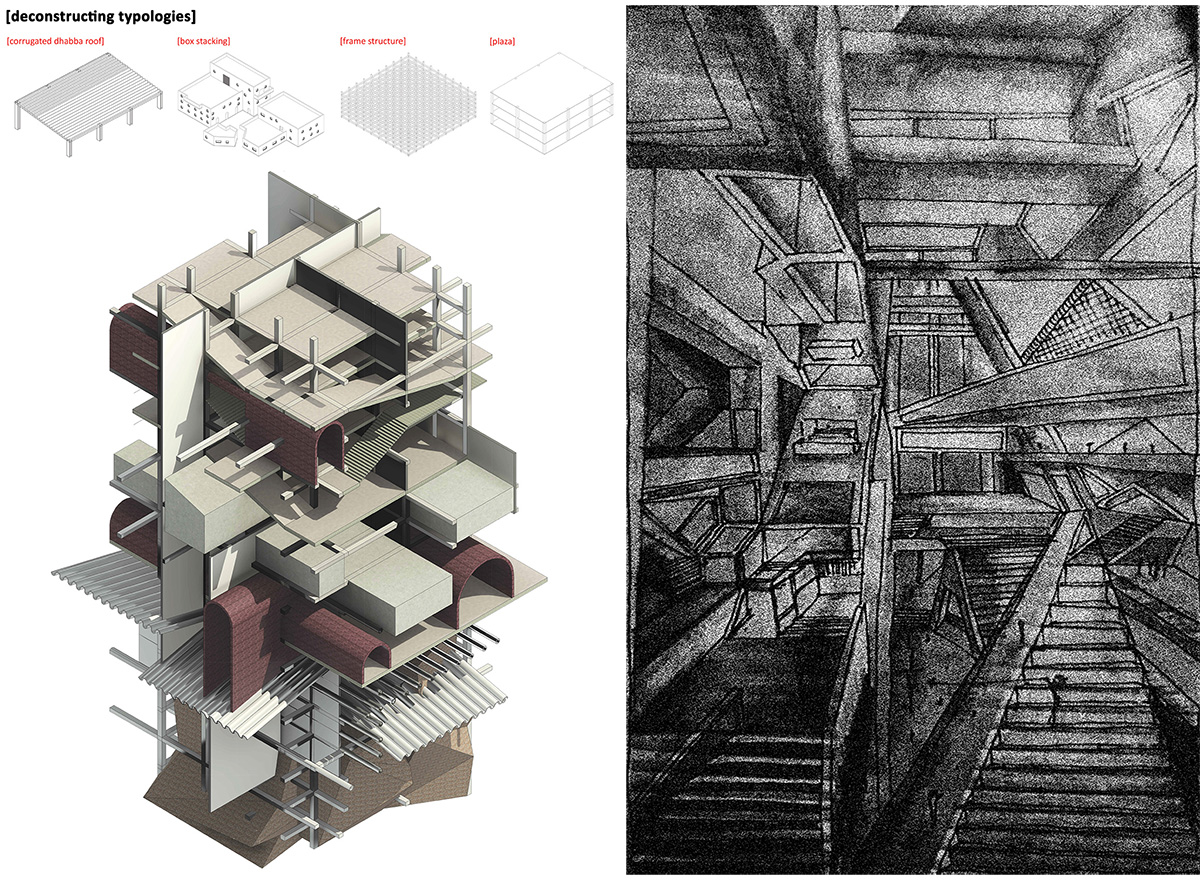
The entire project was developed through an intuitive, part-to-whole methodology using 3D modeling in Autodesk Revit. Plans, sections, and elevations are not primary generators but consequential outputs of spatial exploration.
RenderRenderRender
Programs such as rehearsal spaces, artist residences, and bazaars are intentionally fragmented, reinforcing instability in form and function. Heavy arched tunnels, fractured roofs, exposed structural meshes, and conflicted circulation intensify the negotiation between order and chaos.
RenderRenderRender
Conclusion: Ultimately, “A Tale of the Twin Cities: The Silent Music of Form and Space” positions architecture as a critical medium. It does not resolve tension but gives it presence. By translating urban conflict into spatial experience, the project proposes a new way of understanding architecture—not as a static object, but as an active, performative condition shaped by rhythm, movement, and perception.
[This Academic Project has been published with text and images submitted by the student]
Site Context
Design Process
Final Outcome
To submit your academic project for publication at ArchiDiaries, please visit the following link >> Submit
Get the best of ArchiDiaries, directly in your inbox.
We use cookies on our website to give you the most relevant experience by remembering your preferences and repeat visits. By clicking “Accept All”, you consent to the use of ALL the cookies. However, you may visit "Cookie Settings" to provide a controlled consent.
This website uses cookies to improve your experience while you navigate through the website. Out of these, the cookies that are categorized as necessary are stored on your browser as they are essential for the working of basic functionalities of the website. We also use third-party cookies that help us analyze and understand how you use this website. These cookies will be stored in your browser only with your consent. You also have the option to opt-out of these cookies. But opting out of some of these cookies may affect your browsing experience.
Necessary cookies are absolutely essential for the website to function properly. These cookies ensure basic functionalities and security features of the website, anonymously.
Cookie
Duration
Description
cookielawinfo-checkbox-analytics
11 months
This cookie is set by GDPR Cookie Consent plugin. The cookie is used to store the user consent for the cookies in the category "Analytics".
cookielawinfo-checkbox-functional
11 months
The cookie is set by GDPR cookie consent to record the user consent for the cookies in the category "Functional".
cookielawinfo-checkbox-necessary
11 months
This cookie is set by GDPR Cookie Consent plugin. The cookies is used to store the user consent for the cookies in the category "Necessary".
cookielawinfo-checkbox-others
11 months
This cookie is set by GDPR Cookie Consent plugin. The cookie is used to store the user consent for the cookies in the category "Other.
cookielawinfo-checkbox-performance
11 months
This cookie is set by GDPR Cookie Consent plugin. The cookie is used to store the user consent for the cookies in the category "Performance".
viewed_cookie_policy
11 months
The cookie is set by the GDPR Cookie Consent plugin and is used to store whether or not user has consented to the use of cookies. It does not store any personal data.
Functional cookies help to perform certain functionalities like sharing the content of the website on social media platforms, collect feedbacks, and other third-party features.
Performance cookies are used to understand and analyze the key performance indexes of the website which helps in delivering a better user experience for the visitors.
Analytical cookies are used to understand how visitors interact with the website. These cookies help provide information on metrics the number of visitors, bounce rate, traffic source, etc.
Advertisement cookies are used to provide visitors with relevant ads and marketing campaigns. These cookies track visitors across websites and collect information to provide customized ads.









![Factory[n]Certainty: Redefining Industrial Architecture Through Work, Life, and Community | Bachelors Design Thesis](https://archidiaries.com/wp-content/uploads/2026/09/Siam-Rahman_APR_feat_img.jpg)