Home » Academic projects » Barrio Mercado Cuidador: New System Of Elevated Walkways And Equipment For The Community Of The North Lima Producers’ Market | Architecture Thesis on Urban Regeneration
Barrio Mercado Cuidador: New System Of Elevated Walkways And Equipment For The Community Of The North Lima Producers’ Market | Architecture Thesis on Urban Regeneration
Excerpt: ‘Barrio Mercado Cuidador’ is an architecture thesis by Zarita Gianni Polo Roncal from the ‘Facultad de Arquitectura y Urbanismo – PUCP.’ This project aims to develop an adaptable, care-centered design system that improves safety, accessibility, and living conditions within a self-built market-neighborhood. It explores urban regeneration by integrating commerce and residence, strengthening community networks, and supporting incremental, participatory development without displacing inhabitants.
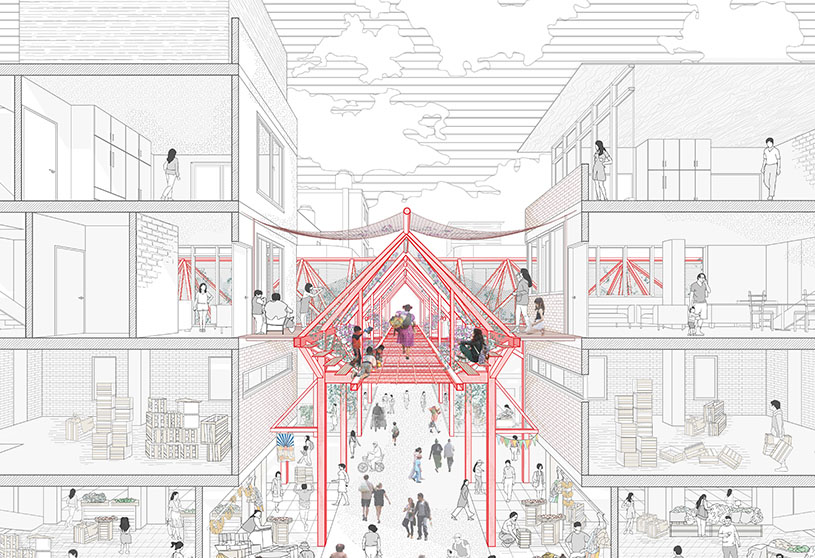
Introduction: The proposal introduces a new system of elevated streets and care facilities for the Mercado de Productores de Lima Norte. This system transforms and enhances its self-built environment, enabling a model of coexistence between commerce and residence based on care and collective resilience.
It is a modular, replicable, and adaptive system that understands existing conditions not as precarious, but as an opportunity for transformation. It intervenes within a self-built neighborhood embedded in the dynamics of the market, without displacing its inhabitants or interrupting the commercial activity that sustains it.
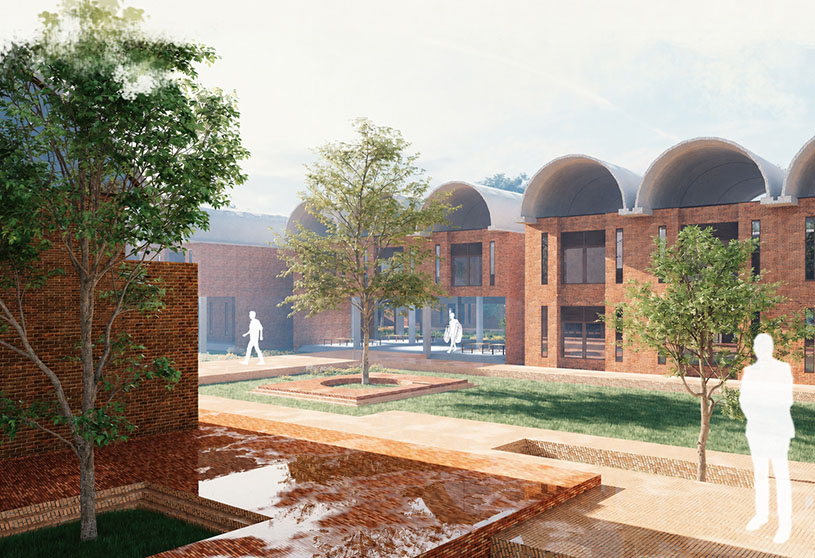
The proposal highlights the social and cultural fabric of the place by incorporating technical and construction safety conditions. It also recognizes local labor and promotes the use of locally available materials as part of a collective learning process. Finally, it makes visible and provides space for care activities—primarily carried out by women vendors—thus acknowledging new ways of inhabiting the self-built city.
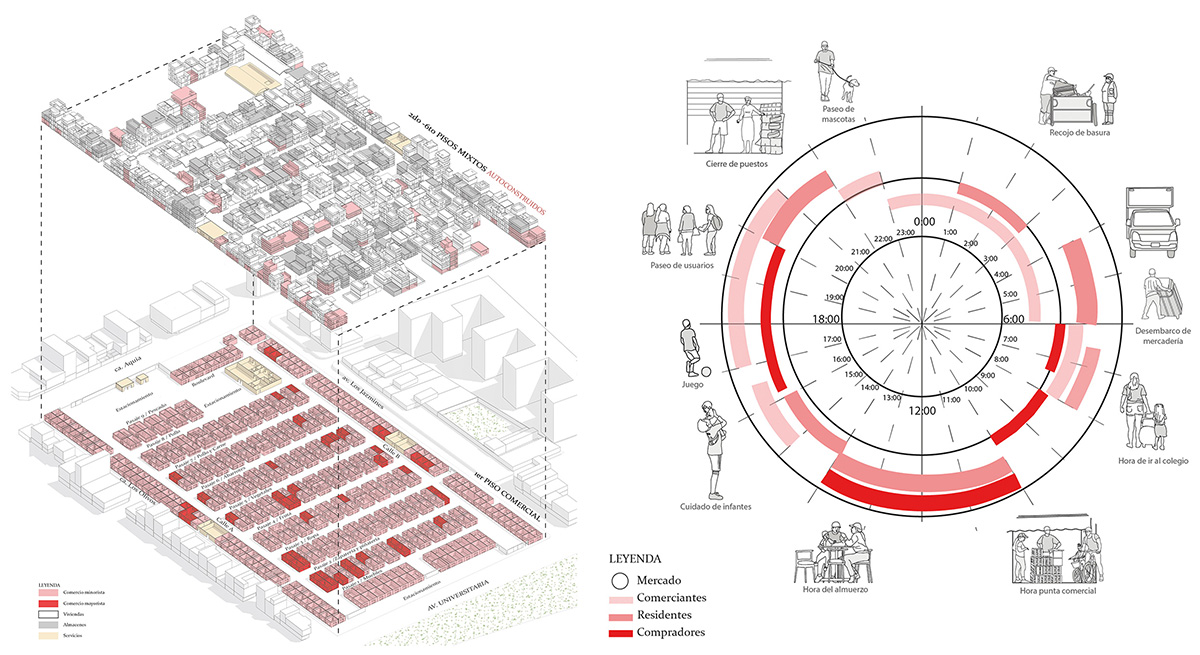
Site LocationCurrent State Isometric | Activities at the MarketNorth Lima Producer’s MarketCurrent Status
The Mercado de Productores de Lima Norte represents a fragment of the self-built city, facing challenges of accessibility, overcrowding, and limited habitability within a highly seismic urban context. It is a self-built neighborhood that has emerged within the interior of a market, generating a mix of uses driven by necessity—an increasingly common condition in the city and a new way of inhabiting it.
Current State IsometricHallwaysHousing TypologiesScenarios
This market-neighborhood accommodates 583 residents, and when including the daily commercial population, it reaches approximately 2,000 people. Of this population, 83% are women and children, who are particularly vulnerable due to precarious safety conditions and the lack of adequate spaces for care. These mixed and informal characteristics position the area as an ideal urban laboratory to explore new collective ways of inhabiting and building.
Design Process
Current State Of SiteConceptual Idea
The proposal is grounded in a participatory process involving key actors in the daily life of this “market-neighborhood”—mothers, children, market authorities, local hardware workers, and builders. This process is essential to identify areas with the highest convergence of activities such as commerce, residence, play, and care, which paradoxically are also the areas of greatest risk, threatening the physical safety of their users. Based on this analysis, design guidelines and project strategies are developed.
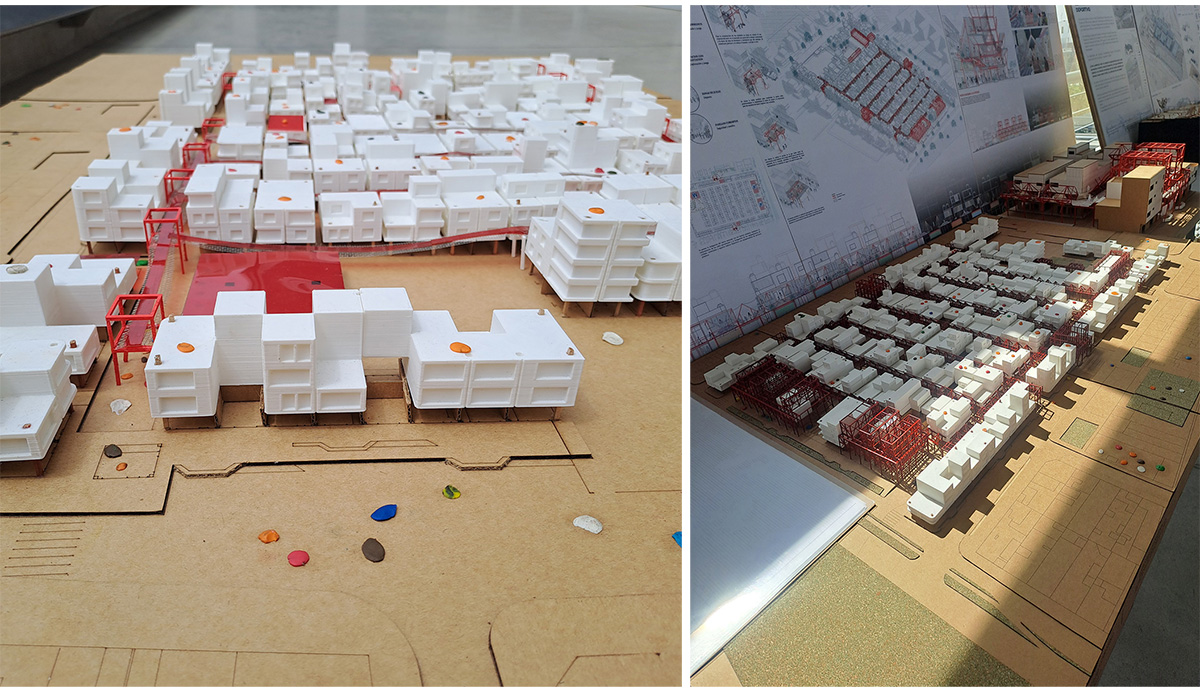
Participatory ProcessProcess Model
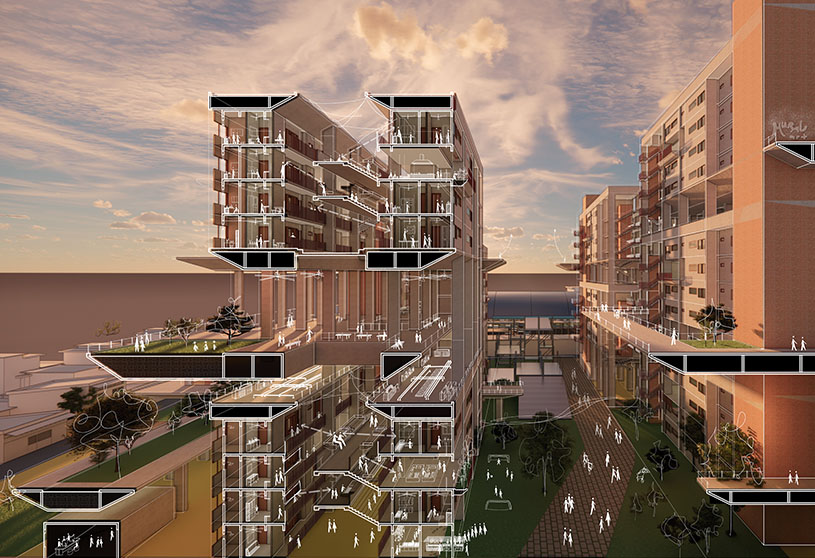
Mitigate And Optimize: A modular system of independent frames that transforms strategic corridors into safe axes, organizes commercial activity, and introduces elevated streets with new residential access points. The system also functions as an evacuation network while strengthening local self-managed construction practices.
Horizontal And Vertical Articulation: A network of safe and care-oriented elevated streets that connects domestic and commercial dynamics, creating urban continuity through new access points, intermediate spaces, and active corners linked to care-centered hubs.
Participatory ProcessParticipatory Process
Integration: A modular exoskeleton that reinforces structurally vulnerable housing while incorporating care facilities. This is integrated with a system of public spaces that activates underused areas, consolidating a market-neighborhood model based on networks of care and collective resilience.
Final Outcome
Total Isometry And StrategiesLongitudinal Section And ConstructionLongitudinal Section
The project articulates analysis, participation, and design as a continuous process, incorporating gradual development and self-management as key project variables. By understanding the market as a constitutive part of the self-built neighborhood, the notion of care is established as an organizing principle that enables the reordering of space based on everyday safety, proximity, and continuous use.
Sector PlanCare Facilities SectionRisk Section
Applied to the Mercado de Productores de Lima, this approach guides the reconfiguration of the market-neighborhood through strategies of incremental improvement, supported by the construction of replicable modular structures. These structures generate a new system of safe streets for both vendors and residents, enabling spatial articulation and strengthening existing community networks through the consolidation of this new urban fabric.
Detail SectionSector Isometric
In this way, commerce, housing, and care are integrated without displacing the population or interrupting the economic activities that sustain it. Within this framework, the “Caring Market-Neighborhood” is conceived not as a fixed model, but as an adaptable methodology for intervening in popular markets—one that values what already exists and makes visible an emerging way of inhabiting the city. This approach is grounded in an inclusive and resilient logic, recognizing the social, economic, and territorial value of everyday practices, particularly those sustained by women, which make its daily functioning possible.
Active Edge ViewAerial Street View – Day
Conclusion: Ultimately, this project reimagines the self-built market-neighborhood as a resilient, care-centered system, integrating living, working, and safety through adaptable design strategies that strengthen community networks without displacement.
[This Academic Project has been published with text and images submitted by the student]
Site Context
Design Process
Final Outcome
To submit your academic project for publication at ArchiDiaries, please visit the following link >> Submit
Get the best of ArchiDiaries, directly in your inbox.
We use cookies on our website to give you the most relevant experience by remembering your preferences and repeat visits. By clicking “Accept All”, you consent to the use of ALL the cookies. However, you may visit "Cookie Settings" to provide a controlled consent.
This website uses cookies to improve your experience while you navigate through the website. Out of these, the cookies that are categorized as necessary are stored on your browser as they are essential for the working of basic functionalities of the website. We also use third-party cookies that help us analyze and understand how you use this website. These cookies will be stored in your browser only with your consent. You also have the option to opt-out of these cookies. But opting out of some of these cookies may affect your browsing experience.
Necessary cookies are absolutely essential for the website to function properly. These cookies ensure basic functionalities and security features of the website, anonymously.
Cookie
Duration
Description
cookielawinfo-checkbox-analytics
11 months
This cookie is set by GDPR Cookie Consent plugin. The cookie is used to store the user consent for the cookies in the category "Analytics".
cookielawinfo-checkbox-functional
11 months
The cookie is set by GDPR cookie consent to record the user consent for the cookies in the category "Functional".
cookielawinfo-checkbox-necessary
11 months
This cookie is set by GDPR Cookie Consent plugin. The cookies is used to store the user consent for the cookies in the category "Necessary".
cookielawinfo-checkbox-others
11 months
This cookie is set by GDPR Cookie Consent plugin. The cookie is used to store the user consent for the cookies in the category "Other.
cookielawinfo-checkbox-performance
11 months
This cookie is set by GDPR Cookie Consent plugin. The cookie is used to store the user consent for the cookies in the category "Performance".
viewed_cookie_policy
11 months
The cookie is set by the GDPR Cookie Consent plugin and is used to store whether or not user has consented to the use of cookies. It does not store any personal data.
Functional cookies help to perform certain functionalities like sharing the content of the website on social media platforms, collect feedbacks, and other third-party features.
Performance cookies are used to understand and analyze the key performance indexes of the website which helps in delivering a better user experience for the visitors.
Analytical cookies are used to understand how visitors interact with the website. These cookies help provide information on metrics the number of visitors, bounce rate, traffic source, etc.
Advertisement cookies are used to provide visitors with relevant ads and marketing campaigns. These cookies track visitors across websites and collect information to provide customized ads.