Excerpt: ‘Beyond Indigo’ is an architecture thesis by Mohi Uddin Jahanggir Jewel from the ‘Faculty of Architecture and Planning – Ahsanullah University of Science and Technology (AUST).’ The aim of this project is to redefine the conventional denim manufacturing facility by integrating sustainable architectural strategies, efficient industrial planning, and nature-based design. It seeks to create a productive, energy-efficient, and worker-centric environment that promotes a resilient model for Bangladesh’s garment industry.
Introduction: The thesis explores the integration of industrial production with the rhythms and principles of nature, focusing on a denim manufacturing facility in Bangladesh. Building upon Bangladesh’s legacy as a global leader in the Ready-Made Garment (RMG) industry, the project reimagines the conventional factory as a responsive and environmentally conscious space, where architecture serves as a mediator between industrial production and ecological balance. Through sustainable design strategies, the thesis seeks to create a productive yet regenerative environment that enhances worker well-being, environmental performance, and the relationship between industry and nature.
The study explores the socio-economic impact of the industry, emphasizing employment generation, women’s empowerment, technological advancement, and export growth. At the same time, it addresses existing challenges related to worker safety, health, environmental concerns, and workplace quality. An approach to carrying the reputation of denim producers on global stages with a highly efficient human-centric working environment is given to the workers.
Design Process
Design Process
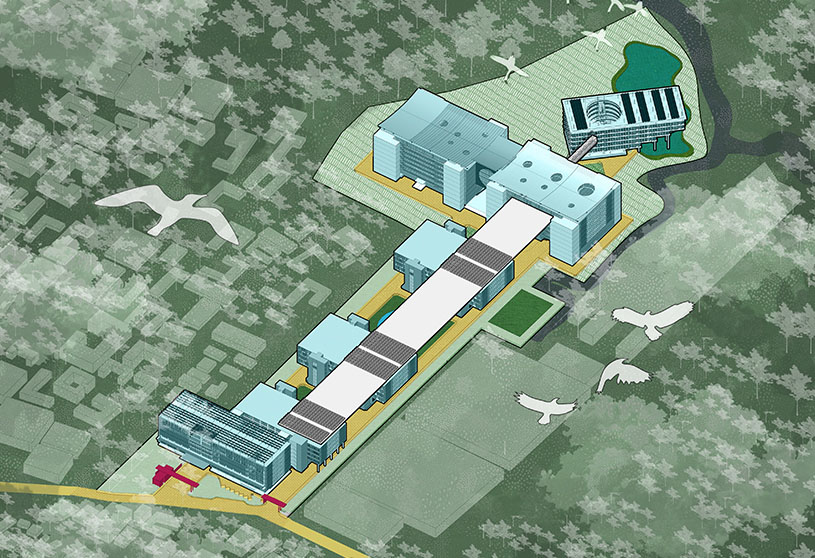
The masterplan responds to critical industrial and environmental parameters by ensuring fire-safe massing, efficient worker movement, optimized production flow, and streamlined distribution networks. A continuous industrial loop, reinforced through an integrated bridge system, enhances operational connectivity. North–south building orientation reduces heat gain, while an artificial water body between the masses provides evaporative cooling, stormwater retention, and ecological landscape regeneration.
Form DevelopmentCirculation
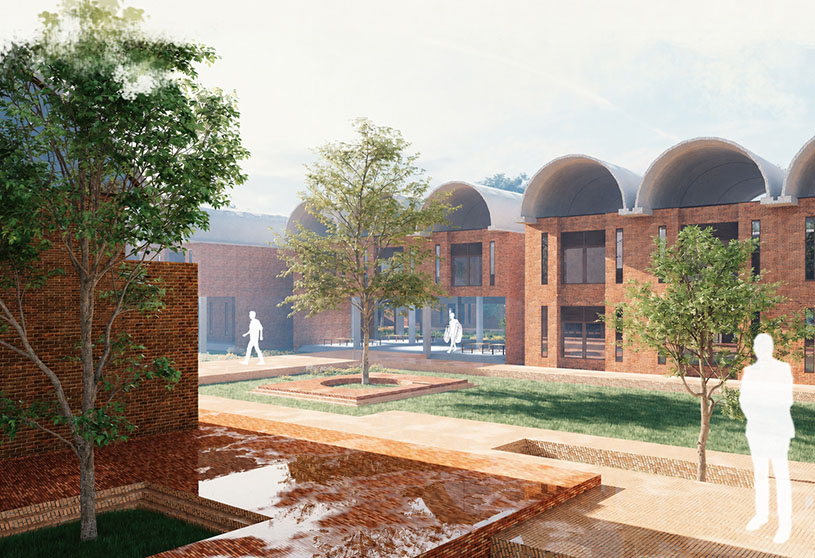
The massing strategy prioritizes fire safety, clear entry–exit routes, and the management of high worker density. A central open courtyard and landscaped pockets introduce daylight, ventilation, and visual relief within the industrial environment. The buildings are oriented along the north–south axis to minimize heat gain and improve environmental performance.
Final Outcome
Ground Floor Plan and SectionExploded DiagramAxonometric Section
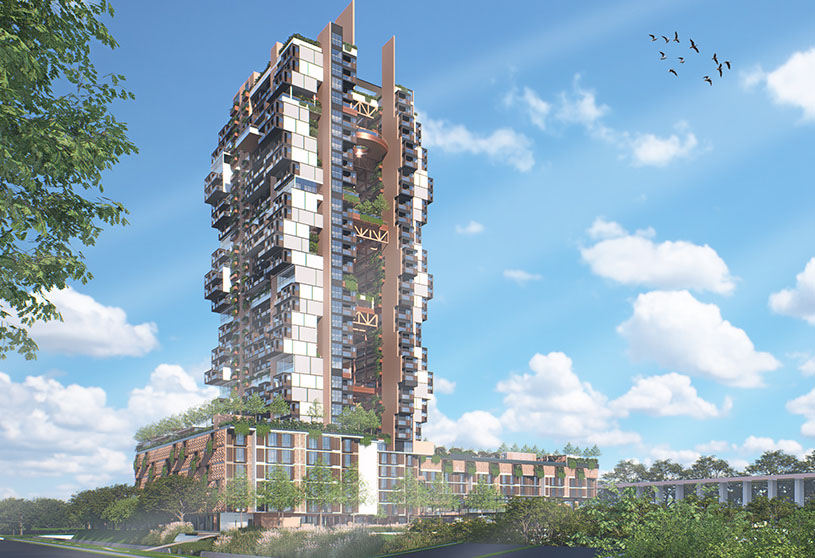
A worker can comfortably work in 25-27 degrees Celsius, which mostly depends on building orientation and facade. All buildings are designed with a north-south orientation; a smart facade system cuts the sun glare, and green integration in the facade also adds a special feature like quality views and air. Ventilation is one of the most concerning issues in production, which has been solved by smooth airflow among the masses.
3D SectionIllustration
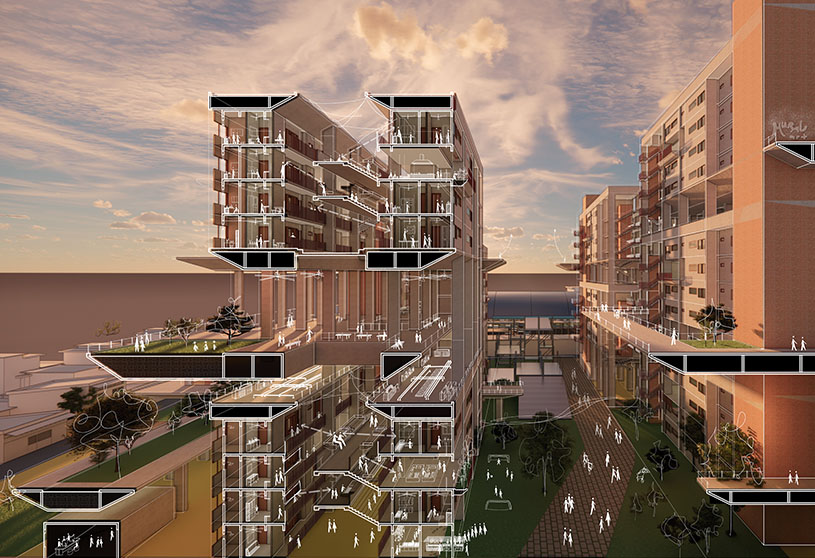
A central circulation core, highlighted by the prominent spiral ramp and stair system, encourages movement, visual connectivity, and social interaction among workers across different levels. The roof structure incorporates solar panels and a sawtooth profile that optimizes daylight harvesting and renewable energy generation. Community-focused amenities such as training facilities, recreation spaces, medical services, daycare, and dining areas are strategically integrated within the building.
RenderRender
Conclusion: Ultimately, this thesis demonstrates how sustainable architecture can redefine industrial manufacturing by balancing productivity, environmental responsibility, and worker well-being. It presents a resilient, human-centric model that strengthens Bangladesh’s position as a global leader in sustainable denim production.
[This Academic Project has been published with text and images submitted by the student]
Site Context
Design Process
Final Outcome
To submit your academic project for publication at ArchiDiaries, please visit the following link >> Submit
Get the best of ArchiDiaries, directly in your inbox.
We use cookies on our website to give you the most relevant experience by remembering your preferences and repeat visits. By clicking “Accept All”, you consent to the use of ALL the cookies. However, you may visit "Cookie Settings" to provide a controlled consent.
This website uses cookies to improve your experience while you navigate through the website. Out of these, the cookies that are categorized as necessary are stored on your browser as they are essential for the working of basic functionalities of the website. We also use third-party cookies that help us analyze and understand how you use this website. These cookies will be stored in your browser only with your consent. You also have the option to opt-out of these cookies. But opting out of some of these cookies may affect your browsing experience.
Necessary cookies are absolutely essential for the website to function properly. These cookies ensure basic functionalities and security features of the website, anonymously.
Cookie
Duration
Description
cookielawinfo-checkbox-analytics
11 months
This cookie is set by GDPR Cookie Consent plugin. The cookie is used to store the user consent for the cookies in the category "Analytics".
cookielawinfo-checkbox-functional
11 months
The cookie is set by GDPR cookie consent to record the user consent for the cookies in the category "Functional".
cookielawinfo-checkbox-necessary
11 months
This cookie is set by GDPR Cookie Consent plugin. The cookies is used to store the user consent for the cookies in the category "Necessary".
cookielawinfo-checkbox-others
11 months
This cookie is set by GDPR Cookie Consent plugin. The cookie is used to store the user consent for the cookies in the category "Other.
cookielawinfo-checkbox-performance
11 months
This cookie is set by GDPR Cookie Consent plugin. The cookie is used to store the user consent for the cookies in the category "Performance".
viewed_cookie_policy
11 months
The cookie is set by the GDPR Cookie Consent plugin and is used to store whether or not user has consented to the use of cookies. It does not store any personal data.
Functional cookies help to perform certain functionalities like sharing the content of the website on social media platforms, collect feedbacks, and other third-party features.
Performance cookies are used to understand and analyze the key performance indexes of the website which helps in delivering a better user experience for the visitors.
Analytical cookies are used to understand how visitors interact with the website. These cookies help provide information on metrics the number of visitors, bounce rate, traffic source, etc.
Advertisement cookies are used to provide visitors with relevant ads and marketing campaigns. These cookies track visitors across websites and collect information to provide customized ads.