Home » Academic projects » Floating Life – Tanka in the Currents: Reimagining Floating Communities Through Ritual, Culture, and Adaptive Architecture | Masters Design Project
Floating Life – Tanka in the Currents: Reimagining Floating Communities Through Ritual, Culture, and Adaptive Architecture | Masters Design Project
Excerpt: ‘Floating Life: Tanka in the Currents’ is a Masters Design Project by Yang Ge from the ‘School of Architecture – Royal College of Art.’ The project aims to reimagine the future of the Tanka floating settlement in Lingshui by integrating environmental resilience, collective infrastructure, and ritual practice. Through a system of adaptive floating public spaces, it strengthens community identity, responds to ecological and climate challenges, and reconnects land and water, transforming traditional rituals into a living framework for resilient collective urban life.
Introduction: Floating Life: Tanka in the Currents investigates the relationship between collective identity, ritual practice, and floating urbanism through the case of the Tanka community in Lingshui, Hainan. Historically, the Tanka can be understood as a form of maritime nomadism whose social and spatial organisation developed through long-term boat dwelling and fishing practices outside dominant territorial systems. While most Tanka communities were absorbed into land-based society during the twentieth century, the Lingshui community maintained a floating way of life through the development of cage aquaculture.
Today, however, this settlement faces intertwined environmental, social, and cultural challenges, including ecological degradation, vulnerability to seasonal typhoons, and the gradual erosion of collective rituals. The project explores how architecture can operate as a form of collective infrastructure capable of addressing these challenges simultaneously. By studying historical maritime rituals and their transformation into contemporary urban processions, the project proposes a system of floating public spaces, ritual infrastructures, and adaptive architectures that reconnect fragmented communities across the boundary between land and water. Rather than preserving tradition as a static heritage object, the project investigates how ritual practices can be reactivated as a living framework for future collective life.
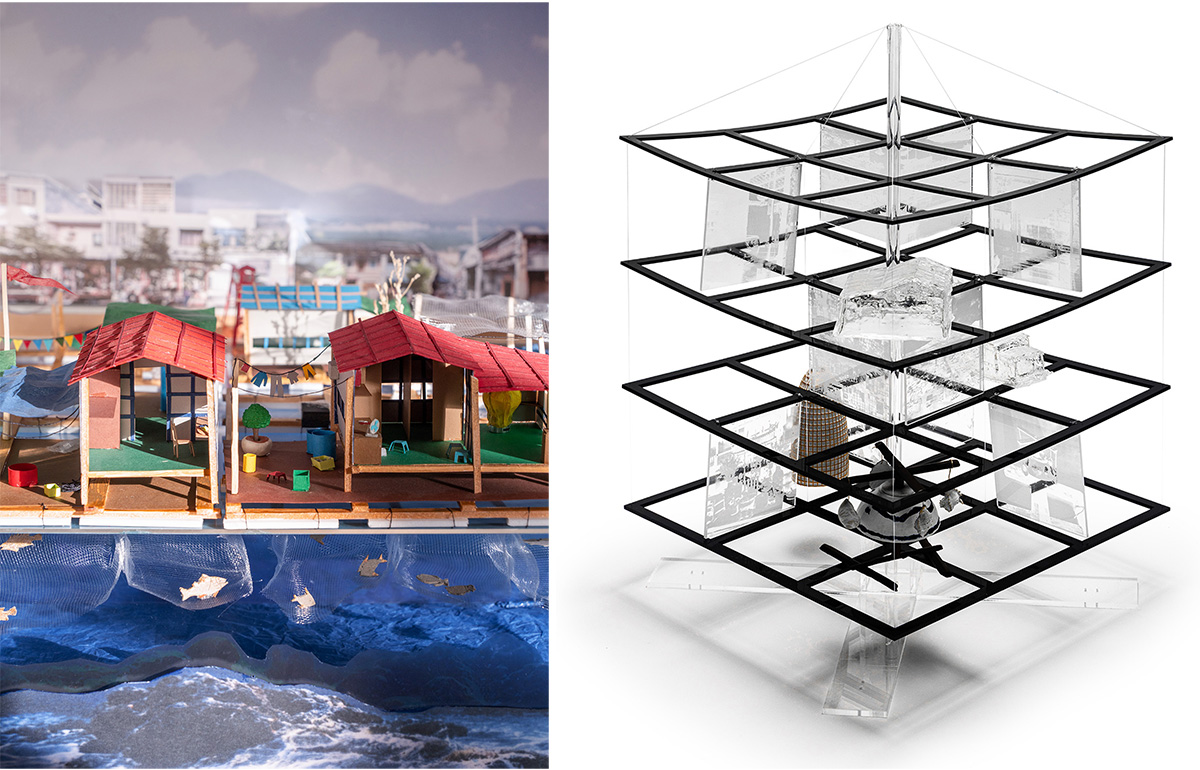
The diorama reconstructs the spatial organisation of the floating settlement, illustrating the relationship between fish rafts, navigation channels, and collective infrastructures within the lagoon.Domestic spaces are integrated with aquaculture production, producing a hybrid spatial condition in which living, working, and circulation occur simultaneously.
The project is situated within the floating Tanka settlement of Xincun Lagoon in Lingshui County, Hainan Province, which represents the largest remaining floating Tanka community in China. Historically organised through fishing and boat dwelling, the settlement underwent significant transformation following state-led relocation policies in the 1960s and the introduction of cage aquaculture in the 1980s. As fish rafts gradually expanded across the lagoon, a distinctive floating settlement emerged in which domestic life, production, and circulation became spatially integrated.
Floating restaurants occupy strategic intersections of navigation channels and function as important spaces of social exchange within the settlement.The 3 × 3 metre grid derived from traditional fish cages provides the basic spatial and structural module for the proposed floating interventions.
The project focuses on the central area of the lagoon, where major navigation channels intersect and where existing floating restaurants, public facilities, and maritime infrastructures already act as points of collective activity. Simultaneously, the project extends beyond the lagoon itself to consider its relationship with adjacent urban settlements and religious procession routes.
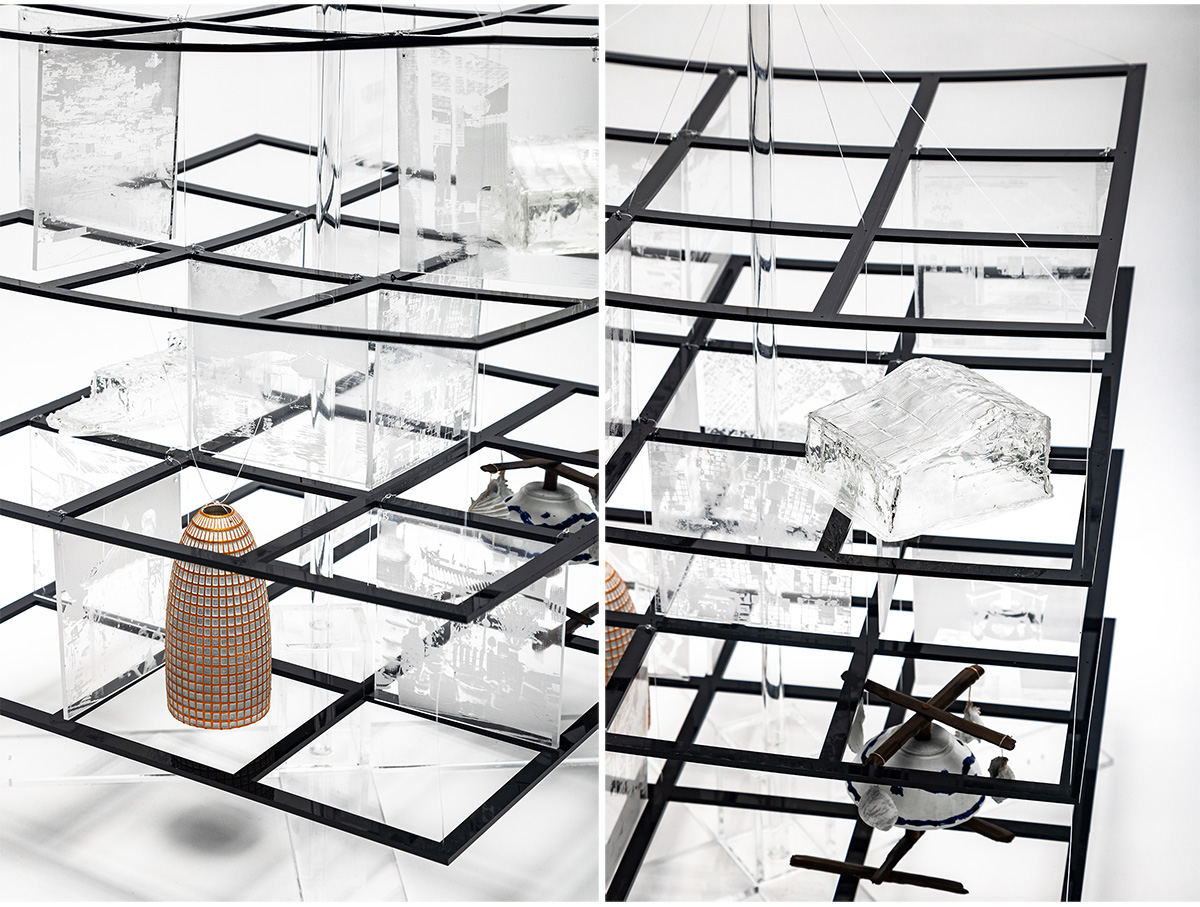
Lightweight construction techniques and incremental extensions enable continuous adaptation to changing environmental and economic conditions. | The box model analyses the settlement through three overlapping dimensions: dwelling traditions, territorial infrastructures, and ritual practices.Traditional fishing tools are understood not only as productive devices but also as material records of maritime knowledge systems. | The floating house and fish bell represent the integration of domestic life, production, and ritual signalling within everyday maritime culture.
Programmatically, the proposal combines environmental infrastructure, repair facilities, ritual spaces, public gathering spaces, floating bridges, shrines, and performance platforms. Together, these elements establish a flexible system capable of supporting everyday life, environmental maintenance, emergency repair, and seasonal collective rituals.
Design Process
The proposal reconnects the floating settlement and the city through a distributed network of ritual infrastructures, public spaces, and floating processions.Cage CultureTemporary Structure
The design process began with an investigation of the historical development of the Tanka settlement through archival research, field documentation, and physical modelling. A diorama model was constructed to analyse the spatial organisation of fish rafts, navigation channels, and everyday life, while a layered box model examined the settlement through three overlapping dimensions: historical dwelling practices, territorial infrastructures, and ritual traditions.
Self-ConstructionAdaptive Floating Urbanism
This research revealed that environmental degradation, climate vulnerability, and the erosion of collective rituals constitute the three primary challenges facing contemporary settlement. These observations were translated into three corresponding design frameworks: environmental infrastructure, repair and resilience, and ritual public space. By mapping annual ritual calendars, typhoon seasons, and historical maritime processions, the project identified opportunities to reconnect collective practices with existing spatial systems.
Conceptual SketchConceptual Sketch
A series of programmatic matrices, spatial archetypes, and modular prototypes were subsequently developed to test relationships between public space, infrastructure, and ritual activity. Through iterative physical and digital models, the project explored how floating architectures could remain adaptable, reconfigurable, and collectively operated over time.
Final Outcome
Master Plan and Assembly SequenceMaster Plan and Assembly SequenceThe section demonstrates how environmental infrastructure, public space, and ritual activities coexist within a layered floating urban environment.Derived from historical boat construction, the mast structure operates simultaneously as infrastructure, landmark, and ritual marker.
The final proposal consists of a distributed system of floating public infrastructures that reconnects the Tanka settlement with the adjacent city through ritual movement and collective activity. New floating structures extend the existing fish-raft grid and provide spaces for environmental management, public gathering, repair activities, and ceremonial events. Their modular and buoyant construction allows spaces to be continuously reconfigured according to seasonal and social conditions.
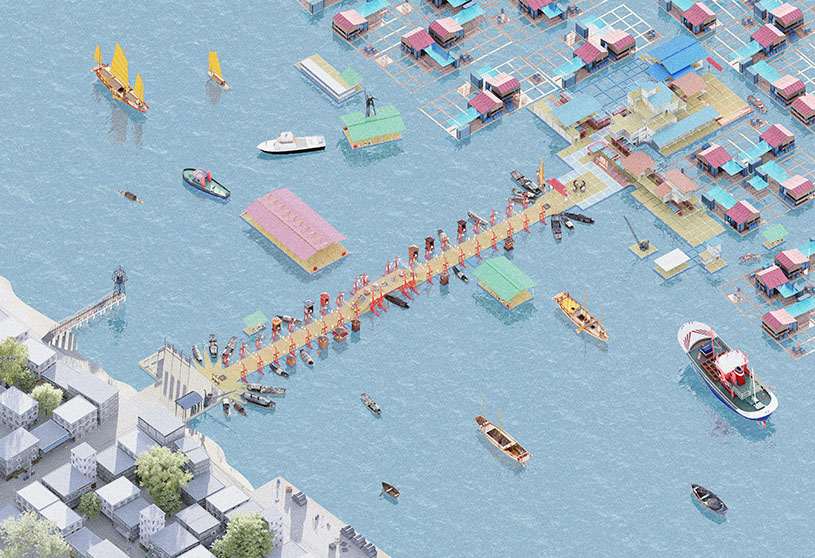
The floating bridge system combines structural support, circulation infrastructure, and ceremonial occupation within a single architectural framework.Temporary attachments and modular construction enable the bridge system to expand, contract, and reconfigure according to ritual requirements.Floating public spaces expand during collective events and contract during everyday use, supporting multiple temporal modes of occupation.The movement and assembly of shrines reconstruct historical ritual circulation as a contemporary form of collective infrastructure.
At the centre of the proposal is the reconstruction of historical maritime ritual practices through a network of floating shrines and temporary bridges. During annual festivals, shrines are transported by boat and assembled through a changing bridge system that transforms the lagoon from a productive landscape into a collective ceremonial space. Floating stages and public platforms further support performances and gatherings, creating a temporary spatial continuity between water and land.
Temporary market structures extend festival activities into everyday economic exchange and informal social interaction.The physical model investigates the spatial relationship between modular construction, public space, and the surrounding water infrastructure.The floating bridge establishes both a physical and symbolic connection between terrestrial and maritime territories.
Conclusion: By integrating environmental resilience, public infrastructure, and ritual practice within a single architectural framework, the project proposes a new model of collective floating urbanism. Rather than preserving tradition as a static cultural artefact, it reimagines ritual as an adaptive and resilient infrastructure for future community life.
[This Academic Project has been published with text and images submitted by the student]
Site Context
Design Process
Final Outcome
To submit your academic project for publication at ArchiDiaries, please visit the following link >> Submit
Get the best of ArchiDiaries, directly in your inbox.
We use cookies on our website to give you the most relevant experience by remembering your preferences and repeat visits. By clicking “Accept All”, you consent to the use of ALL the cookies. However, you may visit "Cookie Settings" to provide a controlled consent.
This website uses cookies to improve your experience while you navigate through the website. Out of these, the cookies that are categorized as necessary are stored on your browser as they are essential for the working of basic functionalities of the website. We also use third-party cookies that help us analyze and understand how you use this website. These cookies will be stored in your browser only with your consent. You also have the option to opt-out of these cookies. But opting out of some of these cookies may affect your browsing experience.
Necessary cookies are absolutely essential for the website to function properly. These cookies ensure basic functionalities and security features of the website, anonymously.
Cookie
Duration
Description
cookielawinfo-checkbox-analytics
11 months
This cookie is set by GDPR Cookie Consent plugin. The cookie is used to store the user consent for the cookies in the category "Analytics".
cookielawinfo-checkbox-functional
11 months
The cookie is set by GDPR cookie consent to record the user consent for the cookies in the category "Functional".
cookielawinfo-checkbox-necessary
11 months
This cookie is set by GDPR Cookie Consent plugin. The cookies is used to store the user consent for the cookies in the category "Necessary".
cookielawinfo-checkbox-others
11 months
This cookie is set by GDPR Cookie Consent plugin. The cookie is used to store the user consent for the cookies in the category "Other.
cookielawinfo-checkbox-performance
11 months
This cookie is set by GDPR Cookie Consent plugin. The cookie is used to store the user consent for the cookies in the category "Performance".
viewed_cookie_policy
11 months
The cookie is set by the GDPR Cookie Consent plugin and is used to store whether or not user has consented to the use of cookies. It does not store any personal data.
Functional cookies help to perform certain functionalities like sharing the content of the website on social media platforms, collect feedbacks, and other third-party features.
Performance cookies are used to understand and analyze the key performance indexes of the website which helps in delivering a better user experience for the visitors.
Analytical cookies are used to understand how visitors interact with the website. These cookies help provide information on metrics the number of visitors, bounce rate, traffic source, etc.
Advertisement cookies are used to provide visitors with relevant ads and marketing campaigns. These cookies track visitors across websites and collect information to provide customized ads.