Home » Academic projects » From Threads to Thriving: The Urban Revitalization of the Crescent Jute Mill, Khulna, Bangladesh | Bachelors Design Thesis on Industrial Heritage Regeneration
From Threads to Thriving: The Urban Revitalization of the Crescent Jute Mill, Khulna, Bangladesh | Bachelors Design Thesis on Industrial Heritage Regeneration
Excerpt: ‘From Threads to Thriving’ is an architecture thesis by Saima Sarwar Riana from the ‘Department of Architecture – Khulna University of Engineering & Technology (KUET).’ This project aims to regenerate the abandoned Crescent Jute Mill through adaptive reuse, transforming it into a sustainable hub for industry, research, heritage, and public life. The project seeks to revive local economic activity, preserve industrial identity, and establish a replicable model for the regeneration of post-industrial sites across Bangladesh.
Introduction: “From Threads to Thriving” is an urban regeneration project that reimagines the Crescent Jute Mill in Khalishpur, Khulna—the second-largest jute mill in Bangladesh, shut down in 2020 after decades of decline. Once the economic backbone of a self-sustaining industrial township employing over 6,000 families, its closure triggered widespread unemployment, urban decay, and the gradual erosion of community identity. The project explores how adaptive reuse, conservation, and modernization can transform an abandoned industrial site into a functional, sustainable, and socially vibrant space.
Major areas of exploration include the socio-economic regeneration of a post-industrial neighborhood, the revival of jute production through research-driven innovation and modern technology, the preservation of industrial heritage as a carrier of collective memory, and the activation of a neglected riverfront as a shared public realm. Rather than treating the mill as a relic, the thesis positions it as a catalyst—a prototype framework for regenerating the many abandoned jute mills across Bangladesh, weaving a new future from the threads of the past.
Site LocationSite PlanHistorical Timeline of the Crescent Jute mill, Khulna, Bangladesh
The 113-acre site sits in Khalishpur, the historic “industrial heart” of Khulna, along the banks of the Bhairab River. Developed in the 1950s–60s as a planned industrial township, the mill complex was a self-contained community with workers’ quarters, a school, a mosque, playgrounds, and a club. Following industrial decline and the mill’s closure, around 60% of workers migrated, informal settlements spread across the grounds, and the once-thriving neighborhood fell into economic stagnation—yet the three primary mill structures, with their sawtooth and concrete shell roofs, remain structurally sound and viable for reuse.
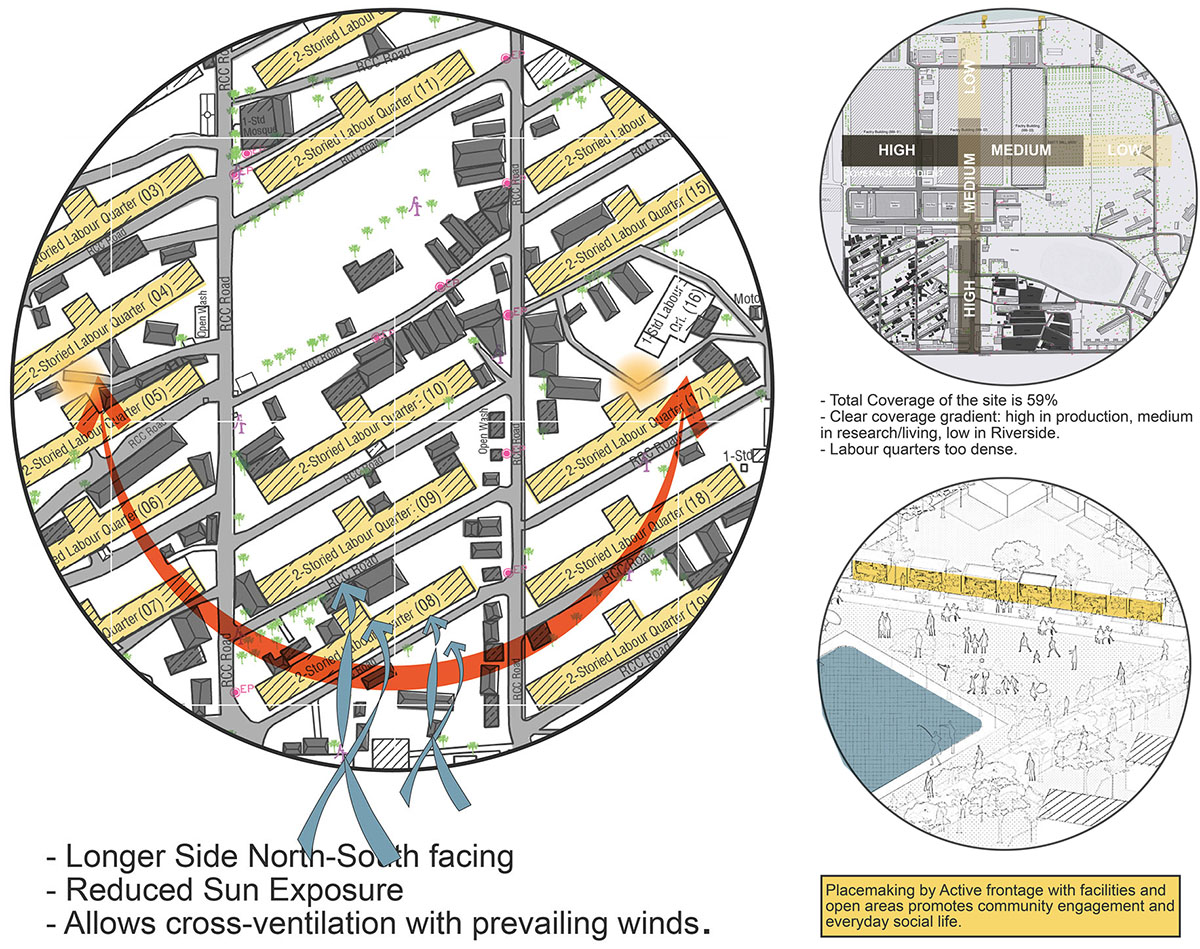
Site Condition MappingSite Survey NarrativesProblems Statement
The proposed program follows a mixed-use regeneration model organized into three interlinked zones: an Industrial Revival zone, where Mill-1 is retrofitted with a modernized, technology-driven jute production line; a Jute Research and Training Centre in Mill-2, promoting product diversification, skill development, and industry–academia collaboration; and an Exhibition and Public Realm zone toward the riverside, integrating museum spaces, markets, recreation, and an activated waterfront. Supporting functions—housing, retail, administration, and utilities—knit industry, research, and community into a self-sustaining ecosystem.
Design Process
Site and SlopeFrontage vs DepthFrontage vs Depth
The design process was rooted in a structured, evidence-based methodology to ensure technical and social viability. It began with an extensive Data Collection phase, involving site analysis, community surveys and a study of global industrial heritage cases to derive best practices. This was followed by Data Sorting and Analysis, where tools like SWOT and thematic analysis were used to identify the site’s historical significance, physical conditions and socio-economic challenges.
The Conceptualization phase focused on urban regeneration, determining zoning strategies that balance industrial revival with public needs. Preliminary designs were developed based on the existing structural grid and plot-pattern analysis, followed by an iterative process of refinement. This ensured that interventions were context-sensitive, incorporating feedback and balancing historical preservation with modern functional requirements.
Final Outcome
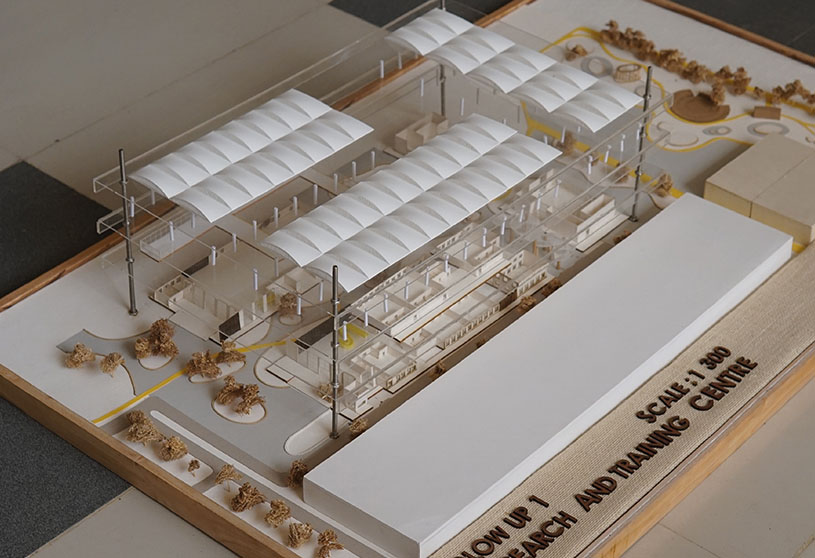
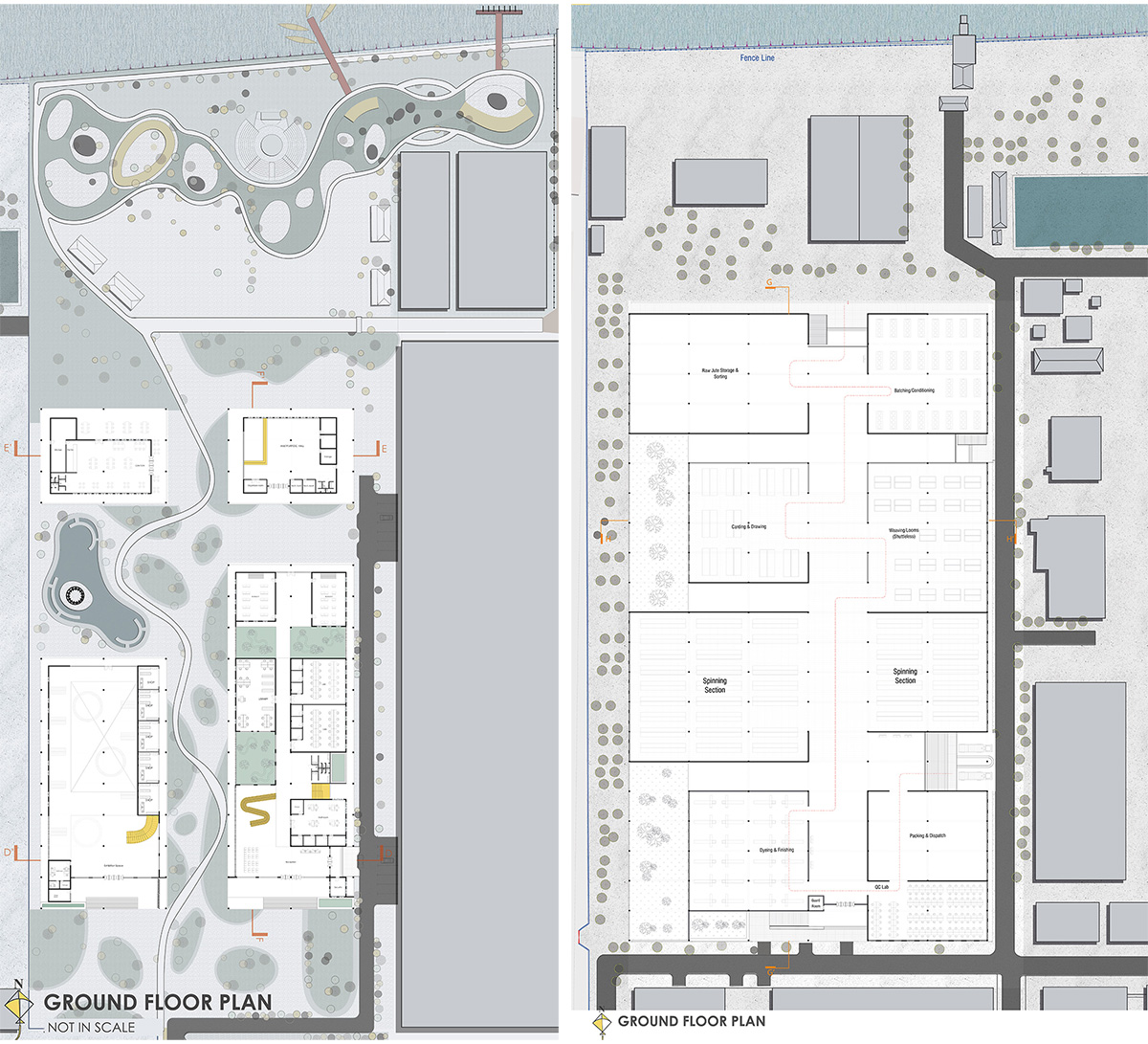
Proposed Master Plan (Top View)Blow Up 1: Research and Training Centre (Adaptive Reuse) | Blow Up 2: Industrial Revival (Retrofit)Blow Up 1: Research and Training Centre (Adaptive Reuse)Blow Up 2: Industrial Revival (Retrofit)Site Elevation
The final outcome is a comprehensive regeneration masterplan that balances production, research, and public life while preserving the mill’s identity. Mill-1, strategically located at the site’s edge near existing service infrastructure, revives as a modernized jute industry with a clear functional sequence from raw material storage to packing and dispatch. Mill-2, with its expressive concrete shell roof, is adaptively reused as a Jute Research and Training Centre incorporating labs, training services, exhibition spaces, a multipurpose hall, and a canteen.
Site ElevationSite ElevationUrban Pocket for Social involvementSite AxonometricRender
The previously inaccessible riverside is transformed into an active public realm with walkways, an amphitheatre, fishing and boat clubs, vendor spaces, and green buffers—reconnecting the community to both its river and its heritage. Crucially, approximately 85% of the site remains open space, a deliberate strategy of minimal intervention that preserves ecological character and allows future responsive development.
RenderRenderRenderRender
Conclusion: Ultimately, the design demonstrates that an abandoned industrial site can become a hub of economic opportunity, learning, and cultural continuity—offering a replicable model for the regeneration of post-industrial landscapes across Bangladesh.
[This Academic Project has been published with text and images submitted by the student]
Site Context
Design Process
Final Outcome
To submit your academic project for publication at ArchiDiaries, please visit the following link >> Submit
Get the best of ArchiDiaries, directly in your inbox.
We use cookies on our website to give you the most relevant experience by remembering your preferences and repeat visits. By clicking “Accept All”, you consent to the use of ALL the cookies. However, you may visit "Cookie Settings" to provide a controlled consent.
This website uses cookies to improve your experience while you navigate through the website. Out of these, the cookies that are categorized as necessary are stored on your browser as they are essential for the working of basic functionalities of the website. We also use third-party cookies that help us analyze and understand how you use this website. These cookies will be stored in your browser only with your consent. You also have the option to opt-out of these cookies. But opting out of some of these cookies may affect your browsing experience.
Necessary cookies are absolutely essential for the website to function properly. These cookies ensure basic functionalities and security features of the website, anonymously.
Cookie
Duration
Description
cookielawinfo-checkbox-analytics
11 months
This cookie is set by GDPR Cookie Consent plugin. The cookie is used to store the user consent for the cookies in the category "Analytics".
cookielawinfo-checkbox-functional
11 months
The cookie is set by GDPR cookie consent to record the user consent for the cookies in the category "Functional".
cookielawinfo-checkbox-necessary
11 months
This cookie is set by GDPR Cookie Consent plugin. The cookies is used to store the user consent for the cookies in the category "Necessary".
cookielawinfo-checkbox-others
11 months
This cookie is set by GDPR Cookie Consent plugin. The cookie is used to store the user consent for the cookies in the category "Other.
cookielawinfo-checkbox-performance
11 months
This cookie is set by GDPR Cookie Consent plugin. The cookie is used to store the user consent for the cookies in the category "Performance".
viewed_cookie_policy
11 months
The cookie is set by the GDPR Cookie Consent plugin and is used to store whether or not user has consented to the use of cookies. It does not store any personal data.
Functional cookies help to perform certain functionalities like sharing the content of the website on social media platforms, collect feedbacks, and other third-party features.
Performance cookies are used to understand and analyze the key performance indexes of the website which helps in delivering a better user experience for the visitors.
Analytical cookies are used to understand how visitors interact with the website. These cookies help provide information on metrics the number of visitors, bounce rate, traffic source, etc.
Advertisement cookies are used to provide visitors with relevant ads and marketing campaigns. These cookies track visitors across websites and collect information to provide customized ads.






![Factory[n]Certainty: Redefining Industrial Architecture Through Work, Life, and Community | Bachelors Design Thesis](https://archidiaries.com/wp-content/uploads/2026/09/Siam-Rahman_APR_feat_img.jpg)