Excerpt: ‘Granular Materials Embassy’ is an architecture thesis by Ilia Bednik from the ‘Moscow Architectural Institute.’ The project aims to challenge conventional urban ideals of permanence and order by repositioning decay and instability as productive forces. It seeks to integrate granular materials into the city as active agents, enabling new spatial and social relationships while fostering coexistence between human and non-human systems through adaptive reuse and transformation.
Introduction: Granular materials are typically excluded from the city as unstable and excessive matter. The project repositions them as an active component of the urban fabric. The site becomes a field of investigation: historical buildings without protected status gradually decay and disappear, re-emerging as part of a new mixed-use structure.
MasterplanMaterial Map of the Site: This analytical map illustrates the full range of materials found in the area surrounding the project site.
The project site is located in the historic fabric of Moscow, currently undergoing rapid transformation. Obsolete structures are being replaced by new, idealized forms of housing, promoting the image of Moscow as a perfectly ordered city.
Site Axonometric
Within this context of enforced cleanliness and control, granular materials — inherently unstable and inert — are perceived as undesirable, disrupting the city’s idealized appearance. The project investigates the displaced presence of these materials, revealing their suppressed role within the contemporary urban condition.
Design Process
Study Model
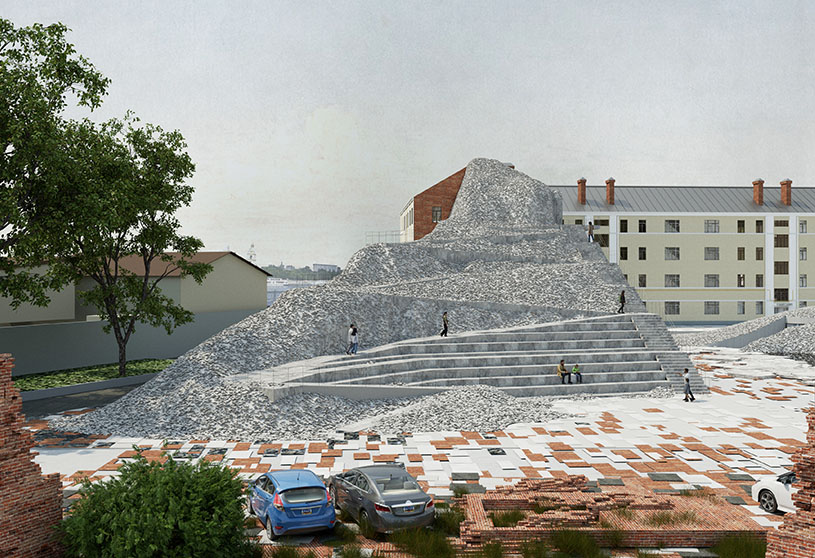
The historic buildings surrounding the site are listed heritage structures, gradually deteriorating until they are officially declared uninhabitable. Within the project, this condition of material decay is reinterpreted as a design methodology. Fragments of the surrounding fabric are accumulated into artificial mounds, extending and partially embedding the existing buildings. These granular formations generate new inhabitable spaces, structured around co-existence with unstable matter.
Final Outcome
Plan Of The Public AreaPlan Of The Residential AreaAxonometric View Of The Design Site
The project culminates in the design of an embassy — an institution mediating non-human life within the human metropolis. Structured as a conventional embassy, it consists of a residence, a consular department — understood here as a bureau for translating between non-human and human languages — and a representation of granular life.
Dormitory CellDormitory Façade
Programmatically, the complex is divided into two halls accommodating workshops and a theatre, an office of translation embedded within the existing constructivist bathhouse, and two residential volumes: a co-living structure and a reconstructed housing block.
Dormitory InteriorMain View Of The Existing Bathhouse Building Between Two New Slopes
Conclusion: Ultimately, the project reimagines urban decay by integrating granular materials as active agents, creating an embassy that mediates human and non-human systems while embracing instability, transformation, and coexistence.
[This Academic Project has been published with text and images submitted by the student]
Site Context
Design Process
Final Outcome
To submit your academic project for publication at ArchiDiaries, please visit the following link >> Submit
Get the best of ArchiDiaries, directly in your inbox.
We use cookies on our website to give you the most relevant experience by remembering your preferences and repeat visits. By clicking “Accept All”, you consent to the use of ALL the cookies. However, you may visit "Cookie Settings" to provide a controlled consent.
This website uses cookies to improve your experience while you navigate through the website. Out of these, the cookies that are categorized as necessary are stored on your browser as they are essential for the working of basic functionalities of the website. We also use third-party cookies that help us analyze and understand how you use this website. These cookies will be stored in your browser only with your consent. You also have the option to opt-out of these cookies. But opting out of some of these cookies may affect your browsing experience.
Necessary cookies are absolutely essential for the website to function properly. These cookies ensure basic functionalities and security features of the website, anonymously.
Cookie
Duration
Description
cookielawinfo-checkbox-analytics
11 months
This cookie is set by GDPR Cookie Consent plugin. The cookie is used to store the user consent for the cookies in the category "Analytics".
cookielawinfo-checkbox-functional
11 months
The cookie is set by GDPR cookie consent to record the user consent for the cookies in the category "Functional".
cookielawinfo-checkbox-necessary
11 months
This cookie is set by GDPR Cookie Consent plugin. The cookies is used to store the user consent for the cookies in the category "Necessary".
cookielawinfo-checkbox-others
11 months
This cookie is set by GDPR Cookie Consent plugin. The cookie is used to store the user consent for the cookies in the category "Other.
cookielawinfo-checkbox-performance
11 months
This cookie is set by GDPR Cookie Consent plugin. The cookie is used to store the user consent for the cookies in the category "Performance".
viewed_cookie_policy
11 months
The cookie is set by the GDPR Cookie Consent plugin and is used to store whether or not user has consented to the use of cookies. It does not store any personal data.
Functional cookies help to perform certain functionalities like sharing the content of the website on social media platforms, collect feedbacks, and other third-party features.
Performance cookies are used to understand and analyze the key performance indexes of the website which helps in delivering a better user experience for the visitors.
Analytical cookies are used to understand how visitors interact with the website. These cookies help provide information on metrics the number of visitors, bounce rate, traffic source, etc.
Advertisement cookies are used to provide visitors with relevant ads and marketing campaigns. These cookies track visitors across websites and collect information to provide customized ads.


![Factory[n]Certainty: Redefining Industrial Architecture Through Work, Life, and Community | Bachelors Design Thesis](https://archidiaries.com/wp-content/uploads/2026/09/Siam-Rahman_APR_feat_img.jpg)