Excerpt: ‘Housing for the Tea Garden Community in Bangladesh’ is an architecture thesis by Sara Seifert from the ‘Faculty of Architecture and the Built Environment – TU Delft.’ The project aims to improve the living conditions of tea garden workers by rethinking workers’ housing as a socially connected and adaptable living environment. Through incremental housing and a community-based masterplan, the project seeks to provide dignified spaces that support everyday life, social interaction, and long-term development while respecting existing cultural and spatial practices.
Introduction: The tea garden community in Bangladesh is one of the most marginalized and socially segregated groups in the country. The workers’ villages face a number of challenges, including overcrowding, inadequate housing, limited privacy, and a lack of communal spaces, particularly for women and children. This project is based on an ethnographic study of the community’s living conditions and social interactions, as well as on the use of traditional, local building materials and techniques.
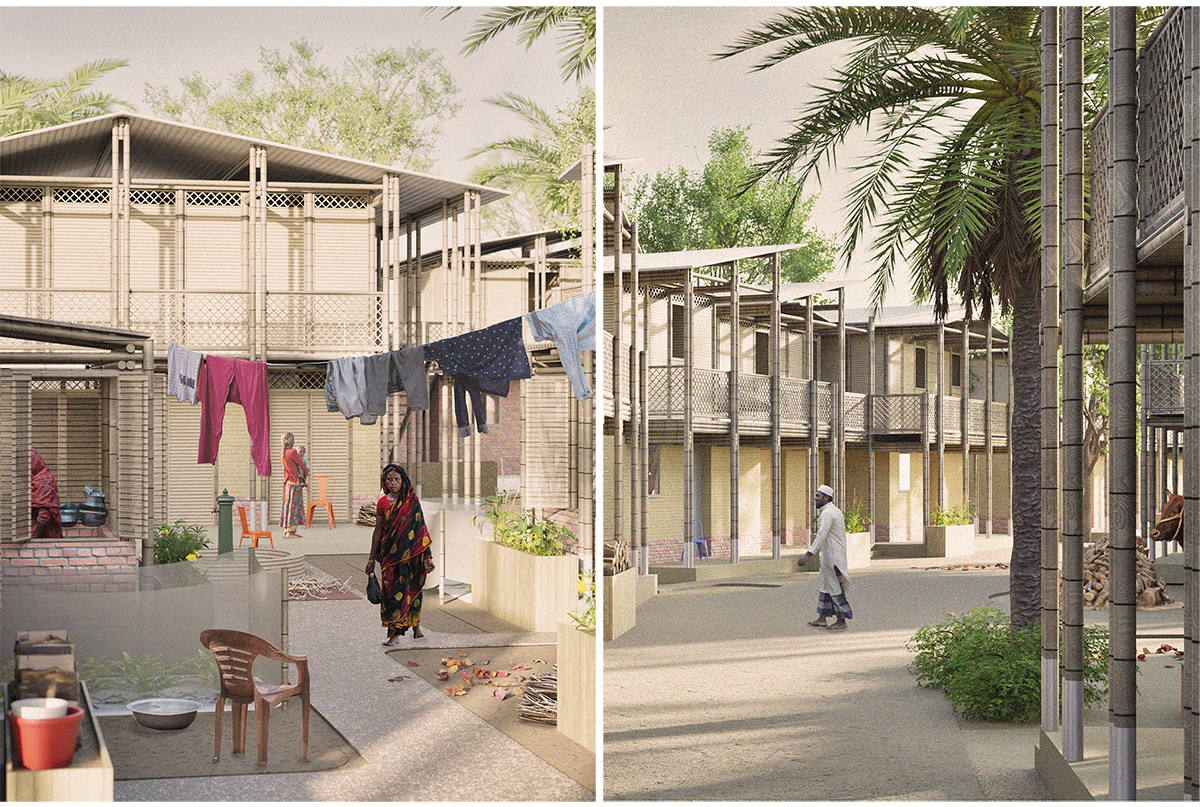
The objective of the project is to transform the workers’ village by reimagining it through the lens of community and tradition at various levels, including the masterplan, the dwellings, and the construction. The masterplan incorporates a variety of residential types with a modular approach that provides a flexible system for the different needs and the possibility of incremental growth. To strengthen the sense of community, the project integrates shared spaces at multiple levels, from public areas to courtyards, in-home spaces, and community buildings.
Existing Tea Garden Workers Village with Adjacent Tea Garden
This thesis project focuses on tea garden villages and the living conditions of tea garden workers. The project is situated in a context where workers’ settlements are physically and socially segregated from surrounding areas. These villages often suffer from poor housing conditions, limited infrastructure, and a lack of spatial quality. The program responds to these challenges by rethinking workers’ housing as more than shelter, but as a living environment connected to everyday routines, family structures, and community life. The project addresses the need for better domestic spaces, shared areas, and a village structure that can support dignity, social interaction, and long-term improvement.
Design Process
Design By Research – Analyzing Existing Living Patterns in the Tea Garden VillagesDesign By Research – Analyzing Existing Living Patterns in the Tea Garden Villages
The design process began with multiple visits to the tea garden villages. During these visits, the designer observed the site, spoke with workers, and documented the existing conditions through photographs. The collected images were then categorized to understand different spatial situations, housing conditions, and daily activities.
Design By Research – Analyzing Existing Living Patterns in the Tea Garden VillagesCategorized And Documented Images for Understanding Living Patterns in the Tea Garden Villages
This research became the foundation for the design. The analysis focused on how workers use both interior and exterior spaces, including living patterns, extensions, shared areas, and transitions between private and communal life. Rather than starting with a fixed architectural form, the project developed from the realities found on site and from the everyday practices of the workers.
Final Outcome
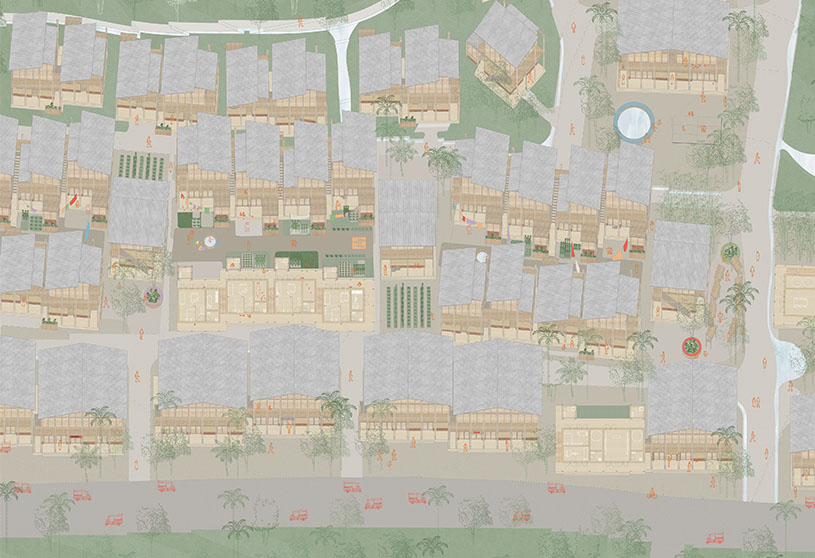
Masterplan AxonometryCourtyard Floorplan
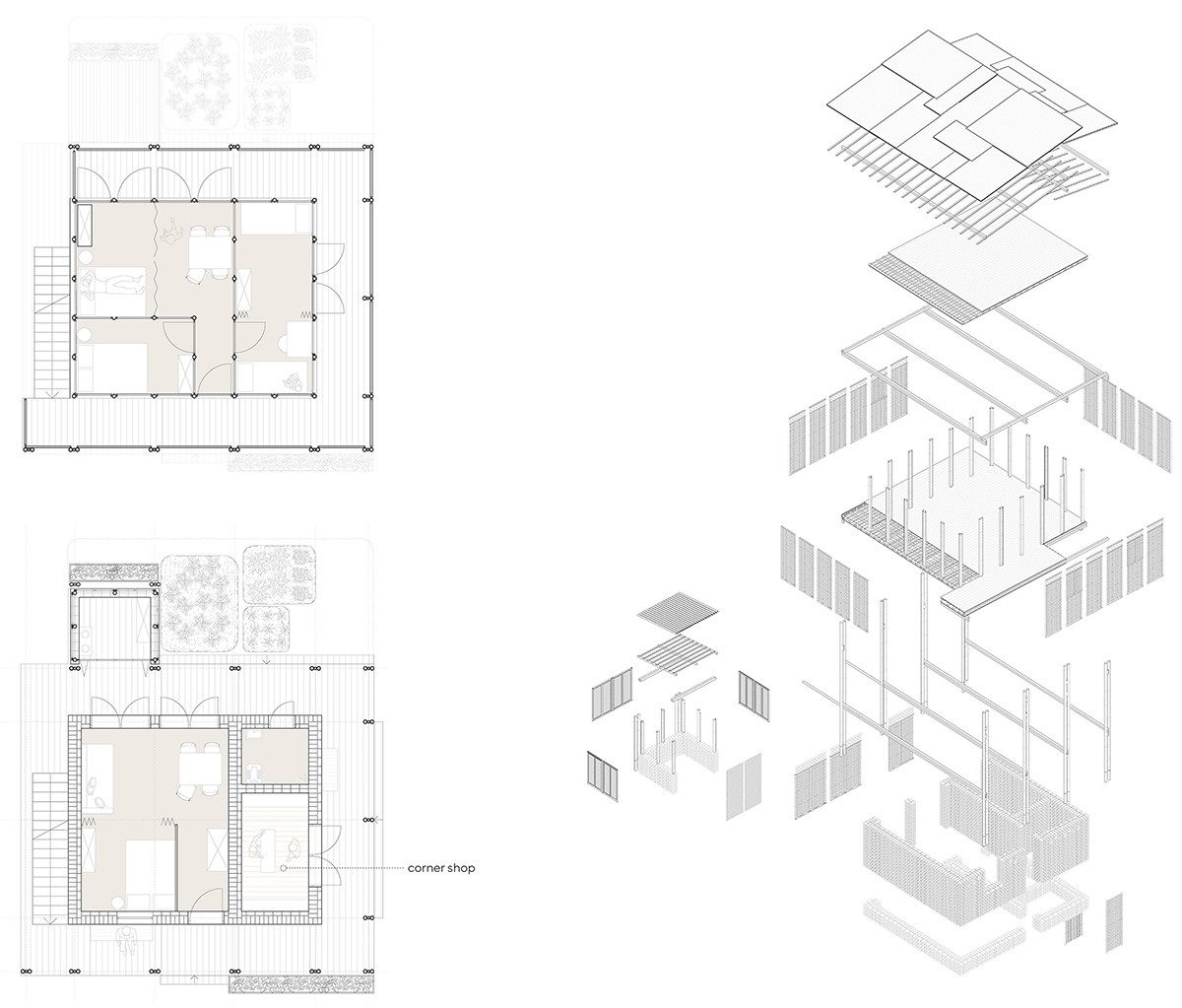
The final outcome of the project is a housing proposal based on incremental growth and a village-scale masterplan. The housing types are designed to allow gradual expansion over time, responding to changing family needs and economic conditions. Instead of replacing the existing way of life completely, the project proposes a flexible framework that supports improvement step by step.
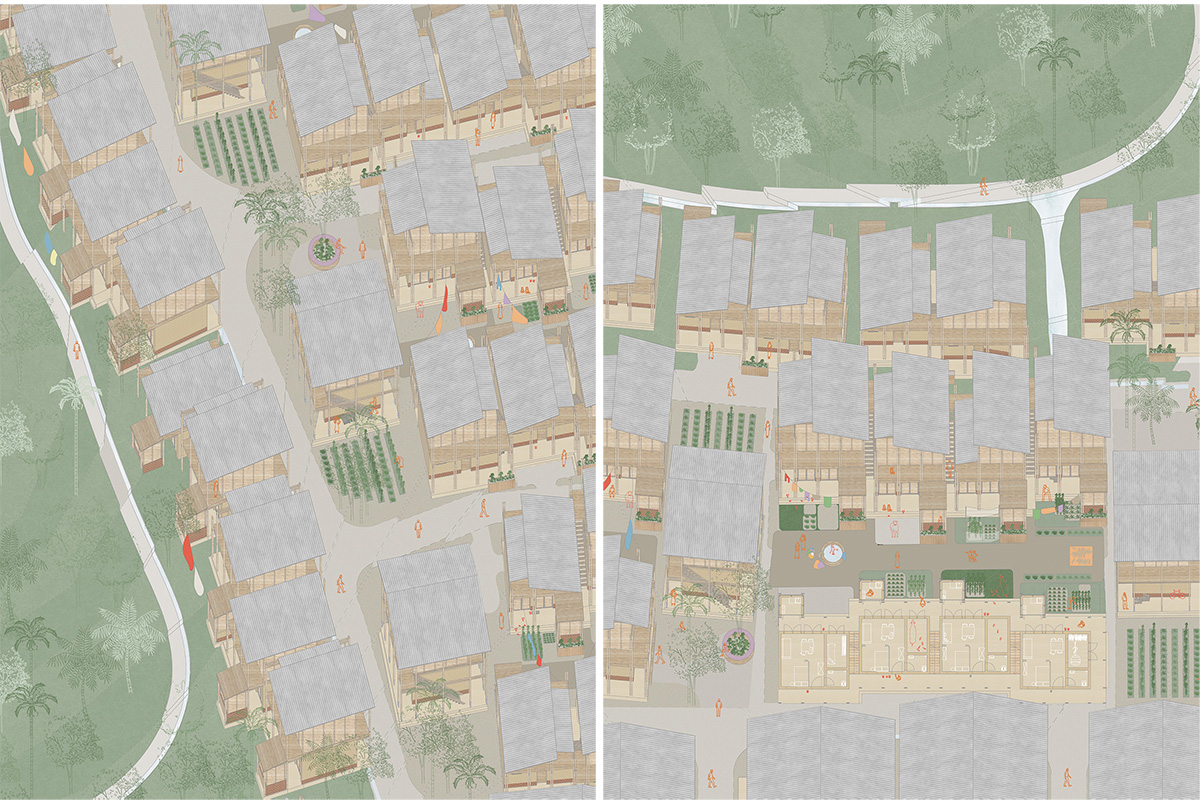
Masterplan Axonometry – Zoom in on Courtyard | Masterplan Axonometry – Zoom in on Different Cluster TypesHousing Types – Cluster ConfigurationsFloorplans Type A | Structural Axonometry
The masterplan organizes housing, circulation, open spaces, and community functions in a more connected and dignified way. Together, the incremental housing types and masterplan aim to improve living conditions while respecting the social patterns and everyday life of tea garden workers.
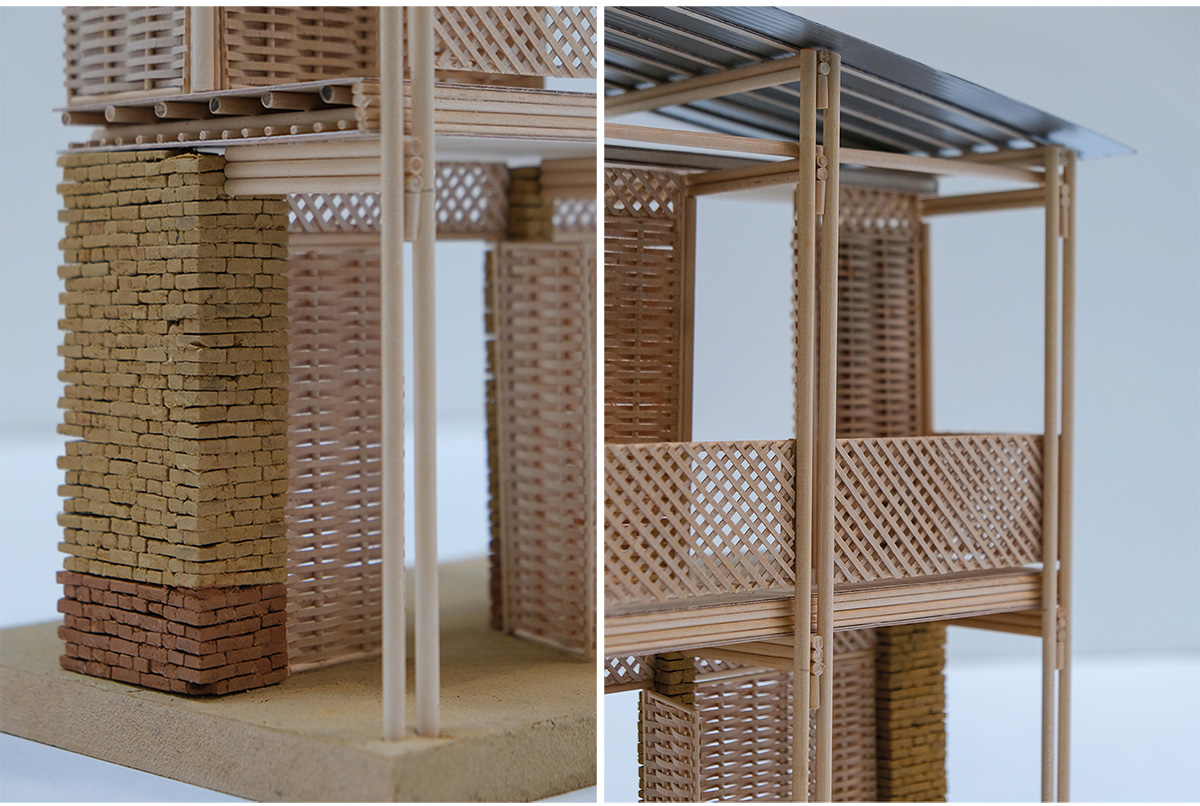
Courtyard Rendering | Street RenderingModel Photo – 1:20
Conclusion: Ultimately, this project proposes a flexible and community-oriented housing model for tea garden workers, combining incremental growth with a responsive village masterplan. By improving everyday living conditions and strengthening social connections, it seeks to create a more dignified, inclusive, and sustainable living environment.
[This Academic Project has been published with text and images submitted by the student]
Site Context
Design Process
Final Outcome
To submit your academic project for publication at ArchiDiaries, please visit the following link >> Submit
Get the best of ArchiDiaries, directly in your inbox.
We use cookies on our website to give you the most relevant experience by remembering your preferences and repeat visits. By clicking “Accept All”, you consent to the use of ALL the cookies. However, you may visit "Cookie Settings" to provide a controlled consent.
This website uses cookies to improve your experience while you navigate through the website. Out of these, the cookies that are categorized as necessary are stored on your browser as they are essential for the working of basic functionalities of the website. We also use third-party cookies that help us analyze and understand how you use this website. These cookies will be stored in your browser only with your consent. You also have the option to opt-out of these cookies. But opting out of some of these cookies may affect your browsing experience.
Necessary cookies are absolutely essential for the website to function properly. These cookies ensure basic functionalities and security features of the website, anonymously.
Cookie
Duration
Description
cookielawinfo-checkbox-analytics
11 months
This cookie is set by GDPR Cookie Consent plugin. The cookie is used to store the user consent for the cookies in the category "Analytics".
cookielawinfo-checkbox-functional
11 months
The cookie is set by GDPR cookie consent to record the user consent for the cookies in the category "Functional".
cookielawinfo-checkbox-necessary
11 months
This cookie is set by GDPR Cookie Consent plugin. The cookies is used to store the user consent for the cookies in the category "Necessary".
cookielawinfo-checkbox-others
11 months
This cookie is set by GDPR Cookie Consent plugin. The cookie is used to store the user consent for the cookies in the category "Other.
cookielawinfo-checkbox-performance
11 months
This cookie is set by GDPR Cookie Consent plugin. The cookie is used to store the user consent for the cookies in the category "Performance".
viewed_cookie_policy
11 months
The cookie is set by the GDPR Cookie Consent plugin and is used to store whether or not user has consented to the use of cookies. It does not store any personal data.
Functional cookies help to perform certain functionalities like sharing the content of the website on social media platforms, collect feedbacks, and other third-party features.
Performance cookies are used to understand and analyze the key performance indexes of the website which helps in delivering a better user experience for the visitors.
Analytical cookies are used to understand how visitors interact with the website. These cookies help provide information on metrics the number of visitors, bounce rate, traffic source, etc.
Advertisement cookies are used to provide visitors with relevant ads and marketing campaigns. These cookies track visitors across websites and collect information to provide customized ads.