Home » Academic projects » Monumentalism in an Urban Realm: Reviving Aurora Talkies as a Platform for Community and Cultural Exchange | Architecture Thesis
Monumentalism in an Urban Realm: Reviving Aurora Talkies as a Platform for Community and Cultural Exchange | Architecture Thesis
Awards: Winner of Ethos Thesis Feature 2025 | Special Recognition- National Finalist at IGBC Green Design Competition 2025 | First Runner- Up at Intra-college category for Resonance 3.0 | Student Panelist at Kurula Varkey Design Forum 2026 by CEPT University
Excerpt: ‘Monumentalism in an Urban Realm’ is an architecture thesis by Ria Desai from the ‘L.S. Raheja School of Architecture.’ The project seeks to reinterpret monumentality within the urban realm by transforming Aurora Talkies into a participatory civic space. It explores how everyday activities, memory, and community use can shape architecture, creating a flexible urban framework that evolves through collective engagement rather than relying on monumental scale or permanence.
Introduction: The undergraduate thesis emerged from a simple moment of curiosity during an internship course, where Hampi Art Labs was casually described as a potential “urban monument.” This observation sparked the question of whether a contemporary structure—one not born of grandeur or legacy—can attain monumentality. Anchored in the idea that monuments acquire meaning through time, the research examined monumentalism beyond traditional definitions of size and permanence.
The study was structured around both tangible attributes and intangible qualities, exploring how memory, participation, and cultural practice shape value. Through precedents such as the Colosseum, Taj Mahal, and Flatiron Building, the research observed how monuments historically projected power.
Influenced by the ideas of Jane Jacobs, monumentality was reframed as experiential and evolving.
Case studies—including Shivaji Park, Lalbaug-Parel, the Rath Yatra, and Dhobi Ghat—demonstrated that collective memory and everyday practices can monumentalize space. The thesis ultimately defined monumentalism as an evolving interplay between physical form and community-shaped meaning.
Site Parameters And SelectionExploring Different Sites
“Monumentalism in the urban realm is a phenomenon shaped by the cohesive interplay of tangible and intangible parameters, each contributing critically to the creation of its intended impact while continuously evolving over time. This equilibrium between physical attributes and symbolic, cultural significance is essential; the collective effect of both forms the conscience of monumentalism, which ultimately acquires meaning through its community.”
Aurora Talkies Over The Years
Narrowing the focus, the research turned to Mumbai. It was suggested by the thesis guide that the study be grounded in a city with which the student could personally relate. Three potential sites were shortlisted: Rang Bhavan, a former hub for the city’s rock culture; Plaza Cinema, known for its association with the Marathi film industry; and Aurora Talkies, a single-screen theater closely linked with the Tamil community in the area. After extensive deliberation, Aurora Talkies was selected as the final site—not for its architectural grandeur, but for the intangible sense of place embedded in everyday use and collective memory.
Timeline Of The SiteActivity Mapping
The study of Matunga revealed a precinct where planned order and lived informality coexist seamlessly. Originally conceived as a structured suburb, its tree-lined avenues and institutional edges provide a calm framework within which everyday life unfolds dynamically. Around King’s Circle, pavements transform into social corridors where book vendors, students, and morning walkers collectively shape the public realm through routine occupation.
Religious anchors such as Asthika Samaj generate rhythmic patterns of activity, with flower stalls and small vendors clustering at thresholds. These informal appropriations are spatially precise and time-bound, embedding ritual into the streetscape. Similarly, food institutions like Cafe Madras extend onto the pavement, where queues and conversations transform waiting into a communal act.
Activity Mapping
Within this layered urban fabric stands Aurora Talkies—modest in form yet monumental in memory. Its significance lies not in architectural scale but in its association with community gatherings and shared cinematic experiences. Through observation and mapping, Matunga emerged as a self-authored urban realm where repetition, memory, and everyday participation quietly construct monumentality.
Design Process
Forming The DefinitionsExploring Different Possibilities Of Monumentalism
The redesign of Aurora Talkies began not with form, but with observation—mapping pedestrian flows, informal vending patterns, and temporal shifts in activity around the site. Rather than imposing a singular monumental gesture, the design process sought to reinterpret monumentality through openness, memory, and participation. The existing Art Deco traces became anchors for intervention; the skylight and façade proportions informed a contemporary yet respectful architectural language.
Exploring Different Possibilities Of MonumentalismConcept And Vision
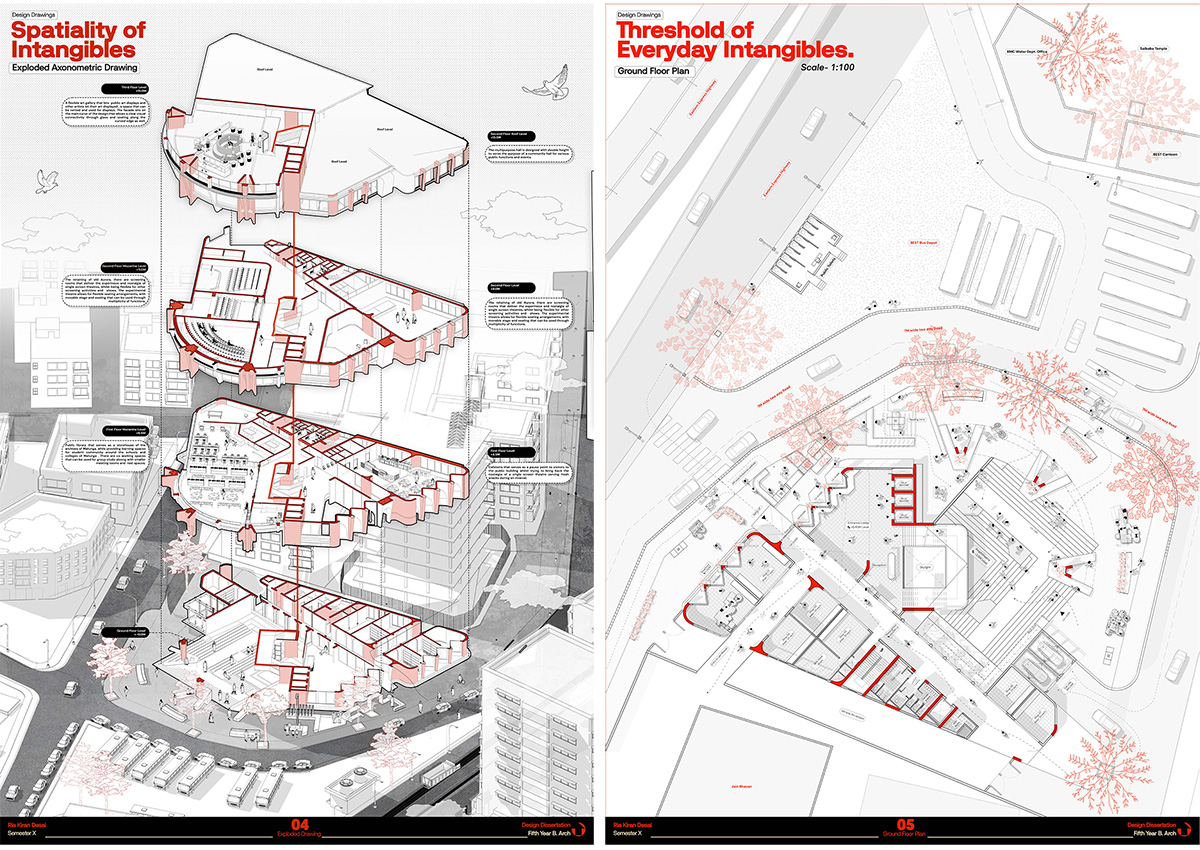
Thresholds were treated as gradients rather than rigid edges. The street-facing amphitheatre emerged from an understanding of how pavements in Matunga naturally evolve into gathering spaces. By eliminating strict boundaries, the ground plane was extended inward, allowing the city to flow seamlessly through the site. Vertical circulation was conceived as an experiential spine—a sculptural staircase that doubles as seating and pause points, encouraging visual and social connections across levels.
Programmatically, flexibility guided the spatial organization. Modular vending bays, movable seating, and adaptable performance zones allow the building to shift its character throughout the day. The design ultimately evolved as a porous framework—less an object and more an evolving urban scaffold continuously shaped by its users.
Site Isometric SectionSectionDetails
The final design emerged as a culmination of layered inquiries into cultural memory, informal occupation, and the lived rhythms of Matunga. Rather than restoring Aurora Talkies as a nostalgic artifact, the proposal reinterpreted it as an active civic scaffold.
DetailsElevation And Facade DetailOverall Isometric View
Conclusion: Monumentality is ultimately reframed as continuity—sustained through participation, adaptability, and collective authorship. The spaces are designed to invite appropriation, allowing rituals, performances, vending, and quiet gatherings to coexist. In doing so, the monument transforms from an object admired at a distance into an evolving urban stage, continually shaped by memory, everyday use, and the presence of its community.
[This Academic Project has been published with text and images submitted by the student]
Site Context
Design Process
Final Outcome
To submit your academic project for publication at ArchiDiaries, please visit the following link >> Submit
Get the best of ArchiDiaries, directly in your inbox.
We use cookies on our website to give you the most relevant experience by remembering your preferences and repeat visits. By clicking “Accept All”, you consent to the use of ALL the cookies. However, you may visit "Cookie Settings" to provide a controlled consent.
This website uses cookies to improve your experience while you navigate through the website. Out of these, the cookies that are categorized as necessary are stored on your browser as they are essential for the working of basic functionalities of the website. We also use third-party cookies that help us analyze and understand how you use this website. These cookies will be stored in your browser only with your consent. You also have the option to opt-out of these cookies. But opting out of some of these cookies may affect your browsing experience.
Necessary cookies are absolutely essential for the website to function properly. These cookies ensure basic functionalities and security features of the website, anonymously.
Cookie
Duration
Description
cookielawinfo-checkbox-analytics
11 months
This cookie is set by GDPR Cookie Consent plugin. The cookie is used to store the user consent for the cookies in the category "Analytics".
cookielawinfo-checkbox-functional
11 months
The cookie is set by GDPR cookie consent to record the user consent for the cookies in the category "Functional".
cookielawinfo-checkbox-necessary
11 months
This cookie is set by GDPR Cookie Consent plugin. The cookies is used to store the user consent for the cookies in the category "Necessary".
cookielawinfo-checkbox-others
11 months
This cookie is set by GDPR Cookie Consent plugin. The cookie is used to store the user consent for the cookies in the category "Other.
cookielawinfo-checkbox-performance
11 months
This cookie is set by GDPR Cookie Consent plugin. The cookie is used to store the user consent for the cookies in the category "Performance".
viewed_cookie_policy
11 months
The cookie is set by the GDPR Cookie Consent plugin and is used to store whether or not user has consented to the use of cookies. It does not store any personal data.
Functional cookies help to perform certain functionalities like sharing the content of the website on social media platforms, collect feedbacks, and other third-party features.
Performance cookies are used to understand and analyze the key performance indexes of the website which helps in delivering a better user experience for the visitors.
Analytical cookies are used to understand how visitors interact with the website. These cookies help provide information on metrics the number of visitors, bounce rate, traffic source, etc.
Advertisement cookies are used to provide visitors with relevant ads and marketing campaigns. These cookies track visitors across websites and collect information to provide customized ads.




![Factory[n]Certainty: Redefining Industrial Architecture Through Work, Life, and Community | Bachelors Design Thesis](https://archidiaries.com/wp-content/uploads/2026/09/Siam-Rahman_APR_feat_img.jpg)