Excerpt: ‘Re-Inflate’ is a Bachelors Design Project by Guka Tsurtsumia and Ivane Gventsadze from the ‘School of Arts and Humanities – The University of Georgia.’ The project aims to transform the abandoned Laguna Vere swimming complex through adaptive reuse, turning it into a self-sustaining urban eco-machine that preserves its modernist heritage while introducing ecological systems and public engagement. Through hydroponics, algae bioreactors, and inflatable tensile structures, the proposal explores a regenerative future where nature, technology, and architecture coexist.
Introduction: Laguna Vere, a once-vibrant modernist swimming complex in Tbilisi, is reimagined as a living eco-machine that preserves the memory of the existing structure while projecting it into a sustainable future. Rather than replacing the abandoned complex, the proposal introduces a lightweight and reversible architectural layer that transforms the site into a public landscape where ecology, technology, education, and leisure coexist in harmony.
Laguna Vere is a unique brutalist aquatic complex in Tbilisi, Georgia, set into a steep hillside and originally designed as a major public sports facility with outdoor pools, grandstands for more than 5,500 spectators, and layered indoor spaces beneath the seating terraces. Once an important venue for national and international events, it was permanently closed in 2015 after financial difficulties and the impact of a major flood, and today it stands as a quiet but powerful urban ruin. Its most recognizable features include the long mosaic entrance façade, the exposed concrete jump tower, and the strong relationship between the building mass and the site’s topography.
Existing Site Images
The TerraViva competition frames Laguna Vere as a site of adaptive reuse, asking designers to preserve its architectural and artistic value while reimagining it through new programs, new connections between interior and exterior spaces, and a sensitive response to the surrounding urban context. Rather than treating it as a lost object, the brief positions Laguna Vere as a place of opportunity: a canvas for cultural, social, recreational, or educational renewal.
Design Process
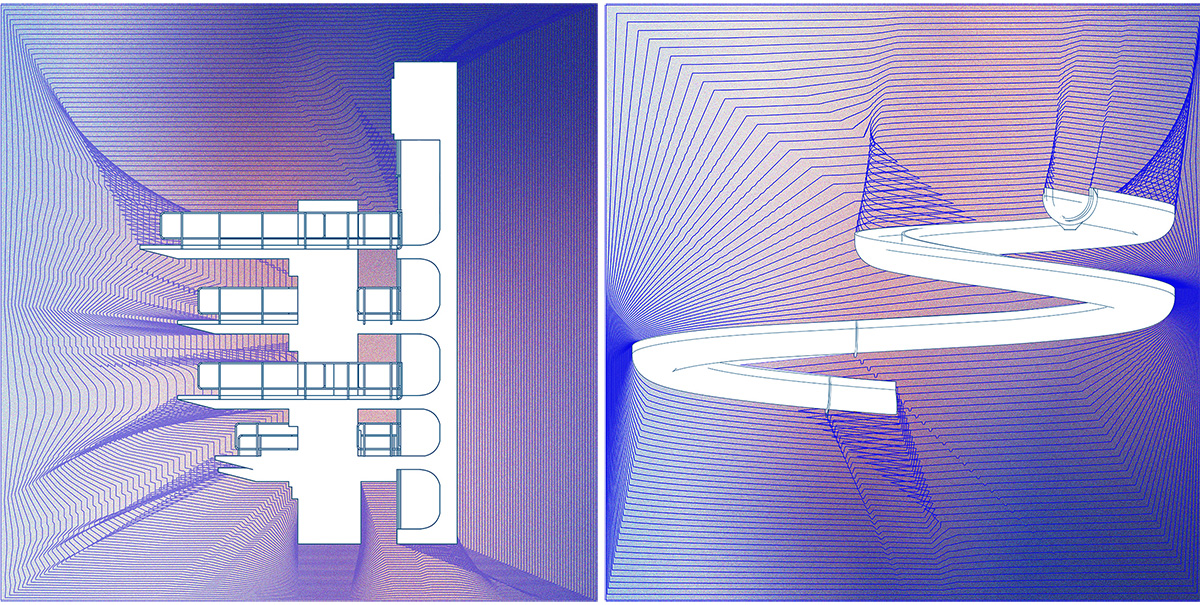
Gradient Ramp | Gradient SlideSun Study
The design process consisted of researching references connected to ideas that had already been explored before the Laguna Vere competition began. The students’ mentor had been studying inflatable architecture and its possibilities extensively, which became a key influence throughout the project.
Space Planning Transparent
The process aimed to maximize sustainability while minimizing intervention and destruction to the existing structure and surrounding environment, ultimately seeking adaptive and opportunistic solutions that could work in harmony with the site.
Final Outcome
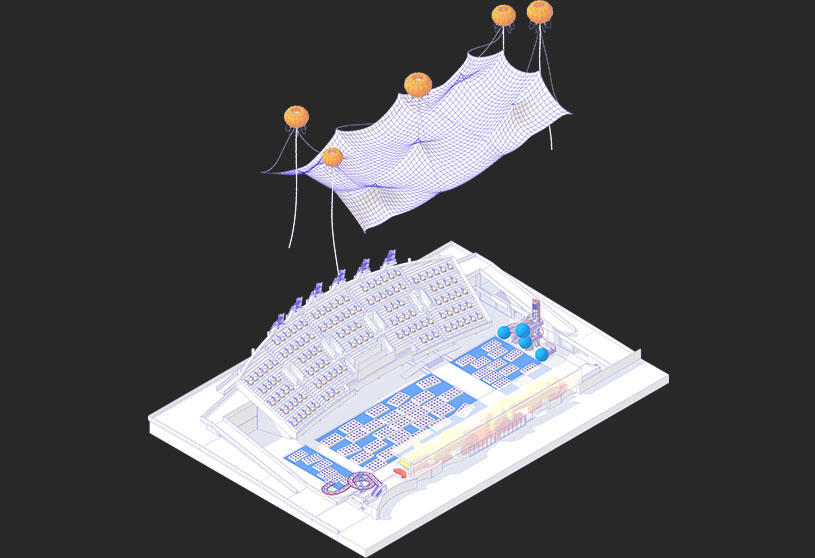
Isometric Diagram
The final outcome is a sustainable, environmentally responsive architectural proposal expressed through a neo–steampunk aesthetic that seeks to harmonize with its surroundings rather than dominate them. The project explores a visual language where industrial imagination merges with ecological sensitivity, creating an atmosphere that feels both speculative and deeply rooted within its context.
At its core, the proposal transforms the abandoned swimming complex into a self-sustaining urban oasis driven by ecological productivity and adaptive architecture. The former pools are repurposed as hydroponic gardens floating on inflatable cushions, where nutrient-rich water supports the cultivation of vegetables and herbs. The stepped spectator seating becomes integrated with aeroponic growing capsules, lightweight suspended spheres that allow plants to grow in air while dramatically reducing water consumption. Along the abandoned slides and railings, spiraling algae tubes function as living bioreactors that absorb CO₂, purify the surrounding air, and contribute oxygen back into the environment. Together, these systems establish a closed-loop eco-machine where water is collected and reused, vegetation filters the atmosphere, and local food production supports an experimental public café.
BioreactorBioreactor Detail
The proposal also introduces educational and cultural layers that reconnect visitors with both the future and history of the site. A ground-floor showroom exhibits the technologies behind the transformation, including hydroponic and aeroponic systems, algae harvesting infrastructure, and tensile membranes supported by helium-inflated balloons. Above, a museum archives the former life of Laguna Vere through photographs, journals, illustrations, newsletters, and memorabilia, preserving the collective memory of the complex while reframing it within a regenerative future.
HydroponicsHydroponics Detail
Architecturally, the project investigates inflatable and tensile systems as primary design drivers. Lightweight membranes are stretched across the pools and elevated through helium balloons and soft-robotic mechanisms that allow the surfaces to breathe, shift, and adapt to environmental conditions. By adjusting balloon heights, the tensile skins dynamically provide shading, collect rainwater, and create changing patterns of light and shadow throughout the site. This responsive architectural layer acts as a reversible soft skin that touches the brutalist concrete structure only where necessary, ensuring the original fabric remains entirely intact.
CafeCafe Detail
Conclusion: The project ultimately proposes a new typology for urban ecological renewal — an architecture that is alive, adaptable, and environmentally integrated. While the final visuals communicate this speculative atmosphere through a neo–steampunk aesthetic, they represent only the visible surface of a much deeper conceptual process. Beneath the imagery lies a broader narrative exploring sustainability, temporality, memory, and the coexistence of nature and technology within the evolving urban landscape.
[This Academic Project has been published with text and images submitted by the student]
Site Context
Design Process
Final Outcome
To submit your academic project for publication at ArchiDiaries, please visit the following link >> Submit
Get the best of ArchiDiaries, directly in your inbox.
We use cookies on our website to give you the most relevant experience by remembering your preferences and repeat visits. By clicking “Accept All”, you consent to the use of ALL the cookies. However, you may visit "Cookie Settings" to provide a controlled consent.
This website uses cookies to improve your experience while you navigate through the website. Out of these, the cookies that are categorized as necessary are stored on your browser as they are essential for the working of basic functionalities of the website. We also use third-party cookies that help us analyze and understand how you use this website. These cookies will be stored in your browser only with your consent. You also have the option to opt-out of these cookies. But opting out of some of these cookies may affect your browsing experience.
Necessary cookies are absolutely essential for the website to function properly. These cookies ensure basic functionalities and security features of the website, anonymously.
Cookie
Duration
Description
cookielawinfo-checkbox-analytics
11 months
This cookie is set by GDPR Cookie Consent plugin. The cookie is used to store the user consent for the cookies in the category "Analytics".
cookielawinfo-checkbox-functional
11 months
The cookie is set by GDPR cookie consent to record the user consent for the cookies in the category "Functional".
cookielawinfo-checkbox-necessary
11 months
This cookie is set by GDPR Cookie Consent plugin. The cookies is used to store the user consent for the cookies in the category "Necessary".
cookielawinfo-checkbox-others
11 months
This cookie is set by GDPR Cookie Consent plugin. The cookie is used to store the user consent for the cookies in the category "Other.
cookielawinfo-checkbox-performance
11 months
This cookie is set by GDPR Cookie Consent plugin. The cookie is used to store the user consent for the cookies in the category "Performance".
viewed_cookie_policy
11 months
The cookie is set by the GDPR Cookie Consent plugin and is used to store whether or not user has consented to the use of cookies. It does not store any personal data.
Functional cookies help to perform certain functionalities like sharing the content of the website on social media platforms, collect feedbacks, and other third-party features.
Performance cookies are used to understand and analyze the key performance indexes of the website which helps in delivering a better user experience for the visitors.
Analytical cookies are used to understand how visitors interact with the website. These cookies help provide information on metrics the number of visitors, bounce rate, traffic source, etc.
Advertisement cookies are used to provide visitors with relevant ads and marketing campaigns. These cookies track visitors across websites and collect information to provide customized ads.




![Factory[n]Certainty: Redefining Industrial Architecture Through Work, Life, and Community | Bachelors Design Thesis](https://archidiaries.com/wp-content/uploads/2026/09/Siam-Rahman_APR_feat_img.jpg)