Excerpt: ‘School for Living Ruins’ is a Masters Design Project by Nicole Zhao from the ‘Bartlett School of Architecture – UCL.’ The project rethinks heritage preservation by transforming the Baths of Titus into a space that combines public engagement, conservation research, and sustainable material reuse. It seeks to challenge conventional, static approaches to preservation through a “care without conservation” strategy, treating the ruin as an active cultural resource rather than a fixed monument.
Introduction: Situated on the historic remnants of Rome, Italy’s Baths of Titus, the project reflects on the predicament of the surrounding historic city. Rome has long battled to strike a balance between the urge to preserve its archaeological legacy and the necessity for modernization. Formalized institutions make the majority of decisions about what should be preserved and how, which prevents the general public from participating in discussions about heritage.
The project adopts a “care without conservation” approach to question conventional heritage care systems, proposing a visitor center and conservation research school that serves as a mediator between the historic site and its patrons. A comprehensive strategy is laid out for the ruin’s maintenance, transforming it into a tourist rest area that provides information on conservation practices and a hands-on hub for experimental research. By speculating on the creation of living, rather than static, built heritage, the ruin is thus used as a cultural tool.
The entire historic centre of Rome was designated as a UNESCO World Heritage site in 1980. The concentration of valued archaeological sites has made it difficult for Rome to balance preservation and modernisation.In the 2016 Lazio earthquake, remnants of historic buildings were seen as valuable but too obsolete to reuse, causing them to lie stagnant in warehouses around Rome. There has been little progress in rebuilding even 8 years after the initial quake. This poses the question: what can we do with built heritage that is precious but defunct?
With its entire historic center named a UNESCO World Heritage site in 1980, Rome is recognized as a site of “global heritage.” Contemporary developments are few and far between and often delayed when archaeological discoveries are stumbled upon in the process of ground-breaking. In more severe situations, Rome’s heritage issue may even make reconstruction more difficult after a disaster. Which raises the question: what can we do with valuable but abandoned built heritage?
The project is sited in the Baths of Titus, one of the oldest imperial Roman baths, dating back to 80 AD. Now, the bath complex is within the public Colle Oppio Park, though it remains as an archaeological location with restricted access.The ruin was built with the Roman opus testaceum technique, which consisted of concrete faced with brick. The concrete core at the inner base of the ruin has deteriorated, increasing the risk of falling masonry debris.
By using Donna Haraway’s concept of “naturecultures,” it is possible to view historic relics that have become stagnant parts of Rome’s natural environment as instruments to support the heritage-building process. By doing this, we hope to develop a heritage strategy of “care without conservation,” which responds to ruin in a way that goes beyond mere preservation.
As part of the heritage care strategy, facing bricks above the decayed core are to be mapped and salvaged. An estimated 30000 bricks can be harvested in this way.Architectural/ Archaeological survey: Neues Museum, David Chipperfield Architects. Survey drawings map out the restoration strategy through layers of information, showing existing conditions, treatment of surfaces, as well as recordings of work done on-site.
This strategy is implemented in the Baths of Titus, which date back to 80 AD and are among the oldest imperial Roman baths. The project starts with an in-depth study of the ruin. By mapping and preserving the facing bricks above the deteriorated core, the collapse risk is eliminated and material research and reuse are made possible.
Design Process
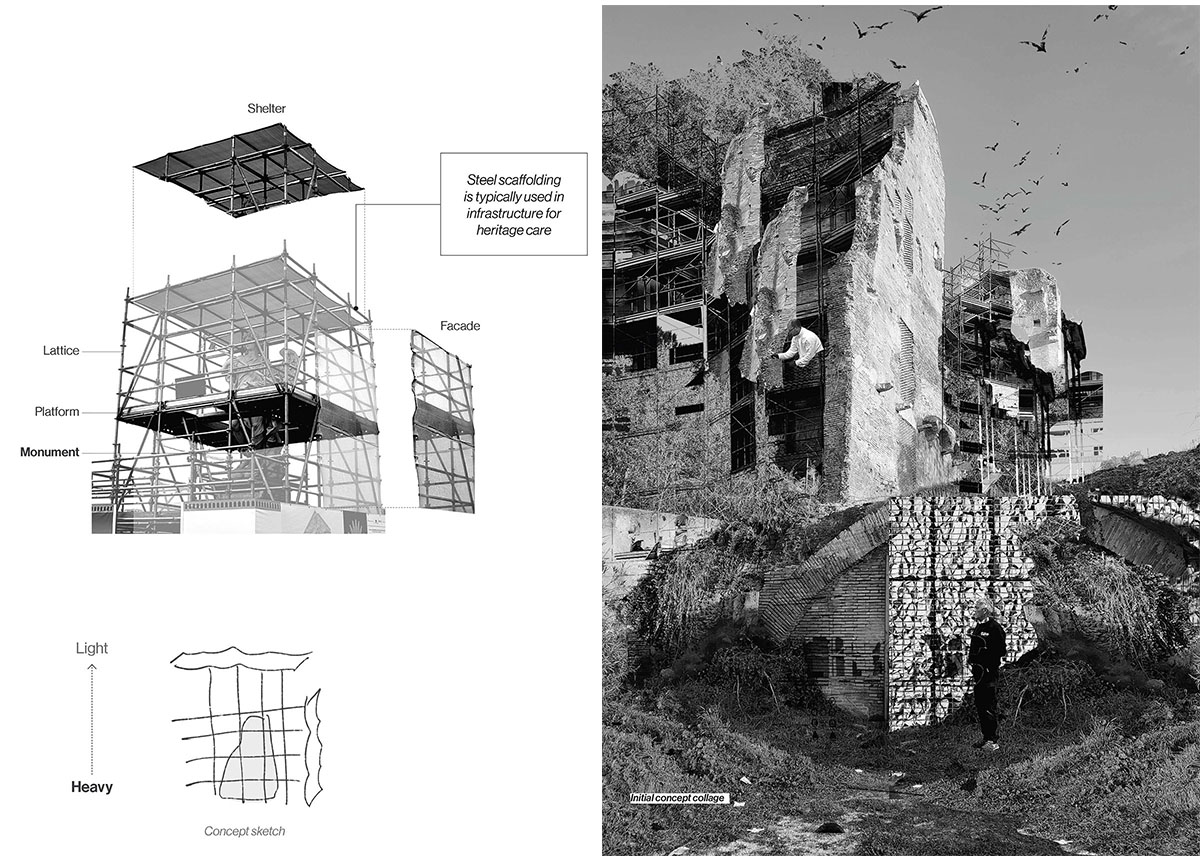
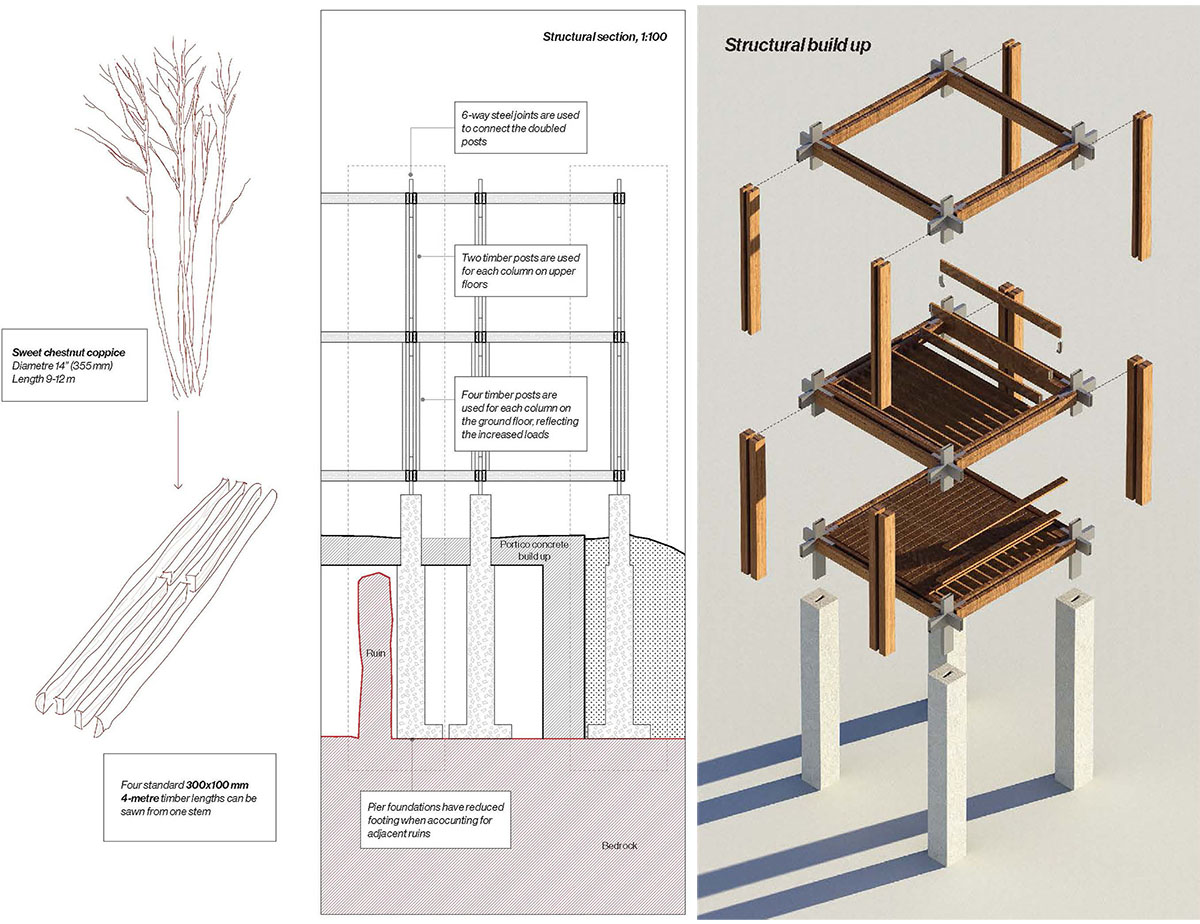
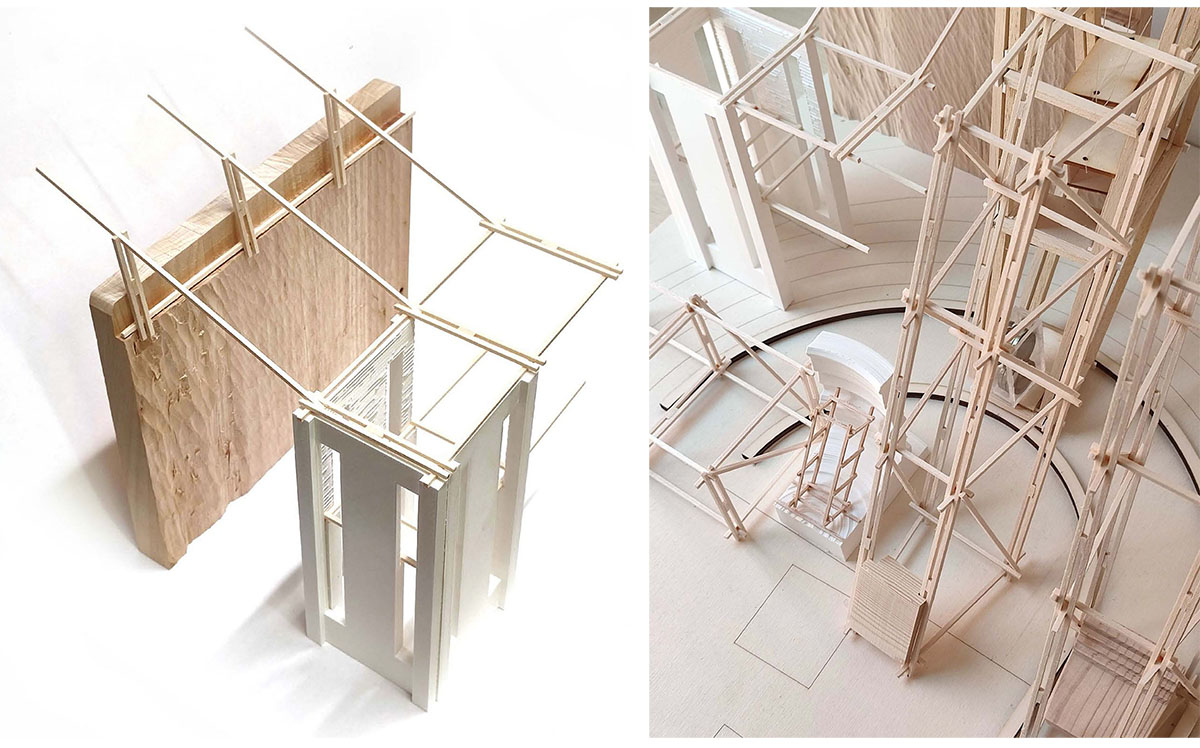
To experiment with the idea of revising care through rubble reconstruction, landmark ruins around Rome are re-imagined as fragmented compositions of old and new.Language of ImpermanenceCoppiced Timber Limitations
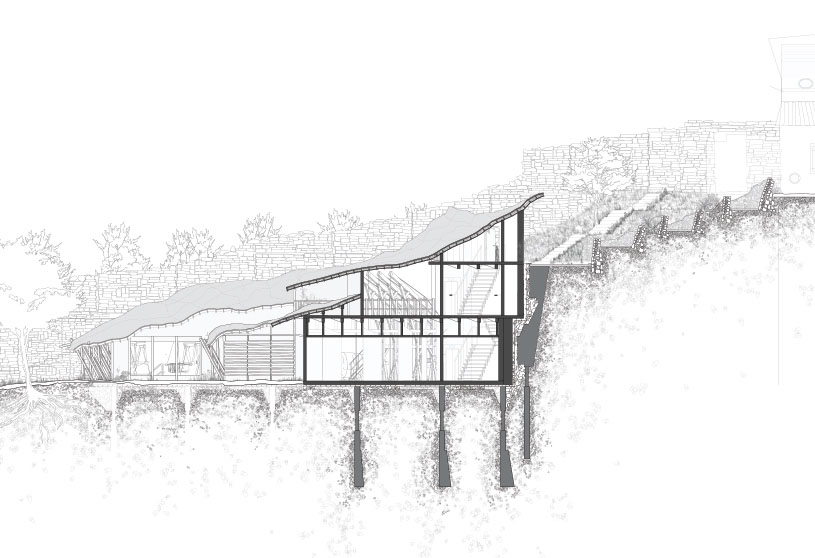
The proposal challenges conventional tourist and heritage care systems by proposing a combined visitor center and conservation research school that engages in the brick harvesting process. The structure replaces the existing perimeter fence and serves as a mediator between the tourist and the ruin. The circulation consists of the ‘front of house’ visitor entrance, with clear views of the ruin as well as a visual connection to the Colosseum, and the ‘back of house’ school entrance. Additional sources of access are provided by existing site features from previous excavations.
Referencing the language of heritage care infrastructure, the design takes a lightweight, temporary approach that contrasts with the heavy ruin. Rather than using large amounts of steel scaffolding, the building looks towards coppiced timber as a more sustainable alternative. The structure intends to complement current local sweet chestnut supply chains in order to improve forest management and provide socioeconomic help to underserved areas of Italy. Therefore, overcoming the limitations of using coppiced timber as the main structural element is the main goal of the material and structural strategies.
Final Outcome
The ground floor plan shows the exhibition space, cafe, harvester, laboratory, workshop, and artefact storage, with the ruin outlined in red. The visitor and school entrances are connected to landscaped paths through the park.
The building functions independently from the ruin while having a close relationship to it, assuming the role of a ‘caretaker’ that gradually assimilates salvaged parts of the ruin into its fabric. Instead of requiring substantial scaffolding support, the ruin harvester is designed to be a mobile structure that moves slowly along the wall to gather fragments where needed.
The building hides and reveals parts of the ruin in the process of caring for it, creating a sense of visual and material fragmentation. The tall undercroft of the building is also utilised as storage space for artefacts and tools required in the harvesting process, with pallets acting as a physical barrier between the interior and exterior.The ‘back-of-house’ view presents the building and ruin as an ongoing process of heritage and cultural production.
Like a “gallery” of contemporary heritage care, the structure becomes a site of continuous movement, deconstruction, and assembly, showcasing innovative developments in the field of heritage conservation. The structure is expected to be in use for 50 years, with a minimum operation period of 6 years, which is the amount of time needed to harvest 30,000 bricks.
The School for Living Ruins
Its temporary nature as heritage care infrastructure makes its end-of-life stage an important consideration. Following decommissioning, the building will be disassembled and repurposed for future conservation initiatives, leaving only new and fragmented masonry as artifacts of the heritage process.
Conclusion: All in all, the school for living ruins follows the approach of care without conservation to facilitate the cultural process of heritage, proposing an alternative system of heritage care in Rome.
[This Academic Project has been published with text and images submitted by the student]
Site Context
Design Process
Final Outcome
To submit your academic project for publication at ArchiDiaries, please visit the following link >> Submit
Get the best of ArchiDiaries, directly in your inbox.
We use cookies on our website to give you the most relevant experience by remembering your preferences and repeat visits. By clicking “Accept All”, you consent to the use of ALL the cookies. However, you may visit "Cookie Settings" to provide a controlled consent.
This website uses cookies to improve your experience while you navigate through the website. Out of these, the cookies that are categorized as necessary are stored on your browser as they are essential for the working of basic functionalities of the website. We also use third-party cookies that help us analyze and understand how you use this website. These cookies will be stored in your browser only with your consent. You also have the option to opt-out of these cookies. But opting out of some of these cookies may affect your browsing experience.
Necessary cookies are absolutely essential for the website to function properly. These cookies ensure basic functionalities and security features of the website, anonymously.
Cookie
Duration
Description
cookielawinfo-checkbox-analytics
11 months
This cookie is set by GDPR Cookie Consent plugin. The cookie is used to store the user consent for the cookies in the category "Analytics".
cookielawinfo-checkbox-functional
11 months
The cookie is set by GDPR cookie consent to record the user consent for the cookies in the category "Functional".
cookielawinfo-checkbox-necessary
11 months
This cookie is set by GDPR Cookie Consent plugin. The cookies is used to store the user consent for the cookies in the category "Necessary".
cookielawinfo-checkbox-others
11 months
This cookie is set by GDPR Cookie Consent plugin. The cookie is used to store the user consent for the cookies in the category "Other.
cookielawinfo-checkbox-performance
11 months
This cookie is set by GDPR Cookie Consent plugin. The cookie is used to store the user consent for the cookies in the category "Performance".
viewed_cookie_policy
11 months
The cookie is set by the GDPR Cookie Consent plugin and is used to store whether or not user has consented to the use of cookies. It does not store any personal data.
Functional cookies help to perform certain functionalities like sharing the content of the website on social media platforms, collect feedbacks, and other third-party features.
Performance cookies are used to understand and analyze the key performance indexes of the website which helps in delivering a better user experience for the visitors.
Analytical cookies are used to understand how visitors interact with the website. These cookies help provide information on metrics the number of visitors, bounce rate, traffic source, etc.
Advertisement cookies are used to provide visitors with relevant ads and marketing campaigns. These cookies track visitors across websites and collect information to provide customized ads.




![Factory[n]Certainty: Redefining Industrial Architecture Through Work, Life, and Community | Bachelors Design Thesis](https://archidiaries.com/wp-content/uploads/2026/09/Siam-Rahman_APR_feat_img.jpg)
