Home » Academic projects » Overgrown – A Nightlife Organization: Rethinking Nightlife as a Civic and Cultural Urban Layer in Medellín | Masters Design Project
Overgrown – A Nightlife Organization: Rethinking Nightlife as a Civic and Cultural Urban Layer in Medellín | Masters Design Project
Excerpt: ‘Overgrown – A Nightlife Organization’ is a Masters Design Project by Aneesh Devi and Dennis Sola from the ‘The Department of Architecture – Harvard Graduate School of Design.’ The project aims to redefine nightlife as a form of public infrastructure rather than a condition to be controlled or excluded. Using the labyrinth as an architectural model, it explores how decay, sensory disorientation, ecology, and ritual can transform urban space into a temporal environment that shifts between a public sanctuary by day and an immersive nocturnal experience by night.
Introduction: The Labyrinth – Architecturalizing the Urban Shadow: This project investigates the friction between Medellín’s burgeoning nightlife and the municipal measures intended to restrict it. Rather than viewing the nocturnal city as a regulatory problem to be solved with curfews or closures, this proposal frames nightlife as the Jungian shadow—a vital but concealed layer of the urban essence.
The core focus explores the Labyrinth archetype as a new model for public infrastructure. This “Fun Palace” serves as a finding and hiding mechanism that rejects the segregation of public space. By conceiving the building as a site of temporary private concessions that alternate with public cultural events, the project bridges the gap between day-use abandonment and nocturnal vibrancy. The exploration centers on the Minotaur (the nocturnal dweller) and the architectural capacity for a structure to exist in a state of planned ruin, evolving through memory, decay, and ecological shroud.
The Nightlife Cluster – From Restriction to Public Infrastructure: Located within the dense nightlife entertainment hubs of Medellín, such as Parque Lleras, the site context is defined by a paradoxical relationship between global tourism and local exclusion. Current municipal interventions—characterized by the closing of public plazas and 1:00 a.m. curfews—have exacerbated urban segregation.
The program reimagines these “Fun Palaces” not as exclusive clubs, but as shared public infrastructure. The building functions through a dual-use program:
By Day: The space acts as a public garden and cultural forum, emphasizing silence, water retention, and local flora.
By Night: It transforms into a complex sensory maze of stroboscopic lights and acoustic shifts.
The program utilizes heavy compacted earth walls and seven distinct layers of geometric complexity to create a path of physical strain and discovery, ultimately leading the visitor to a “center” that encourages a confrontation with the self.
Design Process
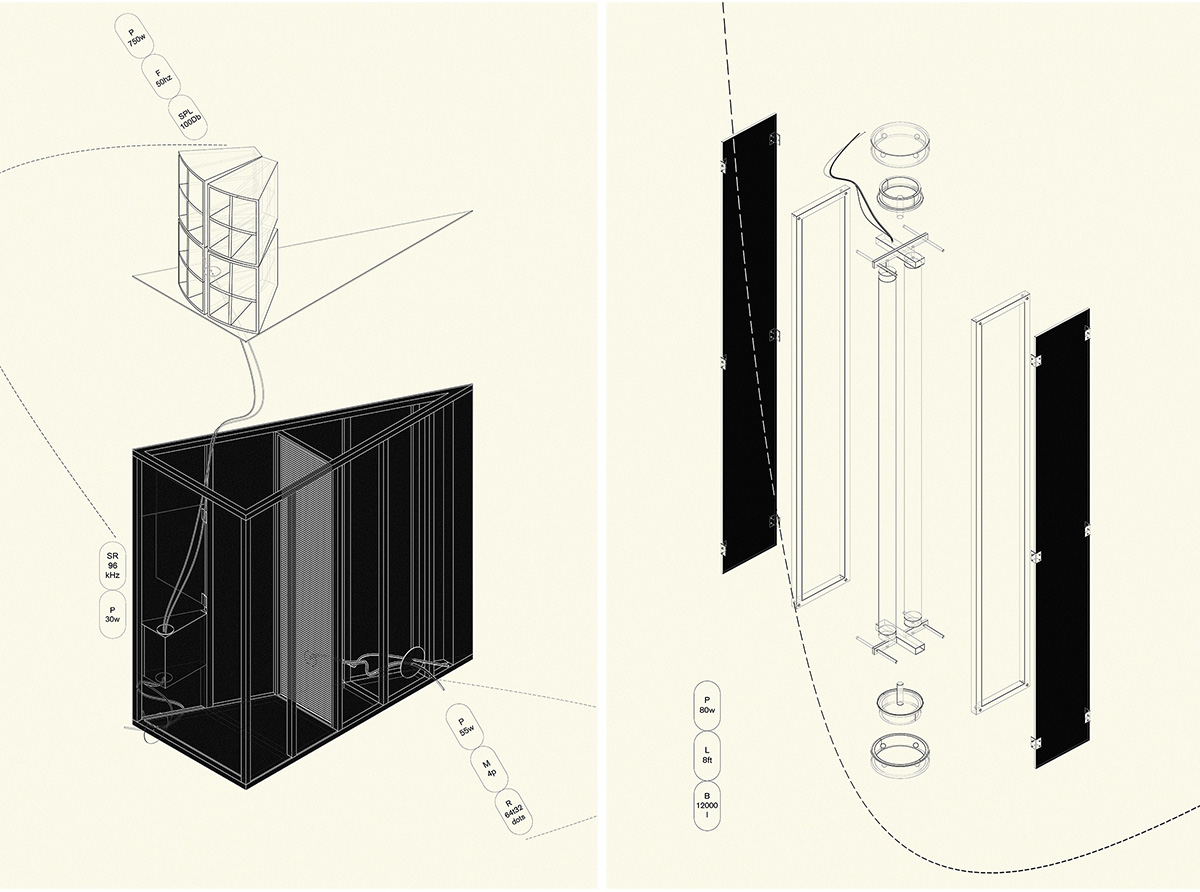
System A-01 | System A-02
The design process was structured through the narrative lenses of four mythological figures: Daedalus, the Minotaur, Theseus, and Ariadne.
Geometric Mapping (Daedalus): The initial phase involved an intense geometric effort to map four access plazas and seven layers of earth walls, prioritizing the “detour principle” to maximize travel time and physical engagement.
2. Atmospheric Layering (The Minotaur): Design iterations focused on sensory disorientation, utilizing perforated light mechanisms and rotating speakers to ensure that shadows and sounds are never static.
Longitudinal Section
3. Physical & Social Choreography (Theseus): The design of platforms and bifurcated galleries was tested to facilitate “group dance” and social adaptability, ensuring that the path to the center is earned through movement.
Section Detail
4. Ecological Ruination (Ariadne): The final stage incorporated time as a primary material. Using Sir John Soane’s ruin logic, the process accounted for the crumbling of earth walls and the growth of gardens, shifting the architectural identity from a rigid structure to a living, disappearing landscape.
Final Outcome
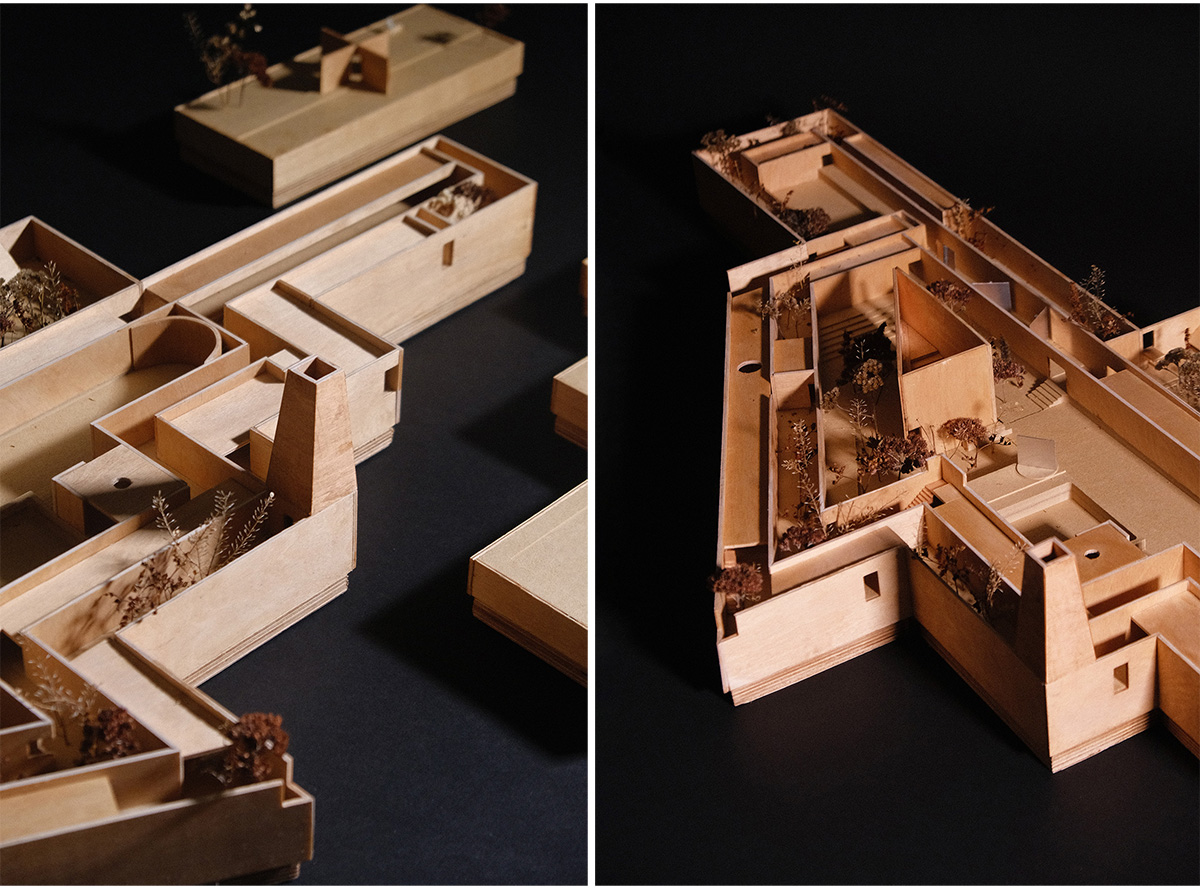
Physical Model
The final outcome of this project is a transformative architectural model that redefines nightlife as a dynamic, temporal system rather than a static building. The proposal culminates in a labyrinthine “Fun Palace” constructed from seven concentric layers of heavy compacted earth. These walls are designed to decay at specific rates, gradually revealing the building’s inner workings and complicating the visitor’s memory of the space over time.
Physical Model
Architecturally, the outcome is characterized by a sophisticated interplay between hard geometry and organic growth. Integrated vegetation platforms progressively shroud the structure, eventually transforming the labyrinth into an unrecognizable urban garden. Inside, the design features “hall of illusions” galleries and “listening rooms” where sound and stroboscopic light act as tectonic elements, shifting to guide or distract the nocturnal dweller.
The project successfully demonstrates that by embracing the “detour principle” and the aesthetics of ruination, we can create a space where the city’s “shadow” is not hidden, but integrated into the urban fabric. The final result is a hybrid infrastructure that serves as a silent public sanctuary by day and a vibrant, ritualistic labyrinth by night, proving that there is no need to escape the garden—only to become part of it.
Conclusion: Ultimately, the project proposes an architecture that embraces decay, illusion, and transformation as active urban conditions, redefining nightlife as an evolving spatial experience rather than a fixed destination.
[This Academic Project has been published with text and images submitted by the student]
Site Context
Design Process
Final Outcome
To submit your academic project for publication at ArchiDiaries, please visit the following link >> Submit
Get the best of ArchiDiaries, directly in your inbox.
We use cookies on our website to give you the most relevant experience by remembering your preferences and repeat visits. By clicking “Accept All”, you consent to the use of ALL the cookies. However, you may visit "Cookie Settings" to provide a controlled consent.
This website uses cookies to improve your experience while you navigate through the website. Out of these, the cookies that are categorized as necessary are stored on your browser as they are essential for the working of basic functionalities of the website. We also use third-party cookies that help us analyze and understand how you use this website. These cookies will be stored in your browser only with your consent. You also have the option to opt-out of these cookies. But opting out of some of these cookies may affect your browsing experience.
Necessary cookies are absolutely essential for the website to function properly. These cookies ensure basic functionalities and security features of the website, anonymously.
Cookie
Duration
Description
cookielawinfo-checkbox-analytics
11 months
This cookie is set by GDPR Cookie Consent plugin. The cookie is used to store the user consent for the cookies in the category "Analytics".
cookielawinfo-checkbox-functional
11 months
The cookie is set by GDPR cookie consent to record the user consent for the cookies in the category "Functional".
cookielawinfo-checkbox-necessary
11 months
This cookie is set by GDPR Cookie Consent plugin. The cookies is used to store the user consent for the cookies in the category "Necessary".
cookielawinfo-checkbox-others
11 months
This cookie is set by GDPR Cookie Consent plugin. The cookie is used to store the user consent for the cookies in the category "Other.
cookielawinfo-checkbox-performance
11 months
This cookie is set by GDPR Cookie Consent plugin. The cookie is used to store the user consent for the cookies in the category "Performance".
viewed_cookie_policy
11 months
The cookie is set by the GDPR Cookie Consent plugin and is used to store whether or not user has consented to the use of cookies. It does not store any personal data.
Functional cookies help to perform certain functionalities like sharing the content of the website on social media platforms, collect feedbacks, and other third-party features.
Performance cookies are used to understand and analyze the key performance indexes of the website which helps in delivering a better user experience for the visitors.
Analytical cookies are used to understand how visitors interact with the website. These cookies help provide information on metrics the number of visitors, bounce rate, traffic source, etc.
Advertisement cookies are used to provide visitors with relevant ads and marketing campaigns. These cookies track visitors across websites and collect information to provide customized ads.






![Factory[n]Certainty: Redefining Industrial Architecture Through Work, Life, and Community | Bachelors Design Thesis](https://archidiaries.com/wp-content/uploads/2026/09/Siam-Rahman_APR_feat_img.jpg)