Home » Academic projects » Yeni Nesil Kahvehane: Reinterpreting Coffeehouse Culture through Contemporary Cultural Architecture | Bachelors Design Thesis
Yeni Nesil Kahvehane: Reinterpreting Coffeehouse Culture through Contemporary Cultural Architecture | Bachelors Design Thesis
Excerpt: ‘ThinkFe 5.0 – Yeni Nesil Kahvehane’ is an architecture thesis by Yasemin Pehlivan from the ‘Department of Architecture – Abdullah Gül University.’ The project seeks to transform the traditional Kahramanmaraş coffeehouse into a contemporary Social R&D Center, fostering creativity, cultural exchange, and technological innovation. By preserving the NFK Cultural Center’s legacy and integrating new spaces, the project aims to create a dynamic hub for workshops, media production, exhibitions, and informal gatherings.
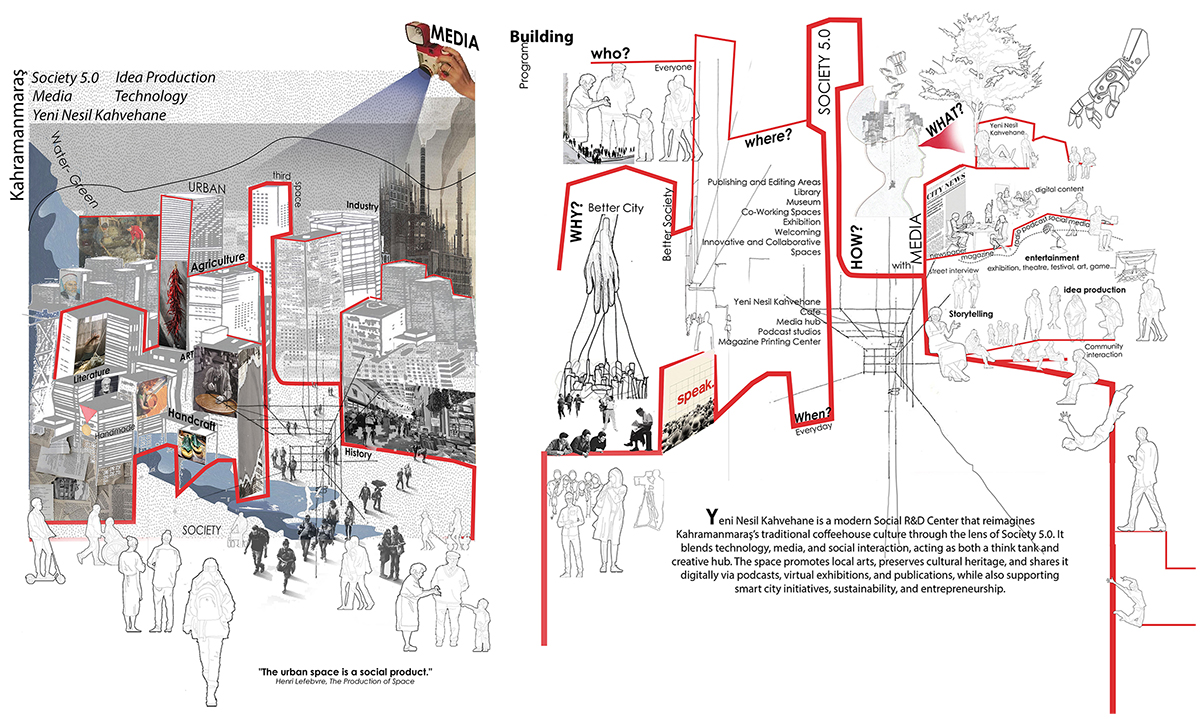
Introduction: Yeni Nesil Kahvehane is a contemporary Social R&D Center inspired by Kahramanmaraş’s traditional coffeehouse culture, reimagined through the human-centered lens of Society 5.0. The project creates a hybrid space combining media production, social innovation, and technology within a culturally rooted architectural language. Serving as both a creative hub and a platform for urban dialogue, it preserves the city’s memory while projecting its voice digitally through publications, podcasts, and interactive exhibitions.
The New Generation Kahvehane is developed on the site of the existing NFK Cultural Center, a landmark of social and cultural importance in Kahramanmaraş. Certain areas of the original building were demolished due to architectural problems. The project preserves the Cultural Center’s original load-bearing system while adding new structures to accommodate contemporary functions. Through careful integration, the historic framework now supports the hybrid program of the New Generation Kahvehane, blending heritage with modern needs.
Urban ContextUrban Context
The site remains a vibrant urban hub, frequently used by locals for social interaction, leisure, and cultural activities. The program combines media production, workshops, exhibition spaces, and shared lounges with a central circulation spine, “The Street,” linking all areas. This transformation creates an adaptable urban park that encourages informal gatherings, creative production, and public engagement, while respecting and enhancing the cultural and structural legacy of the original NFK Cultural Center.
Design Process
Site AnalysisSite Settlements
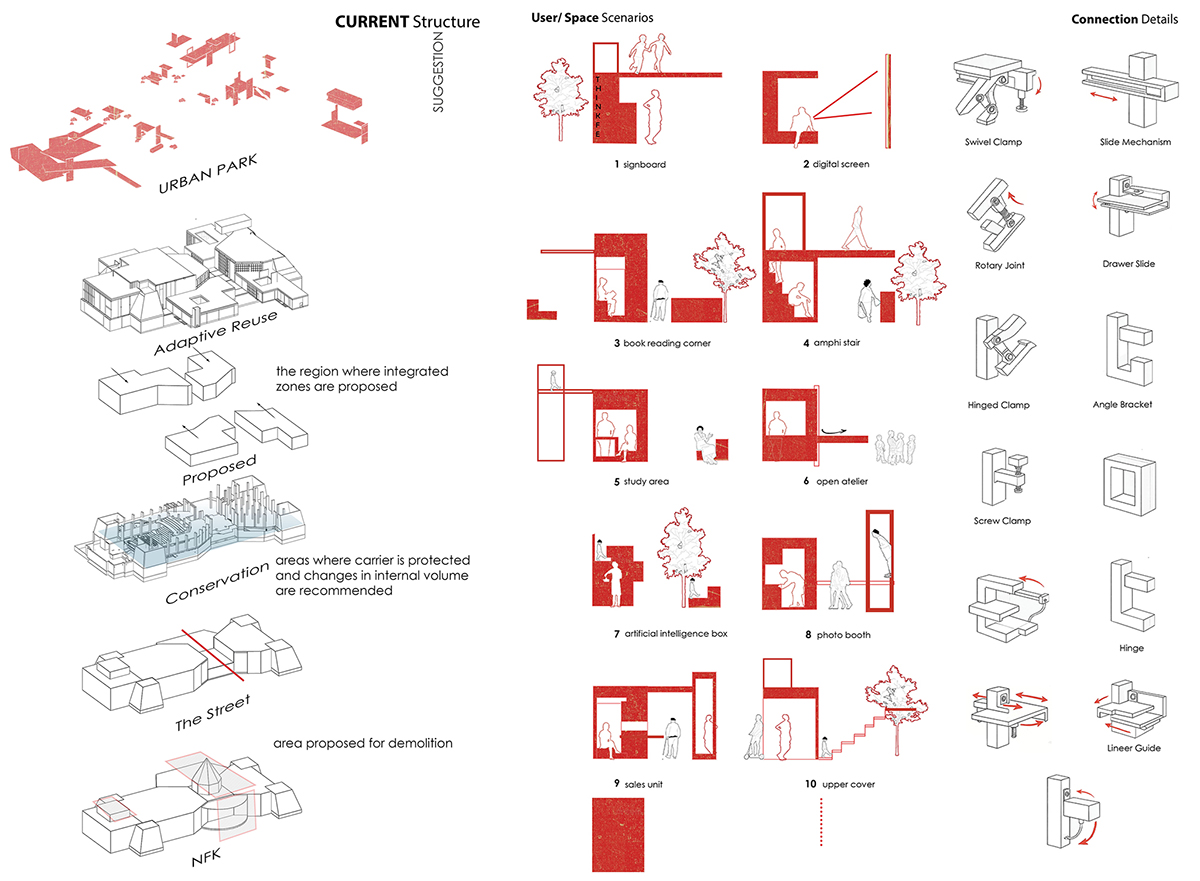
The design process of the New Generation Kahvehane began with an in-depth analysis of the site, the existing NFK Cultural Center, and the surrounding urban fabric of Kahramanmaraş. Initial studies focused on understanding social patterns, public circulation, and areas of architectural constraint within the original building. Based on these insights, problematic sections were carefully removed while the load-bearing system was preserved and reinforced to support new interventions.
Traces From The Initial SiteCurrent Structure Suggestion | User/Space Scenarios And Connection Details
Concept development explored the integration of traditional coffeehouse culture with contemporary, human-centered Society 5.0 principles and Media. Sketches and massing models examined spatial flows, program adjacencies, and the creation of “The Street,” a central circulation spine inspired by the city’s urban rhythm. Iterative testing of modular, flexible structures led to the adoption of a red reconfigurable system that serves multiple functions, from seating to shading to digital signage.
The design process emphasized public engagement and adaptability, transforming the site into a hybrid Social R&D Center. Through physical and digital modeling, workshops, and iterative refinements, the project evolved into a dynamic, culturally rooted space that balances heritage preservation, technological innovation, and community interaction.
Final Outcome
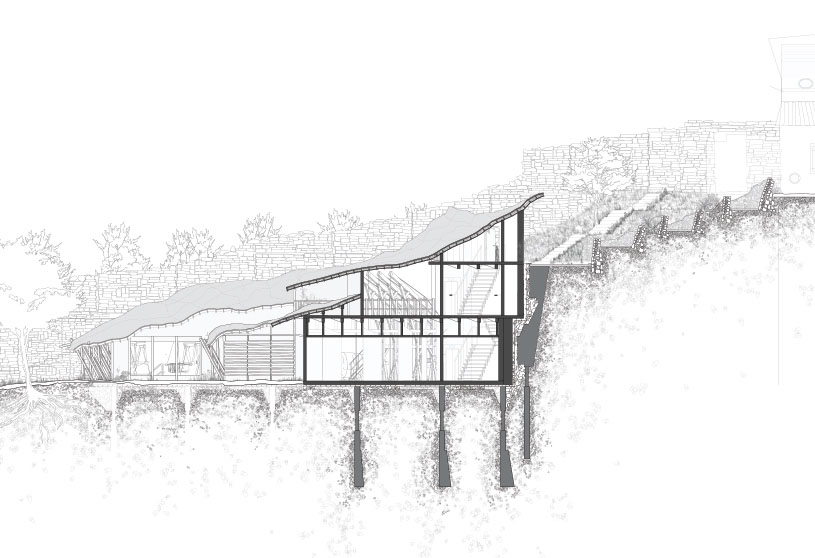
MasterplanGround Floor PlanSectional Elevation
The final outcome of the New Generation Kahvehane is a hybrid Social R&D Center that seamlessly integrates the preserved structure of the NFK Cultural Center with new, adaptable architectural interventions. The project successfully transforms a historically significant yet partially problematic building into a vibrant, multifunctional hub for the community. Preserving the original load-bearing system while reinforcing it where necessary, the design accommodates workshops, media studios, exhibition spaces, and shared lounges, all connected by the central circulation spine, “The Street.”
The building embodies flexibility and interaction through its red modular system, which functions dynamically as seating, shading, digital signage, or reading nooks. Indoor and outdoor spaces merge to create an adaptable Urban Park that encourages informal gatherings, cultural exchange, and creative production. Acting as a “think factory,” the Kahvehane fosters idea generation, critical dialogue, and interdisciplinary collaboration. Community members, creatives, and professionals transform storytelling and conversation into contemporary media formats, bridging local identity with global networks.
A central design element, “The Street,” is a circulation spine inspired by Kahramanmaraş’s urban fabric, linking workshops, studios, exhibition areas, and lounges. More than a corridor, it embodies Henri Lefebvre’s idea that urban space is socially produced, generating interaction and collective experiences.
Sectional ElevationSectional Elevation
The project adopts deconstructivist principles, drawing from Bernard Tschumi’s Event-Cities, with a lightweight, reconfigurable red modular system that transforms the architecture into an Urban Park—an interactive, porous environment supporting gatherings, creative work, and quiet retreat. New Generation Kahvehane merges spatial flexibility with cultural continuity, creating a platform where local identity, technology, and public participation converge in an experience-driven architectural landscape.
System DetailSystem Detail
Conclusion: By blending heritage preservation, contemporary design, and technological integration, the New Generation Kahvehane offers a culturally rooted yet forward-looking environment. It functions not only as a space for social and creative activity but also as a platform for urban dialogue, bridging local identity with global networks while reinforcing the historical and social significance of the original NFK Cultural Center.
[This Academic Project has been published with text and images submitted by the student]
Site Context
Design Process
Final Outcome
To submit your academic project for publication at ArchiDiaries, please visit the following link >> Submit
Get the best of ArchiDiaries, directly in your inbox.
We use cookies on our website to give you the most relevant experience by remembering your preferences and repeat visits. By clicking “Accept All”, you consent to the use of ALL the cookies. However, you may visit "Cookie Settings" to provide a controlled consent.
This website uses cookies to improve your experience while you navigate through the website. Out of these, the cookies that are categorized as necessary are stored on your browser as they are essential for the working of basic functionalities of the website. We also use third-party cookies that help us analyze and understand how you use this website. These cookies will be stored in your browser only with your consent. You also have the option to opt-out of these cookies. But opting out of some of these cookies may affect your browsing experience.
Necessary cookies are absolutely essential for the website to function properly. These cookies ensure basic functionalities and security features of the website, anonymously.
Cookie
Duration
Description
cookielawinfo-checkbox-analytics
11 months
This cookie is set by GDPR Cookie Consent plugin. The cookie is used to store the user consent for the cookies in the category "Analytics".
cookielawinfo-checkbox-functional
11 months
The cookie is set by GDPR cookie consent to record the user consent for the cookies in the category "Functional".
cookielawinfo-checkbox-necessary
11 months
This cookie is set by GDPR Cookie Consent plugin. The cookies is used to store the user consent for the cookies in the category "Necessary".
cookielawinfo-checkbox-others
11 months
This cookie is set by GDPR Cookie Consent plugin. The cookie is used to store the user consent for the cookies in the category "Other.
cookielawinfo-checkbox-performance
11 months
This cookie is set by GDPR Cookie Consent plugin. The cookie is used to store the user consent for the cookies in the category "Performance".
viewed_cookie_policy
11 months
The cookie is set by the GDPR Cookie Consent plugin and is used to store whether or not user has consented to the use of cookies. It does not store any personal data.
Functional cookies help to perform certain functionalities like sharing the content of the website on social media platforms, collect feedbacks, and other third-party features.
Performance cookies are used to understand and analyze the key performance indexes of the website which helps in delivering a better user experience for the visitors.
Analytical cookies are used to understand how visitors interact with the website. These cookies help provide information on metrics the number of visitors, bounce rate, traffic source, etc.
Advertisement cookies are used to provide visitors with relevant ads and marketing campaigns. These cookies track visitors across websites and collect information to provide customized ads.